What a GPX file can change about training and race day planning
The biggest climb on a 151-kilometre route through Germany’s Harz mountains begins after 135 kilometres. It gains 286 metres over 8.7 kilometres. For an example rider with an FTP of 246 watts, IntervalCoach estimates roughly 28 minutes of climbing, arriving late in an already demanding day.
That is a more useful preparation target than “151 kilometres with 2,014 metres of ascent”. The totals describe the ride’s size. The profile shows how the work is distributed, including the sustained effort waiting near the finish.
For riders preparing for a mountainous sportive, that distinction affects more than the route preview. It can influence the intervals selected beforehand, the pacing plan and the amount of food needed along the way.
The same distance produces a different plan.
The Harz course file contains 17 identified sustained climbs. For the example rider, each lasts more than two minutes. The biggest, measured by elevation gain, begins near kilometre 135.
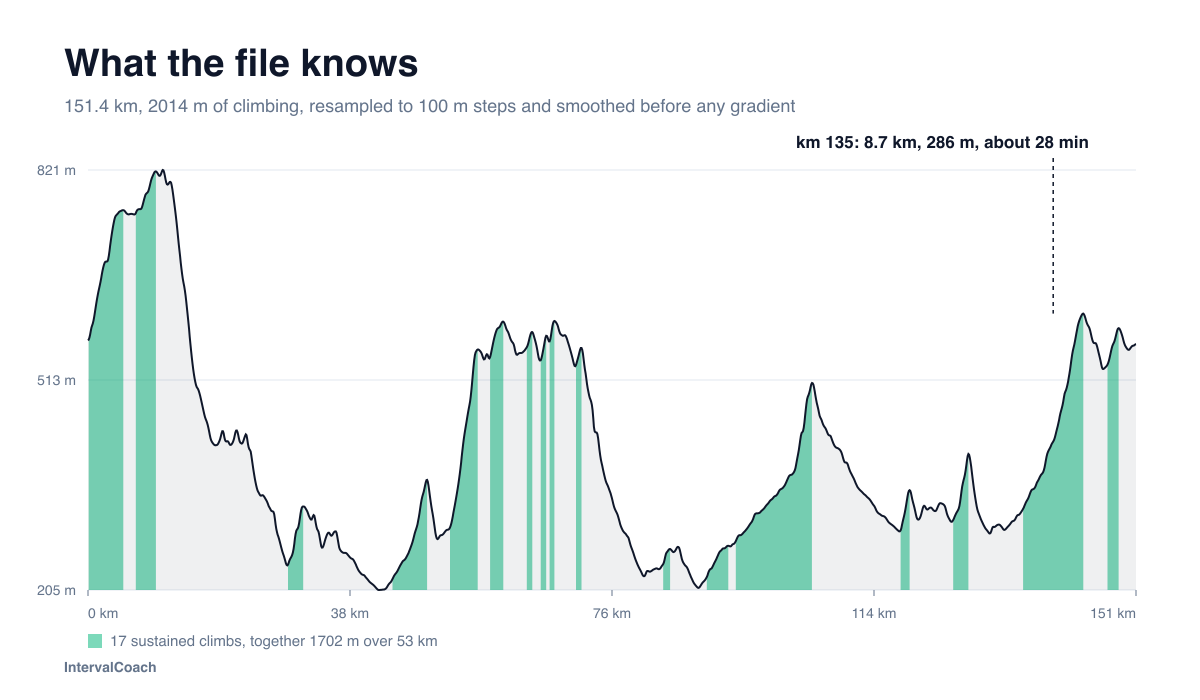
Figure 1. The Harz example route spans about 151 km with 2,014 m of ascent. Green sections indicate 17 identified climbs. The annotation marks the climb beginning near kilometre 135; its roughly 28-minute duration is a model estimate for an example rider with FTP 246 W.
In IntervalCoach‘s distance-only calculation, the ride is estimated at 4.8 hours, with a carbohydrate budget of 434 grams. Adding the course changes those estimates to approximately 6.5 hours and 585 grams.
The extra 151 grams largely reflects the longer estimated day. The comparison illustrates a practical planning consequence: a rider expecting a much shorter outing may arrange supplies for too few hours on the bike. These figures are model estimates for one example rider, not measured ride results or universal fuelling targets.
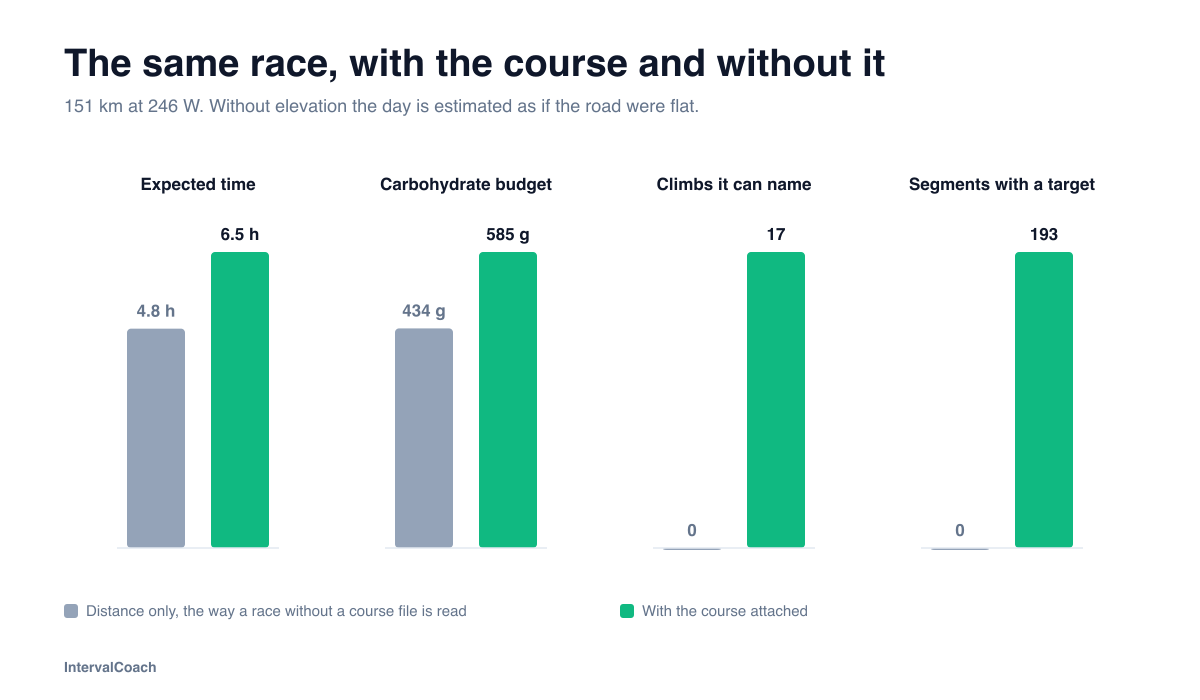
Figure 2. Model estimates for the same example rider and route: distance-only planning gives 4.8 hours and 434 g of carbohydrate; adding the course gives 6.5 hours and 585 g. These are planning outputs, not measured outcomes. The image’s 246 W refers to rider FTP, not a target to hold throughout the ride.
Turning the profile into useful training
Race Recon is the course-analysis feature within IntervalCoach. It accepts GPX or FIT files, identifies climbs and uses their estimated durations to inform preparation and race-day planning. Elevation data is smoothed first, reducing the risk that GPS noise turns a steady ascent into a series of misleading ramps.
A course with sustained climbs gives the coach a reason to select longer efforts. A route dominated by short climbs presents a different pattern to prepare for. Those demands sit alongside the athlete’s recovery, training phase and available time.
Knowing the course is only part of the decision. Two riders with similar FTP can have different training histories and may need different sessions to prepare for the same ascent.
IntervalCoach’s Athlete Profile compares recent power or pace performances with the athlete’s own previous bests across different effort durations. Workout selection also considers the difficulty of sessions the athlete has recently completed. Session demands are assessed through intensity, repetition length and recovery, rather than relying on a broad label such as “threshold”.
The course helps determine which efforts matter. The athlete’s recent training helps determine a suitable starting point. A predicted 28-minute climb does not automatically become a 28-minute training prescription.
Identifying what needs to develop
A race-readiness view connects the course demands with the Athlete Profile and completed training. It explains which capabilities deserve attention for the target event and reassesses those priorities as new training evidence becomes available.
For the Harz route, sustained climbing late in the ride becomes a specific demand to assess. If the athlete’s history supports a development need, the coach proposes relevant training. Later efforts and completed sessions then help establish whether that preparation is progressing.
The distinction between fresh power and performance after several hours matters here. A strong 20-minute best effort does not establish that the same rider can sustain an equivalent effort late in a sportive. When training history provides no relevant evidence, late-race durability remains uncertain.
Arriving at the final climb prepared
On race day, the course provides a structure for power or pace targets and carbohydrate and fluid budgets across climbs, descents and flatter sections. The late Harz climb makes the preceding hours part of the problem: pacing and fuelling have to support the effort still to come.
Wind, road surfaces, stops and riding in a group can all change the outcome. The plan remains an estimate that needs on-the-day judgement.
The Harz ride brings the purpose into focus: 135 kilometres already covered, with the biggest climb still ahead. Linking that demand to the athlete’s training gives each session a clearer purpose, and the race plan a concrete task: helping the rider arrive at the foot of that climb with the legs, energy and time to tackle it.
Quick answers
What file formats does Race Recon accept?
Race Recon accepts a GPX or FIT file of the race or sportive course, which it uses to identify climbs and inform training and race-day planning.
Are the duration and carbohydrate figures measured or estimated?
They are model estimates for one example rider, not measured ride results or a universal fuelling target; actual duration and needs depend on conditions and execution on the day.
How does Race Recon handle noisy GPS elevation data?
It smooths the raw elevation data before identifying climbs, which reduces the risk of GPS noise turning a steady ascent into a series of misleading ramps.
Author: Martijn Russchen, founder of IntervalCoach, edited by the5krunner.
Last Updated on 22 September 2026 by the5krunner
My favourite kit and nutrition
- Garmin Fenix 9 Pro — I’ve just bought one.
- Injinji – Runners protect your toes. Avoid discomfort and minor injury. Run more. Run faster. I use them.
- Garmin 90-degree charging adapter — A small keyring adapter you can use anywhere. Essential when away. I use one.
- Garmin charging puck — the fastest and most reliable way to top up your Garmin before a session. I use one.
- Ravemen FR300 — Front light that mounts directly under your Garmin or Wahoo head unit. Keeps your bars clean and your beam pointed where it matters. I use one.
- Body Glide – The blue anti-chafe stick that all swimmers and many runners use. I use it.
- Maurten — The race nutrition trusted by elite athletes. Gels and drink mixes engineered to be easy on the stomach. I use them.
- Garmin Varia RTL515 — A radar rear light that alerts you to vehicles approaching from behind. Pairs with your Edge or Wahoo. I use this model.
- Favero Assioma Pro RS2 — The power-meter pedals most serious cyclists choose. Accurate, easy to move between bikes. I use this model.
- Garmin Forerunner 970 — A serious choice for a pro-grade triathlon watch. I use this.
- Polar H10 — My daily driver for accurate, waking HRV readings.
- Wahoo ELEMNT Roam 3 — The bike computer that has the feature Garmin lacks: usability. I use mine on most rides.
Reader-Powered Content

This content is not sponsored. It’s mostly me behind the labour of love, which is this site, and I appreciate everyone who supports it.
Support the site: Follow (free, fewer ads) · Subscribe (paid, ad-free) · Buy Me A Coffee ❤️
All articles are written by real people, fact-checked, and verified for originality. See the Editorial Policy. FTC: Affiliate Disclosure — some links pay commission. As an Amazon Associate, I earn from qualifying purchases.

tfk is the founder and author of the5krunner, an independent endurance sports technology publication. With 20 years of hands-on testing of GPS watches and wearables, and competing in triathlons at an international age-group level, tfk provides in-depth expert analysis of fitness technology for serious athletes and endurance sport competitors. ID
