WHOOP
This site has covered WHOOP since the first generation. In 2015, Will Ahmed, WHOOP’s founder and CEO, worked with this site to produce the first detailed independent review of the product. As part of the testing process for that first review, this site was given unprecedented, direct access to raw sensor data from WHOOP’s servers for independent analysis, access that no other publication had at the time. The coverage here reflects over a decade of use across every hardware generation and hundreds of hours of testing against optical heart rate monitors and HRM chest strap reference devices.
That history informs the editorial position: WHOOP is a serious product with genuine science behind it, a subscription model that requires scrutiny, and accuracy characteristics that most reviews misrepresent. What we discuss here covers the hardware, the membership tiers, the use cases, and all the detailed articles this site has produced.
For the full review, including accuracy data from ECG-referenced tests across running, cycling, triathlon, and strength, see the WHOOP 5.0 and MG review.
WHOOP 5.0 and MG: the current hardware
WHOOP runs on a membership model. The hardware, a screenless optical band worn on the wrist or bicep, ships free with any membership. There is no one-off purchase option, and the device needs a subscription to work.
Three membership tiers are currently available.
- The One tier covers the core metrics: Strain, Recovery, Sleep, and steps.
- The Peak tier adds WHOOP Age, advanced performance analytics, and live heart rate.
- The Life tier, paired with the MG hardware, adds an FDA-cleared ECG, irregular heart rhythm notifications, and overnight blood pressure trend estimates requiring an initial cuff calibration.
The MG puck includes an additional ECG module not present in the standard 5.0 hardware, while the optical sensors are otherwise identical in both.
WHOOP initially reneged on previous commitments about free hardware upgrades when launching 5.0, requiring either a $49 fee or a subscription extension. After customer backlash, it backtracked, and the current policy is a free upgrade with 12 months or more remaining, though it is more restrictive than what members were originally led to expect.
The band is screenless by design. There are no notifications, no display, and no GPS, although the smartphone app can record a GPS track. WHOOP processes your workout data on its own servers rather than on the band or in the app. That maximises battery life to market-leading levels and yields more accurate results than a small wearable processor could.
Who WHOOP is for
WHOOP is built for athletes who train consistently and want coaching around recovery, readiness, and optimal strain rather than real-time GPS data. Whoop is progressively extending its ecosystem into medical-adjacent wellness with unique insights into health management and longevity.
It suits CrossFit and HYROX athletes particularly well. The low-profile, screenless form factor is durable and safer for contact and barbell work, and WHOOP’s strain model incorporates velocity-based training elements that no other mainstream consumer wearable offers. Triathletes and cyclists use it as a recovery layer alongside a GPS watch rather than as a replacement for one – the form factor makes it ideal for wearing outside of sport and during sleep when a screen might not be wanted. Strength athletes benefit from the Passive MSK update introduced in February 2026, which estimates musculoskeletal load automatically without manual logging. The brand’s recent sponsorship of Ferrari F1, the British and Irish Lions, and the Ryder Cup reflects its positioning at the performance end of the market.
WHOOP in the competitive market
The screenless recovery band category has grown materially since 2025. Fitbit Air launched in May 2026 for $99 with no subscription for core features, targeting the same screenless form factor at a fraction of the price. Garmin CIRQA launched in July 2026 at $199.99 with no compulsory subscription, bringing Garmin’s ecosystem directly into WHOOP’s territory. The full CIRQA review found excellent wrist heart rate accuracy in the gym, yoga and cycling, with failures specific to open water swimming and running intervals, both fixed by moving it to the biceps. Polar Loop and the Amazfit Helio Strap are already established at lower price points, each reviewed in detail on this site with WHOOP accuracy comparisons included. None of these closes the gap on WHOOP’s decade-long headstart in recovery-coaching software, the depth of its AI coaching layer, or the subscription model’s accumulated data advantage.
The subscription remains the sharpest objection for most buyers, and it is a legitimate one, despite many of the alternatives needing a subscription for the full feature set. Whether it is justified depends on how actively the athlete engages with the coaching, not with the hardware. For a full comparison of the screenless and lifestyle band category, including Fitbit Air, Amazfit Helio, Polar Loop, and Garmin CIRQA, see the recovery tracker guide.
WHOOP coverage on this site
Review and buying guide
- WHOOP 5.0 and MG: full review, accuracy tests, and 10-year verdict
- Is WHOOP 5.0 accurate? A definitive answer
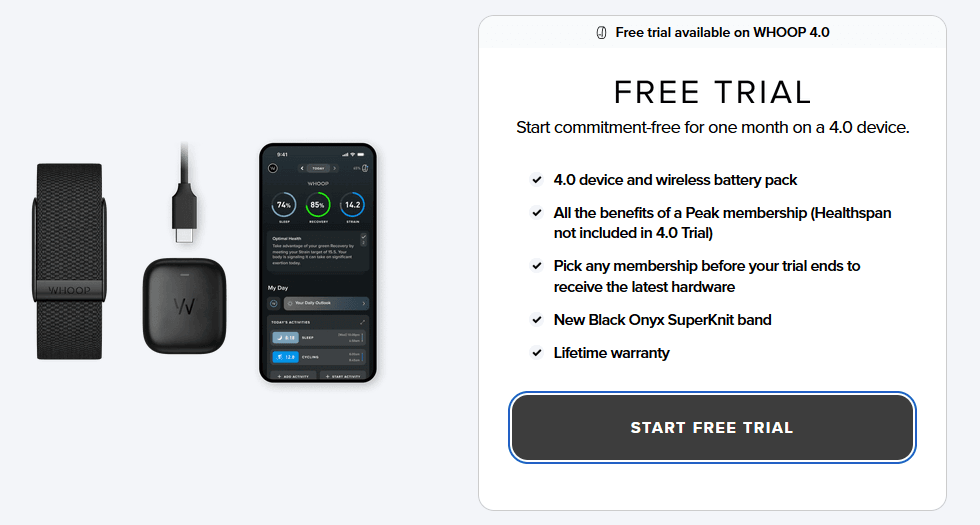
- WHOOP 5.0 free trial and best discount
Accuracy tests and head-to-head comparisons
- Garmin CIRQA review: accuracy tested against WHOOP MG across six sessions
- 150-minute ride: WHOOP MG, Fitbit Air, and ECG strap — statistical methodology and results
- Fitbit Air review: accuracy tested against WHOOP MG across cycling, running, and treadmill
- Polar Loop review: HR accuracy and recovery depth compared to WHOOP
- Amazfit Helio Strap review: accuracy and app tested against WHOOP
- HybridCharge vs Garmin Body Battery vs WHOOP Recovery: readiness scores compared
Hardware and sensors
- WHOOP 4.0 vs 5.0: sensor architecture changes in detail
- WHOOP muscle oxygen sensor patent: what it means for athletes
- WHOOP Navigator Band: What is new for outdoor athletes
Features and updates
- WHOOP HR algorithm update: February 2026
- WHOOP Strength Trainer update: Passive MSK explained
- WHOOP 5.0 firmware accuracy boost
- WHOOP 5.0 upcoming features
- Keeping WHOOP 5.0 and MG connected to the app
Strategy and market
- WHOOP $10bn valuation vs Garmin: what the numbers say
- WHOOP vs Garmin: F1, elite sport, and brand positioning
- WHOOP IPO: 600-person hiring drive signals public listing
- WHOOP vs Bevel: trade dress lawsuit explained
- WHOOP vs Chinese rival: trade dress case details
- WHOOP vs Polar: copycat lawsuit analysis
- WHOOP strategic pivot: why it threatens Apple and Garmin
Explore the full resource library
This site covers endurance sport technology across a range of dedicated reference sections. Each one collects the most relevant articles, tests, and analysis on its topic in one place.
Buyer guides
- Best sports watch — tested recommendations by sport and athlete type: triathlon, running, marathon, cycling, hiking, and women
- Best Garmin watch — Forerunner versus Fenix by series, sport, and budget
- Best wearables — recovery trackers, heart rate monitors, running power meters, and female athlete tech
- Best cycling products — computers, smart trainers, power meters, and cycling heart rate monitors
Brand and product guides
- Amazfit — the full Amazfit range from Balance to Cheetah to T-Rex, accuracy tests, HYROX partnership, and Zepp Health analysis
- Apple Watch — athlete-first coverage of Apple Watch across running, cycling, and triathlon
- COROS — watches, features, and firmware across the full COROS range
- Garmin — the company, the platform and the full range, and the starting point for choosing across every Garmin product line
- Garmin Edge — bike computers from entry-level navigation to flagship endurance and mountain biking
- Garmin Fenix — every model, feature, and firmware development for Garmin's flagship outdoor watch
- Garmin Fenix 8 Series — which variant to buy, upgrade advice, accuracy data, and the full Fenix 8 review and firmware coverage
- Garmin Forerunner — the full Forerunner line covered from entry level to triathlon flagship
- Garmin Instinct — rugged GPS watches for endurance and adventure athletes
- Garmin Features Explained — how Garmin's metrics work, from Training Load and Body Battery to Race Predictor and HRV Status
- Google Fitbit — Fitbit Air, Google Health, Pixel Watch and the Wear OS platform
- Polar — watches, sensors, Polar Flow and training science across the full Polar range
- Suunto — Race, Vertical, Run and the SuuntoPlus ecosystem
- Strava — features, privacy, segments, and how Strava fits into a serious training setup
- Wahoo — KICKR trainers, ELEMNT bike computers, and the Wahoo ecosystem
- WHOOP — strain, recovery, sleep and the full WHOOP ecosystem
Specifications database
- Full Specifications Database — detailed spec sheets, battery life, sensor lists and generation-on-generation comparisons for current Garmin, COROS, Amazfit, Samsung, Google Fitbit, Huawei, Polar, Suunto, Wahoo and Apple Watch models
Glossary
- Sports Technology Glossary — non-branded terminology across running, cycling, swimming, triathlon, hiking, strength training, HYROX, sensors, ecosystems, and brands
Sport and topic guides
- Running Watches — how to choose by discipline: road racing, trail, track, beginner, and multisport
- Triathlon and Multisport Technology — watches, sensors, and race-day tools for swimmers, cyclists, and runners
- HYROX — training science, race analysis, and technology for the functional fitness race format
- parkrun — technology, training, and performance for the weekly 5K
- Hiking Technology — navigation, safety, and trail tech for walkers and hikers
- Heart Rate Monitoring — optical sensors, chest straps, accuracy comparisons, and how to set training zones
- GPS Accuracy — how satellite systems perform across brands, terrains, and conditions
- Sports Watch Battery Life — battery claims, real-world tests, and how to manage battery life across Garmin, Apple, Amazfit and Coros
- Recovery Trackers — WHOOP, Oura, and the science of readiness scoring
- Female Athlete Tech — wearables, physiology, and performance for female endurance athletes, covering cycle-synced training, RED-S, HR accuracy, and VO2max
- Sports Science — peer-reviewed research on HRV, VO2max, lactate threshold, running power, wearable accuracy, and supplementation
- Testing Methodology — how this site tests GPS accuracy, heart rate, battery life, and other performance claims
Content series
- Release Radar — confirmed launches, leaks, and rumours across Garmin, Apple, COROS, Polar, Suunto, and Wahoo
- Deep Dive Feature Files — weekly firmware feature updates across all brands (bug fixes excluded)
- Fix Files — weekly firmware bug fix tracking across all brands
