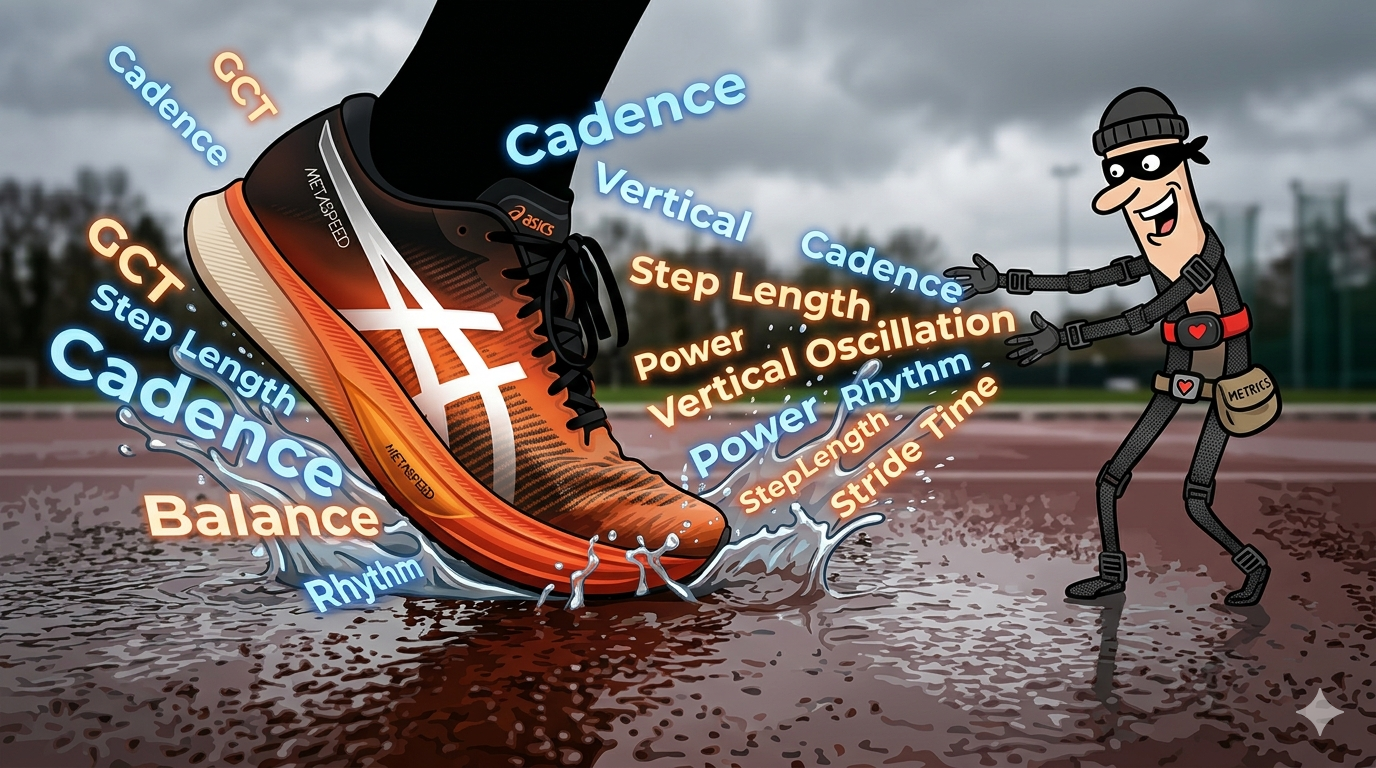
 How a developer tricked a Garmin watch into accepting running data it was never meant to receive
BLE-only third-party sensors have generally been unable to feed Garmin’s native Running Dynamics pipeline, leaving their data confined to Connect IQ fields that Garmin’s own analytics never read. A Belgian developer named Sam Dumont has changed that, and the product at the centre of the story is one I reviewed here in early 2025, after which I introduced Sam to the team building it.
Dumont reverse-engineered the proprietary Bluetooth protocol Garmin uses internally for its HRM 600 chest strap. This protocol integrates Running Dynamics natively into the watch’s recording stack and uses it to enable a non-Garmin sensor to speak that protocol fluently. The result is a third-party chest strap that a Garmin watch treats as its own Running Dynamics source, feeding vertical oscillation, ground contact time, left/right balance, step length, and cadence directly into Garmin’s native recording and analytics pipeline.
Why was this a BLE problem specifically
It is worth being precise about what was actually locked.
Running Dynamics over ANT+ has had an open profile since 2017. Stryd uses it. Any manufacturer willing to implement that ANT+ profile could feed native Running Dynamics to a Garmin watch. The problem is that ANT+ is now effectively a legacy protocol with no active development and declining support among new sensor manufacturers. Garmin ended its ANT+ membership and certification programmes on 30 June 2025. No new profiles are being written. Every sensor manufacturer building new hardware today builds for Bluetooth LE.
No documented, interoperable BLE path existed for third-party manufacturers to deliver Garmin-native Running Dynamics. A BLE-only sensor was locked out of Garmin’s native recording pipeline, regardless of its data quality. Dumont’s work closes that gap at exactly the moment it became the only gap worth closing.
What the lock is
Running Dynamics over BLE has required a Garmin strap for the richer metrics, not because no other sensor could measure them, but because the Bluetooth path into the watch’s native recording was undocumented and proprietary.
It is worth noting that newer Garmin watches from the Fenix 7 and Forerunner 955 generations onwards can generate Running Dynamics data from the watch’s internal sensors. A chest strap adds balance data and can improve accuracy, but is no longer the only source on those models. On older hardware, the strap was the only path entirely. In both cases, third-party BLE sensors were forced into Connect IQ data fields: visible on screen, logged in the FIT file, but outside Garmin’s native Running Dynamics set and the analytics features linked to it.
Techie Talk: Dumont decoded the stack layer by layer: a Bluetooth multiplexer, a Garmin-specific framing protocol, and a protobuf message schema extracted from a decompile of the Garmin Connect Android app. He also leaned on prior work from Gadgetbridge, the open-source watch companion project that had already mapped significant portions of the transport layer. The watch does not check if Garmin made the sensor. Instead, it checks whether the sensor is speaking the right language. Speak it correctly, and the watch lets you in. Dumont’s sensor identifies itself as OpenRD and received the full native treatment.
What the Darefore running sensor does with this
The Darefore sensor is worn on the chest. In running mode, it produces the standard Garmin Running Dynamics set natively, so vertical oscillation, ground contact time, balance, step length, and cadence go into Garmin’s native recording pipeline the same way an HRM 600 feeds them. Beyond that, it produces three metrics that the HRM 600 cannot: torso stability, fatigue drift, and asymmetry. Darefore’s own marketing argues that these reveal structural degradation in running form before pace and heart rate respond, thereby catching the mechanical signal of a runner tiring in real time.
Those additional metrics land in developer fields because Garmin has no standard data bucket for them. The standard Running Dynamics set goes into the native pipeline. The combination means Garmin’s analytics are properly fed, while the runner gets a layer of structural insight that no Garmin strap can provide.
The sensor also resolves a second problem Dumont had been working on for years. A Garmin watch refuses to let one Bluetooth device simultaneously pair as the native HR monitor and supply data to a Connect IQ app. The connections fight, and one wins. His fix is to make the single chip inside the sensor appear as two devices at two different Bluetooth addresses. The watch pairs the HR monitor, and the Connect IQ field connects to what it believes is a separate device.
This doesn’t really count as a Garmin exploit, as it follows the standard BLE protocol.
The full technical details are in Dumont’s own write-ups: reverse-engineering the HRM 600 Running Dynamics protocol and the dual BLE identity technique.
What it cannot do
Running power is the obvious question most readers would ask.
Sorry. No.
Garmin’s running power metric is computed by the watch rather than being accepted as a native external input. There is no writable external field for it, and this work does not change that.
Availability
Darefore Run is in pre-launch, with launch-priority registration open at darefore.com/run. Founder Marios Kyriakou confirms that native Garmin Running Dynamics integration ships with the initial launch, that existing Darefore hardware supports the running mode without requiring new hardware, and that pricing will be competitive. The same device covers both cycling and running.
The wider point
Dumont has published the full protocol and is contributing the sensor-side code to Gadgetbridge this week. Gadgetbridge had mapped the watch-to-phone transport direction for years. The sensor-to-watch direction, the part that feeds Garmin’s native pipeline, was missing until now. For any developer building a BLE-only sensor, the engineering cost to add native Garmin RD integration is now measured in days rather than months.
Whether there is a large enough market for a chest-worn running biomechanics sensor remains an open question. History is littered with failed insole running gait sensors.
The cycling version of Darefore is technically capable and remains niche. But clearly running is a bigger market and a decent chunk of it may want new form-related metrics – physios and coaches spring to mind. The technology is no longer the constraint.
Quick answers
Does Darefore Run work with all Garmin watches?
The protocol has been tested on the Epix Gen 2 Pro, which is Fenix 7-generation hardware, and is expected to work on any Garmin watch on the official Running Dynamics-compatible device list. That list includes Fenix 7 series, Forerunner 955, and newer models. Compatibility with older hardware is being confirmed.
Can Darefore Run send running power to my Garmin watch?
No. Garmin’s running power metric is computed by the watch itself rather than being accepted as an external input. That is an architectural limit; this work does not change it.
What is the difference between native fields and developer fields on a Garmin watch?
Native fields are recorded and read by Garmin’s own analytics features. Developer fields are visible on screen and logged in the FIT file, but sit outside Garmin’s own algorithms. Until now, all third-party BLE sensor data has been captured only in developer fields. The Darefore running sensor puts the standard Running Dynamics set into native fields, with its additional biomechanical metrics in developer fields as well.
Why did this require reverse engineering rather than using Garmin's developer tools?
Garmin’s Connect IQ developer platform gives third parties access to custom data fields and Connect IQ apps, but not to the native sensor protocols that feed Garmin’s own analytics. The Running Dynamics BLE protocol is undocumented and not available through official developer channels. Reverse engineering was the only path.
Last Updated on 3 October 2026 by tfk the5krunner
Small things I always use
- Garmin 90-degree charging adapter: Charges your Garmin from any USB-C cable. Essential when travelling. I use one.
- Body Glide: The blue anti-chafe stick swimmers and runners carry. I use it.
- Speedo earplugs: Fewer ear infections and no cold-water dizziness. I use them.
- Dryrobe Advance: My winter changing robe for open-water swims. I use one. A cheaper option is the AONYIYI changing robe.
- Maurten: Race fuel that stays easy on the stomach. I use them.
- Beet It Sport nitrate shots: Beetroot shots I take in the days before a race. I use them.
- Garmin charging puck: The quickest way to top up before a session. I use one.
- Injinji: Toe socks that stop rubbing, so you run more. I use them.
- Ultimate toe protectors: Stop black toenails on long runs. They work. I use them.
- Compressport R2 v2 calf sleeves: My calf sleeves of choice. I use them.
- Cellucor C4: My pre-workout before hard sessions.
- TPU tubes: Schwalbe Aerothan, Tubolito and Pirelli SmarTube. Light, tiny spares. I use all three.
- G8 insoles: Adjustable insoles that are good. I use them.
- Cycplus Cube: A 97g electric pump that gets a road tyre rideable in two minutes. I carry one. 5% off with code THE5KRUNNER.
Watches and sensors
- Polar H10: My daily driver for waking HRV.
- Polar Verity Sense: My backup arm-worn HR sensor.
- Nomad bedside charger: Charges my iPhone and Apple Watch overnight. I use it, and many of their bands.
- Train.Red: The best muscle oxygen sensor I’ve used.
- Tymewear: Accurate heart rate and reliable ventilatory zones. I use it to pace endurance rides over an hour.
- Garmin Forerunner 970: A pro-grade triathlon watch. I use this.
- Apple Watch Ultra 4: My daily smartwatch. No phone needed on rides.
- Garmin Fenix 9 Pro: I’ve just bought one.
On the bike
- Continental GP5000 for everyday riding, and Aero 111 on the front for special occasions.
- Helmets: Specialized S-Works Evade 3 for road riding, and Rudy Project Wing for TT-style races. I use both.
- Ravemen FR300: A front light that mounts under your Garmin or Wahoo. I use one.
- Wahoo TRACKR Radar: I use it on one bike and Varia on the other. They perform the same.
- Garmin Varia RTL515: Radar that warns you of cars from behind. I use this model.
- Wahoo ELEMNT Roam 3: The bike computer that’s easy to use. I use mine on most rides.
- Favero Assioma Pro RS2: Accurate power pedals that swap easily between bikes. I use this model.
Home and indoor training
- NPE Runn: Makes my basic treadmill smart, sending more accurate speed and distance to my watch and Zwift. I use it.
- Google Wifi: Keeps Zwift connected in my pain cave. I use it.
- Apple TV 4K: Zwift on the big screen. I use two.
- Google Nest Doorbell (wired, 2nd gen): My video doorbell, running in both Google Home and Apple Home. I use it.
Health, recovery and sleep
- FreeStyle Libre 3 Plus: Shows how my blood sugar responds to diet.
- hDrop: Measures my sweat loss in summer and indoors.
- Fourth Frontier Zone: Checks my heart under load in hard sessions.
- Oura Ring 5: My partner’s recovery tracker of choice.
- Eight Sleep: A cooling mattress cover my partner and I use nightly.
Reader-Powered Content

This content is not sponsored. It’s mostly me behind the labour of love, which is this site, and I appreciate everyone who supports it.
Support the site: Follow (free, fewer ads) · Subscribe (paid, ad-free) · Buy Me A Coffee
Written by real people, with AI assistance. Fact-checked and verified for originality. See the Editorial Policy. FTC: Affiliate Disclosure — some links pay commission. As an Amazon Associate, I earn from qualifying purchases.
tfk is the founder and author of the5krunner, an independent endurance sports technology publication. With 20 years of hands-on testing of GPS watches and wearables, and competing in triathlons at an international age-group level, tfk provides in-depth expert analysis of fitness technology for serious athletes and endurance sport competitors. See the gear tfk uses. ID

Very interesting feat, even if it doesn’t pan out hardware wise. I’ve registered for the pre-order.
it is interesting.
there might be a follow on piece as well to add to the interesting!!
Any news on this front?