Amazfit Active Max Review: A Superior Coros Alternative 2026
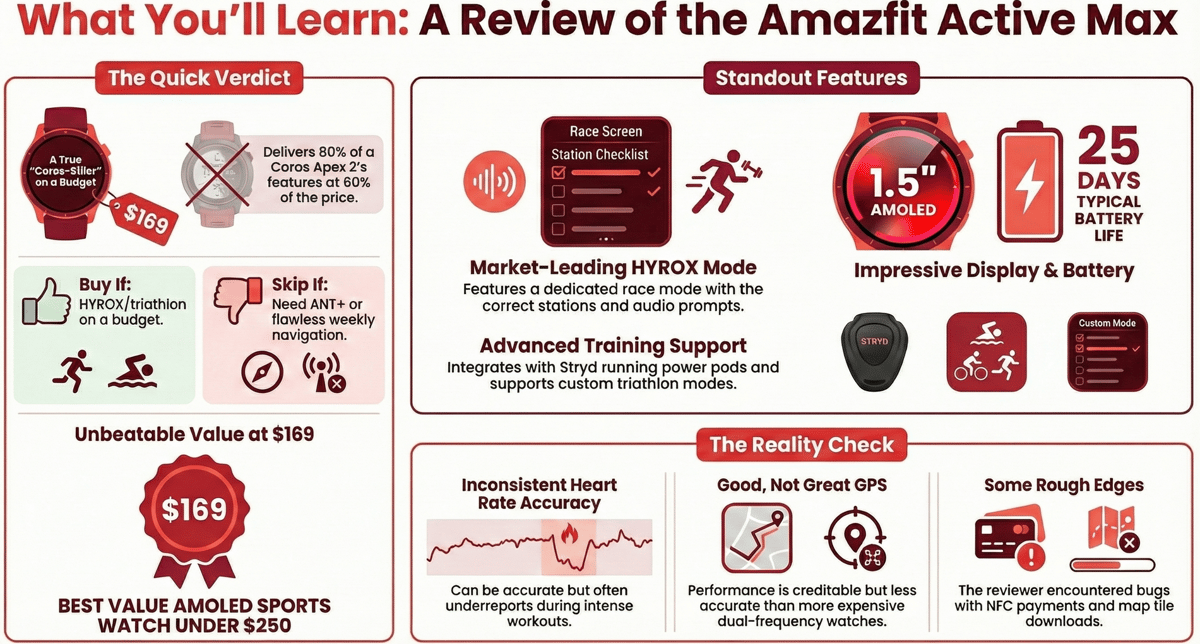
It's a Coros-killer for most people. Not quite a Garmin-killer—their ecosystem operates on a different level.
A Buy Recommendation For Everyone On A Budget
Buy if: You want a good-looking, feature-packed sports and fitness watch for genuine 24/7 wear, or need HYROX/CrossFit/triathlon support on a budget.
Skip if: You regularly follow new routes, or require ANT+ sensor support, or you want to avoid occasional bugs.
Pros
- Best value budget watch out there
- Market-leading AMOLED display size for the case (small bezel)
- Market-leading battery life
- Best native Hyrox support (also CrossFit/triathlon)
- 3rd party app ecosystem plus watchfaces
Cons
- Some bugs, e.g., NFC not working
- HR/GPS Accuracy needs tweaking
- So-so call quality
- Minimal viable features, e.g. Stryd lacks auto calibration
- No Strava route sync – needs manual GPX
Heads Up: This is a media loaner device from Amazfit. The review is not paid for or influenced in any way (including the unpaid Award below). Please support the work here by buying through one of the affiliated links, where I get a commission or Buy Me A Coffee if you enjoy these kinds of reads, but never buy the watches.
This product has been awarded the the5krunner Editor's Choice 2026. The award is given to products that achieve an exceptional standard in independent testing.See all Editor's Choice awards.

Listen to the discussion
Why You’re Reading This Review of the Amazfit Active Max – Is it really a Coros Killer?
Amazfit’s Active Max offers slightly better overall value than a Coros Pace Pro or Pace 4, but each has obvious strengths over the other. Rest assured that whichever you choose, the core fitness features are very well covered by both.
Amazfit wins on looks and edges it when comparing official list prices – though Amazfit often discounts, whereas Coros rarely does. The Amazfit Active Max edges it out too, with market-leading battery life claims that rival Coros. Similarly, although Amazfit offers good-quality sports data (heart rate and GNSS/GPS), Coros wins out with market-leading GPS.
Looking at the sports features, there is no clear winner, and it depends on what you’re looking for. If you want to follow structured training plans that you buy online, Coros is the one to go for. But if you’re looking to compete in a Hyrox event, Amazfit has a new market-leading feature. Both have advanced sports profiles like track mode and stats, with Amazfit recently adding support for running power with Stryd – a feature Coros added several years ago. Both support triathlons, but are weak options for tech-serious triathletes (Garmin is the main option), and both are weaker than Garmin for advanced routing and mapping. At this price point, you won’t get any Garmin maps, and Amazfit’s maps are better than those from Coros.
Coros edges it out in advanced sports physiology, while Amazfit covers the basics. Both lag significantly behind Garmin’s higher-end sports physiology metrics.
However, the big win for Amazfit is its smart features. Coros is really just a watch most people will use during sports, but Amazfit is designed to be on your wrist 24/7. So it adds NFC payments, watchfaces you won’t be embarrassed to show off, the ability to make and take calls on a connected smartphone, and an AI voice assistant plus a QWERTY on-screen keyboard.
Price – The elephant In The Room
Amazfit Active Max is priced at $169/£169/169€ and is clearly the cheapest medium-format AMOLED sports watch from the key brands, with the older Active 2 the most affordable smaller format AMOLED watch.
| Watch | USD Price | Display Size |
|---|---|---|
| Amazfit Active 2 | $99 | 1.32″ |
| Amazfit Active Max | $169 | 1.5″ |
| Coros Pace 4 | $249 | 1.2″ |
| Coros Pace Pro | $299 | 1.3″ |
| Garmin Forerunner 165 | $250 | 1.2″ |
| Polar Vantage M3 | $399 | 1.28″ |
| Suunto Run | $249 | 1.32″ |
| Apple Watch SE 3 | $249 | 1.57″/1.73″ |
What Makes Active Max Different
Amazfit Active MAX – What’s New
New to Active Max (vs Active 2):
- Larger 1.5″ AMOLED (480×480)
- Bigger 658mAh battery (~25 days typical)
- 4GB storage
- NFC, tap and go payments (Zepp Pay in EMEA)
- Speaker + mic (Bluetooth calls)
- Higher brightness (3000 nits peak), glove mode
- Rotor vibration motor
- Aluminium alloy buttons/frame
Amazfit’s 2025 Positioning
Coros (2018) and Amazfit launched their first watches at roughly the same time. Their subsequent strategies panned out differently: Coros focused on a Garmin sports copycat model (lower prices, superior battery, niche sports), while Amazfit aimed for truly budget prices and smart features. Amazfit ships notably more watches each year, but the Coros strategy has reaped dividends in more recent years. Unsurprisingly, 2026 sees both companies’ strategies converge on the middle ground (though not with the Active MAX) as the number of features continues to grow but starts to plateau.
I remember buying the first Amazfit Stratos and being wowed by it. It was a standout product in 2017, with a huge number of features and a super-low price point. It got a lot of PR and market traction at the time, but always seemed a few steps away from offering a dominant alternative to the likes of Apple Watch or Garmin.
Amazfit Product Timeline (2013-2026)
This timeline shows how the company probably decided to react in 2019 to the breakout success of Garmin Fenix by releasing a rugged watch the following year.
| Date | Model | Key Notes |
|---|---|---|
| 2013 | Huami founded | Parent company of Amazfit |
| August 2016 | Amazfit Smartwatch (Pace) | First Amazfit model |
| 2017 | Stratos / Pace 2 | Sports-focused |
| 2018 | Bip / Verge | Budget and smart features |
| 2019 | GTR / GTS | Flagship round/square |
| 2020 | T-Rex / GTR 2 / GTS 2 | Rugged and updated flagships |
| 2021 | GTR 3 / GTS 3 | Improved OS |
| 2022 | GTR 4 / GTS 4 | Advanced GPS, sports features |
| 2023 | Balance / Cheetah / Active | Premium AI, running, lifestyle |
| 2024 | T-Rex 3 | Rugged update |
| January 2025 | Active 2 | Lifestyle/fitness |
| March 2025 | Bip 6 | Affordable AMOLED |
| May/June 2025 | Balance 2 | Premium AI all-rounder |
| September 2025 | T-Rex 3 Pro | Rugged outdoor/adventure |
| December 30, 2025 | Active Max | Mid-size endurance/fitness |
Amazfit 2025-2026 Watch Range
Amazfit now offers a range of case types and sizes with similar feature sets. The larger, premium case sizes of the likes of Amazfit’s T-Rex 3 Pro are priced to sit in competitive parts of the markets, places where people spend several hundred dollars and want the best features, but only Garmin has them and even then, only at even higher prices.
However, that’s not the case for Amazfit’s Active Max. This hits a super-nice sweet spot at a highly attractive price.
| Model | Positioning | Display | Battery Life | Sports Modes | Key Features |
|---|---|---|---|---|---|
| Active 2 (Round & Premium) | Budget lifestyle/fitness | 1.32″ AMOLED | ~10 days | 160+ | GPS, Bluetooth calls, AI fitness |
| Active Max | Mid-range endurance/lifestyle | 1.5″ AMOLED (480×480, 3000 nits) | ~25 days | 170+ | GPS, NFC (EMEA), speaker/mic, BioTracker PPG |
| Balance / Balance 2 | Premium all-rounder with AI | 1.5″ AMOLED (sapphire) | ~21 days | 170+ | Offline maps, golf/diving, BioCharge |
| Bip 6 | Affordable entry-level AMOLED | 1.97″ AMOLED | ~14 days | 140+ | GPS, Bluetooth calls, AI coaching |
| T-Rex 3 / T-Rex 3 Pro | Rugged outdoor/adventure | 1.5″ AMOLED (2000 nits) | ~27 days | 170+ | Dual-band GPS, 10ATM, extreme durability |
What’s New vs Active 2
Larger 1.5″ AMOLED Display (480×480, 3000 nits)
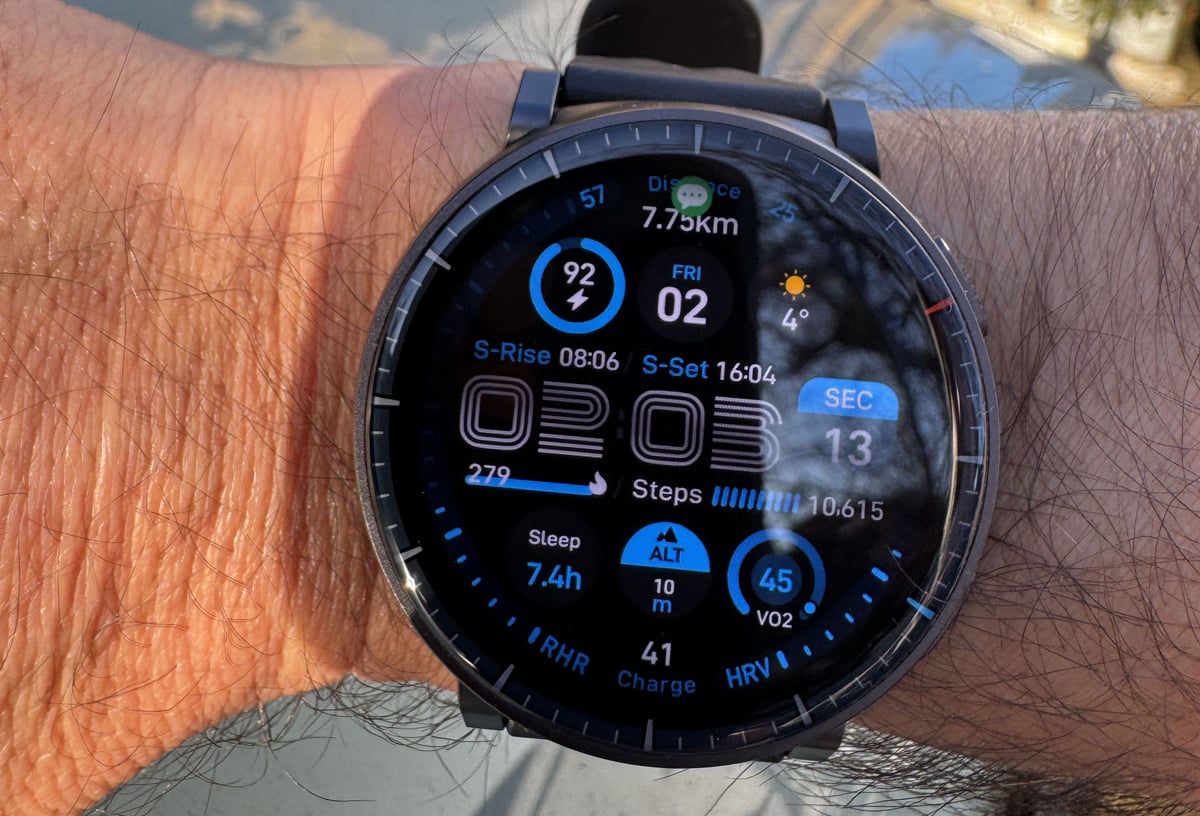
On a bright, sunny winter day, the display is easily readable at 3000 nits. However, if you made the mistake of manually cranking the brightness down to the minimum for indoor use (that’s fine), but step outside, and it is very hard to read in direct sunlight at that setting. The auto mode handles this kind of variation.
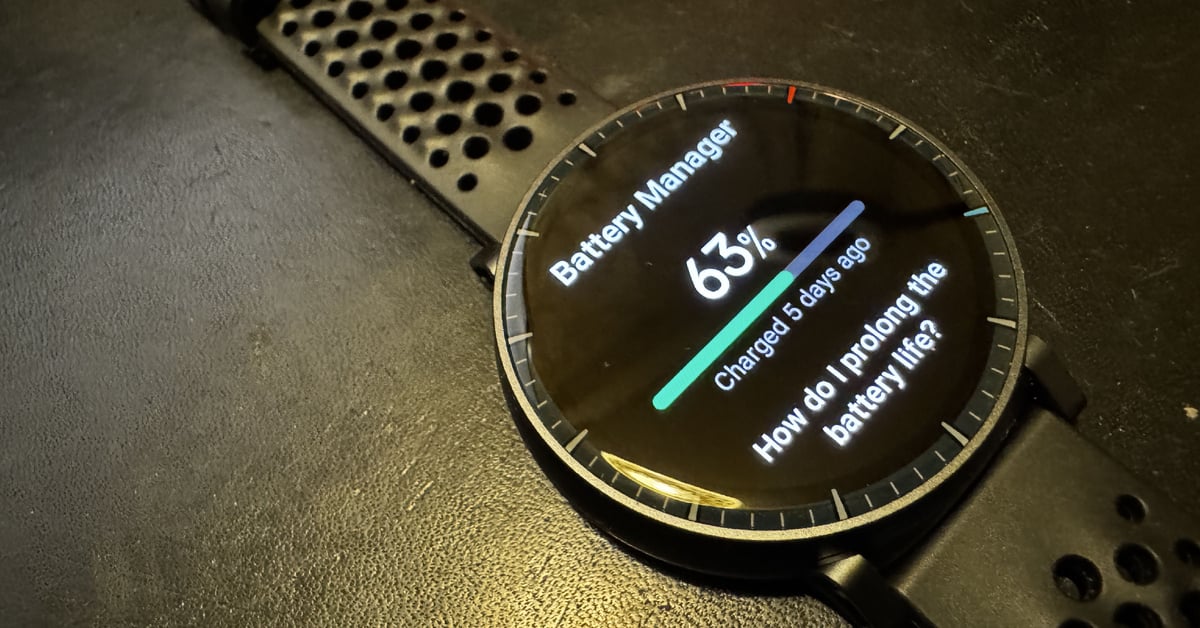
Extended Battery (658mAh, ~25 days)
No one will get 25 days of use from one charge. Buyers of this watch will use it for fitness to some degree, so the battery life for simple everyday use from one charge will be reduced.
Based on my real-world testing in mixed-use and 24/7 wear, including sports, you should easily get a week of full use between charges. The two critical factors that would stop you from getting a week of use are Bluetooth music playback and frequent use of connected calls on your smartphone. From experience with other brands’ watches in similar situations, those long, Bluetooth-intensive connections will eat into the battery. Obviously, lots of 5-hour bike rides outdoors with GPS would eat the battery too.
Speaker/Mic for Bluetooth Calls
Several permissions must be set for this to work on iOS. I eventually got it working.
You will end up with the watch pairing in a similar technical way to earbuds, i.e., you must be connected to your phone to make a call. It is not possible to get a 4G/5G connection with an Amazfit watch.
The sound volume was loud enough but not super loud, and I’m guessing it might not be great in very busy settings. In a few test calls, the receiver could hear me clearly, but when they spoke, I found the voice clearly audible but a little distorted.
This would be fine for occasional daily use on short calls, and it just saves you from having to take your phone out of a pocket or bag.
Hardware Upgrades (buttons, rotor motor, glove mode)
A quick note on some of the smaller, new hardware upgrades.
The new metal buttons have a nice press; however, they are almost flush with the case. Both buttons have a ridged texture as shown in the image below; it is pleasantly tactile and easy to locate. Amazfit makes a point of noting ‘glove mode’, which isn’t for the buttons, as they are not glove-friendly at all. Maybe glove mode relates to the touchscreen, which is very sensitive (works with gloves to a reasonable degree, but is also easily impacted when wet)
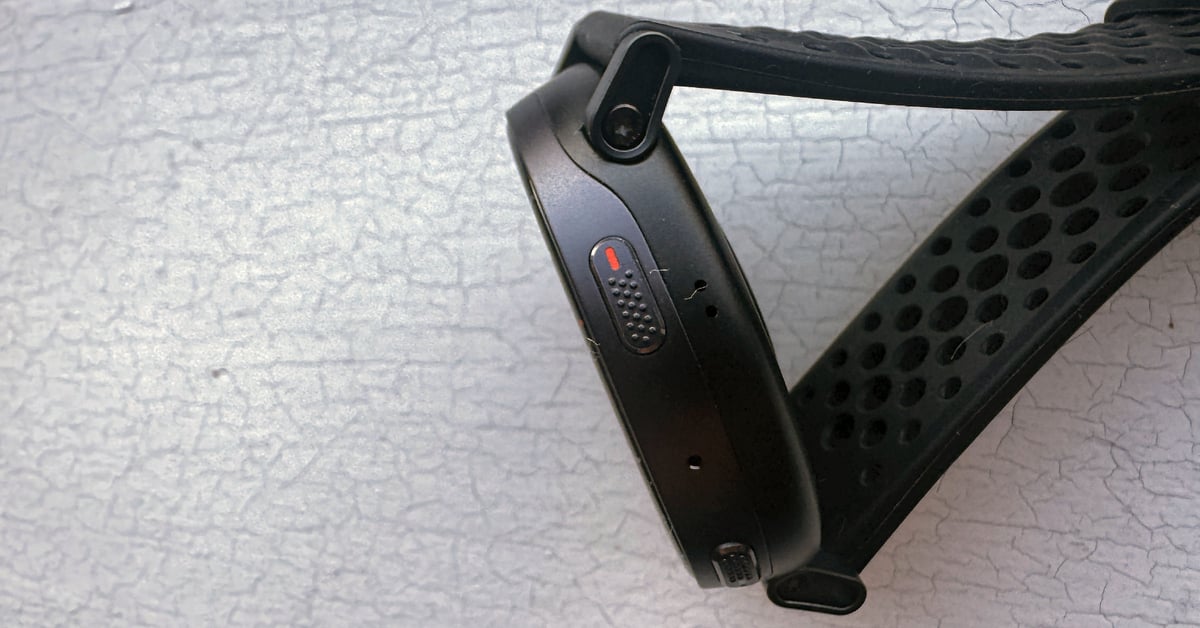
There is a new rotor for haptic/vibration feedback. This just about hits the sweet spot between noticability and annoyance, though it might be very slightly on the weak side of where it needs to be.
Deep Dive: High End Features at Low End Prices
HYROX Mode Analysis (Why It Matters for Functional Fitness)
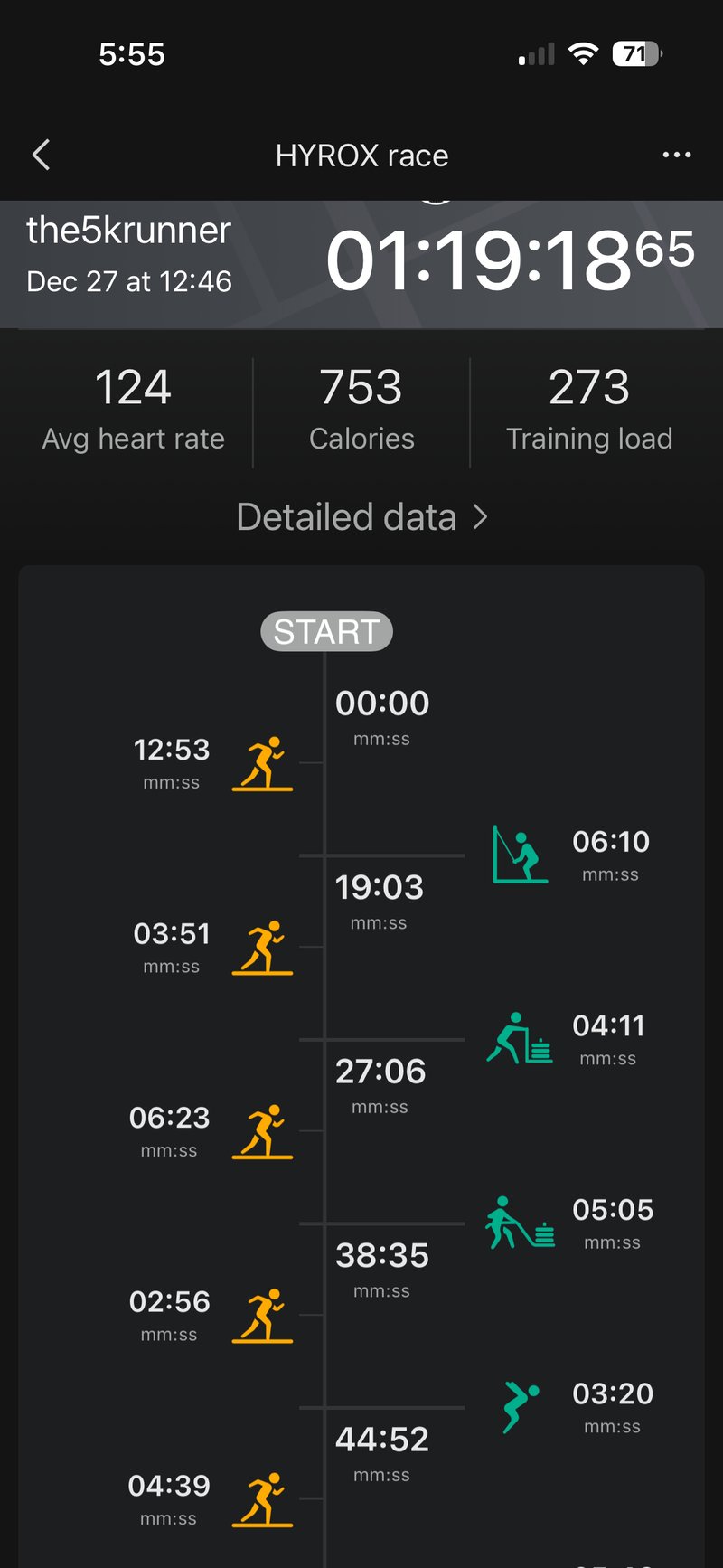
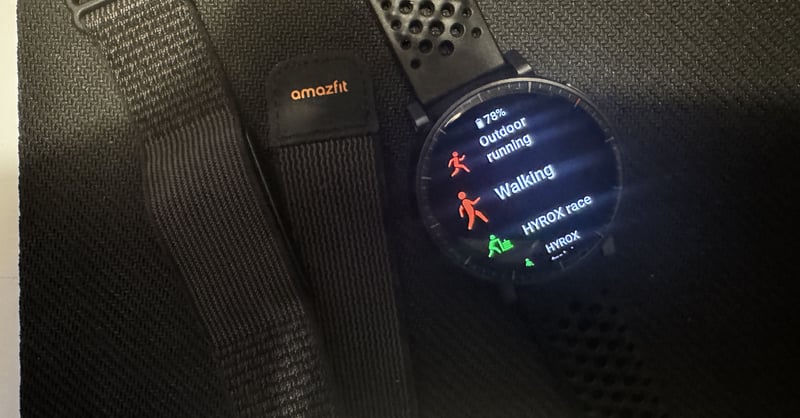
I typically complete one indoor Hyrox simulation every 3 or 4 weeks, mostly because I enjoy the challenge and variation from my regular training. My preferred method is to use a Garmin workout to prompt and record the 16 legs. This is an unsatisfactory method as it is impossible to construct a single multi-stage workout or multisport profile in the Garmin environment that precisely matches the Hyrox stations (there is the Roxfit CIQ app). I was excited to test Amazfit’s new Hyrox profile against the Garmin, and I also added the Roxfit app on my Apple Watch Ultra 3 for the three-way test.
Here’s what I liked about Hyrox Race mode
- A top button press can undo a previous misspress
- Last/current/next profiles are clearly shown as icons
- Audio prompts are clear for those who use them
- It has the correct stations! (Hard to customise on other platforms)
- (AMRAP, TABATA and EMOM workout templates areavailable for training mode)
Here’s what I didn’t like
- On-screen metrics were customisable, but the choice was limited. I couldn’t find reps (e.g. for wall ball) or pace/distance (e.g. for running legs with a footpod)
If I use more than one watch simultaneously in a test, an interesting observation is to see which watch I favour when checking my progress. In the case of a Hyrox Sim, the Amazfit wins.
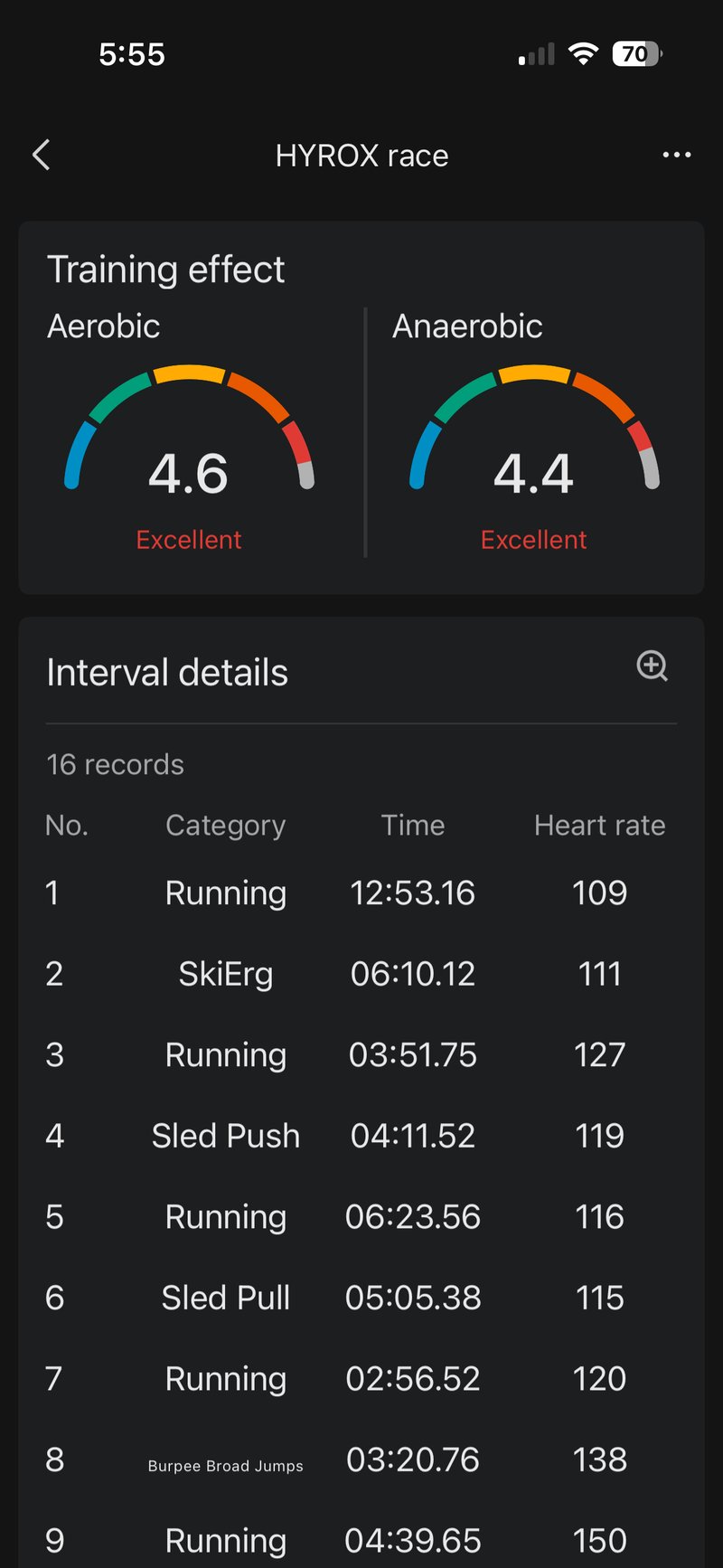
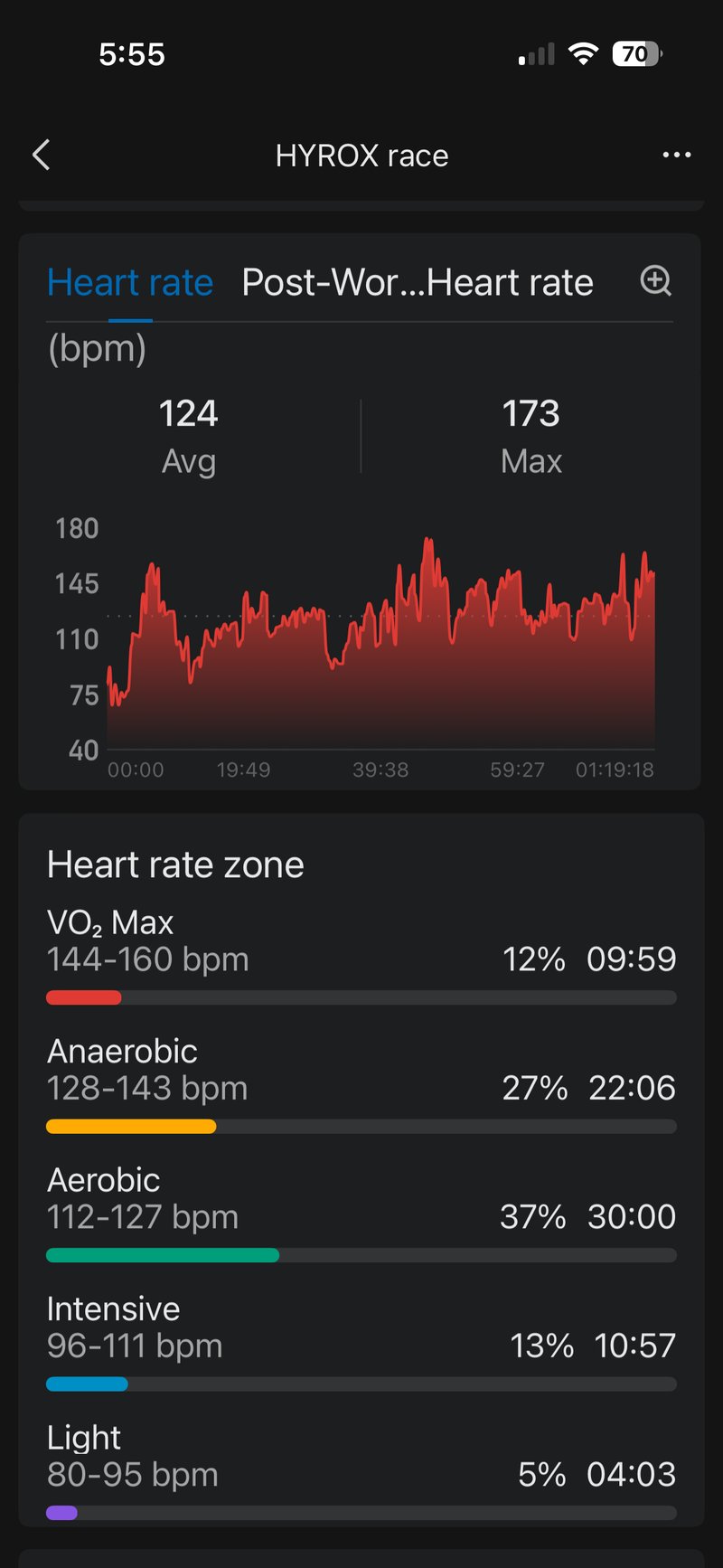
The post-workout metrics on the smartphone app had more details about the splits for each leg.
Overall, a serious Hyrox athlete dedicated to improving and competing in multiple events would likely go down the Roxfit route. However, for anyone completing a Hyrox as a one-off challenge, Amazfit can be recommended to do a great job.
Custom Triathlon Mode Setup
I typically do 3 to 5 multisport (triathlon/duathlon) races a season at a high age-group level. I tend not to do triathlon race simulations, but I do perform many ‘brick’ sessions, repeating bike-run legs. With a simple swim-and-run or bike-and-run training on a given day, I’d probably just record them as separate workouts. At my level, when racing, all I’m really interested in is my current pace or power for short courses. On longer courses, I would want to see some element of cumulative progress.
Anyone taking triathlon seriously will use a high-end Garmin watch, as they do everything (almost everything!) a triathlete needs. All other watch brands are not as good, and compromises will be needed at some point. If you are using an Amazfit watch to train for your first, and perhaps only, triathlon, it will do a great job.
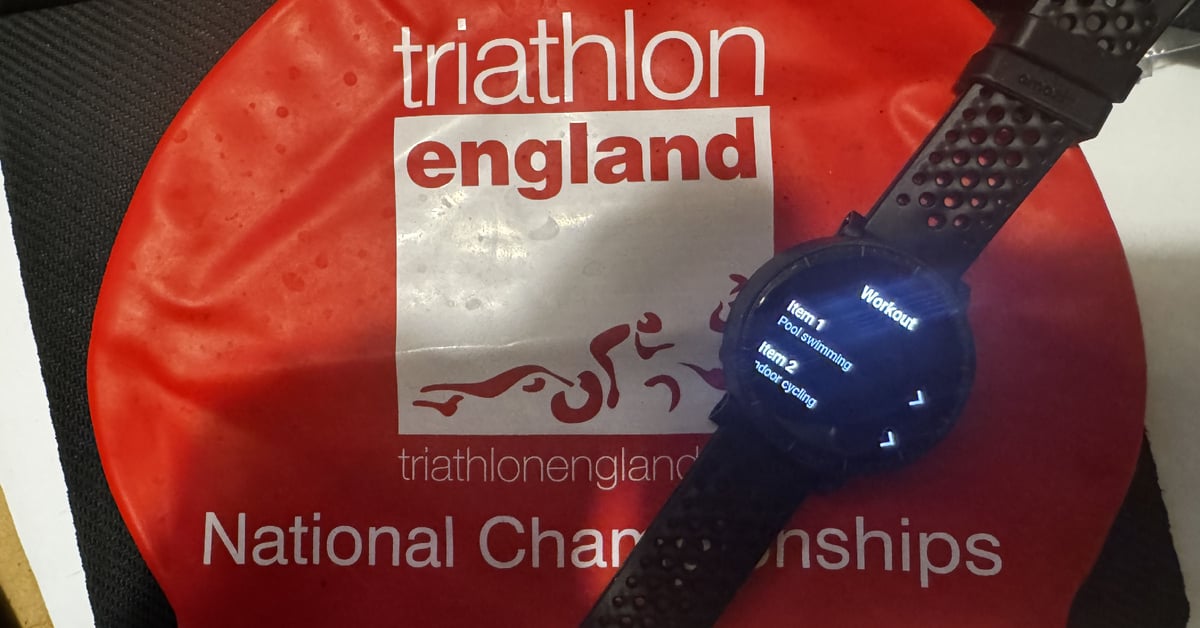
I tested Amazfit Active Max’s ability to create a custom multisport profile for a dry indoor triathlon simulation. This is actually one of the multisport scenarios that Garmin can’t do 100% either, so it’s a complicated (impossible) test. I used my Vasa Swim Trainer (power-capable), a high-end Wahoo Kickr Bike Pro (controllable and power-capable) smart trainer, and a cheap treadmill (can’t do much, but I used Stryd power pods too).
The first limitation with Amazfit is that you can only use either the fixed, outdoor triathlon profile (i.e. swim, bike, run) or the customisable multisport profile. There’s only one version of each, so I had to use the latter and configure it on the day.
What you can do
- Create an unusual multisport profile for training or race day, like pool swim + bike + run
- Create a 10-step brick workout, e.g., 5x (bike+run)
- Include transitions
- Customise metrics
- There is automatic workout detection, but I didn’t notice how well it automatically switched from bike to run.
What you can’t do
- is change the triathlon profile – it’s swim+bike+run, all outdoor. That’s it.
- Save multiple multisport profiles, e.g., a brick workout and your pool-based triathlon race.
- Use a customised profile within the multisport profile. i.e., if you include running in a triathlon, it uses your setup for the running profile (which is OK)
- Create an indefinitely repeating profile, e.g., many (bike+run)
- Control an indoor smart trainer
- Access ANT+ power meters (Vasa – Garmin can’t add Vasa to a customised openwater swim profile with GPS disabled)
Stryd Running Power Integration
Amazfit Active Max supports the Stryd running power pod(s).
Stryd (with its patents) provides more accurate pace/distance and power inputs than any competitor, including Garmin, Coros, Suunto, Polar, and Apple.
Several measurements are used to calculate running power by one of two methods, each giving quite different results. Results vary from brand to brand and there is no gold standard device that is considered correct.
However, Stryd is the only device to measure live wind speed, my understanding is that the foot is a better place to take measurements. I’m confident that Stryd has the most accurate inputs to its power calculations. Furthermore, its sensors appear highly precise in my testing over the years (I use it for every run) when auto-calibrated.
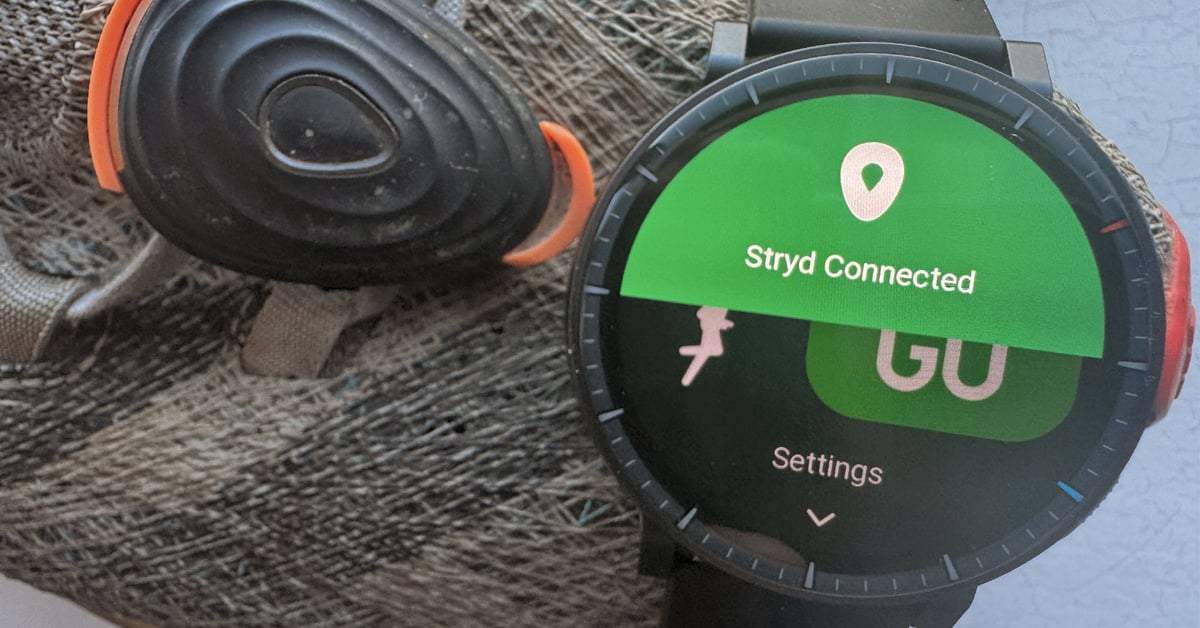
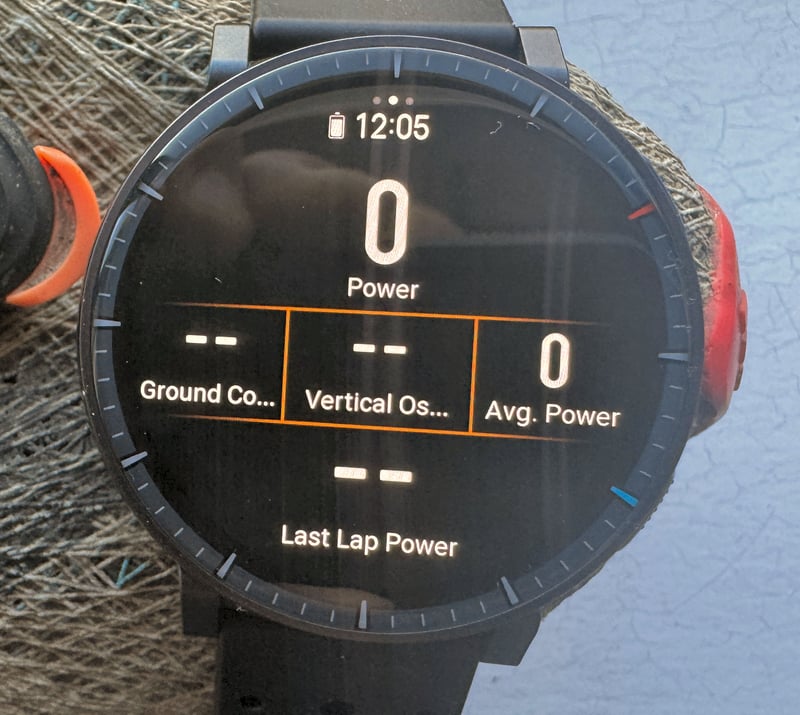
Pairing Active Max with Stryd is easy, and a screen of its specialist gait metrics is automatically added, including ground contact time (GCT), vertical oscillation (VO), and power. Improve any of those metrics, and you will run faster. The best training to improve them is to run faster and further! The usefulness of power is enormous and complex (a topic for another day); a straightforward example is that it can be used to give even effort on undulating terrain, which tends to make you faster overall.
What’s Easy
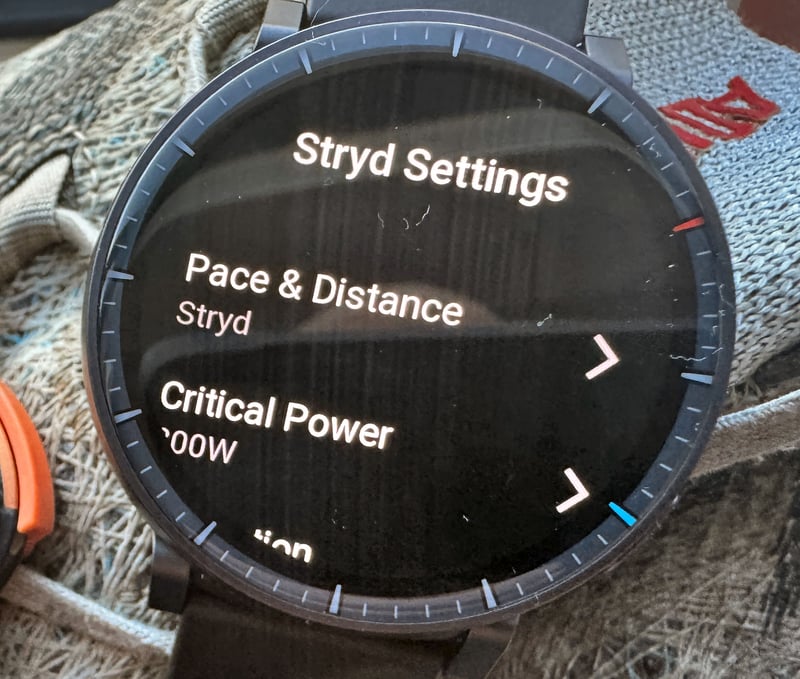
- Set Stryd as the default source of power and distance
- Stryd’s metrics can be added to existing screens
- There is a pre-made screen of Stryd metrics
What’s not
No integration with the Stryd ecosystem (yet)
- Critical power (your power signature) is not downloaded or updated. You have to do it manually.
- The calibration coefficient can only be set manually. Other platforms have an auto-calibrate option.
- The Stryd metrics screen is not configurable.
NFC Payment Experience (Zepp Pay vs Garmin Pay)
Garmin has an issue with the availability of Garmin PAY on various banking networks. Essentially, it has to negotiate per-bank details, unlike Apple Pay, which has generic deals with Mastercard, Visa and Amex. This initially narrowed down my Garmin PAY usage to Starling Bank in the UK; however, I subsequently discovered a CURVE Card. Curve (Mastercard) acts as financial glue between your current cards and either Garmin PAY or Zepp PAY. Curve does not require a balance, but there is a one-off £10 joining fee.
My curve card currently works on Garmin PAY, but I could not get past the initial Zepp PAY screen, i.e. I couldn’t load my card onto the watch.
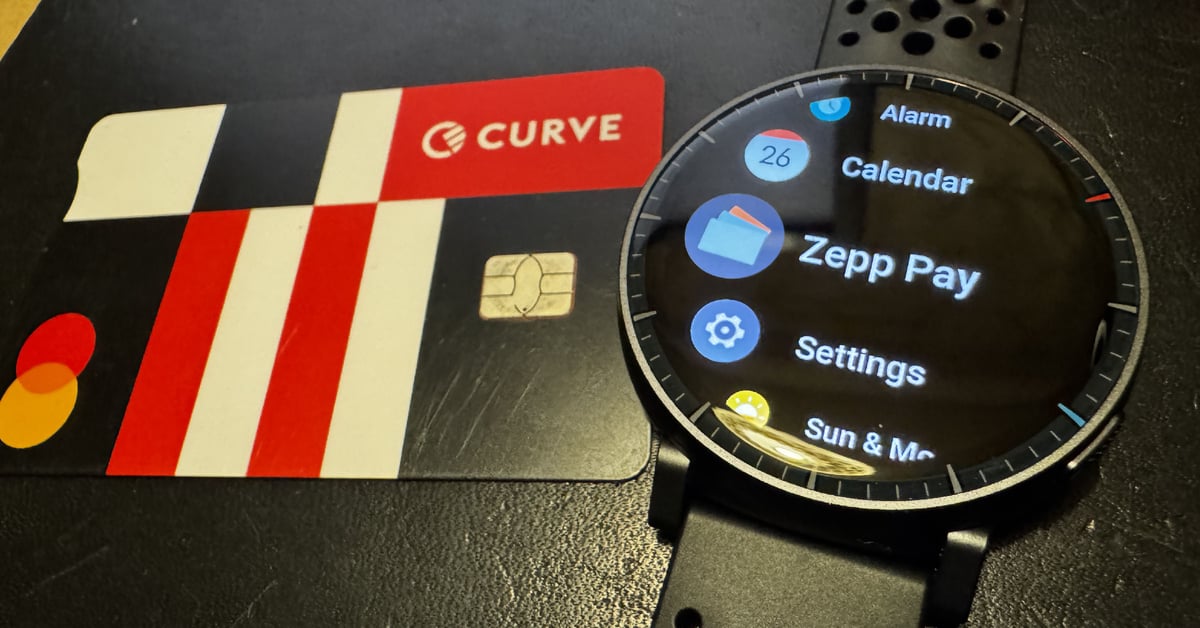
As part of the Zepp Pay setup, you correctly need to create a PIN for security, and you are correctly prompted to re-enter it if the watch is removed from your wrist. However, my preference would be to require the PIN code only when making a payment; it’s annoying to have to enter it every time the watch is removed.
Hopefully, not getting this working was a me-issue.
Navigating A Hike, Experience On The North Downs (Amazfit Active Max vs. Apple Watch Ultra 3 vs. Garmin Forerunner 970)
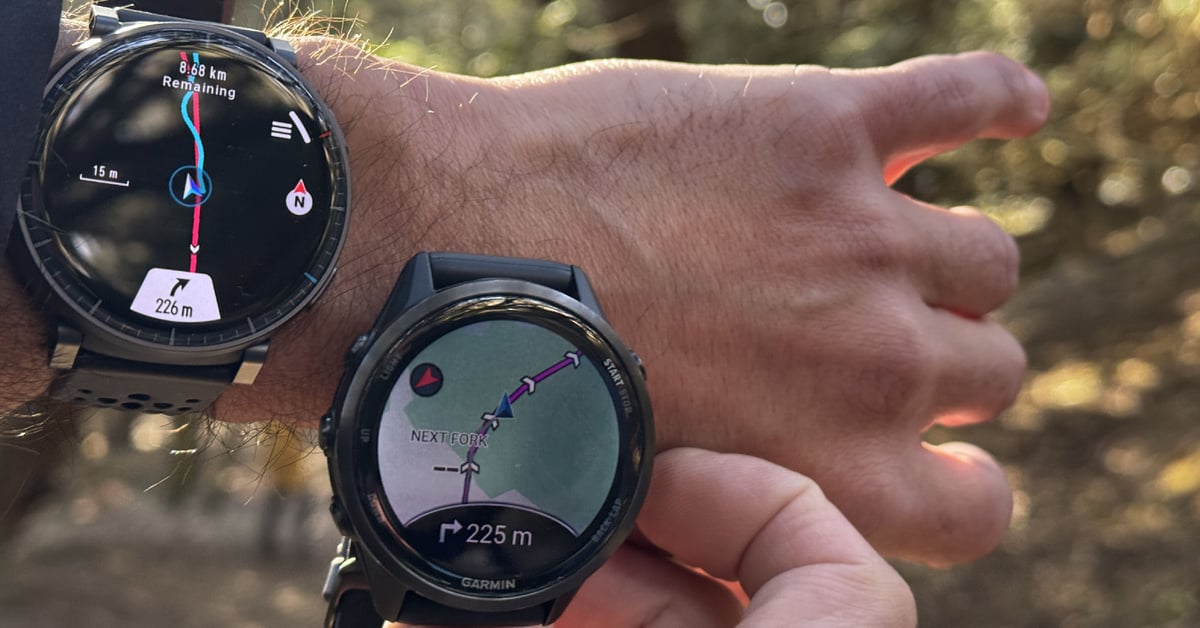
Tip: When map downloads worked, I had the Amazfit charging at the same time.
Advanced routes can be created in Garmin Connect, Strava, Komoot, or with specialist, excellent tools like Plotaroute. I mention Garmin Connect as I used it for this test, knowing I was going off piste in an unfamiliar area (Headley Common), and I wanted the certainty of following routes others frequently use – heatmaps.
With Garmin, my route was almost magically sent to my watch. Exporting a route from Garmin Connect (or another platform) to the Zepp app required an annoying extra step: creating and sending a GPX file. It just added 3 minutes to the process, fine if you’re doing it once a year, unacceptable if you do this sort of thing every week.
Before sending the route from the Zepp app to the watch, I could have reversed its direction.
Adding the route to the hiking profile was logical and easy enough. From memory, the watch prompted me to automatically add turning points because Garmin didn’t create them. Following the route was largely uneventful.
Towards the end of the hike, we were running out of time and had to head back to the start more directly. I expected to have to rely on the Garmin to find a route back; however, it didn’t find any suitable trails (there were many). The Amazfit is unable to recalculate a route. So I had to head back to the start on a bearing, which both Amazfit and Garmin did equally well.
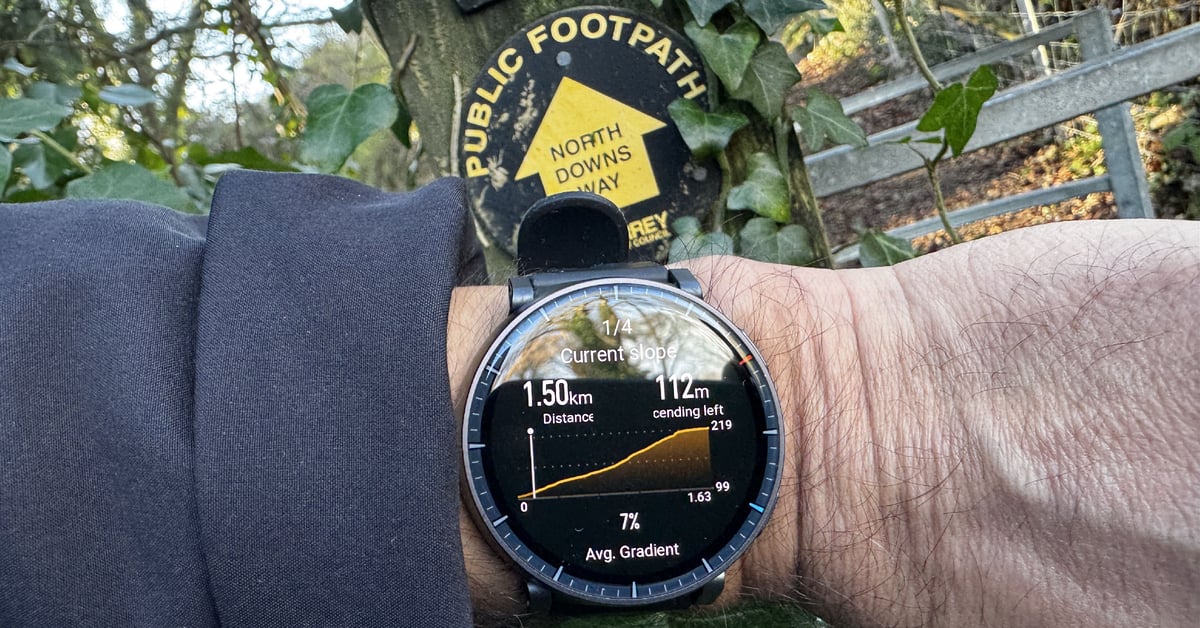
ClimbPro – While Zepp doesn’t have a formal feature that gives details of the upcoming climb(s) on a planned route, it does provide some single-climb information.
Design and Build Quality
Aluminium Alloy Construction & General Durability
The exterior looks and feels rugged. The case/bezel is aluminium, but the lens is a strengthened glass (not sapphire), and the backplate is polymer. This is better than a typical competitor and good for the price point, but the simple truth is that more expensive watches can be much more durable with titanium cases and sapphire lenses. So Active Max is not going to be suitable for extended outdoor adventures, but wth a bit of care it should fare well in day-to-day fitness use.
Other points: Tested as OK for swimming. The brand claims 5ATM (50m depth, ISO 22810:2010), but makes no claims for the case or lens durability. No signs of wear were found after a few weeks of testing.
Size, Weight, Comfort
At 48.5 x 48.5 x 12.2 mm, the case size is very slightly larger than a typical medium-sized competitor model – my Garmin Fr970 is 47 x 47 x 12.9 mm.
However, by some miracle of wrist engineering, Amazfit have crammed on board a 1.5″ AMOLED display (480px x 480px), where typically a competitor might have 1.4″ (454px x 454px)
I’ll mention one other unusual design aspect that I can’t recall seeing on any other smart watch – the strap lugs pivot, giving a more snug wrist fit.
Summing up and factoring in the light 39.5g weight (excl. strap), it feels good and looks and feels pretty much as any medium-sized smartwatch would. The large screen is the unexpected bonus.
Sports, Fitness, & Wellness Sensor Testing Methodology
I undertook about 30 hours of sports testing, covering race simulations (Hyrox, indoor triathlon), running, cycling (indoor and outdoor), hiking, walking, and gym work. I tended to avoid pairing with external sensors (e.g., HR straps) to ensure I was correctly recording Amazfit’s own sensor data, though I did specifically test Stryd for running. The outdoor conditions were all cold and wintry, sometimes below freezing and sometimes with light rain. Locations were in and around SW London and the Surrey Hills.
Generally, the tests are part of my regular running/triathlon training for an HM and duathlon in Q1.2026. Still, I will sometimes choose a specific route for the GPS/HR tests or to let my dog run off-lead safely without interfering with the test. Test durations are at least one hour, and the longest this time was a 3-hour ride; the longest run was 13 miles.
Comparator devices typically include my Garmin Forerunner 970, Apple Watch Ultra 3, Garmin HRM PRO Plus, Garmin HRM 600, Polar SENSE, Whoop MG, Coros Pace and Huawei GT 6 Pro. I choose comparator watches because I think they will produce more accurate data than direct competitors (both approaches have pros and cons). I have one specific longitudinal test that compares the GPS track against historical tracks from most other GPS sports devices of the last decade.
The most critical data is heart rate, as it underpins a wide range of sports and health metrics in the Zepp ecosystem. GNSS data has several purposes, some important and some not: a pretty track for your Strava feed, workout trigger points (segment start/end, hill start/end, junctions), instant pace, and cumulative distance during a workout/race. Other sensors, such as the altimeter, temperature, SpO2, and HRV, are often among the inputs to metrics such as sleep stages, stairs, and stress.
Battery Life Reality Check
Claim: The Amazfit Active Max offers 64 hours of continuous GPS tracking, the longest among AMOLED sports watches under $600 (e.g., beating Coros Pace 4’s 41 hours standard).
These claims are plausible, enabled by its large 658 mAh battery, lightweight Zepp OS, single-frequency GNSS (Airoha’s newer AG3352B, based on the 2022 original, has a lower power draw than dual-band alternative), and fewer resource-intensive features than rivals.
In personal use, I charged weekly while logging ~15 hours of GPS per week (at max brightness), topping up early to avoid low-battery concerns.
Other devices, such as Garmin, record battery levels throughout a workout, but Amazfit does not. Thus, I have to estimate battery usage. During a typical hour of a GPS workout, the battery consumption was at least 2% and no more than 3%; I would estimate 2.5%. This would give a battery life of 40 hours with display brightness set to minimum and AOD disabled, showing on wrist turn. I can’t see how the claimed 64 hours can be achieved unless the screen is entirely off, the battery performance changes throughout the discharge cycle (likely), or the battery charge state is not calibrated or miscalibrated (possible).
Charging and Charging Speed
Amazfit claims an unremarkable 2 hours of battery life on a full charge. I didn’t specifically test a complete charge cycle, but on one occasion, I easily reached 50% in an hour (batteries are typically harder to charge in the last 20%).
My personal preference is for fast-charging watches, like those from Coros and Apple. The Active Max’s superb battery life somewhat compensates for the inconvenience of the normal charging speed.
The Smartwatch Experience
The watch performs smoothly almost everywhere, with screens easily switching from one to the next. With only two buttons and a touchscreen, smart interactions rely very much on the latter, which can sometimes be a tad too sensitive. Swiping left and right scrolls nicely through a series of tiles (similar to Wear OS), and the top button brings up the more innovative options, whereas the bottom button brings up the sporty ones. There are a lot of smart options/apps (and more can be added), which gave me a super long list to scroll through, but I could switch to a grid view.
The raise-to-wake feature is perhaps excellent and unnecessary. I hardly noticed the time it took to wake he screen and, in any case, the battery life is so long that AOD mode can be used with abandon.
The notification came through almost instantly, and features like the music controls for smartphone playback also worked smoothly.
Zepp smartphone App
The app appears to be midway through a redesign. The overview, biocharge, sleep and exertion main pages are clearly based on the Whoop app’s awesome look and feel. The screen isn’t too crowded and only key metrics are initially displayed, and dismissable onscreen insights work well without being too intrusive.
Delving into the details of individual workouts in history is easy enough, and each workout gets a long, scrollable list of charts and metrics, starting with a route overview. It’s probably as good as it needs to be, with more than adequate options to send completed workout data elsewhere, e.g., via manual export, Strava sync, or sharing a report via WhatsApp (+ others).
Moving away from the main pages are individual pages for each of your Amazfit devices (you might also have the Helio Strap). These seem designed with a slightly older look and feel; nevertheless, it’s still easy and intuitive to find one of the many device options or apps you might be looking for.
The app has fewer workout insights than the likes of Garmin Connect, and it syncs just as well with the watch as Garmin Connect. I had no issue with multiple Amazfit devices paired.
GPS and Sensor Accuracy
Heart Rate Accuracy
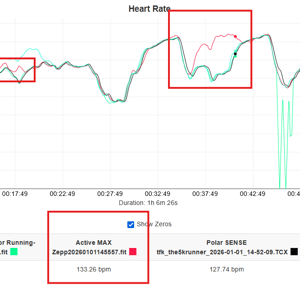
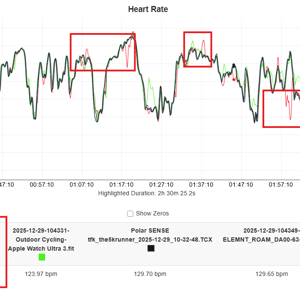
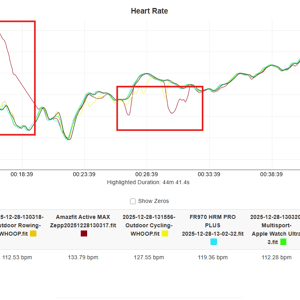
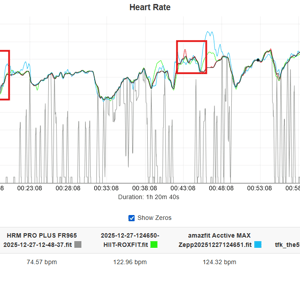
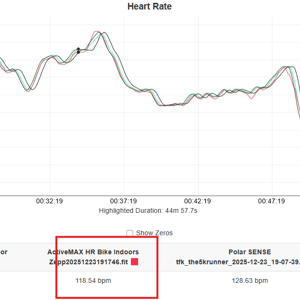
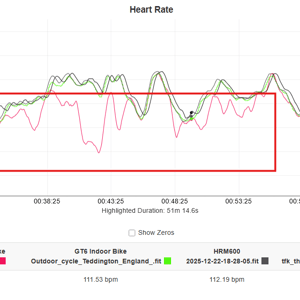
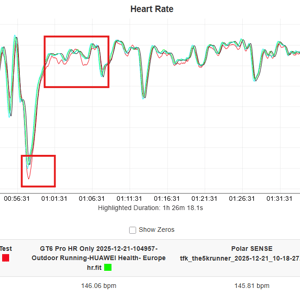
These seven HR charts from a variety of workouts, typically well over an hour, clearly show that the Active Max can deliver accurate heart rate readings at times (+/- 1% error) but is inconsistent at others. Common themes include underreporting and mishandling of more difficult efforts, leading to overall workout errors of up to 10%. Results will vary by person and use case; I tend to get worse HR results on the wrist than most people do, and worse results in winter conditions like those on the tests.
Multi-Band GPS Performance
The Amazfit Active MAX performed well on my standard 10-mile test route (methodology here). With conservative scoring, it earned a creditable 81%, ranking it in the second tier of accuracy among GPS watches over the last decade. Only the more expensive current-generation dual-frequency chipsets score better (Suunto Vertical and Coros Pace 3 have the best-ever scores of 92%).
Amazfit uses a refreshed generation of Airoha AG3352B (updates the 2022 chip that Garmin used), critically though, the performance you see is linked to the power available to the chip, the antenna, interference management and function with accelerometer inputs. Amazfit seems to have several aspects of the overall integration done well, as evidenced by the tunnel performance that indicates the sensor fusion element is working well. Also working well is a section where there are almost always multipath errors with other watches – Amazfit performs better here than many of the expensive chipsets that are specifically marketed to reduce multipath errors (they don’t always). However, overall, it got the score it did because it performed very well on the sections with easy reception conditions and less well at times on the more difficult sections. It’s a decent result.
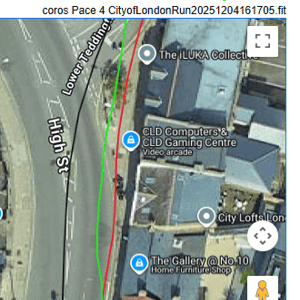
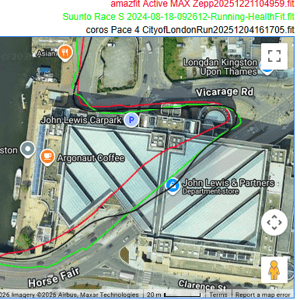
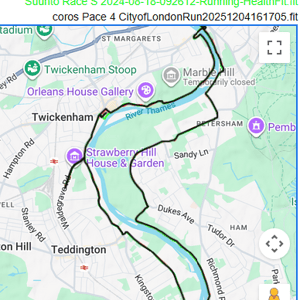
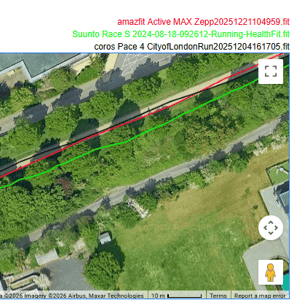
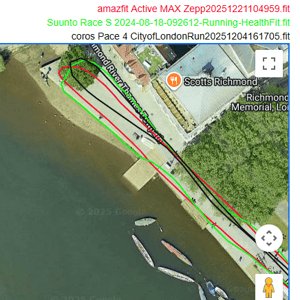
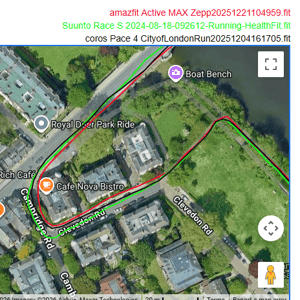
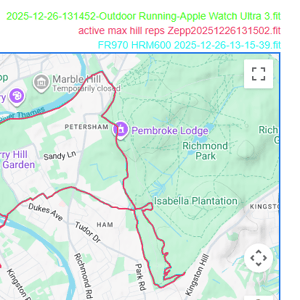
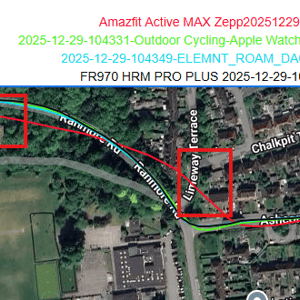
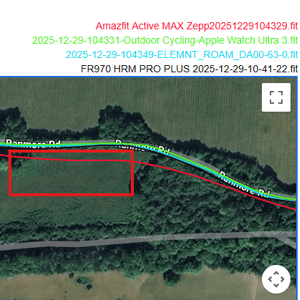
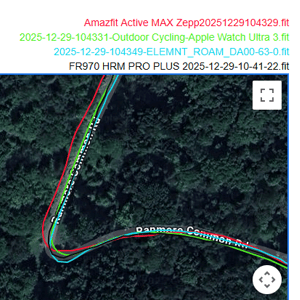
Running hill reps in Richmond Park with the Forerunner 970 and Apple Watch Ultra 3 (two of the most accurate dual-frequency devices), you can see that Amazfit rounds the route slightly and deviates slightly from the proper path. These are the sorts of errors most people would not notice with only one watch, but become obvious when compared to two others that agree. That said, it’s a decent performance again from the Active Max in tricky conditions.
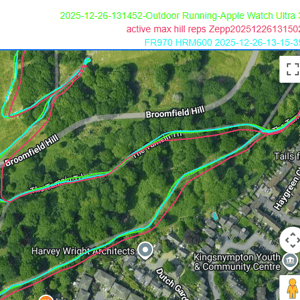
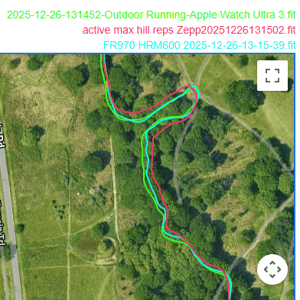
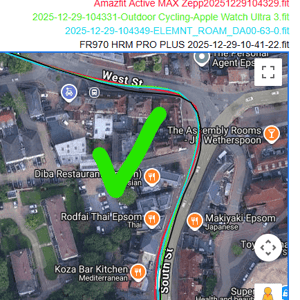
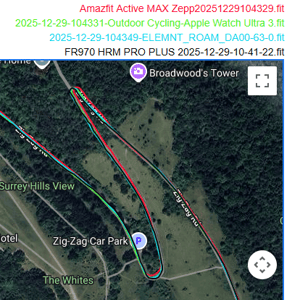
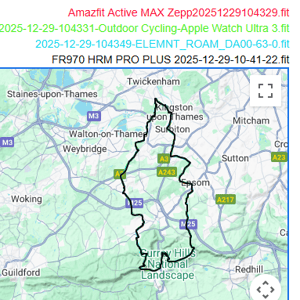
Here are some more results from a road bike trip to the Surrey Hills, including a comparison with a handlebar-mounted bike computer. Generally, Amazfit’s performance is outstanding but not excellent, and I’ve included examples of where it struggles near trees. For this particular road ride, I expected a superb GPS track from every device, but Amazfit didn’t quite deliver on this day. In terms of what that means to you, the recorded distance was near perfect, and the start and end points of any strava segments will be reasonably accurately recorded (you won’t notice timing errors of a split second that might result).
Elevation Performance
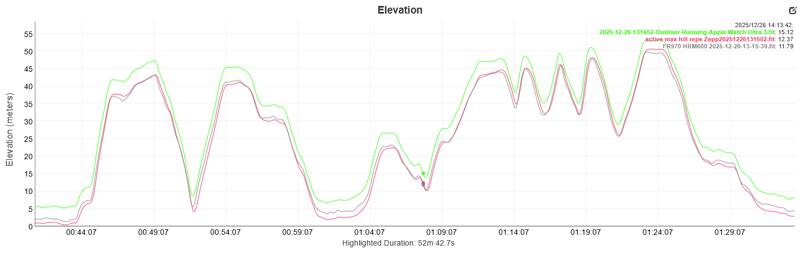
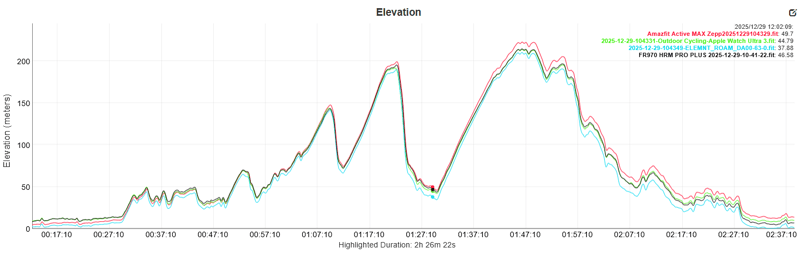
Elevation performance is significant for hiking, road cycling, and climbing. The Amazfit has a barometric altimeter to support those sports, which uses fine changes in air pressure to determine elevation changes and is periodically recalibrated using a 3D GPS position.
Here are two example charts from two workouts over 90 minutes; the first shows agreement with FR970, where Apple Watch Ultra 3 overestimates, and the second shows slight over-reporting by Amazfit. This level of accuracy is likely acceptable for 99% of us.
Accuracy of minor metrics: Distance, speed, pace, cadence.
When riding, speeds up to 60 km/h are broadly in line with other test devices. Over a hilly 2-hour ride, I noted the following average speeds, and Amazfit consistently overestimated them, albeit very slightly.
| Amazfit Active MAX
|
Apple Watch Ultra 3
|
Garmin Forerunner 970
|
Wahoo ELEMNT ROAM 3 | |
|---|---|---|---|---|
| Avg Speed | 25.62 kph | 25.47 kph | 25.07 kph | 25.41 kph |
When running, Amazfit overestimated cadence on mixed trail terrain.
| Apple Watch Ultra 3 | Amazfit Active Max | Forerunner 970 | |
|---|---|---|---|
| Avg Cadence | 81.88 rpm | 87.38 rpm | 83.19 rpm |
Although Amazfit obviously records distance, it did not write that information correctly into FIT files as a separate data set for either running or cycling.
Stryd Running Power vs Native Metrics
This chart shows Stryd running power data recorded by the Amazfit MAX, compared with Garmin and Apple Watch running power. This simply illustrates that very different running power results will be shown by each vendor. Nothing here can infer accuracy, as there is no gold standard.
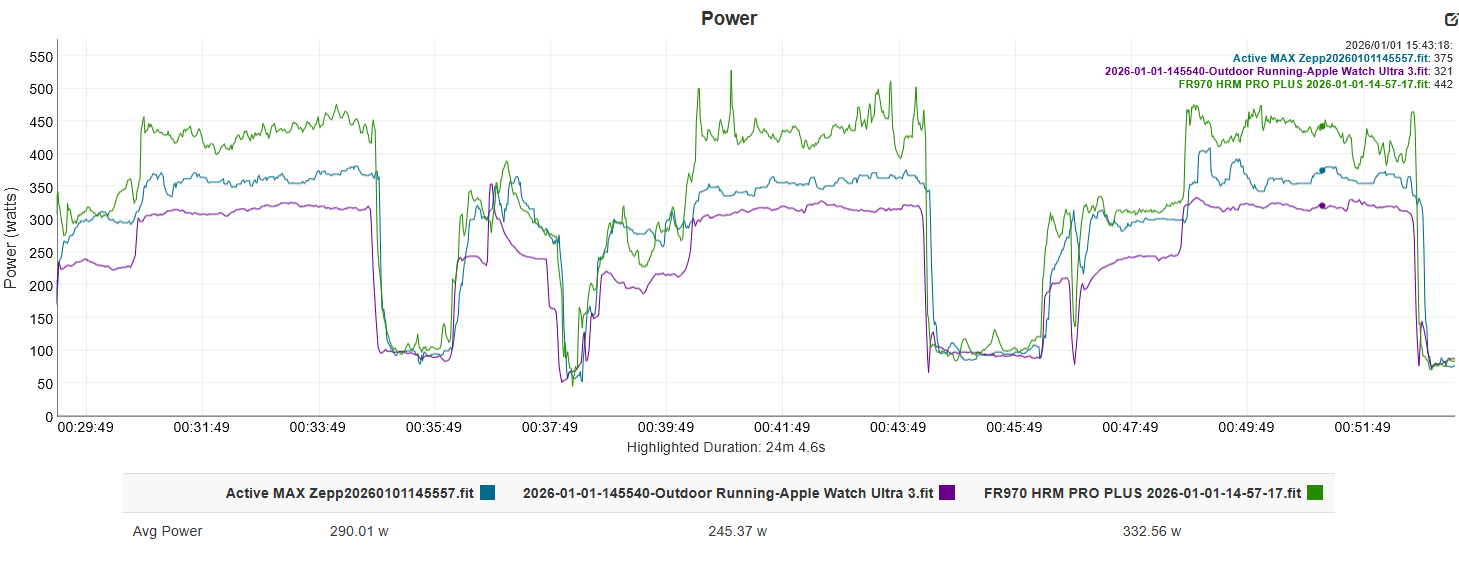
Compare Stryd-derived power metrics to Coros’s native wrist power and Garmin’s Running Power, test consistency across different paces and terrain, and assess whether Stryd integration works as seamlessly as advertised.
Features for Athletes
Workout Modes and Customisation
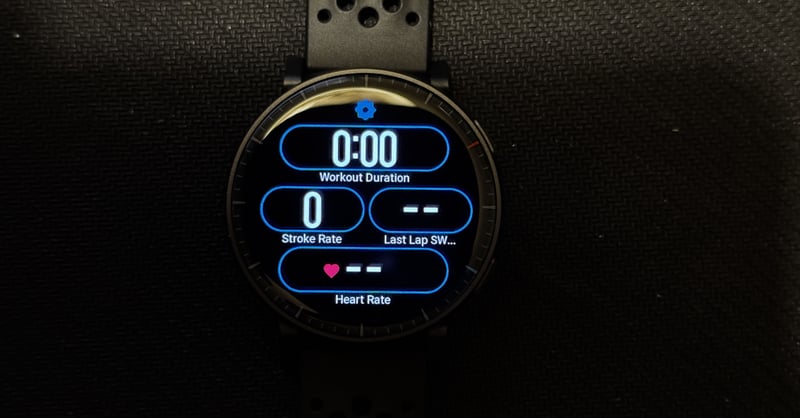
Amazfit has 170 sports profiles and somewhere close to 150 metrics, 10 customisable pages per profile, and 6 metrics per page. There are at least 8 types of charts that can be shown as separate pages, e.g., pace, elevation, and heart rate graphs.
With the notable exception of Garmin, many brands use generic metrics (time, HR, calories) and sports profiles solely for classification – Amazfit is no exception. That said, running, swimming, cycling, strength training, HYROX, and freediving all have profile-specific metrics/algorithms, such as SWOLF/strokes in swimming, rep counting in strength training, and running VO2max.
Training Plans
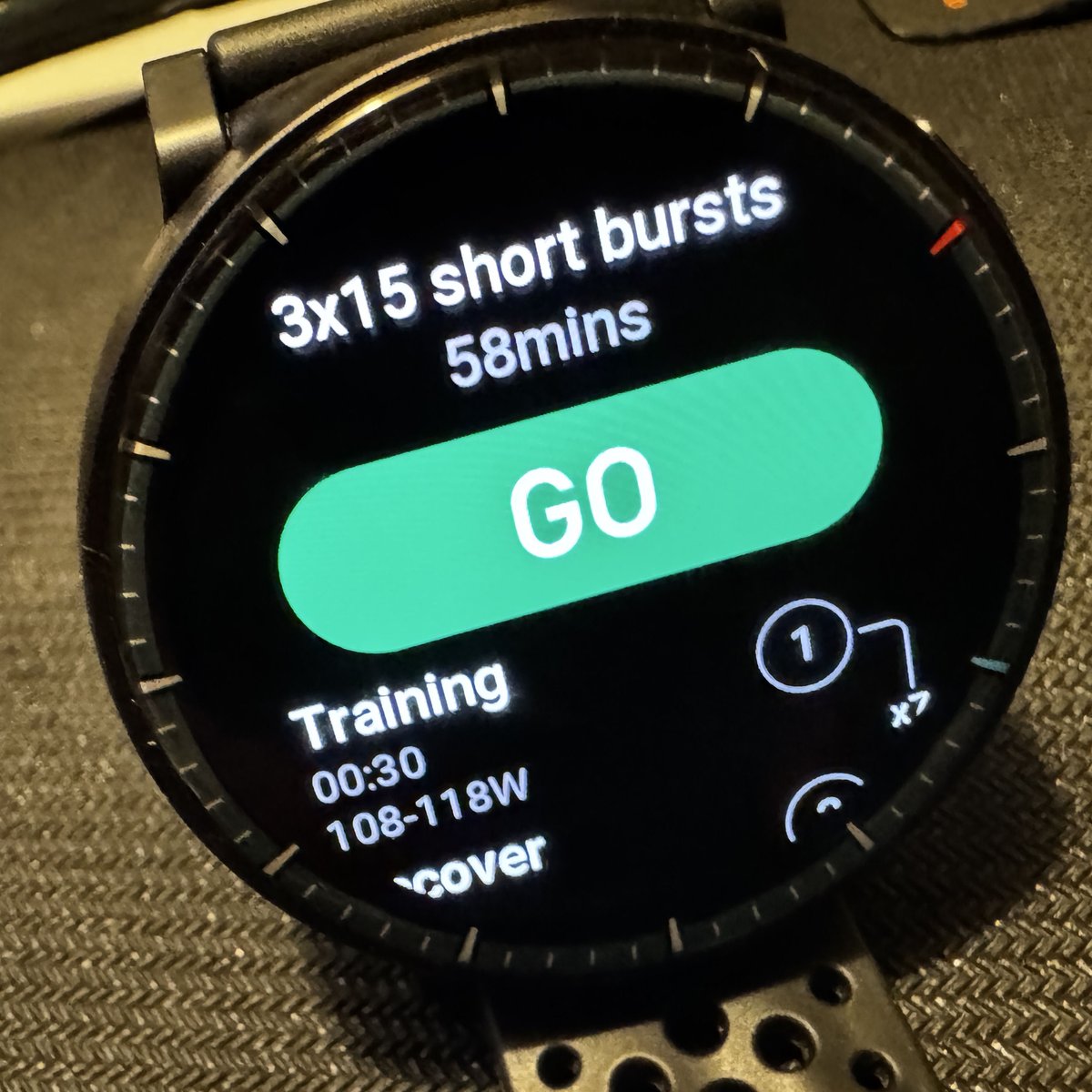
I was pleasantly surprised to see planned workouts sync from Training Peaks to the Watch. A planned ride workout for today would be directly selected and started with two screen taps.
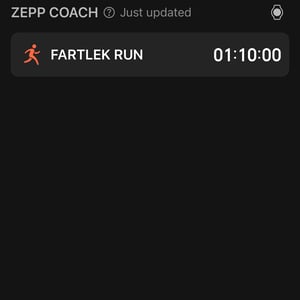
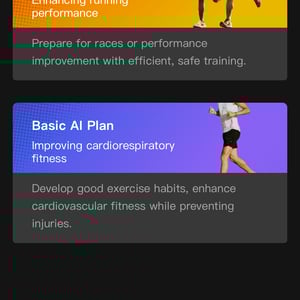
There are many other kinds of structured training options – surprising at this price point. They include simple intervals, training templates (created on the app), and workouts.
Physiology Metrics and Recovery
Amazfit gets its physiology algorithms from PeakBeats (sounds a bit like Garmin’s Firstbeat… but isn’t). These core metrics are covered.
- VO₂max
- Training Effect (aerobic & anaerobic)
- Training Load (7-day & 42-day)
- Recovery Time
- PAI (Personal Activity Intelligence – like TRIMP)
- Readiness Score
- Exertion Score
- BioCharge Energy (select models)
- HRV (Heart Rate Variability)
- Resting Heart Rate
- Heart Rate Recovery
- Stress Level
- Sleep Scores (stages, breathing quality)
Many metrics mostly seemed broadly in line with what I would expect, like HRrest and HRV. However, BioCharge seems overly generous when I wake up, and the periodic’ performance condition’ during workouts gives erratic feedback, alternating between ‘very good’ and ‘fatigued’ multiple times over a two-hour workout.
Other metrics didn’t correctly calculate fatigue or training status. However, I investigated only to discover that my heart rate zones were set by default to my age (i.e., too low for me), so my effort levels and, hence, fatigue were overstated. That said, after a hard session yesterday and a poor night’s sleep, the app said I was all set to go for a peak session today. So I’ll need to delve further to explain that one!
Many of the metrics are shown in the app using a similar style to Whoop, i.e., with dismissable insights. This is a good way to present insights without the overt intrusiveness of pop-ups.
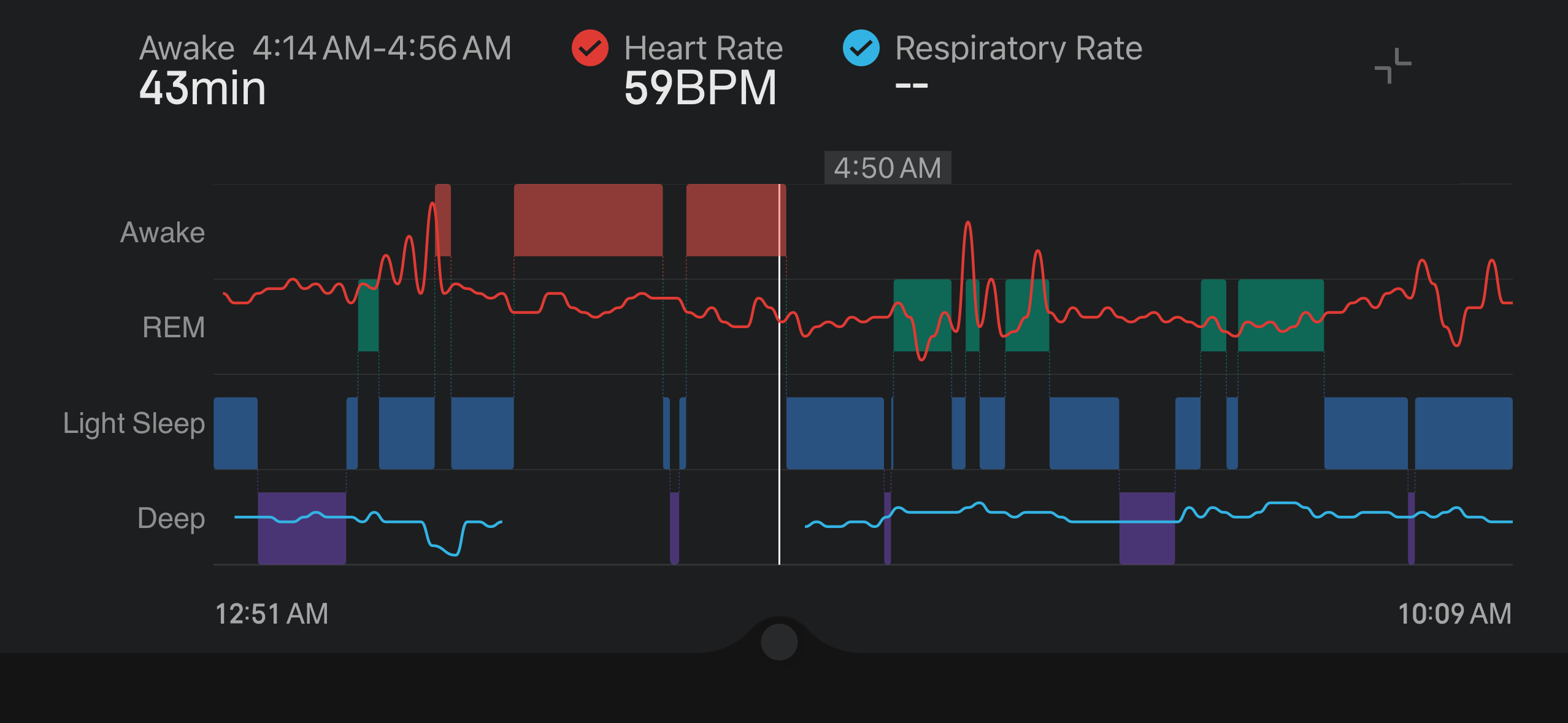
The sleep metrics seem mixed. I like Amazfit’s presentation of my sleep last night (below); it’s a bit different from the homogeneity elsewhere and easy to read. However, it definitely misses out on some of my other awake moments that night. Casting a casual glance over prior nights’ sleep stages and comparing to Eight Sleep, Amazfit seems to struggle to correctly identify REM and Light Sleep stages. Deep sleep looks pretty good, though.
Third-Party App Ecosystem Gaps
The core outgoing workout syncs to Strava, and Apple Fitness/Health works as expected once you get the permissions set correctly; other key ones are in place, such as Training Peaks, Komoot, and Intervals.icu. The main omission is the lack of seamless syncing of inbound routes from Strava.
| Brand | Strava Routes to Watch | TrainingPeaks Workouts/Plans to Watch |
|---|---|---|
| Garmin | Yes (automatic) | Yes (automatic) |
| Polar | Yes (automatic) | Yes (automatic) |
| Suunto | Yes (semi-automatic) | Yes (automatic) |
| Coros | Yes (semi-automatic) | Yes (automatic) |
| Amazfit | No (manual workaround) | Yes (automatic) |
Perhaps the key strategic differentiator is the ability to run 3rd-party apps. Garmin has long been the winner here, offering 3rd-party watch faces, data metrics, widgets, and apps. Coros has nothing to offer, whereas Suunto’s app store keeps growing. Perhaps surprisingly, the budget option, Amazfit, does have a 3rd party ecosystem – APK Pure notes that Amazfit has over 300 downloadable mini apps (downloaded over 15 million times) and more than 5,700 watch faces (downloaded over 72 million times)
| Feature | COROS | Garmin Connect IQ | Zepp OS (Amazfit) |
|---|---|---|---|
| Apps run on watch? | No | Yes | Yes |
| App store? | No | Yes (extensive) | Yes (growing) |
| Developer SDK? | No | Yes (mature) | Yes (newer) |
| Primary function | Data sync only | Full app platform | Mini apps + integrations |
| Ecosystem maturity | Integrations only | Most mature | Rapidly expanding |
Bugs and incomplete features
I received and noted several reader comments about the bugginess of Amazfit’s watches, so I feel compelled to address that in the context of other brands.
Catastrophic bugs – I never received any of these. Every workout was recorded in full, and on no occasion was I prevented from interacting with an active workout. I contrast that with my high-end Garmin FR970, which (6 months on) still occasionally reboots and gets stuck on a warning about unsecured sensor connection pairings (needing a reboot).
Regular bugs – this is where Amazfit’s bugs are. e.g., I couldn’t get Zepp PAY to work on iOS or Android (I’m in the UK with a Curve card), and I had difficulty downloading MAP tiles over Bluetooth to the watch. You only have to check the Garmin forums to find that Garmin watches have numerous bugs, typically in much narrower areas of functionality; e.g., a particular widget might display something incorrectly, rather than an entire area of functionality like Garmin PAY failing to work.
Feature omissions, e.g. Coros lacks NFC payments and ClimbPRO. Amazfit has those, but lacks route sync with Strava. Garmin leads the way with feature innovation and richness.
Feature Shortcomings – Garmin does not have these, but it often fails to implement features in an easy-to-use manner. Coros has these, and Amazfit has these. This is where a headline feature is added and publicised (e.g., Stryd compatibility), but the feature lacks key elements (e.g., Stryd auto-calibration). Coros has questionable physiology metrics.
Compare that to Apple. Apple Watches just don’t have bugs of note. They work reliably. You get pared-back features, but sometimes they are implemented in innovative ways.
If Amazfit tidied up their existing app and watch features, buying one at their budget prices would become a no-brainer. At present, you might worry that a bug or two will spoil your experience. Generally, you can work around Amazfit’s bugs; it’s just annoying.
Amazfit Active Max – FAQ
Q: Is the Active Max worth $70 more than the Active 2?
A: It’s slightly better hardware and very similar software. So it’s only worth it if you want the larger screen. Wait a few months, and I’d bet it gets discounted.
Q: Can the Active Max replace a Garmin or Coros for structured training?
A: Yes, for some people it will be fine. However, if you want to control a smart trainer or use a platform like Final Surg,e you won’t be able to.
Q: How accurate are the heart rate and GPS compared to Garmin/Coros?
A: The GPS is not quite as accurate as Coros/Garmin high-end models, but it is accurate enough for most uses. HR was not precise enough for me, but results vary by person and use case so that you might be fine (but I suspectyou won’t be)
Q: Does offline mapping and navigation actually work well in real use?
A: Yes, once you download the map! The map pan and scroll are very smooth and superior to Garmin
Q: What bugs and issues should I expect day-to-day?
A: Amazfit has a large ecosystem, and I have only tested a part of it. Based on my experience, you will encounter some features where you might prefer an extra option or two, but the most striking error for me was the inability to get Zepp Pay working. Going back to my first few years with sports watches, Active Max would have been way more feature-full than I ever needed or wanted.
Who Should Buy the Active Max?
Price and value are the key attractions for most potential buyers of the Active Max.
The core buyer of the Active MAX will be someone who wants a competent set of sports and smart features at a budget price. Beyond that, it’s the HYROX market that might find something here that’s harder to find elsewhere.
Although Amazfit is targeting triathletes, runners who want to train by power and other niches, there are better alternatives from different brands, but only at notably higher prices. It all depends on your willingness to pay those higher prices for a slightly richer feature set that you might not need.
Amazfit Active Max TL;DR – Skip to the End Review Summary
Amazfit Active Max has the largest 1.5″ AMOLED display in a medium-sized case, market-leading GPS battery life of 64 hours (claimed, lower in testing), onboard maps with TBT directions and street names, structured workout support and guidance (eg Training Peaks and onboard AI plans), 170 sports modes (including HYROX/tri), external Bluetooth sensor support (including power meters and Stryd), NFC, and Bluetooth calls, easily making it the best value sports watch under $250 – except it’s listed at $169.
It directly competes with the smaller Coros Pace 3 ($229) and easily undercuts the Garmin Forerunner 165 ($250) and similarly sized Coros Pace Pro ($299), while adding features Coros lacks (payments, connected call support). HR accuracy and GPS accuracy are not market-leading, but Stryd and a heart rate strap will give excellent accuracy to any watch at any price point (that’s what I do). In real-world conditions, the GPS battery lasts more like 50 hours (still excellent), and as a smartwatch, it will easily give multi-week use between charges – I easily got over a week.
Some brands focus on niche sports – where Garmin is the triathlon king, Coros might be the king of the mountains, but Amazfit is the Hyrox King.
Apple Watch would be the Queen of smart features, beautiful watch faces, and extensive 3rd party sports features. But Amazfit edges out Coros in those areas.
If you want an excellent-looking sports watch you can wear all day, I would seriously consider Amazfit over the likes of Garmin/Coros.
One Amazfit weak point is a slight roughness around its otherwise excellent edges, with bugs and usability quirks. Garmin is guilty here as well, so if a wholly bug-free experience is what you are looking for, then go for an Apple Watch.
Take Out: It really is a Coros-killer for most people. It’s not a Garmin killer whose ecosystem is on a different level.
- Buy if: you want a general sports and fitness watch for genuine 24/7 wear, or if you want HYROX/CrossFit/triathlon support on a budget.
- Skip if: you need to follow new routes every week, or need ANT+ sensor support.
- Research more or ask below if you have unusual sports or smart needs

Last Updated on 18 March 2026 by the5krunner
Reader-Powered Content

This content is not sponsored. It’s mostly me behind the labour of love, which is this site, and I appreciate everyone who supports it.
Support the site: Follow (free, fewer ads) · Subscribe (paid, ad-free) · Buy Me A Coffee ❤️
All articles are written by real people, fact-checked, and verified for originality. See the Editorial Policy. FTC: Affiliate Disclosure — some links pay commission. As an Amazon Associate, I earn from qualifying purchases.
tfk is the founder and author of the5krunner, an independent endurance sports technology publication. With 20 years of hands-on testing of GPS watches and wearables, and competing in triathlons at an international age-group level, tfk provides in-depth expert analysis of fitness technology for serious athletes and endurance sport competitors.

I came from Reddit, and this is a very comprehensive analysis. It took me two hours to read it, thank you for sharing. I think it would be very helpful not only for Amazfit but also for people considering buying Garmin or Coros. By the way, what software do you use to analyze your heart rate? Could you share the name with me? I also really enjoy comparing and analyzing exercise data.
ty
i use dcrainmaker’s analyzer. sy i should have perhaps put that in the text (yet more words!) an alternative is intervals.icu
Which one has better screen visibility? This one or balance 2?
Which one is better for a (road) runner?
Balance 2 is 70€ more expensive on amazon.de
Is the price difference worth?
very similar.
the code is similar on all their watches.
you want to opt for the most appropirate case format you like.
the two buttons on the active MAX might put you off…or not.
the rotating crown works well but the looks might put you off
t-rex has the buttons that work well but the octagonal shape might put you off
for basic road running needs any watch will do. you’d have to state a specific feature you need.
I am only hesitating between Active 2 Max and Balance 2. I am not interested in the other Amazfit models. I know the software is almost identical.
– A well visible screen it the sun is very important to me. I read somewhere that Balance 2 has some kind of coating over the sapphire glass that leaves fingerprints and reduces visibility. Is this true?
– The GPS signal quality is also important to me. Is GPS with one sensor in Active 2 Max comparable with 2 sensors in Balance 2?
These two things are the most important to me. Price difference is 70 EUR at the moment.
hi
both are super bright and visibility will be fine for both.
in my tests balance 2 (dual frequency) was a bit better than Active MAX on the gnss accuracy front. there is little real world differencem if you want accurate pace and distance then buy a second hand stryd running pod. cycling tracks on the road will be highly similar.
i seem to recall that active max 2 has a new antenna whihc they might be able to tweak performance improvements from over time.
active max 2 uses an improved version of an older gnss sensor, i woudl have expected very slightly better performance from it. again, same as previous point they might be able to tweak this
or not.
Just a side note, the side buttons are programable, just as they are in the BIP6 (my current watch). In the past 5months I have experienced (what I call a major hiccup), with the sleep reading/data. I finally got connected with the (what I like to call 3rd level techs), where there was daily request for logs, screen shots, app log uploads, in order to get to the root of what might be the problem. No, it wasn’t the age of my watch which is just now at its 1 year mark, as newer owners (roughly 2 months) are experiencing the same issues.
The last communication with my contact advised that updates are coming… and sure enough, within a week the App Update came, with the watch update following a week later. Did it fix things? Well, um, I do get more daily metrics, but as for the accuracy? Um, just as you pointed out, I think there still missing something. Its coming back with my sleep period being off, although, its not very explanatory as to what that is relative to… Meaning is just picking out one segment of the sleep metrics. I know during the correspondence they commented that they are lowering the required sleep zone so it will pickup the patterns better. I trust that’s why I’m finally getting daily metrics, Alot more than the past 4-5 months. Prior to that time everything was working well. I suggested to the tech team to go back to that point and find out just what exactly changed in the watches programming that made such a disablement of the sleep info. I mean it went from working to not working. In short, go back over your steps.
On another note, I have a feeling there were some changes in the company where there might be a different development group? Why, because normal email communication was find during the initial use of the watch, trying that old email now kicks back a notice saying there have been some business changes and to use the website to submit questions, etc. Also, during my 1-on-1 with 3rd level, I was asked to upload some logs, no problem, but I advise I had submitted easily over 10 in the past 4months… then asking did they receive them? where did they go? did they fall on deaf ears or simply hit the trash can.
Although I Love my Bip6, its display being larger, albeit a different layout, and the fact it fits nicely under my work gloves.
So I bit the bullet and ordered the Active Max. (soon to arrive Friday, US Version). First reason I like the style of the watch, and its not that BOHEAMETH MILITARY LOOK like everyone else seems to like. Its the same reason I got the Bip6, which was a stepup from the Band 5 and Band 7 which was a huge improvement. I have a selection of smart watches that range from my first being a Fossil. (I’m into more tech/health than tri-athletics.), I’ve got my few cheap ones and a few Samsung’s, which on that note, I do miss a Very Cool feature I wish Amazfit would hookup with… That being I have an app called Look-Back, which when you load the app on the Samsung Watch, it become a remote monitor for where-ever you are aiming the phones camera at. (ie. you doing engine work and can’t exactly see between the engine and the firewall cavity, so you fire up the app and WALLA, a remote set of eyeballs.) Equally helpful and fun is since the Samsung watch connects with WiFi, you can leave the phone propped up in a room, then being in another room and it becomes a surveillance camera. But Alas, I digress.
Another reason for the order of the Active Max is to do a comparison. No, not on different arms, but I’ll switch bi-weekly and submit that data in hopes of improving their sleep algorithm.
thank you for the detailed comment, hopefully it helps others
some helpful info for you
1. there should be a notable update this week.
2. I know that Huawei is taking its sports watch presence much more seriosuly. Perhaps there is a new internal team.