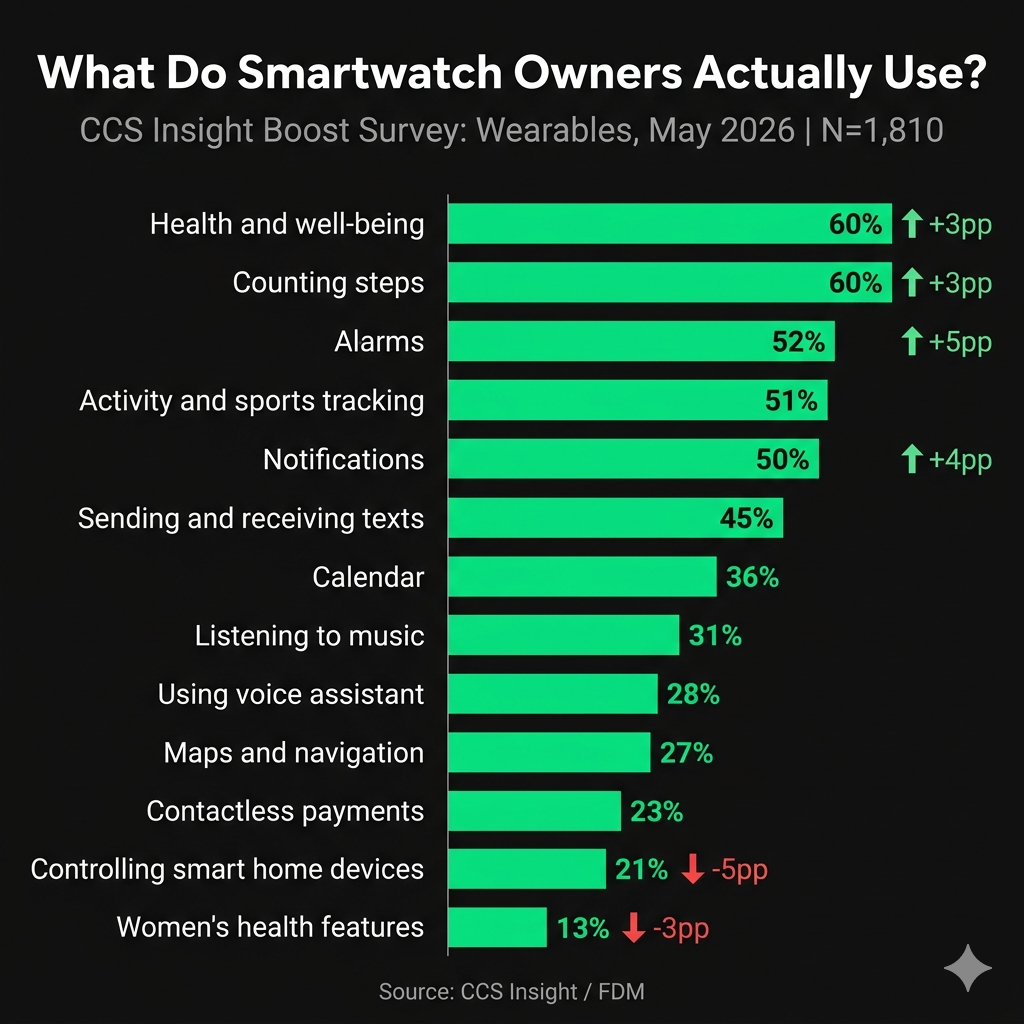
A new consumer survey puts a number on something the sports watch industry has probably suspected for a while. Nearly 56% of smartwatch owners say they are open to switching brands. Among Apple Watch owners, that figure drops to 38%. Garmin and Coros owners sit well above that – more willing to switch than any other major sports watch brand.
The data comes from CCS Insight’s Boost Survey: Wearables, published May 2026, covering 1,810 smartwatch owners and users across Germany, Spain, the UK, the US and India.
The loyalty gap has a straightforward explanation. Apple Watch owners are buying into a phone ecosystem, a health platform, an app library, and a payments system. Switching watch brands means friction across all of those. The cost of leaving is high.
Garmin and Coros owners face no equivalent switching cost. Their watches talk to third-party platforms. Strava, TrainingPeaks, and Komoot do not care which watch you wear. A Garmin user eyeing a Coros Pace 4, an Apple Watch Ultra, or a Polar Vantage 3 faces an ever-smaller ecosystem penalty for moving. The watch is the product. Nothing else locks them into the downstream analytic and social tools.
That is a structural problem for the sports watch brands. They compete on hardware and software features in a market where customers have every reason to shop around. Every product cycle is a retention event. Miss on battery life, GPS accuracy, training load metrics, or price, and the door is open.
Apple only needs to be good enough in sports. The Ultra has closed most of the functional gap with dedicated sports watches for most endurance athletes who are not at the sharp end of performance. For that user, the switching cost calculation runs firmly in Apple’s favour.
This site has argued at length that the structural cracks in Garmin’s empire are already visible. The CCS Insight loyalty data adds consumer evidence to that argument. It is one thing to identify strategic vulnerabilities at the business level. It is another to see them reflected in the willingness of actual customers to walk or, at least, to talk about walking.
The survey findings also have implications for how sports brands should think about new features. Ecosystem depth — connecting the watch more tightly to proprietary coaching platforms, health services, or third-party integrations — is one of the few levers available. Garmin Connect, Garmin Coach, and the Connect IQ platform are moves in that direction. So is Coros’s decision to open its data to AI platforms via MCP — a bet that deeper data access creates stickiness. Neither brand has yet to create the kind of lock-in that keeps a customer as well as Apple.
The 56% overall switching intention figure is also a market opportunity. More than half of smartwatch owners are, in principle, available. The brands that articulate a clear reason to switch, and remove the friction of doing so, stand to gain.
For Garmin and Coros, the loyalty data is a warning. For Apple, it is confirmation that the ecosystem strategy is working exactly as intended.
What the Data Shows
- 56% of smartwatch owners overall are open to switching brands
- Apple Watch owners: only 38% open to switching — the most loyal segment
- Fitbit users: over 70% open to switching — the least loyal segment
- Survey base: 1,810 smartwatch owners and users across Germany, Spain, the UK, the US and India
- Source: CCS Insight Boost Survey: Wearables, May 2026
Why Ecosystem Lock-In Is Key To Long-Term Survival
The gap between 38% and 56% is significant. It reflects a fundamental structural advantage that Apple has built over a decade of ecosystem investment. When a customer buys an Apple Watch, they are also deepening their dependency on iPhone, iCloud, Apple Health, Apple Pay, and AirPods. Each of those integrations raises the cost of switching to a competing platform.
Sports watch brands have not built an equivalent. Garmin’s move into the recovery-wearable space with CIRQA is one attempt to extend the ecosystem beyond the watch. But a recovery band alone does not replicate the depth of Apple’s integration across productivity, communication, and payments.
The comparison with what Garmin continues to do wrong strategically is instructive. The loyalty data is consumer-level evidence that a strategy has not yet solved the retention problem.
Data source: CCS Insight Boost Survey: Wearables, May 2026. Base: 1,810 smartwatch owners and users in Germany, Spain, the UK, the US and India.
Last Updated on 3 October 2026 by tfk the5krunner
Small things I always use
- Garmin 90-degree charging adapter: Charges your Garmin from any USB-C cable. Essential when travelling. I use one.
- Body Glide: The blue anti-chafe stick swimmers and runners carry. I use it.
- Speedo earplugs: Fewer ear infections and no cold-water dizziness. I use them.
- Dryrobe Advance: My winter changing robe for open-water swims. I use one. A cheaper option is the AONYIYI changing robe.
- Maurten: Race fuel that stays easy on the stomach. I use them.
- Garmin charging puck: The quickest way to top up before a session. I use one.
- Injinji: Toe socks that stop rubbing, so you run more. I use them.
- Ultimate toe protectors: Stop black toenails on long runs. They work. I use them.
- Compressport R2 v2 calf sleeves: My calf sleeves of choice. I use them.
- Cellucor C4: My pre-workout before hard sessions.
- TPU tubes: Schwalbe Aerothan, Tubolito and Pirelli SmarTube. Light, tiny spares. I use all three.
- G8 insoles: Adjustable insoles that are good. I use them.
- Cycplus Cube: A 97g electric pump that gets a road tyre rideable in two minutes. I carry one. 5% off with code THE5KRUNNER.
Watches and sensors
- Polar H10: My daily driver for waking HRV.
- Polar Verity Sense: My backup arm-worn HR sensor.
- Nomad bedside charger: Charges my iPhone and Apple Watch overnight. I use it, and many of their bands.
- Train.Red: The best muscle oxygen sensor I’ve used.
- Tymewear: Accurate heart rate and reliable ventilatory zones. I use it to pace endurance rides over an hour.
- Garmin Forerunner 970: A pro-grade triathlon watch. I use this.
- Apple Watch Ultra 4: My daily smartwatch. No phone needed on rides.
- Garmin Fenix 9 Pro: I’ve just bought one.
On the bike
- Continental GP5000 for everyday riding, and Aero 111 on the front for special occasions.
- Helmets: Specialized S-Works Evade 3 for road riding, and Rudy Project Wing for TT-style races. I use both.
- Ravemen FR300: A front light that mounts under your Garmin or Wahoo. I use one.
- Wahoo TRACKR Radar: I use it on one bike and Varia on the other. They perform the same.
- Garmin Varia RTL515: Radar that warns you of cars from behind. I use this model.
- Wahoo ELEMNT Roam 3: The bike computer that’s easy to use. I use mine on most rides.
- Favero Assioma Pro RS2: Accurate power pedals that swap easily between bikes. I use this model.
Home and indoor training
- NPE Runn: Makes my basic treadmill smart, sending more accurate speed and distance to my watch and Zwift. I use it.
- Google Wifi: Keeps Zwift connected in my pain cave. I use it.
- Apple TV 4K: Zwift on the big screen. I use two.
- Google Nest Doorbell (wired, 2nd gen): My video doorbell, running in both Google Home and Apple Home. I use it.
Health, recovery and sleep
- FreeStyle Libre 3 Plus: Shows how my blood sugar responds to diet.
- hDrop: Measures my sweat loss in summer and indoors.
- Fourth Frontier Zone: Checks my heart under load in hard sessions.
- Oura Ring 5: My partner’s recovery tracker of choice.
- Kineon MOVE+: Red light therapy for niggles. It works.
- Eight Sleep: A cooling mattress cover my partner and I use nightly.
Reader-Powered Content
This content is not sponsored. It’s mostly me behind the labour of love, which is this site, and I appreciate everyone who supports it.
Support the site: Follow (free, fewer ads) · Subscribe (paid, ad-free) · Buy Me A Coffee ❤️
Written by real people, with AI assistance. Fact-checked and verified for originality. See the Editorial Policy. FTC: Affiliate Disclosure — some links pay commission. As an Amazon Associate, I earn from qualifying purchases.
tfk is the founder and author of the5krunner, an independent endurance sports technology publication. With 20 years of hands-on testing of GPS watches and wearables, and competing in triathlons at an international age-group level, tfk provides in-depth expert analysis of fitness technology for serious athletes and endurance sport competitors. ID

Ecosystem lock‑in is a deal-breaker for me. I prefer the freedom to switch brands and devices based on my needs, budget, and priorities. Buying a device already requires compromises — features, price, battery life, usability — so adding artificial restrictions on top of that doesn’t make sense.
While ecosystems can offer benefits, they also create a sense of being trapped because you’ve invested too much to leave. I’d rather keep my options open than feel locked into a system that no longer fits my needs.
As an old (in two senses 🙂 Garmin user I do have some lock with Garmin. Many ANT+ only sensors and a belief that even my dual sensors like Stryd are better to be used with ANT+ and not BT.
So I was trapped via ANT+ by Garmin.
Just an example: what the hell I should do with my 5 Tempe sensors? 🙂
5!?! – are you going for the record?
I can’t believe his 5 Tempes are still working. Mine ended up being mostly disposable, crapping out in 2 years or less.
I switched after 14 years of use Fenix watches for a short time to an AWU 3 as my 24/7. Then I switched to an Amazfit Balance 2 and I am using an Amazfit Cheetah 2 Ultra now as my 24/7. No regrets.
I think this is a story we will increasingly hear over the coming months and years
Cirqa is a really big deal here! For actual sports use, I never felt locked into Garmin because the data is objective (lap splits, HR, etc.), and totally mobile. But 24/7 monitoring is a different story because every company is using their own proprietary metrics. Even assuming they’re all basically equal, there’s real value in having longitudinal data that’s built on one system. Of course, for people who wear their Garmins all day, it doesn’t matter, but a lot of people don’t want to wear a sports watch 24/7, so Cirqa is a great way to generate some loyalty from those customer. I’m that customer, incidentally. I will wear my Garmin all day (other than at specific, formal events) when I’m in really heavy training, for maybe 8-10 weeks of the year, but the rest of the time it’s a workout-only thing. I’d seriously consider wearing a Cirqa, though, especially if I could wear it on the bicep so nobody sees it.
After der Garmin “betray”, introducing Connect+ and a subscription fee, many, including me, were fuming and thinking of ditching the brand, I guess! Well, I made a vow to never buy ans Garmin at MSRP again but I am still deeply rooted in their ecosystem. But I would never go AW again, unless they change their design from square and smooth to round and rugged und battery life to at least 7 days, even though I am an Apple client too. I believe Garmin is still superior in many categories I care for and when you are not in a hurry, you can acquire pre-loved watches for 40% and more off! But I think Garmin has to work a good bit on their fan base. The way they ditched the 7 Pro in favor of the 8 in terms of updates was brutal and their excuse, new UI and SW, was lame. If they would have added a few new things like activities to the older models, the gripe could have been contained. I guess we’ll see what happens when the next generations will hit the market. Next thing is the CIRQA…Garmin used to have small bands in the past but they abandonned that concept in favor of big, shiny and really expensive watches insted of improving them over time. Now they seem to struggle to come back and unless the CIRQA is a Whoop aquivalent and much better then the new Fitbit Air (it will certainly be much more expensive!) and is as unreliable as their Sleep Monitor and/or bug ridden as many of their newly issued Garmin devices, Garmin will lose some of the older and not regain new customers, adding to the slow decline over time. I don’t think Garmin, unlike Polar, is in imminent danger to disappear from the market but if their is no steady increase in quaterly earnings every single year, the company might become less interesting for inverstors and shareholders, which is bad for the company as a whole. Switching brands is easy nowadays since the competition as getting so much better. Garmin can not afford to be too arrogant and maybe should look at other companies like Disney, who made garbage that nobody wanted to see and pay for and produced one box office disaster after another becasue they didn’ listen to their fan base.
I was trying to find something to disagree with there. I failed.
Thing is, Garmin must know this right? But…
To make your pain smaller, one from the five Tempe has some sort of fluctuations, like +/-0.5 C degree. The other 4 are perfect, I tested them many times in a stable environment. Ofc offsets are needed for almost all of them, ranging from -1.25 to +0.875 degrees. Since I use a ciq datafield which makes preset offsets possible I am fine with it.
And I am really luck, because all the three Suunto mini footpods I acquired when they became discontinued still work. These ANT+ footpods and Tempe share the same case and I surmise the internals were manufactured by the same Chinese (?) company.
And I still have a Garmin HRM-3SS working being at least a decade old.
I also have ANT+ only speed sensor and cadence sensors, thank for God one of my Powertap hub which was ANT+ only has died after 11 years of duty. The other two have BT channels, too.
So altogether 13-14 ANT+ only sensors I have.
I am trapped under ice.