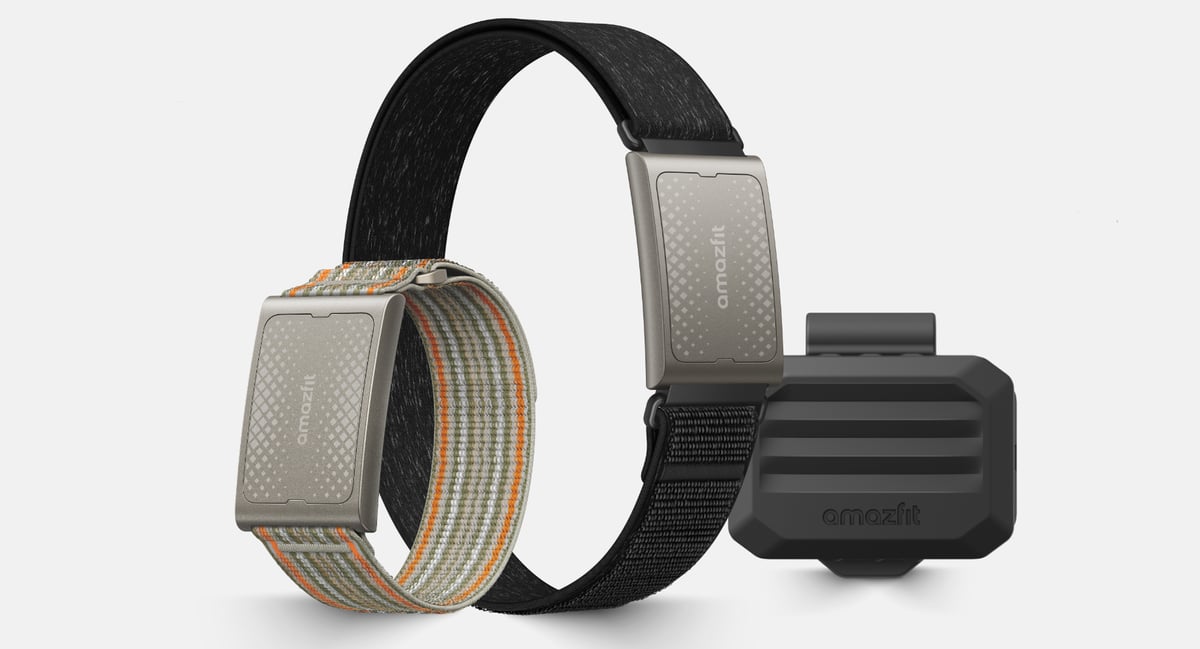
Amazfit launched the Helio Strap Pro at the HYROX World Championship in Stockholm this week. I had a hands-on with both modules at the event, but no formal workout time with the system as yet. A full review will follow in a few weeks time. This piece is based on an exclusive interview with Jimmy Kennedy, Director of Products for Hybrid Training at Amazfit.
What is Helio Strap Pro
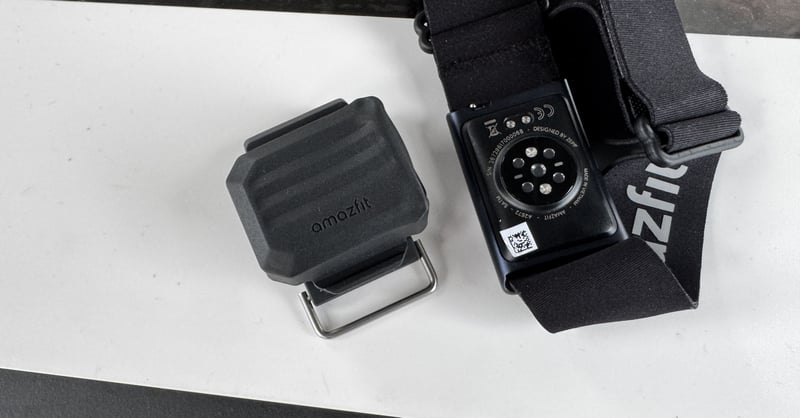
The Helio Strap Pro is a two-piece system. It pairs the Helio Core Motion HR, an arm or wrist-worn optical heart rate sensor, with the Helio Core Motion, a 9-axis motion sensor worn at the centre of the waist. The Helio Core Motion HR is the evolution of the original Helio Strap. The waist sensor is entirely new.
The full Amazfit Helio Strap Pro specifications are set out separately.
The Helio Core Motion HR is new and supports more than 50 workout modes, continuously tracks heart rate, SpO2, sleep, stress, and HRV, and delivers a refined version of HybridCharge, Amazfit’s 24/7 readiness score. The original Helio Strap ran BioCharge, the older metric, later updated as an input to HybridCharge, but with a less accurate muscular load component.
The Helio Core Motion has no heart rate sensor, no display, and, at least for now, no standalone functionality outside HYROX Race and HYROX Simulation modes. At launch, the full two-device system works only with the Balance 3 and Balance Ultra.
It’s also worth noting that the Helio Core Motion requires calibration before every HYROX session because precise wearing position and orientation affect accuracy.
What it is trying to achieve
Heart rate-based training (cardio) load is a well-understood problem. Applying time in heart rate zones to a standard formula produces a sufficiently reliable cardio stress number for running, cycling, and rowing. It does not account for muscular strain, which is a separate component of physical load and the dominant stress in a HYROX race as well as many of your gym sessions.
To quantify muscular work properly, you need to quantify the work done, one method includes capturing the following info: which muscles are working, the load applied, the range of motion, and the speed and acceleration of the movement. This is the basis of velocity-based training. A single wrist sensor is blind to what the rest of the body is doing across eight consecutive stations. Sled push leg drive, SkiErg torso mechanics, and wall ball loading patterns produce almost no useful signal at the wrist.
In HYROX, one of those four variables is fixed by the competition rules. Station weights do not vary other than between men/women and pro/age groupers. That removes the one input sensor that cannot otherwise measure. In a HYROX context, all four variables are either known or measurable, which makes the muscular load calculation easier in a way it is not in a general gym environment.
How Helio Core Motion tries to solve it
The Helio Core Motion sits at the centre of mass at the waist. When combined with the arm or wrist sensor, the system generates a two-point motion signature for each exercise and cross-references the signatures. “Every movement pattern will have a very distinct signature across every device,” Kennedy said. “When you put all those together, now you’re cross-referencing the sensitivity.”
The system classifies movements against a trained library of 30 HYROX and strength exercises, applies a coefficient based on whether the movement is whole-body or isolated, and uses the motion sensor’s speed and acceleration data to estimate mechanical work per station. The original Helio Strap auto-detects 25 strength training movements. The Pro’s library extends that to 30, with the second sensor sharpening classification and measurement accuracy across the entire range.
Competitor approaches
WHOOP is working toward a similar goal by a different route. Its current approach requires athletes to log workout types before training begins. That solves the classification problem in a structured session, but breaks down in a race environment where you move between eight stations without stopping to log anything, and further breaks down when the motion on the wrist or biceps does not meaningfully quantify the movements, e.g. a sled push has a relatively static wrist from which the sensor has little data to infer.
WHOOP’s acquisition of Humon Hex points toward muscle oxygen monitoring as a longer-term direction. Measuring muscle oxygen tells you directly how hard a muscle is working – a good method. But the sensor must be placed over the active muscle group, repositioned between exercises, and positioned identically each time to ensure comparable readings over time. None of those conditions is practical in a HYROX race. Garmin has explored the same territory. Neither brand currently offers an autonomous solution that estimates muscular load across multiple consecutive exercise stations without athlete intervention. (Garmin CIQ and Apple: The Roxfit app will log the exercise and record cardio load, but cannot deliver the muscular load component.)
What it produces
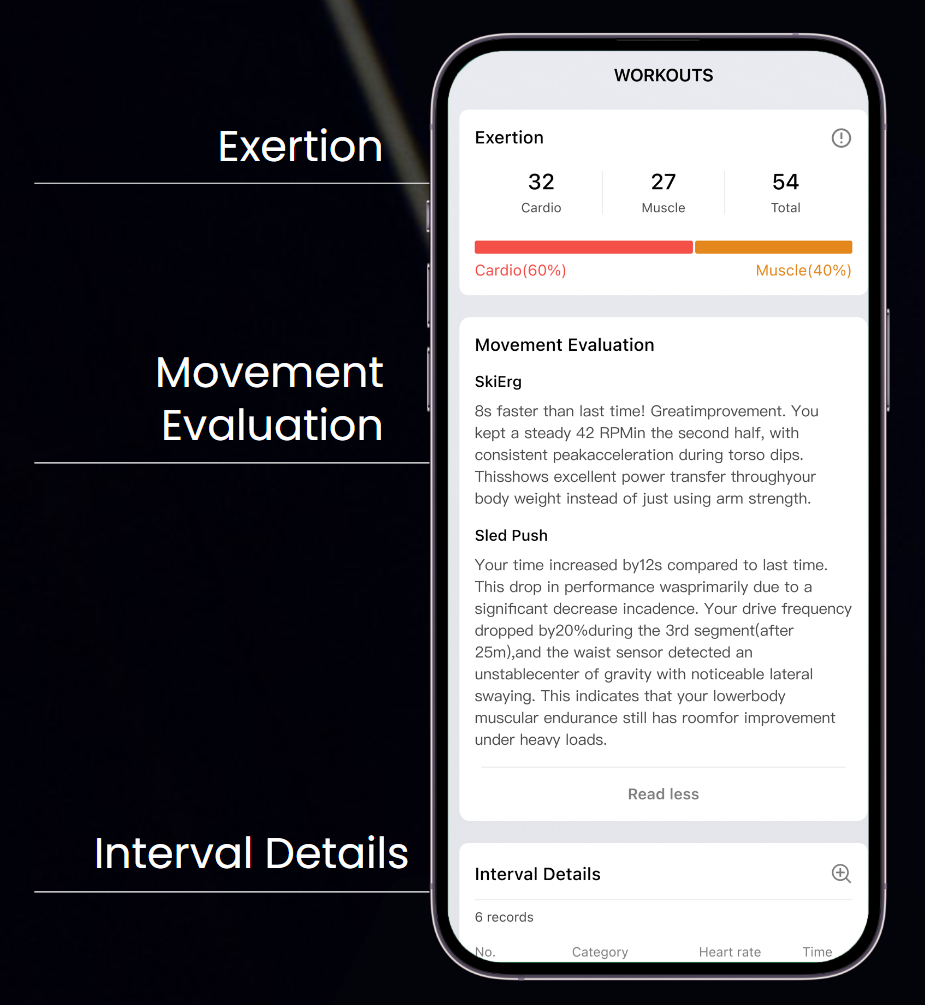
After a HYROX Race or HYROX Simulation session, the Zepp app delivers three outputs: a cardio/muscle exertion split, a per-station movement evaluation, and natural-language feedback for each of the eight stations. In Amazfit’s launch materials (above), the exertion split for a sample session read 32 cardio, 27 muscle, 54 total, displayed as a 60/40 split.
The per-station feedback goes further than a number. For a SkiErg station, the system reported a steady 42 RPM maintained in the second half and identified power transfer as coming from body weight rather than arm strength alone. For a sled push, it detected drive frequency dropping 20% after the 25-metre mark, with the waist sensor detecting lateral sway, flagged as lower body muscular fatigue under load. That sled push example is worth noting: the lateral sway detection comes specifically from the waist sensor reading centre-of-gravity shift, information a wrist sensor cannot capture.

The app breaks down all 16 stages of a HYROX race or simulation, covering both the eight running laps and the eight exercise stations. Outputs are at the session and station levels. There is no rep-by-rep feedback during the workout itself.
Because the Helio Core Motion feeds muscular load data into HybridCharge, a HYROX session now contributes correctly to the readiness score, including the muscular component. The original Helio Strap’s BioCharge had no muscular load input at all. That gap is closed here.
Battery Life
Battery life
The Helio Core Motion HR arm strap runs for up to 11 days on a single charge (up from 10 hours). The Helio Core Motion waist sensor lasts up to 40 days, which makes sense given it is only active during HYROX Race and HYROX Simulation sessions rather than continuously.
The HYROX partnership
The Amazfit-HYROX partnership goes beyond branding. Kennedy described a specific problem with the current race prediction tool, illustrating how closely the two organisations are working. “In New York, for Run 8, you actually entered on the opposite side of the track. It was 2.5 laps instead of two. Our pace prediction just kept it at the same pace. It was actually a minute slower.” Accurate venue geometry for each race city is in development through direct data access from HYROX. It is not a launch feature.
Kennedy also acknowledged a gap in race prediction personalisation that the current system does not yet address. “I have three races of data. We should be taking that and personalising it.” The current model uses cohort averages from athletes who finished within two minutes of your target time. Individual race history, including your specific strengths and weaknesses across stations, is not yet factored in. Kennedy confirmed the direction directly; there is no timeline.
The honest scope
The Helio Core Motion waist sensor works only in HYROX Race and HYROX Simulation modes at launch. Amazfit’s own support documentation states explicitly that more workout modes will be added in future updates. For general gym work, CrossFit, and open hybrid training, the relevant device today is the Helio Core Motion HR arm sensor used on its own. That delivers HybridCharge, more than 50 workout modes, including automatic detection of 30 HYROX and strength movements, auto workout detection, continuous heart rate, SpO2, sleep, and full health tracking. That is functionally the original Helio Strap with a platform upgrade from BioCharge to HybridCharge. The two-piece system with per-station muscular load analysis is a HYROX product at launch.
Hands-on
The wrist device seems highly similar to the Gen 1 strap, but with perhaps a slightly more refined fit.
The waist pod is a simple puck that fits inside a tight rubber clip.
Open questions
Venue geometry data is in development and not available at launch, meaning, for example, that the start and finish run legs of a Hyrox can be different lengths, as can the transition. The information is all known; it just has to be incorporated into the ecosystem.
Race prediction personalisation from individual race history is a gap Kennedy acknowledged directly.
Broader workout mode support for the Helio Core Motion waist sensor is confirmed, with no timeline.
Pricing has not been announced.
Watch compatibility beyond Balance 3 and Balance Ultra has not been stated.

Quick answers
Does the Helio Core Motion waist sensor work outside HYROX modes?
No, not at launch. Amazfit’s support documentation confirms it is completely inactive outside HYROX Race and HYROX Simulation. More workout modes are confirmed as coming with no timeline given.
Which watches are compatible with the Helio Strap Pro system?
At launch, Balance 3 and Balance Ultra only. No other Amazfit watches are currently supported for the full three-device system.
Do I need to calibrate the waist sensor before every session?
Yes. Amazfit’s documentation states calibration is required before every HYROX Race or HYROX Simulation. Without it, neither the cardio/muscle load split nor the per-station analysis is available.
Is the Helio Strap Pro useful for general gym training?
The Helio Core Motion HR arm sensor works as a standalone device with more than 50 workout modes, HybridCharge, and full health tracking. The muscular load analysis and per-station feedback require the waist sensor, which is HYROX-only at launch.
Last Updated on 28 July 2026 by the5krunner
My favourite kit and nutrition
- Garmin Fenix 9 Pro — I’ve just bought one.
- Injinji – Runners protect your toes. Avoid discomfort and minor injury. Run more. Run faster. I use them.
- Garmin 90-degree charging adapter — A small keyring adapter you can use anywhere. Essential when away. I use one.
- Garmin charging puck — the fastest and most reliable way to top up your Garmin before a session. I use one.
- Ravemen FR300 — Front light that mounts directly under your Garmin or Wahoo head unit. Keeps your bars clean and your beam pointed where it matters. I use one.
- Body Glide – The blue anti-chafe stick that all swimmers and many runners use. I use it.
- Maurten — The race nutrition trusted by elite athletes. Gels and drink mixes engineered to be easy on the stomach. I use them.
- Garmin Varia RTL515 — A radar rear light that alerts you to vehicles approaching from behind. Pairs with your Edge or Wahoo. I use this model.
- Favero Assioma Pro RS2 — The power-meter pedals most serious cyclists choose. Accurate, easy to move between bikes. I use this model.
- Garmin Forerunner 970 — A serious choice for a pro-grade triathlon watch. I use this.
- Polar H10 — My daily driver for accurate, waking HRV readings.
- Wahoo ELEMNT Roam 3 — The bike computer that has the feature Garmin lacks: usability. I use mine on most rides.
Reader-Powered Content

This content is not sponsored. It’s mostly me behind the labour of love, which is this site, and I appreciate everyone who supports it.
Support the site: Follow (free, fewer ads) · Subscribe (paid, ad-free) · Buy Me A Coffee ❤️
All articles are written by real people, fact-checked, and verified for originality. See the Editorial Policy. FTC: Affiliate Disclosure — some links pay commission. As an Amazon Associate, I earn from qualifying purchases.
tfk is the founder and author of the5krunner, an independent endurance sports technology publication. With 20 years of hands-on testing of GPS watches and wearables, and competing in triathlons at an international age-group level, tfk provides in-depth expert analysis of fitness technology for serious athletes and endurance sport competitors. ID
