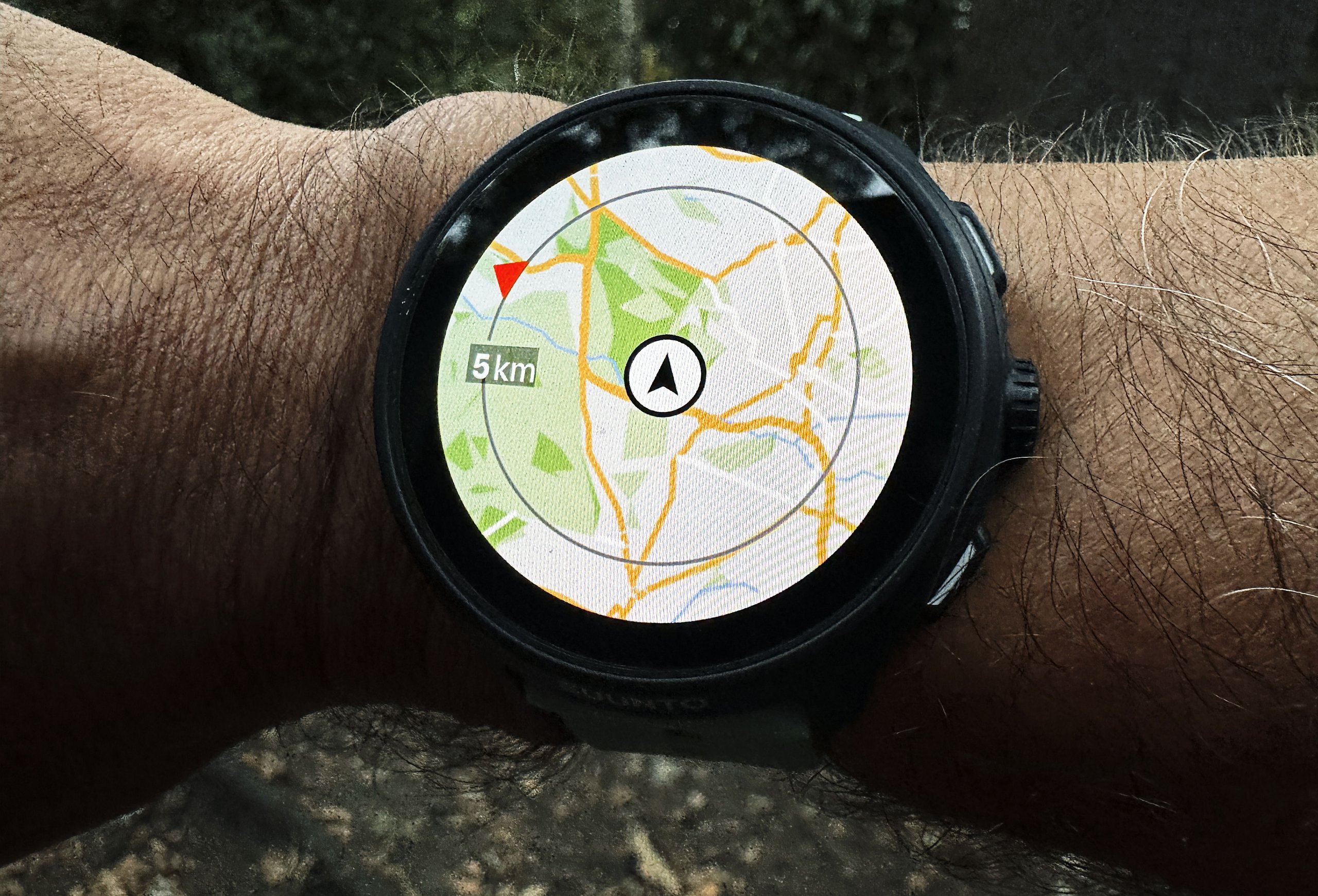
The Suunto Run 2 is the entry-level alternative to Garmin’s Forerunner 170. Both storage versions include free offline maps, something Garmin’s cheapest watch with built-in maps, the Forerunner 970, doesn’t offer until $749.99, twice the price of the Run 2’s £299 64GB model. The cheaper £265 4GB model has less room for map regions and music, but the maps themselves aren’t restricted. Like Coros and Amazfit, Suunto now offers a compelling alternative to the market leader for those with a budget around £300/$300.
Suunto beats Garmin on maps, yet trails it on smart features such as contactless payments and offline MP3 playback instead of full streaming support. Coros shares a similar competitive position but, like the Run 2, lacks the third-party app store that Garmin and Amazfit provide; Suunto reserves that for its pricier watches. Suunto pulls ahead in design and usability: quality, more durable materials, a well-styled case, and menus that are feature-rich yet straightforward—something you can’t say about Garmin.
Most sports watches in 2026 are good, and the models discussed in this review are no exception, whichever you end up buying.
Heads Up: Suunto provided this watch as a media loaner. I buy the other devices I use for my own training with my own money.
Suunto Run 2 Verdict
Suunto Run 2: accurate heart rate tracking and maps half the price of Garmin
Mapping and heart rate tracking are the standout improvements over the original Run, staying accurate on the wrist across all tests. GPS tracking held up against two independently measured distances and varied from good to excellent elsewhere. One small trade-off is the daily battery life, which drops slightly compared with the original Run, even though the per-second GPS recording time for workouts is improved.
Pros
- Offline maps at a price no Garmin watch matches
- Accurate heart rate from the wrist in testing
- Good-to-excellent distance and GPS accuracy in testing
- Meaningful 3rd party app store – unlike COROS
- Superior case and lens compared to Garmin FR170
- Manual structured workouts (SuuntoPlus Guides)
Cons
- Everyday battery life is shorter than the original Run’s, but still good in class
- About 20 watch faces. Limited choice, but some look good
- No Spotify or contactless payment support
- Core physiology and sleep features only; Garmin wins here
- No 3rd party plan support (SuuntoPlus Guides)
Who should buy the Run 2, and who shouldn’t
This is a solid watch with a competent ecosystem that will suit any level of runner, from beginner through to advanced runner
Who should buy this
- Older Suunto watch owners wanting more reliable heart rate data
- Solid upgrade for anyone with a 5yo Suunto
Who should avoid this
- Anyone looking for wide smart feature support for music like Spotify/YouTube Music (Apple Watch, Garmin) or Contactless Payments (Apple Watch, Garmin 170 and above)
- The aesthetic and watchfaces are very sport-focused and may not suit all-day wear.
- Buyers of a Suunto Run from 2025 won’t be upgrading for features
- Someone preferring a button-only interface (Garmin)
- Someone who also wants core cycling sensor support – power meter and smart trainer (Forerunner 170)
- Someone who wants wrist-based Running Power or Running Dynamics (Forerunner 170)
What the Run 2 changes over the Run
The Run 2 replaces the Suunto Run, which launched at $250/£199/€249.
| Region | 4GB | 64GB |
|---|---|---|
| UK | £265 | £299 |
| US | $349 | $399 |
| EU | €299 | €349 |
The Run 2 costs roughly £66–100 more than the Run’s launch price, depending on SKU.
Hardware and software changes over the Run are significant:
- New-generation dual-band GNSS, per Suunto. The antenna spec supports the same GPS L1 and L5 frequencies the original Run already used, so the frequency capability itself isn’t new.
- The new optical heart rate sensor performs notably better. The original Run’s sensor “needed improvement” and results were “sometimes excellent and oftentimes not,” requiring a chest strap or biceps band for reliable results. Across eight separate Run 2 test sessions (10-mile tempo run, treadmill intervals, outdoor cycling, track ramp, weights, trail run, long steady tempo run, zone 2/3 run), bias has stayed under 1 bpm, a clear and consistent improvement to a more than acceptable level.
- A brighter display: 2,000 nits versus the Run’s 600nits.
- 64GB storage on the higher-capacity model, up from the Run’s 4GB. Free offline maps are included on both storage tiers; the 64GB model simply has more room for map regions and music.
- A new charger for the Run 2 specifically: it switches to the magnetic charger used across the rest of the Suunto range.
- Suunto’s current live pages confirm the original Run at 12 days of daily use and 20 hours in training/GPS mode, but other official sources differ. Battery capacity is 380mAh, up from 295mAh.
Offline music carries over as drag-and-drop MP3 storage, as on the Run; Suunto has no streaming support. Music playback process and quality are unchanged; storage space for music files has increased
Setting up the Run 2
Setup is generally very easy, with a few minor caveats. First, Suunto only allows one watch to pair with its app at a time. Second, getting the Bluetooth pairing PIN is sometimes tricky with this brand, though I had zero issues this time. Third, installing maps over Wi-Fi is oddly confusing and hard for a first-timer to figure out.
Design, Comfort and Ease of Use
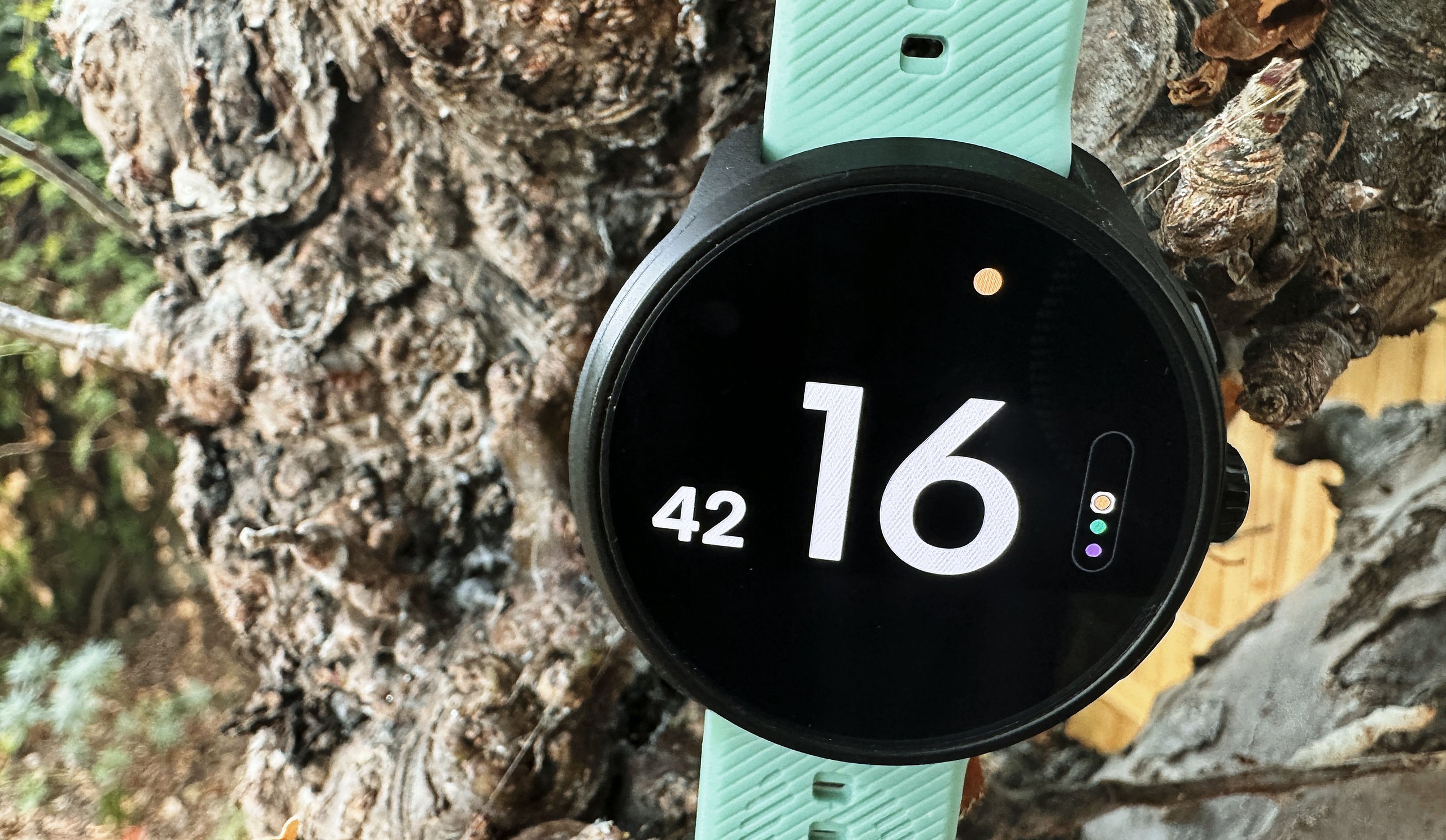
The watch feels as comfortable and light as other Coros and Garmin watches in its class, with little to choose between them. Of the three, I prefer the looks and quality materials of Suunto’s hardware. The Forerunner 170’s case is fibre-reinforced polymer throughout with chemically strengthened glass, at 43mm and 41g; the Run 2 uses a stainless steel bezel and Gorilla Glass over a polymer case, at 46mm and 35g. Despite the larger case, Run 2 is lighter and uses tougher materials for the bezel and lens. Its watchfaces are limited, whereas Coros has many; Garmin, on the other hand, lets you pay for and download many from its app store, although its out-of-the-box offerings mostly look poor.
All comparable competitors wear well in sport and use broadly similar screen layouts for showing metrics while running.
Coros is generally the easiest to use, with Suunto coming a close second and Garmin trailing with more complexity than needed.
How I tested the Run 2
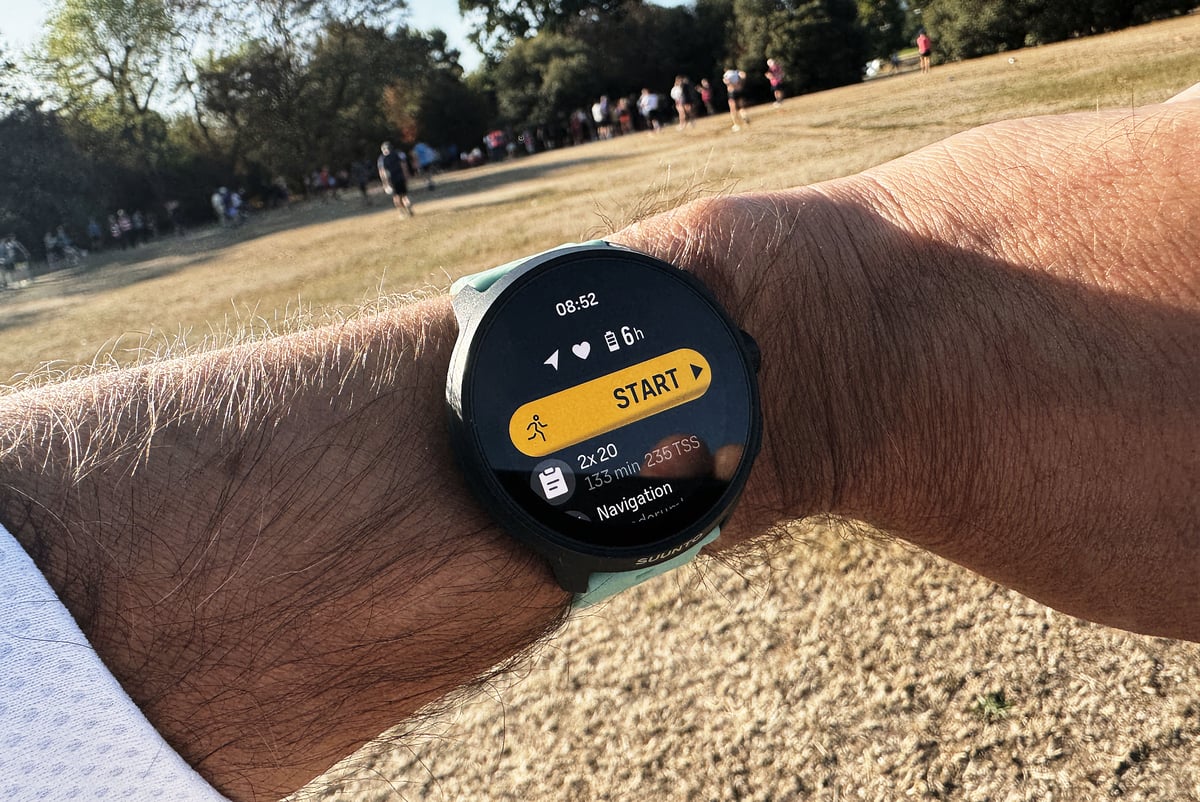
I tested the Suunto Run 2 at a range of intensities and in a variety of running environments: road, trail, track and treadmill. Here is my detailed testing methodology.
Run 2 GPS accuracy: tested
See our GPS accuracy hub to compare these tests across brands.
Test A: 10-mile test run
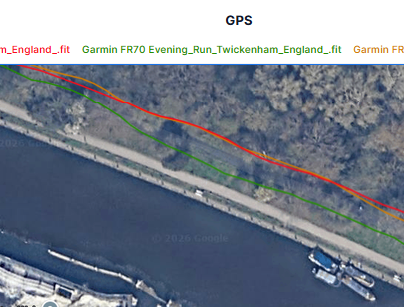
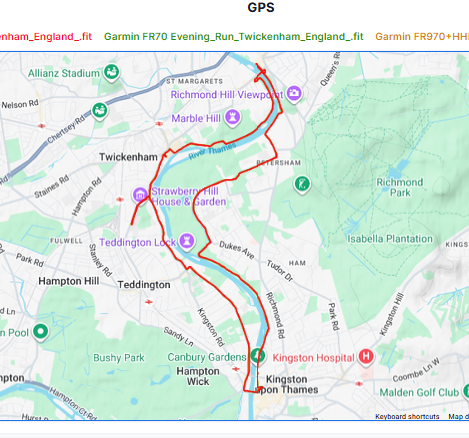
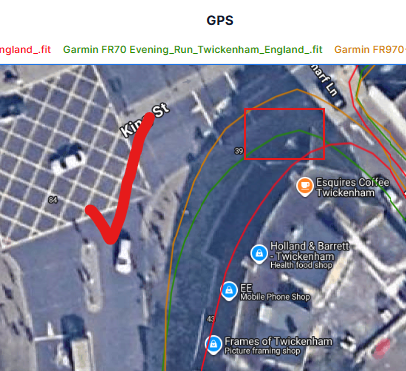
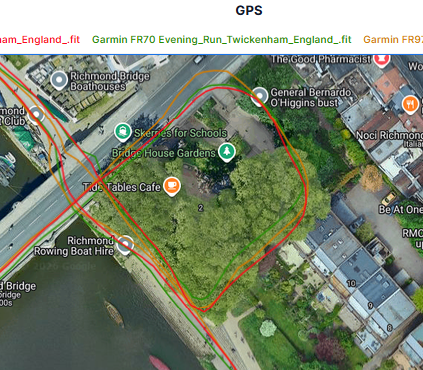
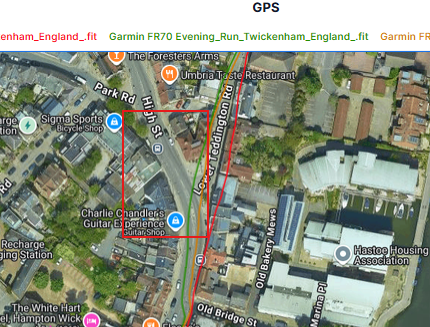
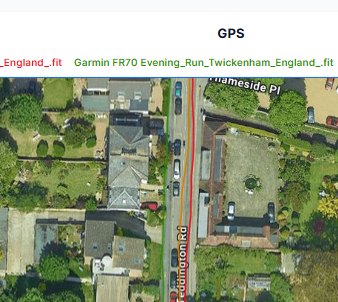
The Suunto Run 2 scored 90% in my standard 10-mile test, an excellent result. Core performance broke down to 88% on the easy sections, 94% on the medium-difficulty sections, and 90% on the hard sections, with nothing to suggest it would perform materially differently if re-tested. There were no concerns in this test at all, and the only oddity was a section where almost every other device will show a multipath (reflected signal) error. Suunto didn’t, but then 10m after the section had an unexpected counterbalancing error in the opposite direction, which was probably linked in some way I don’t understand! Like every device, it didn’t record in a 50m tunnel, but it seemed to handle the fused accelerometer-GPS signal as well as other devices and re-acquired the signal very quickly once it was back in open skies. Performance under a dense tree canopy was also good here.
Here are some sample images of sections of the test with Suunto shown in red.
Test B: running track, St Mary’s University
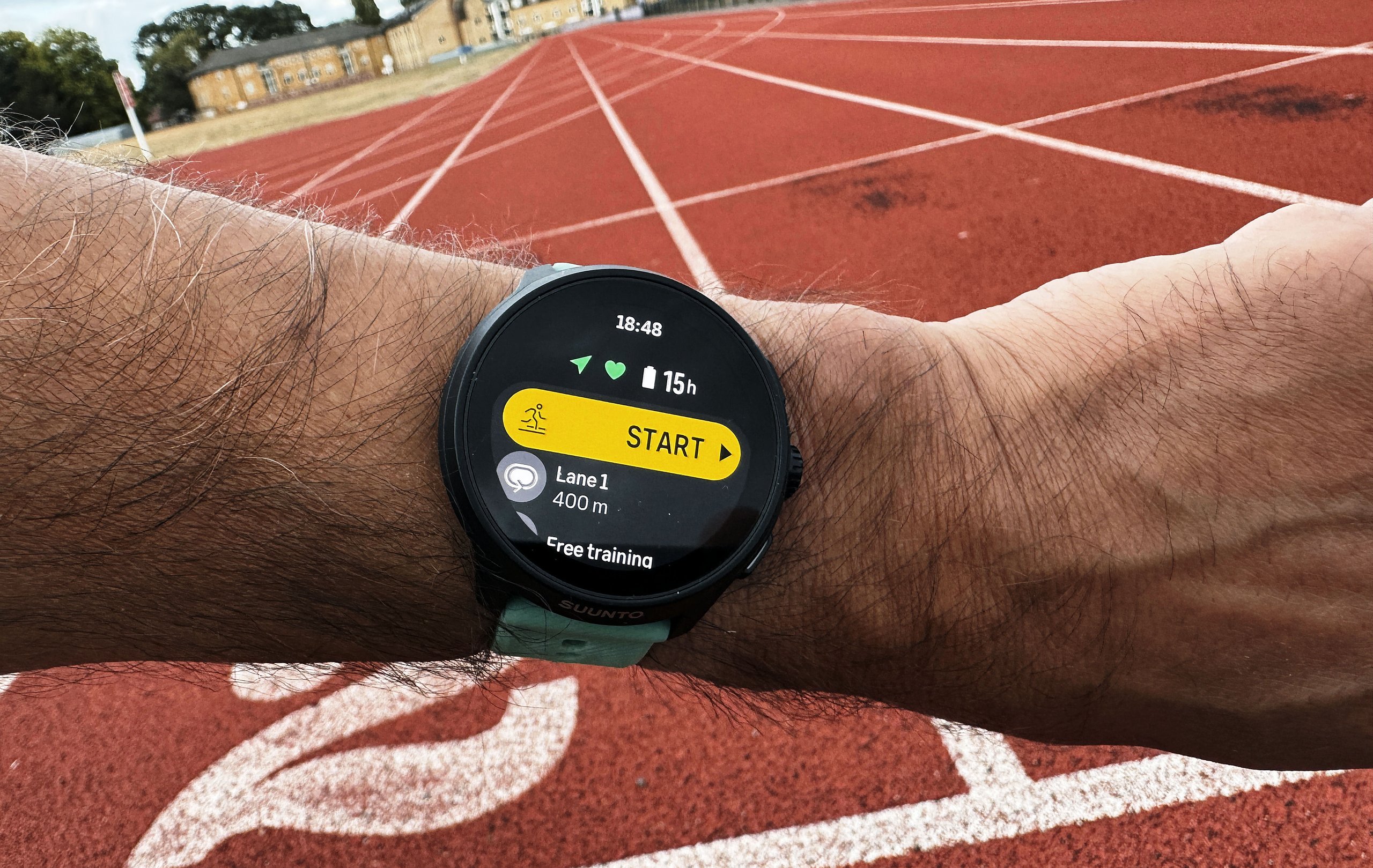
At St Mary’s University Running Track, I completed three tests of 4 laps each in Lane 2, with each device set to Lane 2: Suunto Run 2 (left), Apple Watch Ultra 3 (right), Garmin Forerunner 970 (right, held), and Amazfit Balance 3 (left, held). The images below show one test. Visually, the Apple Watch was the best on the test, with the closest visual tracking to Lane 2.
The likely actual distance travelled by a watch worn on the left was 1.628km on the left line of lane 2, and on the right approximately 1.64 km in the middle to right of lane 2.
| Model | Actual | Recorded |
|---|---|---|
| Garmin FR970 | 1.64 | 1.64 |
| Suunto Run 2 | 1.628 | 1.62 |
| Apple Watch Ultra 3 | 1.64 | 1.60 |
| Amazfit Balance 3 | 1.628 | 1.62 |
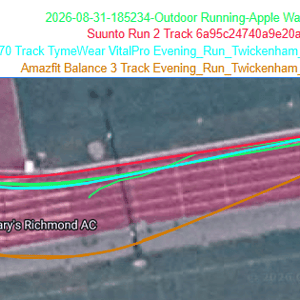
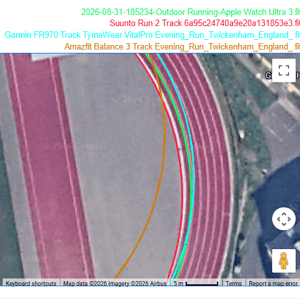
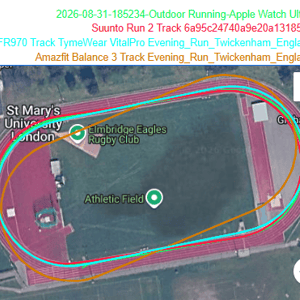
Suunto and Garmin won this test with visually correct-looking tracks and an accurate distance. Apple had the best-looking visual tracks but likely underestimated distance, whereas Amazfit had an accurate distance but positioned the geometry incorrectly on the map.
Test C: Wimbledon Common Woods Trail Run
This 6 km run was mostly on gravel and loose trail conditions under good tree cover. At a high level, both the Fenix 9 Pro and Suunto Run 2 deviate from what appears to be the consensus route, which is usually a bad sign. Forerunner 970 and the Amazfit T-Rex Ultra 2 were also tested here. I mistakenly had the Fenix 9 Pro on ‘normal’ satellite accuracy; however, analysis of the FIT file showed it often defaulted to max accuracy due to the difficult conditions, which is correct behaviour.
Inspecting the track at a higher zoom level revealed that the Fenix 9 Pro’s route was correct everywhere I checked, interestingly even on one section where two of the other devices followed where the map said the trail was, but wasn’t. The Suunto Run 2 and T-Rex had frequent sections where the recorded track ran 5m parallel to the actual track; however, this wasn’t in a consistent direction, suggesting it was more of a reception issue than a signal timing issue. Fenix 9 Pro was excellent here, and Suunto Run 2 was quite good.
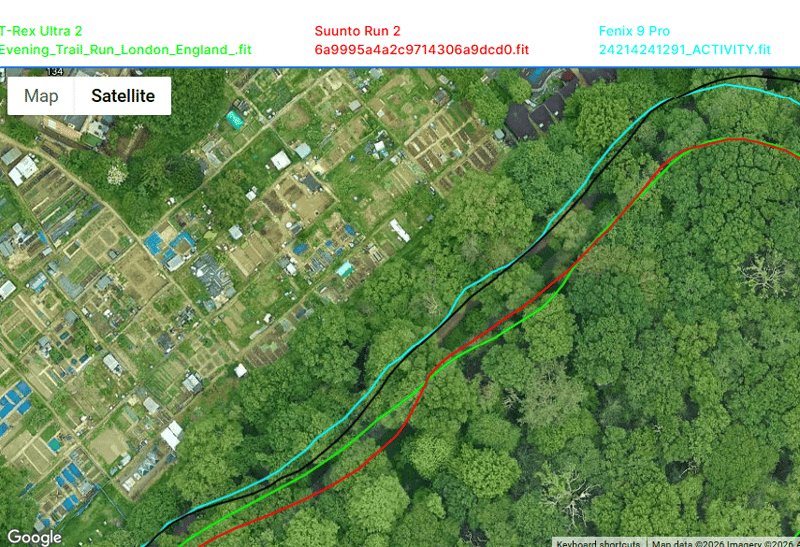
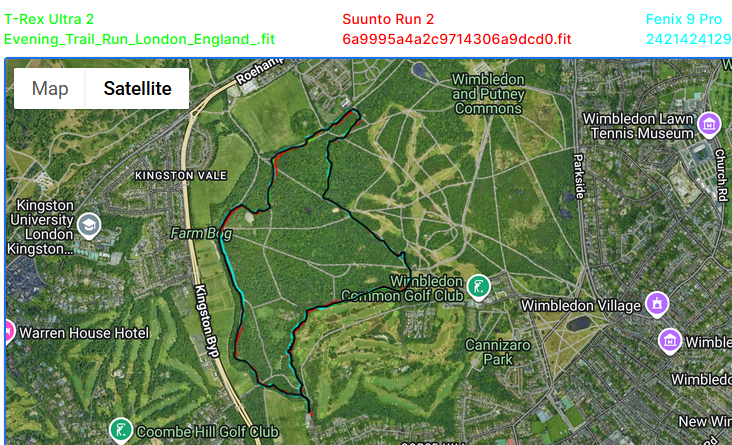
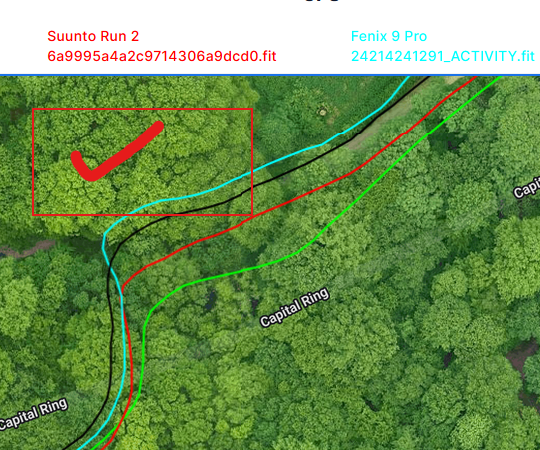
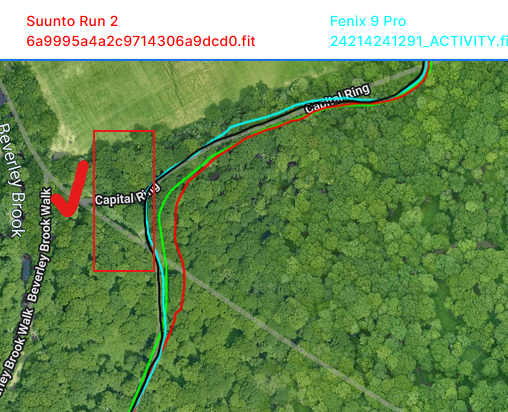
The distances recorded were
- T-Rex Ultra 2 – 5.30km
- Suunto Run 2 – 5.34km
- Fenix 9 Pro – 5.43km
- Forerunner 970 – 5.42km
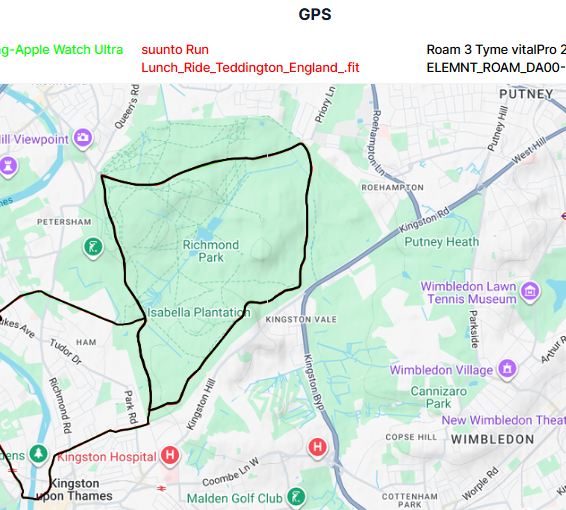
Test D: cycling, Richmond Park
This cycling GPS track of laps of Richmond Park showed all devices repeating the same track for each lap. The differences between the devices were minuscule and not worth commenting on. Suunto Run 2 was accurate in this test.
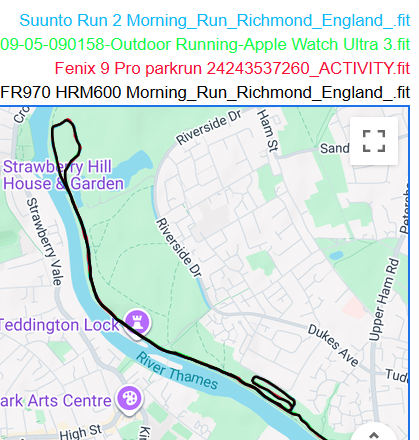
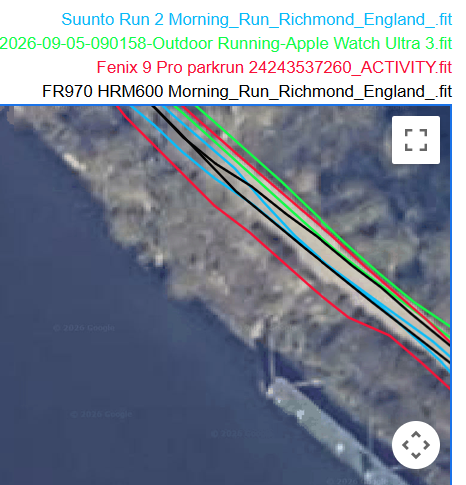
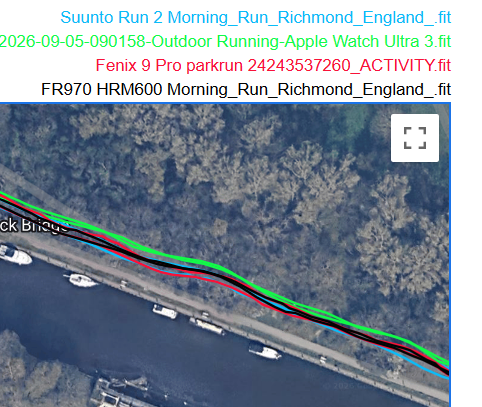
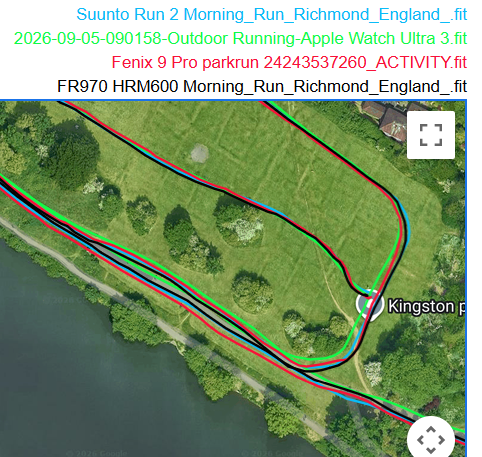
Test E – parkrun testing at Kingston
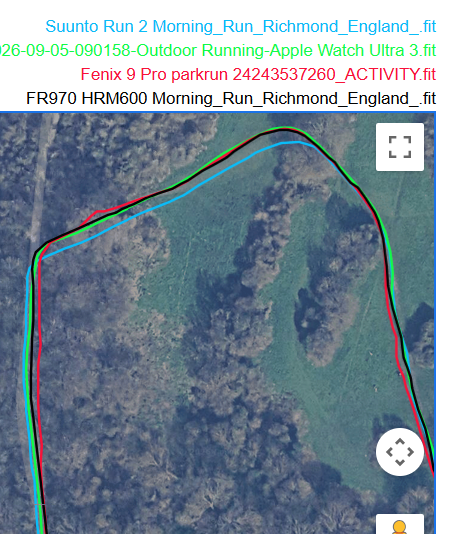
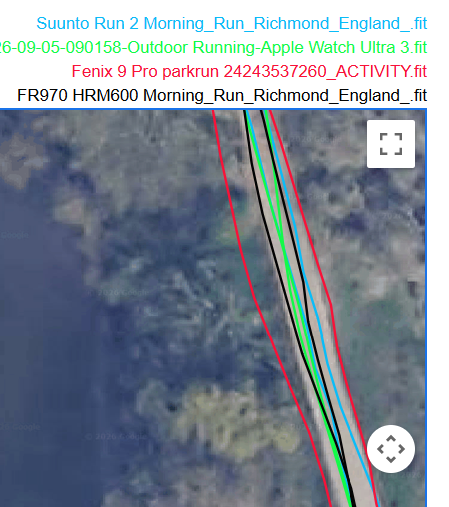
The Kingston parkrun course is an out-and-back course along the Thames, with about 3km under a fairly dense tree canopy, making a tricky GPS test. This course supposedly has a ratified length by English Athletics; however, I’m unconvinced the coned lap section at the start is accurately laid out each week. Supporting my theory, all devices measured 5km or slightly less, which is impossible. My guess is that I ran 10-20m further than the course on the day, and that the watches also introduced errors beyond my overrunning. These are the recorded distances, all seemingly excellent:
- Suunto Run 2 – 5.00km
- Apple Watch Ultra 3 – 4.99km
- Garmin Fenix 9 Pro – 4.98km
- Garmin Forerunner 970 – 4.99km
A visual inspection of the GPS tracks shows that all 4 watches were broadly acceptable. However, Suunto Run 2 was clearly off track a couple of times, and the Fenix 9 Pro struggled slightly to get the precise position under tree cover in max accuracy mode. The Forerunner 970 and Apple Watch Ultra 3 had the best visual tracks on test, and coincidentally also agreed on the recorded distance.
Distance accuracy
Against a known, measured distance
Two tests had a real distance to check against: the track’s known lane geometry, and parkrun’s ratified course length.
| Test | Recorded | Measured distance | Deviation |
|---|---|---|---|
| B: St Mary’s track (4 laps, Lane 2) | 1.62km | 1.628km (calculated lane distance) | -8m |
| E: Kingston parkrun | 5.00km | 5.00km (English Athletics ratified course) | 0m |
Against a real, independently known distance, Suunto Run 2 was accurate in both tests.
Against the average of other devices
In areas with trickier GPS reception conditions (trees, in this case), the actual track differed notably from the known track, and unsurprisingly the difference was larger than the average of other devices that appeared to have visually better tracks.
| Test | Recorded | Average of other devices | Deviation |
|---|---|---|---|
| C: Wimbledon Common trail | 5.34km | 5.38km (T-Rex Ultra 2, Fenix 9 Pro, Forerunner 970) | -40m |
Run 2 HR accuracy, tested
See our heart rate accuracy hub for background on how wrist-based optical sensors are tested.
HR Test 1
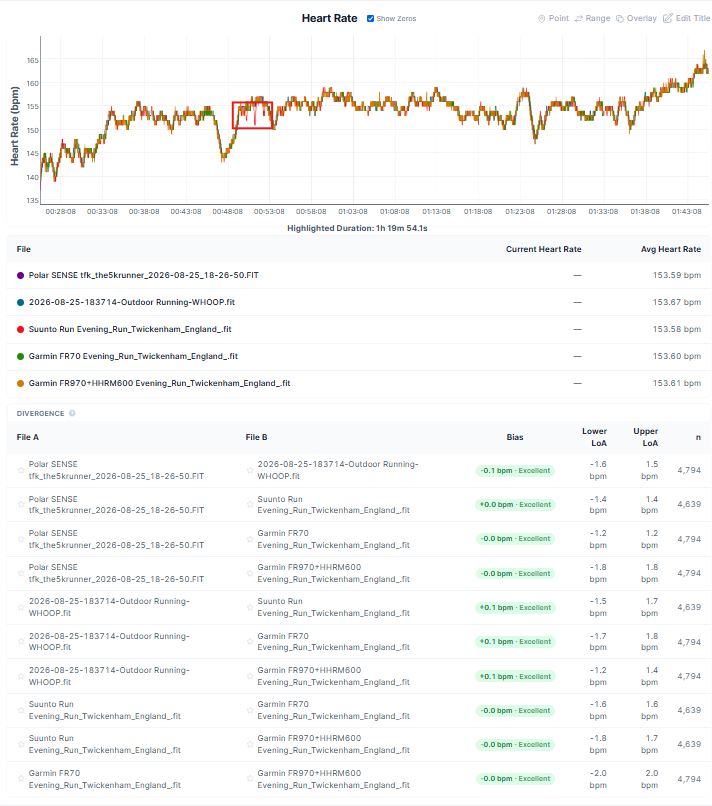
The Suunto Run 2 demonstrated excellent heart rate tracking accuracy against the Polar Sense optical armband, recording a mean bias of 0.0 bpm and limits of agreement between -1.4 bpm and +1.4 bpm. Against the benchmark Garmin HRM600 chest strap, the Suunto Run 2 maintained a 0.0 bpm mean bias with limits of agreement from -1.8 bpm to +1.7 bpm across 4,639 data points during outdoor running. Visually, the track appears very slightly jagged, but the y-axis range selection makes it more noticeable, highlighting a few tiny troughs at 00:50 that might otherwise be hard to see.
HR Test 2 – Treadmill
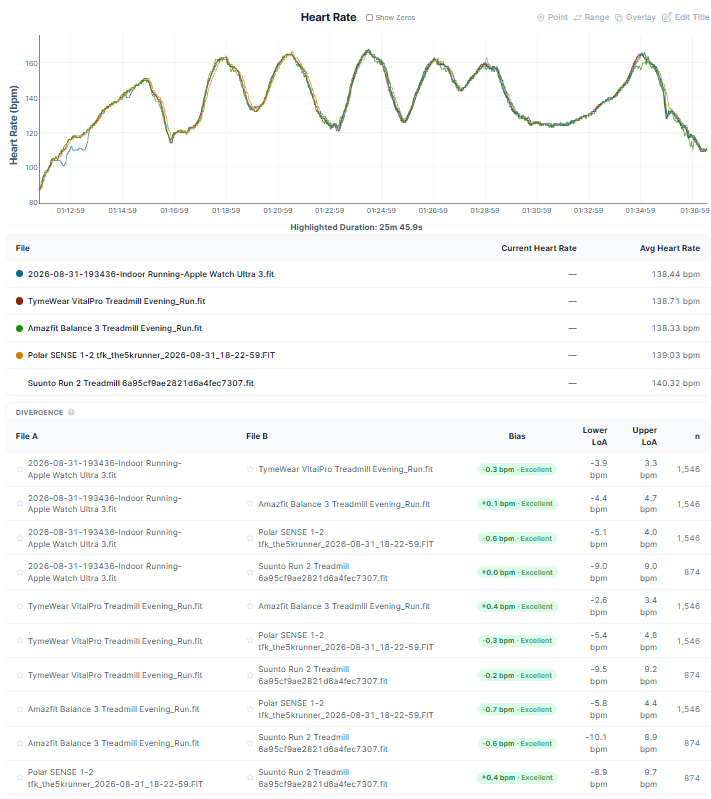
This was an indoor interval test on a treadmill, pitting Suunto Run 2 against Apple Watch Ultra 3, TymeWear VitalPro and Amazfit Balance 3.
In this indoor interval treadmill test, Suunto Run 2 showed excellent overall agreement with the primary reference (TymeWear VitalPro recorded on Garmin) and the secondary reference (Polar SENSE).
Versus TymeWear VitalPro, the bias was –0.2 bpm (Excellent, limits of agreement –9.5 to +9.2 bpm, n = 874); versus Polar SENSE, the bias was +0.4 bpm (Excellent, –8.9 to +9.7 bpm). The other devices (Apple Watch Ultra 3, Amazfit Balance 3) also aligned tightly with both references (biases under 1 bpm and narrower LoAs of roughly ±3–5 bpm). Suunto’s limits of agreement were somewhat wider than the rest of the field, and the overlapping sample count was lower, but the near-zero bias still places it firmly in the Excellent category for this session.
HR Test 3 – Trail Run
HR Test 4 – Cycling
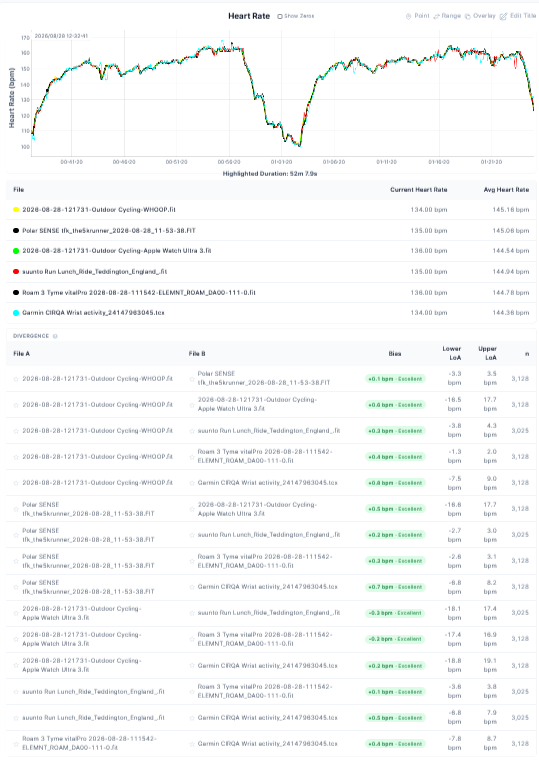
During outdoor cycling, the Suunto Run 2 showed high heart rate tracking accuracy against the TymeWear VitalPro chest strap, with a mean bias of +0.1 bpm and limits of agreement between -3.6 bpm and +3.8 bpm across 3,025 data points. Compared to the Polar Sense optical armband reference, the Suunto Run 2 recorded a mean bias of +0.2 bpm with limits of agreement ranging from -2.7 bpm to +3.0 bpm. Visually, there are a few tiny troughs in the test that present no concern.
HR Test 5 – Gentle Outdoor Track Ramp
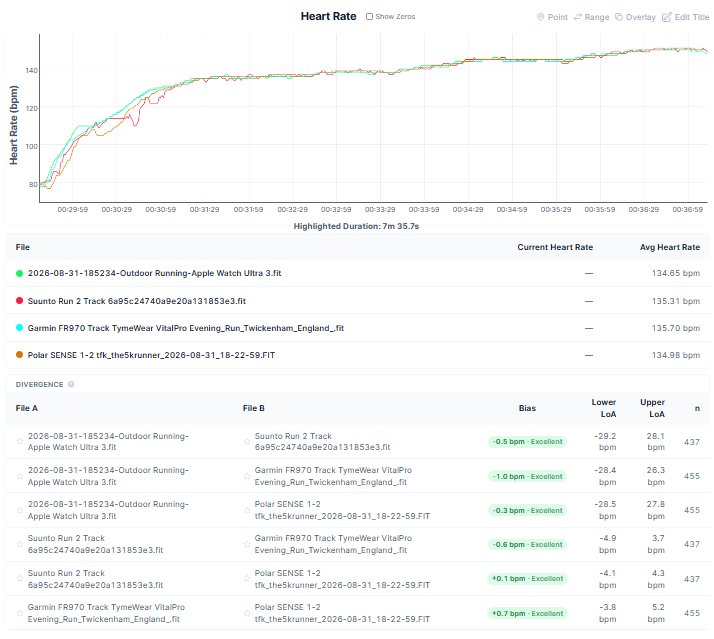
In this outdoor gentle ramp test on a track, Suunto Run 2 showed excellent agreement with the primary reference (TymeWear VitalPro on Garmin FR970) and the secondary reference (Polar SENSE). Versus TymeWear VitalPro, the bias was –0.6 bpm (Excellent, limits of agreement –4.9 to +3.7 bpm, n = 437); versus Polar SENSE, the bias was +0.1 bpm (Excellent, –4.1 to +4.3 bpm). The two reference devices themselves differed by only +0.7 bpm with similarly tight limits. By contrast, Apple Watch Ultra 3 exhibited much wider limits of agreement (around ±28 bpm) against all three. Overall, Suunto Run 2 tracked the chest-strap and optical references accurately and tightly throughout this session.
HR Test 6 – Weight Training for Runners. Core and Legs only
This test saw a failure from the HRM600, which failed to cache and retrieve all its data to the FR970 in my locker; thus the reference became the Polar SENSE on my right biceps. The Whoop MG was on my left biceps and Suunto Run 2 on my left wrist. There should have been no motion artefact issues, as the workout was a runner’s weights workout focused solely on legs and core.
Readers should note that heart rate in strength training cannot measure muscular strain, so recording it is pointless. But many of you do it, so here are my results.
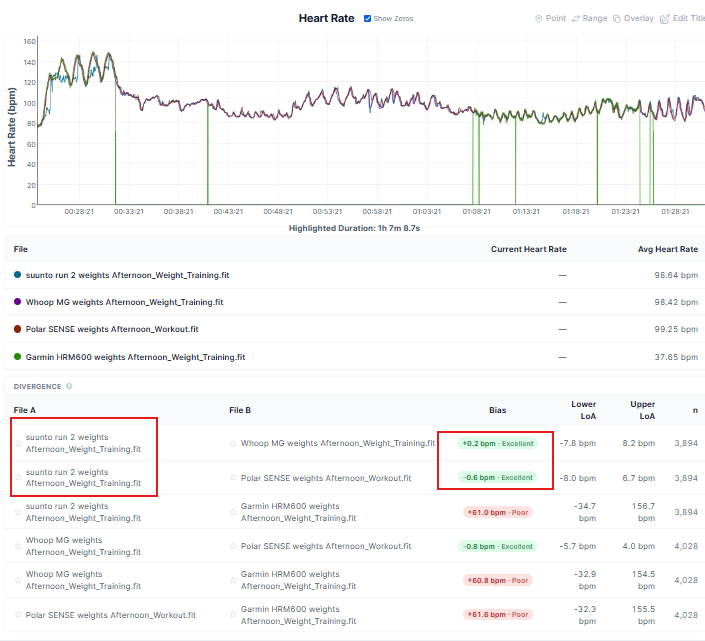
In this lower-leg and core weights session (expected to have few or no motion artefacts), Suunto Run 2 showed excellent agreement with the designated reference Polar SENSE and with Whoop MG. Versus Polar SENSE, the bias was –0.6 bpm (Excellent, limits of agreement –8.0 to +6.7 bpm, n = 3,894); versus Whoop MG, the bias was +0.2 bpm (Excellent, –7.8 to +8.2 bpm). Whoop and Polar themselves differed by only –0.8 bpm with tight limits. The Garmin HRM 600, however, suffered significant dropouts and produced large positive biases of around +61 bpm (Poor) against all three devices, rendering it unusable as a reference for this test. Overall, Suunto Run 2 tracked the optical and chest-strap references accurately and consistently throughout the session.
This result is specific to a legs-and-core session, the kind most runners actually do and care about. Upper-body and full-body weights sessions put far more motion at the wrist, and results there are typically worse for any optical sensor. @thequantifiedscientist’s, found that Run 2 missed a meaningful number of heart rate peaks during upper-body weights work. Treat my test as representative of runner-style leg sessions specifically, not strength training in general.
HR Test 7 – long steady tempo run
This test was a relatively constant-tempo effort for well over an hour, and the result was surprisingly close to perfect.
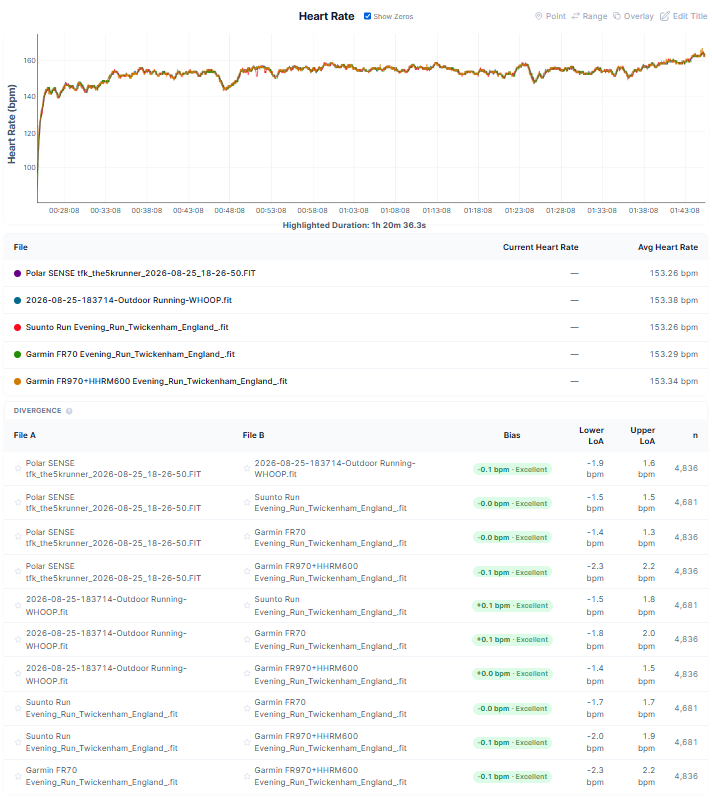
During an 80-minute, flat road run at a steady tempo pace, the Suunto Run 2 delivered highly accurate optical heart rate tracking performance against both reference sensors. When evaluated against the Garmin HRM600 chest strap paired with a Forerunner 970, the Suunto Run 2 recorded a mean bias of -0.1 bpm with limits of agreement between -2.0 bpm and +1.9 bpm across 4,700 data points. Compared to the Polar Sense optical armband, the device maintained a 0.0 bpm mean bias with limits of agreement spanning -1.5 bpm to +1.5 bpm across 4,701 data points.
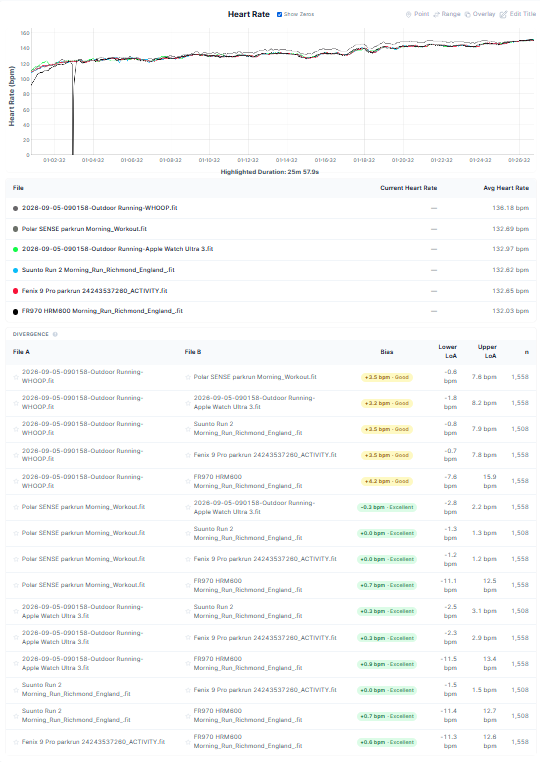
HR Test 8 easy zone 2/3 run
In this short Zone 2/3 run on mostly hard, flat surfaces, the Suunto Run 2 performed excellently against both the primary reference (HRM 600) and the backup reference (Polar SENSE). Versus Polar SENSE, the bias was a perfect 0.0 bpm (Excellent, extremely tight limits of agreement –1.3 to +1.3 bpm, n = 1,508); versus the HRM 600, the bias was +0.7 bpm (Excellent, –11.4 to +12.7 bpm).
It also matched the other optical devices almost perfectly: 0.0 bpm versus Fenix 9 Pro and +0.3 bpm versus Apple Watch Ultra 3, both with very narrow limits. WHOOP read systematically higher (around +3.5 bpm) against the Suunto, Polar SENSE, Fenix and Apple Watch. Overall, the Suunto Run 2 tracked the arm-band and chest-strap references with high accuracy and consistency, clustering tightly with the other strong optical performers in this steady-effort session.
Elevation, tested
Run 2 does allow manual or automated elevation calibration. For these tests, I did neither and just let all the watches do their own thing. It seems sensible to recommend calibrating elevation when you know the correct values.
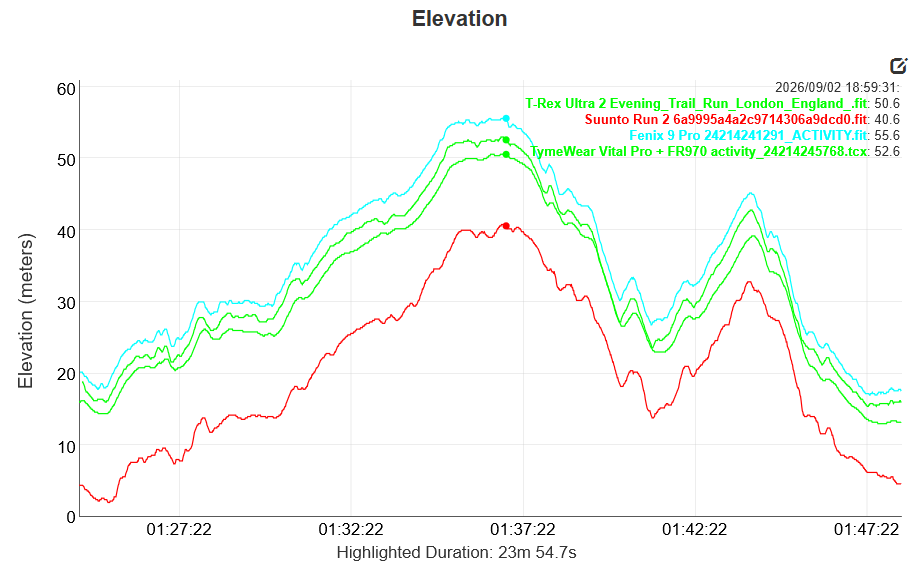
Elevation Test 1
The following chart shows how Suunto Run 2 records elevation while running up a 40m hill. The ongoing trace appears parallel to that of the Amazfit and Garmin. It appears accurate in stable atmospheric conditions.
Elevation Test 2
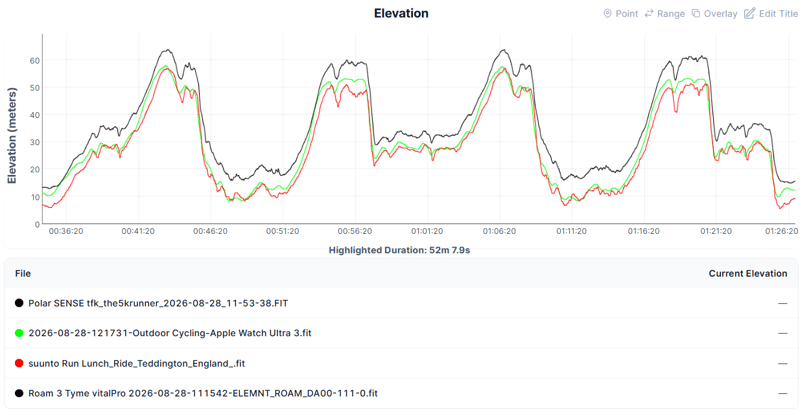
The following chart shows how Suunto Run 2 records elevation during a ride. The start and end elevations are the same, and the ongoing trace appears parallel to that of the Apple Watch and Wahoo Roam 3. It appears accurate, with 200m of elevation gain over an hour in stable atmospheric conditions.
Battery life against the 24-hour claim
The claimed maximum GPS recording time has increased by 20% to 24 hours, which is fine for a running watch at this price point and broadly in line with competitors but superior to smartwatches like the Apple Watch SE. See our sports watch battery life hub for how this compares across the market.
| Mode | Suunto Run 2 | Suunto Run |
|---|---|---|
| Daily use (marketing headline) | Up to 10 days | Up to 12 days |
| Daily use, smartwatch mode (Suunto support page) | Up to 13 days | – |
| High-performance GPS, multi-band | Up to 24 hours | Up to 20 hours |
| Multi-band with Always-on Display | Up to 18 hours | – |
| Single-band GNSS | Up to 30 hours | – |
| Power-saving GNSS | Up to 40 hours | Up to 40 hours |
Suunto’s own support page gives a daily smartwatch-mode figure of “up to 13 days”, which sits oddly against the “10-Day Daily Battery” figure used everywhere else in Suunto’s marketing for this watch. I haven’t tested the single-band, power-saving or 13-day figures myself.
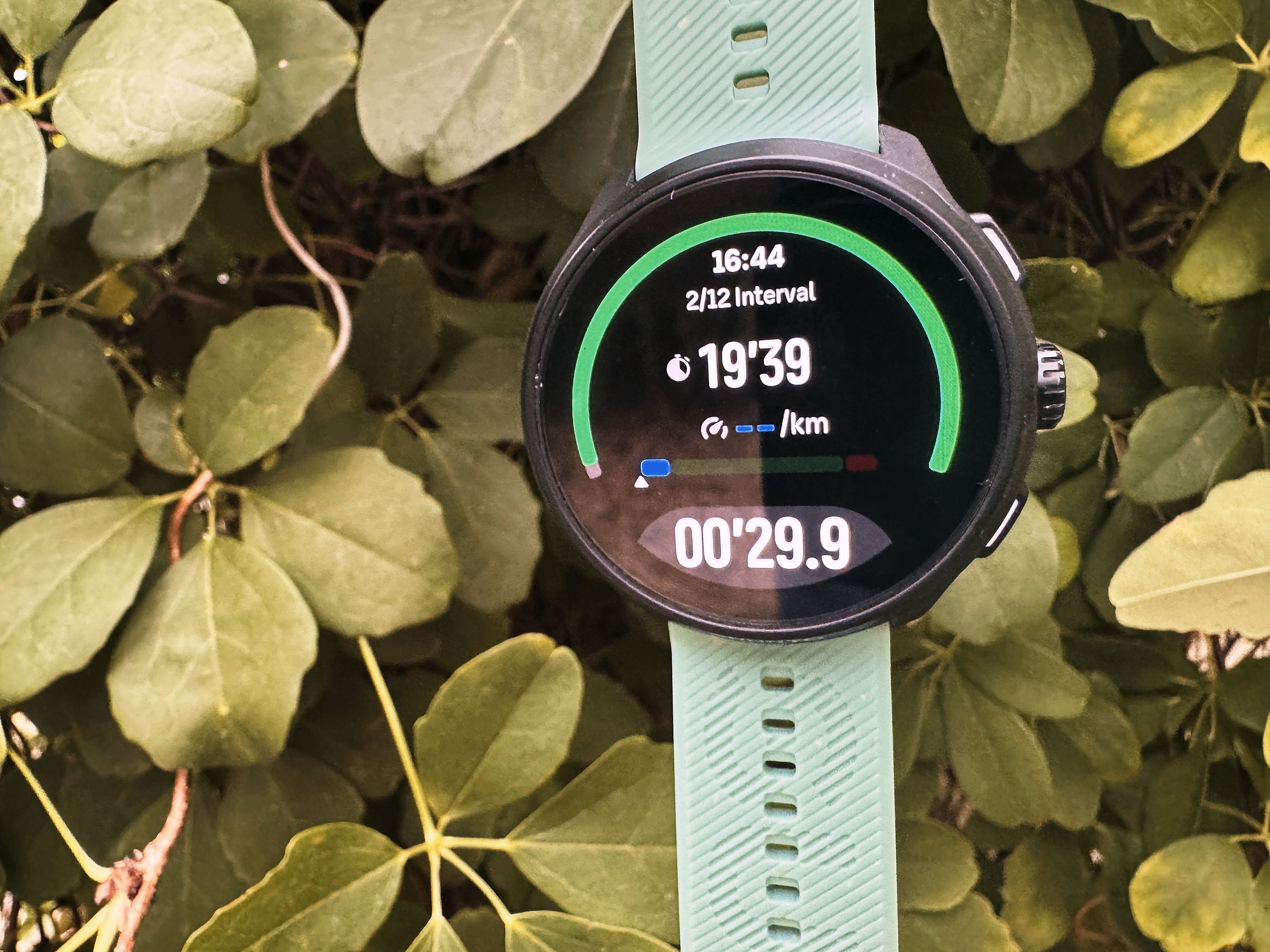
I used High Brightness, a 60-second off-screen time, and Always-on-display as my preferred settings. Based on the average difference between the starting and ending battery percentage figures around a workout, I estimate battery life with my settings to be significantly lower, around 15 or 16 hours. However, with the default settings, the one test I did where I recorded the battery consumption showed a fall from 41% to 37% in just under an hour, which is pretty much in line with the claims. On other occasions, when I started measuring from fully charged (100%), the drop seemed smaller, which is probably a factory calibration issue (i.e., it stayed at 100% for some time, which must be incorrect).
Suunto Coach, ZoneSense, Physiology and Recovery
If you stray beyond the headline features, Suunto Run 2 has many very nice surprises in store for you.
- For the advanced runner, it’s ZoneSense. This feature uses HRV from a quality chest strap to determine your Z2 and Z4 upper limits in real time. This is based on DDFA/dfa a1 and can be a great option for your long runs – as you tire, your Zone 2 limit is adjusted accordingly.
- Suunto training plans are solid, generated and adjusted by Suunto AI Coach based on your progress.
- Ghost Runner lets you follow a previous best-pace effort
- Zone-based training by heart rate, pace and power is all supported
- Progress shows your increasing fitness level (CTL), VO2max, fitness age, Lactate Threshold, and your personalised 5KM PB/PR estimate.
- SuuntoPlus Guides for structured training content, though only manually created guides work. Guides linked to external providers, such as TrainingPeaks, show as incompatible on the Run 2. There’s no access to the SuuntoPlus Sports Apps store, unlike Suunto’s pricier watches.
- EnergySense: a real-time effort tool showing what percentage of your energy remains and how far you can sustain your current pace, based on your lactate threshold. It’s beta and running-only at launch.
Smart features and what is missing
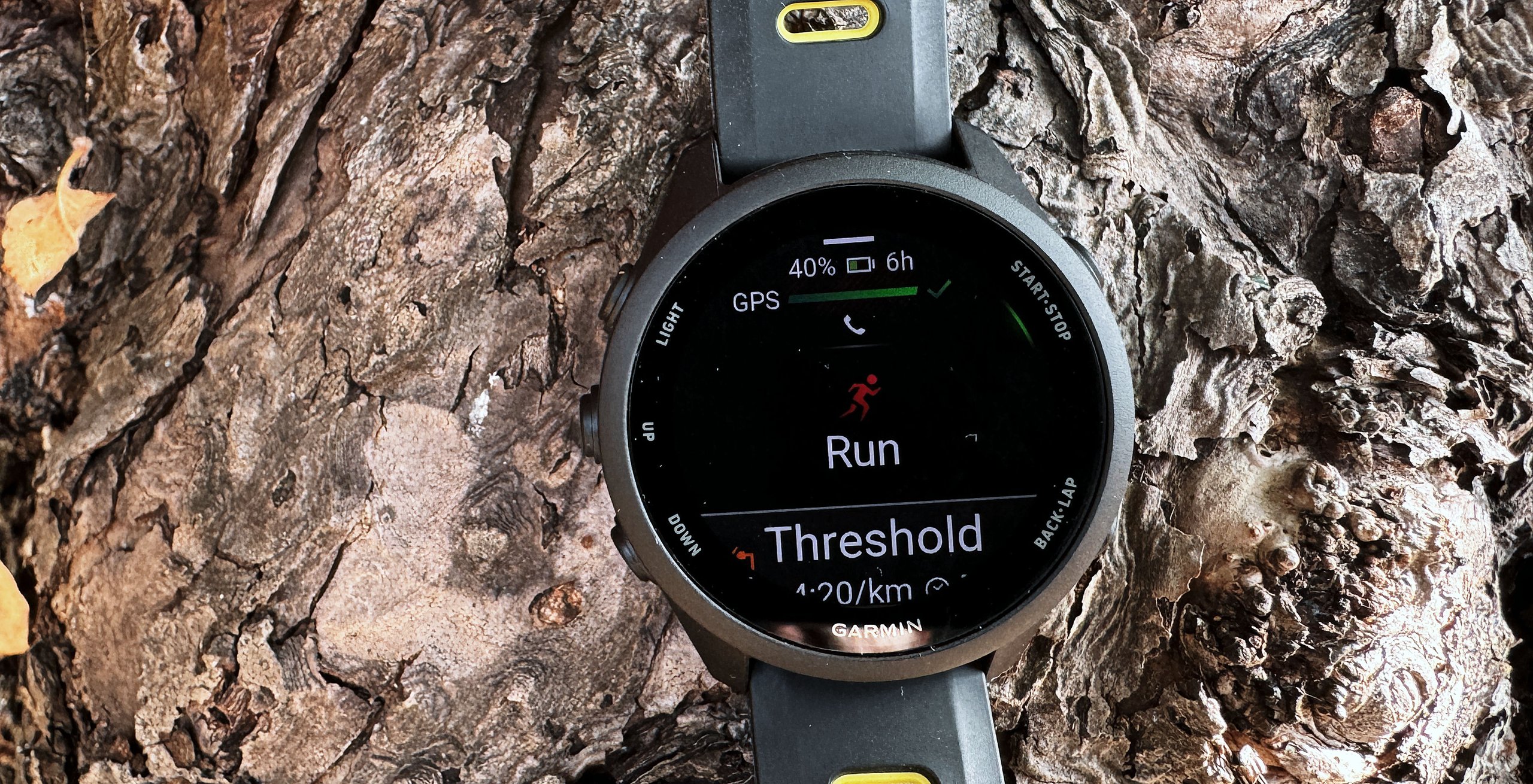
Bluetooth Classic and Low Energy, 2.4GHz and 5GHz Wi-Fi (used for offline map downloads), smartphone notifications, and offline music via drag-and-drop MP3 storage.
The headline smart omissions are simple: no contactless payments, no cellular connectivity, and no streaming music support. But that’s it. If you’re looking for a solid sports watch, Suunto Run 2 is a good contender.
When to get the Forerunner 170 instead, or the Race S
Forerunner 170 has Garmin Pay, a wider range of training features, and additional sensors, none of which the Run 2 has. The Run 2 does have a barometric altimeter and SpO2, carried over from the original Run. The FR170 has no onboard maps, and its GPS is single-frequency, versus the Run 2’s dual-band. The Race S has onboard maps with Climb Guidance, a more detailed navigation feature the Run 2 doesn’t have; both watches include free offline maps as standard. Race S has now been replaced by Race 3S, and Race 3S vs Race 2 vs Run 2 compares all three.
| Model | Price at launch | When to choose it over the Run 2 |
|---|---|---|
| Garmin Forerunner 170 | £259.99 / $299.99 | Choose it for Garmin Pay and a deeper training feature set (Training Readiness, Training Status, wrist-based Running Power) if you’re already in the Garmin ecosystem. The trade-off: single-frequency GPS and no onboard maps at all, against the Run 2’s dual-band GPS and free offline maps on both storage tiers. |
| Suunto Run | $250/£199/€249 | Choose it to save £66–100 if maps and heart rate accuracy genuinely don’t matter to you. Otherwise it’s a false economy: no maps, a less consistent heart rate sensor, and less GPS-mode battery than the Run 2. |
| Suunto Race S | $349 / €349 / £299 | Choose it for Climb Guidance, a more detailed navigation feature the Run 2’s maps don’t include. The trade-off: my own Race S review found its heart rate sensor “inconsistent… if anything worse than the older sensor on the original Race”, against the Run 2’s near-zero HR bias across eight test sessions. Race S is also heavier (63g steel case vs 35g). |
Suunto Run 2 summary specifications
Our database has the full specification details for Suunto Run 2 here.
| Category | Spec |
|---|---|
| Case | 46 x 46 x 11.7mm, stainless steel bezel + polymer case, Gorilla Glass |
| Weight | 35g (watch), ~50 g with strap |
| Display | 1.32″ AMOLED, 466x466px, up to 2,000 nits |
| Water resistance | 5 ATM |
| GNSS | Dual-frequency L1+L5 |
| Satellite systems | GPS, GLONASS, Galileo, BeiDou, QZSS |
| Heart rate | 12-channel optical sensor |
| Storage | 4GB / 64GB models |
| Maps | Free offline maps included on both 4GB and 64GB models |
| Music | Offline MP3 storage, no streaming |
| Battery | 10 days of daily use / 24h high-performance GPS |
| Connectivity | Bluetooth Classic+LE, Wi-Fi 2.4/5GHz; no NFC, no cellular |
Suunto Run 2 price: where to buy
| Region | 4GB | 64GB |
|---|---|---|
| UK | £265 | £299 |
| US | $349 | $399 |
| EU | €299 | €349 |
Suunto Run 2 launched on 8 September 2026, in Aloe Green, All Black and Feather Gold. The box contains: the watch, a 22mm Athletic 6 silicone strap (S/M), a quick guide, a USB-C charging cable, and paperwork.
Suunto Run 2
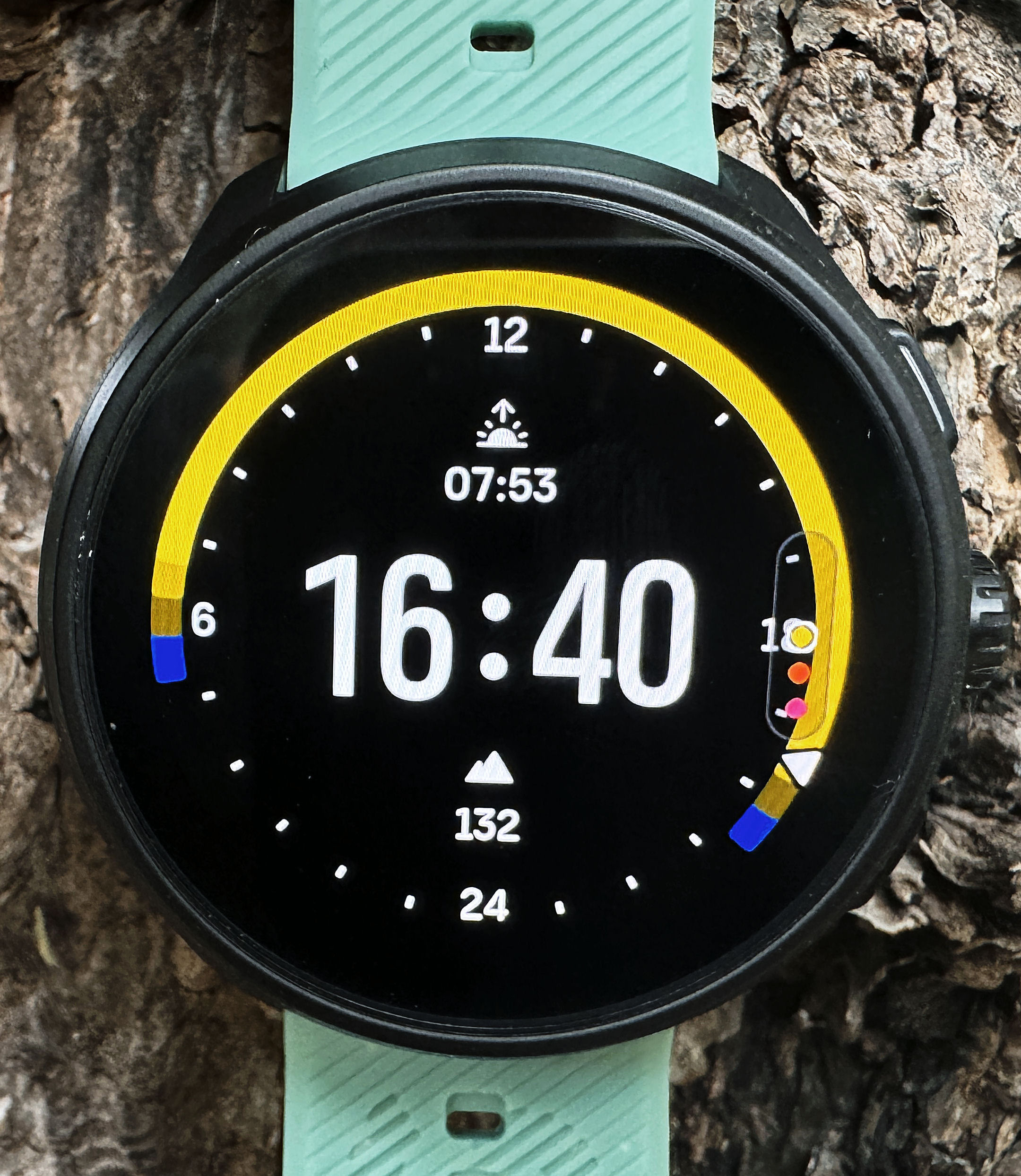
Stainless steel bezel, 1.32" AMOLED (2,000 nits), dual-band GPS, 10-day battery.

Verdict
The Suunto Run 2 is a good pick if you want offline maps without spending flagship money. It works well for someone upgrading an older Suunto, or for beginners who prefer a simple interface over loads of advanced features.
The biggest upgrade is the heart rate sensor. The original Run often needed a chest strap for reliable numbers. This one stayed within 1 bpm of the reference sensors across all my run testing.
GPS was excellent on the standard 10-mile test, scoring 90%. That result didn’t repeat everywhere: errors against known distances elsewhere stayed in single digits or low double digits, solid but not at the same level — nothing that would mess up a workout, but not uniformly outstanding either.
Battery life matched Suunto’s claims in testing.
The main downside is the price. At £265–£299, it’s £66–£100 more than the original Run. If you don’t need the maps or the better heart rate sensor, the older model is better value. But if maps at this price matter to you, no Garmin comes close.
Quick answers
Is the Suunto Run 2 GPS accurate?
It uses dual-band L1 + L5 GNSS, the same frequency setup as the original Run rather than a new capability. The standard 10-mile test score was exceptional at 90%. That didn’t carry through to every test: it landed within 8m of a known distance on a running track and dead on the ratified Kingston parkrun course length, but a trail run under tree cover came in 40m under the average of other devices. Overall, accuracy is strong, with one standout result rather than uniform excellence across every condition.
Does the Suunto Run 2 have offline maps?
Yes, on both the 4GB and 64GB models. Free worldwide offline maps come as standard; the 64GB model just has more storage for map regions and music. The original Run had no offline maps on either version.
How long does the Suunto Run 2 battery last?
Suunto claims up to 10 days daily use and 24 hours in high-performance GPS mode. A direct test showed a drop from 41% to 37% in under an hour of GPS recording with default settings, broadly in line with that claim. With High Brightness, a 60-second off-screen time and Always-on Display enabled, real-world battery life falls to an estimated 15 to 16 hours.
Suunto Run 2 vs Suunto Run: what's different?
Confirmed changes: a 12-channel optical heart rate sensor, offline maps, and a battery trade-off (more GPS-mode runtime, less daily-use runtime). The dual-band GNSS itself is not a new capability, the original Run already had it. For most buyers, the maps and the heart rate sensor are worth the price jump; those who need neither can save money on the original Run.
Is the Suunto Run 2 good for beginners?
Yes. Setup is generally easy, the interface is straightforward, and heart rate accuracy has been excellent throughout testing without needing a chest strap. Beginners who want contactless payments or Spotify streaming should look elsewhere; neither is supported.
How much does the Suunto Run 2 weigh?
35g for the watch body, around 50g with the silicone strap fitted. That’s despite a larger 46mm case than the Garmin Forerunner 170’s 43mm, since the Run 2 uses lighter materials overall.
Suunto Run 2 vs Coros Pace 4: which should I buy?
Both target the same entry-level buyer with dual-band GPS and a similar price. The decisive factors are heart rate accuracy, where the Run 2’s redesigned sensor stayed under 1bpm bias across eight test sessions in our testing, and build quality. Buyers prioritising Suunto’s build quality and app ecosystem should lean Run 2; those wanting the cheapest dual-band option with maps as standard should check current Coros Pace 4 pricing and specs directly.
Last Updated on 15 October 2026 by tfk the5krunner
Small things I always use
- Garmin 90-degree charging adapter: Charges your Garmin from any USB-C cable. Essential when travelling. I use one.
- Body Glide: The blue anti-chafe stick swimmers and runners carry. I use it.
- Speedo earplugs: Fewer ear infections and no cold-water dizziness. I use them.
- Dryrobe Advance: My winter changing robe for open-water swims. I use one. A cheaper option is the AONYIYI changing robe.
- Maurten: Race fuel that stays easy on the stomach. I use them.
- Beet It Sport nitrate shots: Beetroot shots I take in the days before a race. I use them.
- Garmin charging puck: The quickest way to top up before a session. I use one.
- Injinji: Toe socks that stop rubbing, so you run more. I use them.
- Ultimate toe protectors: Stop black toenails on long runs. They work. I use them.
- Compressport R2 v2 calf sleeves: My calf sleeves of choice. I use them.
- Cellucor C4: My pre-workout before hard sessions.
- TPU tubes: Schwalbe Aerothan, Tubolito and Pirelli SmarTube. Light, tiny spares. I use all three.
- G8 insoles: Adjustable insoles that are good. I use them.
- Cycplus Cube: A 97g electric pump that gets a road tyre rideable in two minutes. I carry one. 5% off with code THE5KRUNNER.
Watches and sensors
- Polar H10: My daily driver for waking HRV.
- Polar Verity Sense: My backup arm-worn HR sensor.
- Nomad bedside charger: Charges my iPhone and Apple Watch overnight. I use it, and many of their bands.
- Train.Red: The best muscle oxygen sensor I’ve used.
- Tymewear: Accurate heart rate and reliable ventilatory zones. I use it to pace endurance rides over an hour.
- Garmin Forerunner 970: A pro-grade triathlon watch. I use this.
- Apple Watch Ultra 4: My daily smartwatch. No phone needed on rides.
- Garmin Fenix 9 Pro: I’ve just bought one.
On the bike
- Continental GP5000 for everyday riding, and Aero 111 on the front for special occasions.
- Helmets: Specialized S-Works Evade 3 for road riding, and Rudy Project Wing for TT-style races. I use both.
- Ravemen FR300: A front light that mounts under your Garmin or Wahoo. I use one.
- Wahoo TRACKR Radar: I use it on one bike and Varia on the other. They perform the same.
- Garmin Varia RTL515: Radar that warns you of cars from behind. I use this model.
- Wahoo ELEMNT Roam 3: The bike computer that’s easy to use. I use mine on most rides.
- Favero Assioma Pro RS2: Accurate power pedals that swap easily between bikes. I use this model.
Home and indoor training
- NPE Runn: Makes my basic treadmill smart, sending more accurate speed and distance to my watch and Zwift. I use it.
- Google Wifi: Keeps Zwift connected in my pain cave. I use it.
- Apple TV 4K: Zwift on the big screen. I use two.
- Google Nest Doorbell (wired, 2nd gen): My video doorbell, running in both Google Home and Apple Home. I use it.
Health, recovery and sleep
- FreeStyle Libre 3 Plus: Shows how my blood sugar responds to diet.
- hDrop: Measures my sweat loss in summer and indoors.
- Fourth Frontier Zone: Checks my heart under load in hard sessions.
- Oura Ring 5: My partner’s recovery tracker of choice.
- Eight Sleep: A cooling mattress cover my partner and I use nightly.
Reader-Powered Content

This content is not sponsored. It’s mostly me behind the labour of love, which is this site, and I appreciate everyone who supports it.
Support the site: Follow (free, fewer ads) · Subscribe (paid, ad-free) · Buy Me A Coffee
Written by real people, with AI assistance. Fact-checked and verified for originality. See the Editorial Policy. FTC: Affiliate Disclosure — some links pay commission. As an Amazon Associate, I earn from qualifying purchases.
tfk is the founder and author of the5krunner, an independent endurance sports technology publication. With 20 years of hands-on testing of GPS watches and wearables, and competing in triathlons at an international age-group level, tfk provides in-depth expert analysis of fitness technology for serious athletes and endurance sport competitors. See the gear tfk uses. ID

Very interesting move here, Suunto and Coros are strength challengers compared to Garmin and now we have a lot alternative to FR970.
Amazfit is from my personal experience interesting too and it’s software strategy is now clear and shared to the customers.
Thanks for your review !
Good to see that Suunto is releasing new and improved watches, even though I am not switching from Garmin…at this point. But this watch wouldn’t be for me anyway since I will never go back to a sport watch without a flashlight and after owning the X1 for a couple of month, I prefer the possibility to operate the watch with buttons only.
COROS Pace 4 Pro will be released on September 22 at 9:00 PM Beijing Time.
The COROS Pace 4 Pro will be released on September 22 at 9:00 PM Beijing Time.
ty !
Run just got the climbing guidance, so I’m surprised Run 2 didn’t get it. Are you sure?
Hi, you have a mistake at “Race S is also heavier (63g steel case vs 35g) and Bluetooth-only, with no Wi-Fi for map downloads.” -it has wifi for map download. Nice review tho, thanks!
You’re right, thanks for the catch — Race S does have Wi-Fi
I’m wondering if the watch can perform basic media controls to whatever source is already playing from my phone (is. Pause, start, Skip forward, skip back)
I used this capability year’s ago on a polar watch and it was all I needed. I have a Garmin Epix gen 2 now, and never use the Spotify integration (or contactless payment) – I find the Garmin GPS to be poor and slow to adjust to pace changes (which is really annoying on pace targeted intervals etc), and this Suunto might be ideal for me
yes it controls either music playing from the mp3 on the watch or controls the media player on the connected phone
Excellent findings.
I wonder why all of the Sunnto watches don’t have Bluetooth calling support along with ECG.
Also, if you can also show us details on what is shown on the Maps view during navigation, that would be hepful.
Btw, waiting on the Race 3 and Coros Pace 4 Pro on what it is offering 🙂