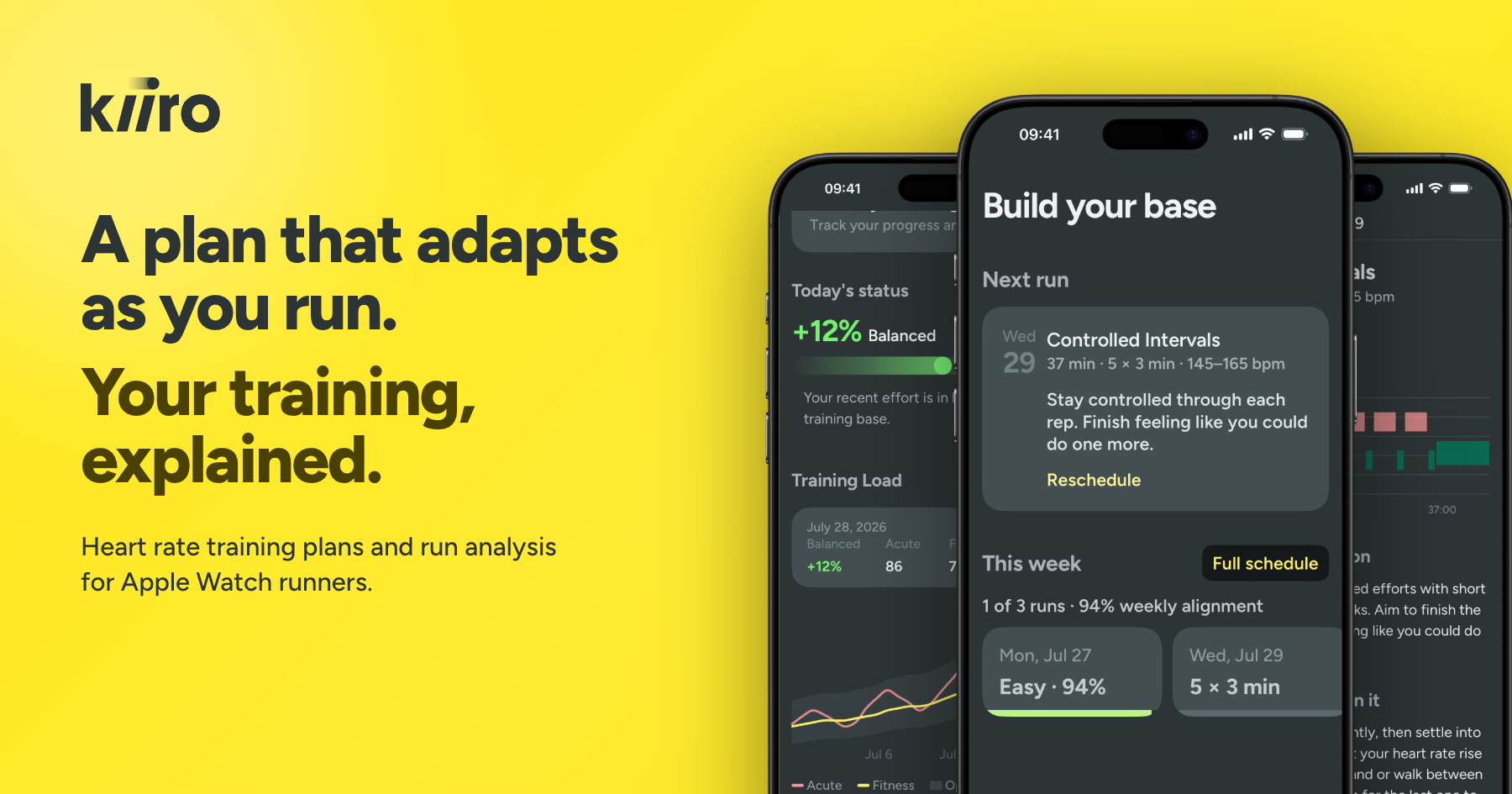
A pace target assumes every day is the same. After a short night, a stressful week or a hard session earlier in the week, the usual easy pace costs far more than an easy effort. Hills and heat do the same. Holding the number turns the easy day into a moderate one, and slowing down feels like failing the session.
Heart rate follows what a run costs, whatever the cause. Kiiro, an iPhone app for Apple Watch runners, uses it on both sides of training: a training plan sets what to run next, and the analysis shows whether it is working.
How Kiiro works
TL;DR: Kiiro syncs Apple Watch runs from Apple Health and builds a training plan from the runner’s own history. Each run has a heart rate target instead of a pace, and each week adjusts to what was run. Kiiro also shows whether the training is working, through training load, Fitness level, Load balance, same-route comparisons and personal bests.
The heart rate plan
The plan starts from what the runner has been doing: the last three weeks and an eight-week baseline of how often, how long and how hard. It also takes the available days, weekly time, long-run day and whether the aim is to build or maintain fitness. It keeps most running easy and adds harder work in small steps.
Each session has a clear job.
Easy Run and Long Run
These runs are the base of the plan. The instruction reads: “Keep this one relaxed and finish with plenty left.”
Endurance Run
An Endurance Run puts a steady block in the middle of an easy run.
Controlled Intervals
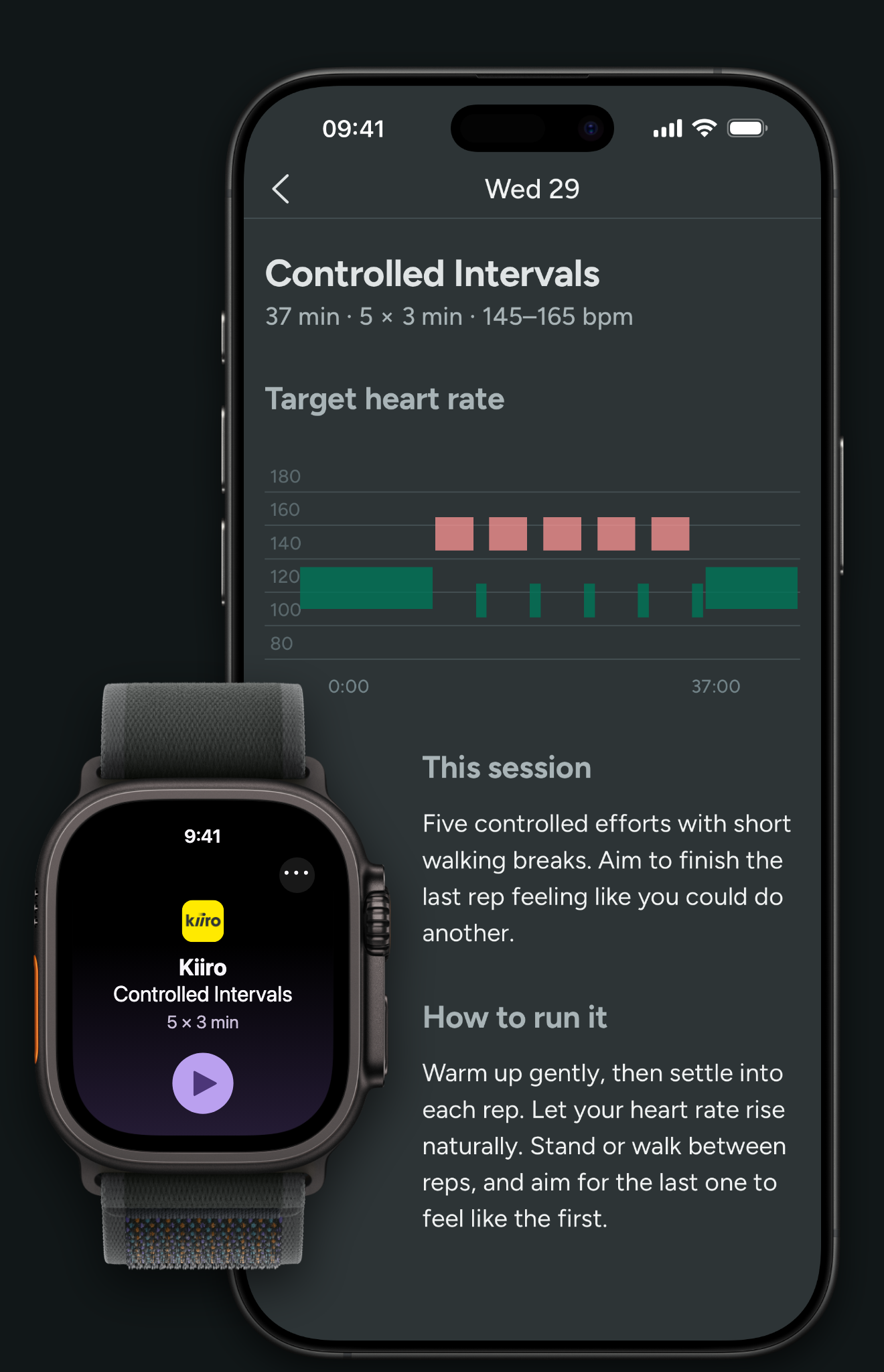
Controlled Intervals are repetitions of 3 to 10 minutes, run controlled and not flat out, with standing or walking breaks. The instruction reads: “Let heart rate rise naturally during each rep.”
Every session comes with a heart rate target and no pace target. The pace that comes with it depends on the day.
On the watch
Planned sessions appear in the Workout app on Apple Watch, with a heart rate alert on each step when the runner drifts above or below its range.
Scoring and wrist heart rate
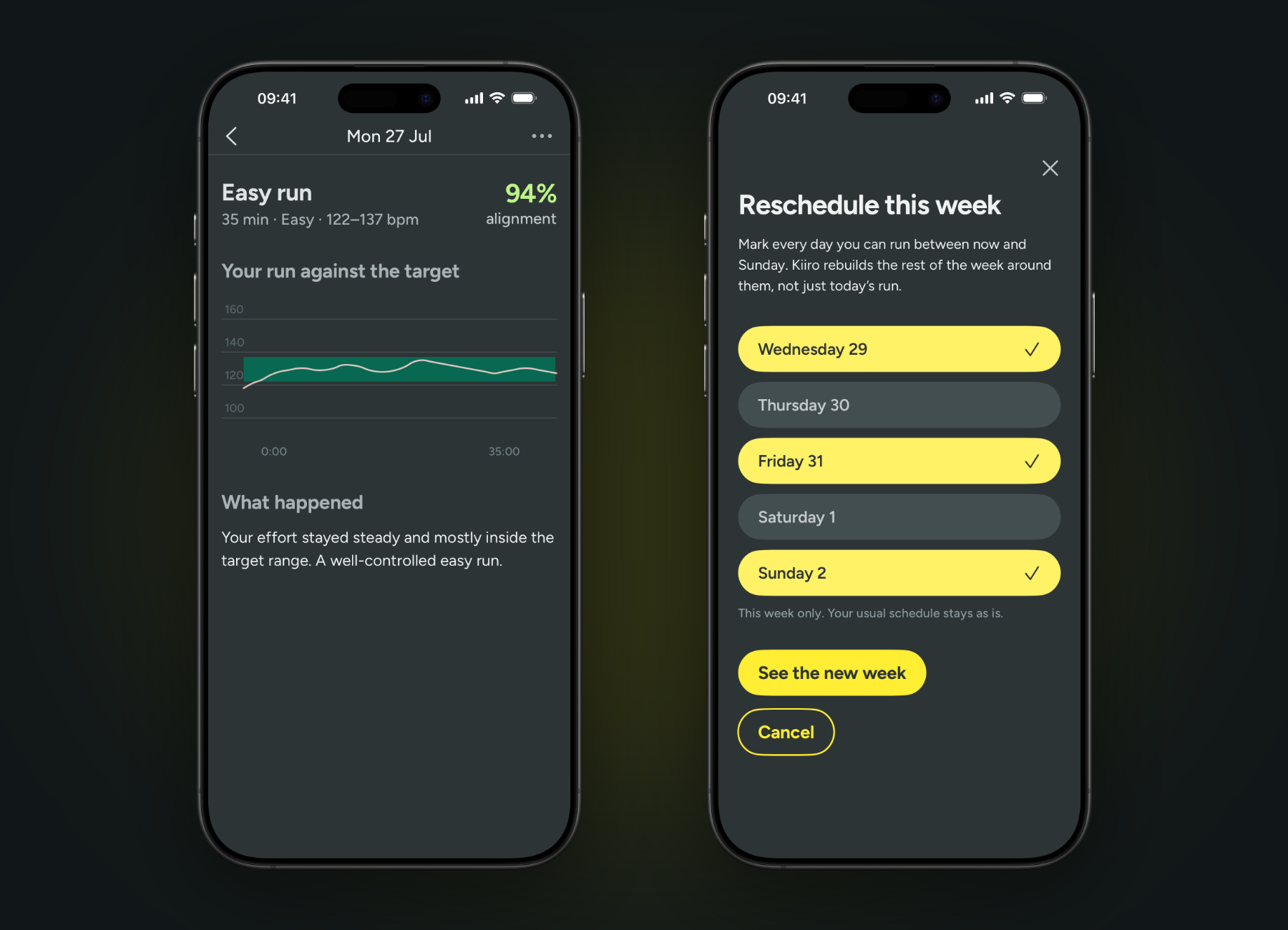
After the run, Kiiro scores duration and time in range. Pace plays no part, so a slow run on a heavy day still scores well. The score allows 3 bpm either side of the range. Below-range heart rate in the first 60 seconds of a repetition does not count, because heart rate lags. No repetition is shorter than three minutes.
Week to week
Each new week, the plan makes at most one main change based on what was run: more weekly time, a longer or extra interval block, or shorter recoveries. Otherwise it holds the week, or cuts back when recent load runs high against Fitness level. A missed or extra run can prompt an offer to rebuild the rest of the week.
Is it working? The analysis
Every run gets a training load from its heart rate, so a long easy run and a short hard session land on the same scale. From that, Kiiro builds three views:
- Fitness level and Load balance are a 42-day and a 7-day average of training load. Load balance shows how far the recent average sits above or below fitness, named from Fresh through Balanced and Building to Fatigued.
- Route progress matches runs on the same route automatically, so the same loop at the same pace with a lower heart rate shows up as progress.
- Personal bests are found inside every run, alongside trends for VO2 max, resting heart rate and heart rate variability from Apple Health.
Worked example: Jaro’s numbers
These numbers are Jaro’s own: a week of a Kiiro plan from late September 2026, and the build to an April 2026 marathon before that.
A week that adapted
The table shows the plan adapting after an unplanned run on a rest day.
| Day | Before | After |
|---|---|---|
| Mon | Rest | Unplanned run, 48 min |
| Tue | Intervals 4 × 3 min | Rest |
| Wed | Easy 45 min | Intervals 4 × 3 min |
| Thu | Easy 45 min | Easy 45 min |
| Fri | Endurance 45 min | Easy 45 min |
| Sat | Rest | Rest |
| Sun | Long 70 min | Long 65 min |
| Week | 245 min | 243 min, with Monday’s run |
Monday’s run counted toward the week, so the total stayed about the same. The next week went back to 245 minutes, with one change: five interval repetitions instead of four.
A hilly long run
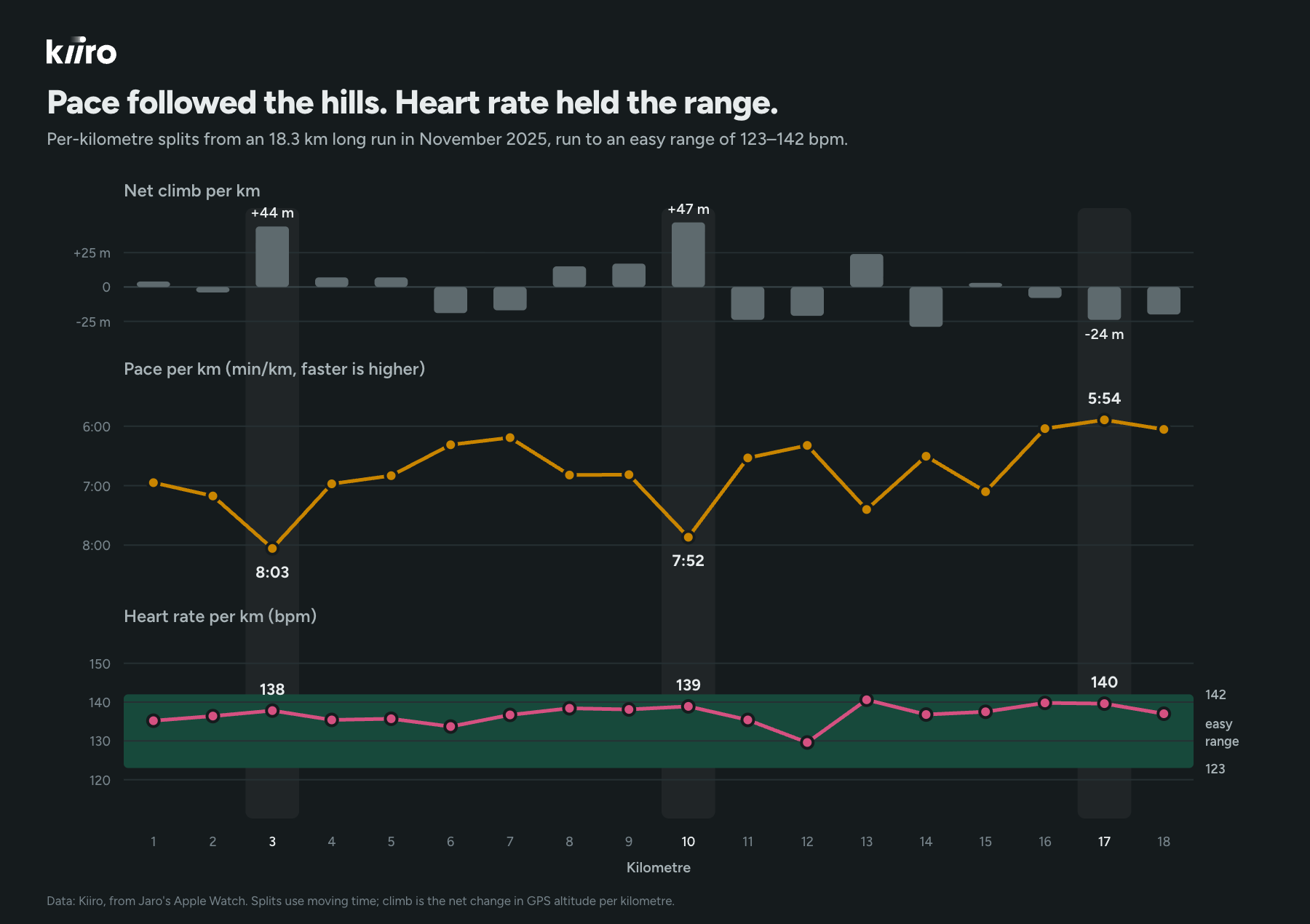
In November 2025, during the build to the marathon, Jaro ran an 18.3 km long run with 288 m of climbing to an easy range of 123 to 142 bpm. Pace ranged from 5:54 to 8:03 per kilometre, while heart rate stayed between 130 and 141 bpm.
Progress on a familiar loop
Kiiro tracks runs on the same route, so progress shows up on a familiar loop. These are the averages on Jaro’s 8.5 km loop before and after the build.
| The 8.5 km loop | Pace | Heart rate |
|---|---|---|
| November 2025, 5 runs | 6:47 /km | 138 bpm |
| March to April 2026, 5 runs | 6:21 /km | 136 bpm |
By spring, the loop was 26 seconds per kilometre faster at a heart rate 2 bpm lower, and the build ended with a 3:42 marathon in April 2026.
Integrations, compatibility and price
- Kiiro works only with Apple Watch. It needs a Series 4 or later, any SE or Ultra, and an iPhone on iOS 18 or later. The best Apple Watch for sport guide covers the current models.
- Kiiro reads runs from Apple Health with heart rate, route, elevation, power and form metrics, plus VO2 max, resting heart rate, heart rate variability and cardio recovery.
- Runs sync to Kiiro’s servers for the plan and the analysis. Kiiro does not export files or send runs to other services.
- The plan needs Kiiro Pro, which costs $14.99 a month or $99.99 a year in the US. The analysis is free.
Background
Kiiro is built by three runners: Jaro on the backend and plan engine, Ivan on the iOS app and Eduard on design. It grew out of Jaro’s frustration with pace plans, and with jumps in training load that were hard to sustain. The name comes from kiire, Estonian for fast.
Kiiro is on the App Store.
More: kiiro.app
Quick answers
Is heart rate training better than pace training for running?
Heart rate tracks what a run costs on the day, so the target still fits after poor sleep, on hills or in heat. A fixed pace does not adjust for any of those. Kiiro gives every session a heart rate range and scores the run on time in range, with pace playing no part.
Does Kiiro need a chest strap?
No, the watch’s own heart rate sensor is enough. A Bluetooth strap paired with Apple Watch works too, and Kiiro uses its readings for the scoring and the analysis. A strap helps most on interval days.
Which Apple Watch models work with Kiiro?
Kiiro works with Apple Watch Series 4 or later and any SE or Ultra, paired with an iPhone on iOS 18 or later. It does not work with Garmin or other watches, or with Android phones.
How does the Kiiro plan change from week to week?
Each new week the plan makes at most one main change based on what was run. That change is more weekly time, a longer or extra interval block, or shorter recoveries. Otherwise it holds the week, or cuts back when recent load is high against Fitness level.
Can the Kiiro plan fit around a busy week?
Yes, Reschedule marks the days still free this week, and Kiiro rebuilds all the remaining sessions around them. The usual schedule stays as it is.
Can Kiiro be used without the plan?
Yes, the analysis works on its own for every run synced from Apple Health. It covers training load, Fitness level, Load balance, route progress and personal bests, and it is free.
How much does Kiiro cost?
The analysis is free. The heart rate training plan needs Kiiro Pro, which costs $14.99 a month or $99.99 a year in the US.
Related reading
- Somvia: threshold, critical power and race times from Apple Watch data
- SportVitals: transparent training load and HRV for Apple Watch
- Fit File Forge: 120 classic workouts ready for Garmin
Previous Indie Spotlight: Padel Smash: padel scoring on Garmin, called out loud
Author: Jaro, Ivan and Eduard, the team behind Kiiro, edited by the5krunner.
Last Updated on 6 October 2026 by tfk the5krunner
Small things I always use
- Garmin 90-degree charging adapter: Charges your Garmin from any USB-C cable. Essential when travelling. I use one.
- Body Glide: The blue anti-chafe stick swimmers and runners carry. I use it.
- Speedo earplugs: Fewer ear infections and no cold-water dizziness. I use them.
- Dryrobe Advance: My winter changing robe for open-water swims. I use one. A cheaper option is the AONYIYI changing robe.
- Maurten: Race fuel that stays easy on the stomach. I use them.
- Garmin charging puck: The quickest way to top up before a session. I use one.
- Injinji: Toe socks that stop rubbing, so you run more. I use them.
- Ultimate toe protectors: Stop black toenails on long runs. They work. I use them.
- Compressport R2 v2 calf sleeves: My calf sleeves of choice. I use them.
- Cellucor C4: My pre-workout before hard sessions.
- TPU tubes: Schwalbe Aerothan, Tubolito and Pirelli SmarTube. Light, tiny spares. I use all three.
- G8 insoles: Adjustable insoles that are good. I use them.
- Cycplus Cube: A 97g electric pump that gets a road tyre rideable in two minutes. I carry one. 5% off with code THE5KRUNNER.
Watches and sensors
- Polar H10: My daily driver for waking HRV.
- Polar Verity Sense: My backup arm-worn HR sensor.
- Nomad bedside charger: Charges my iPhone and Apple Watch overnight. I use it, and many of their bands.
- Train.Red: The best muscle oxygen sensor I’ve used.
- Tymewear: Accurate heart rate and reliable ventilatory zones. I use it to pace endurance rides over an hour.
- Garmin Forerunner 970: A pro-grade triathlon watch. I use this.
- Apple Watch Ultra 4: My daily smartwatch. No phone needed on rides.
- Garmin Fenix 9 Pro: I’ve just bought one.
On the bike
- Continental GP5000 for everyday riding, and Aero 111 on the front for special occasions.
- Helmets: Specialized S-Works Evade 3 for road riding, and Rudy Project Wing for TT-style races. I use both.
- Ravemen FR300: A front light that mounts under your Garmin or Wahoo. I use one.
- Wahoo TRACKR Radar: I use it on one bike and Varia on the other. They perform the same.
- Garmin Varia RTL515: Radar that warns you of cars from behind. I use this model.
- Wahoo ELEMNT Roam 3: The bike computer that’s easy to use. I use mine on most rides.
- Favero Assioma Pro RS2: Accurate power pedals that swap easily between bikes. I use this model.
Home and indoor training
- NPE Runn: Makes my basic treadmill smart, sending more accurate speed and distance to my watch and Zwift. I use it.
- Google Wifi: Keeps Zwift connected in my pain cave. I use it.
- Apple TV 4K: Zwift on the big screen. I use two.
- Google Nest Doorbell (wired, 2nd gen): My video doorbell, running in both Google Home and Apple Home. I use it.
Health, recovery and sleep
- FreeStyle Libre 3 Plus: Shows how my blood sugar responds to diet.
- hDrop: Measures my sweat loss in summer and indoors.
- Fourth Frontier Zone: Checks my heart under load in hard sessions.
- Oura Ring 5: My partner’s recovery tracker of choice.
- Kineon MOVE+: Red light therapy for niggles. It works.
- Eight Sleep: A cooling mattress cover my partner and I use nightly.
Reader-Powered Content
This content is not sponsored. It’s mostly me behind the labour of love, which is this site, and I appreciate everyone who supports it.
Support the site: Follow (free, fewer ads) · Subscribe (paid, ad-free) · Buy Me A Coffee ❤️
Written by real people, with AI assistance. Fact-checked and verified for originality. See the Editorial Policy. FTC: Affiliate Disclosure — some links pay commission. As an Amazon Associate, I earn from qualifying purchases.
tfk is the founder and author of the5krunner, an independent endurance sports technology publication. With 20 years of hands-on testing of GPS watches and wearables, and competing in triathlons at an international age-group level, tfk provides in-depth expert analysis of fitness technology for serious athletes and endurance sport competitors. ID
