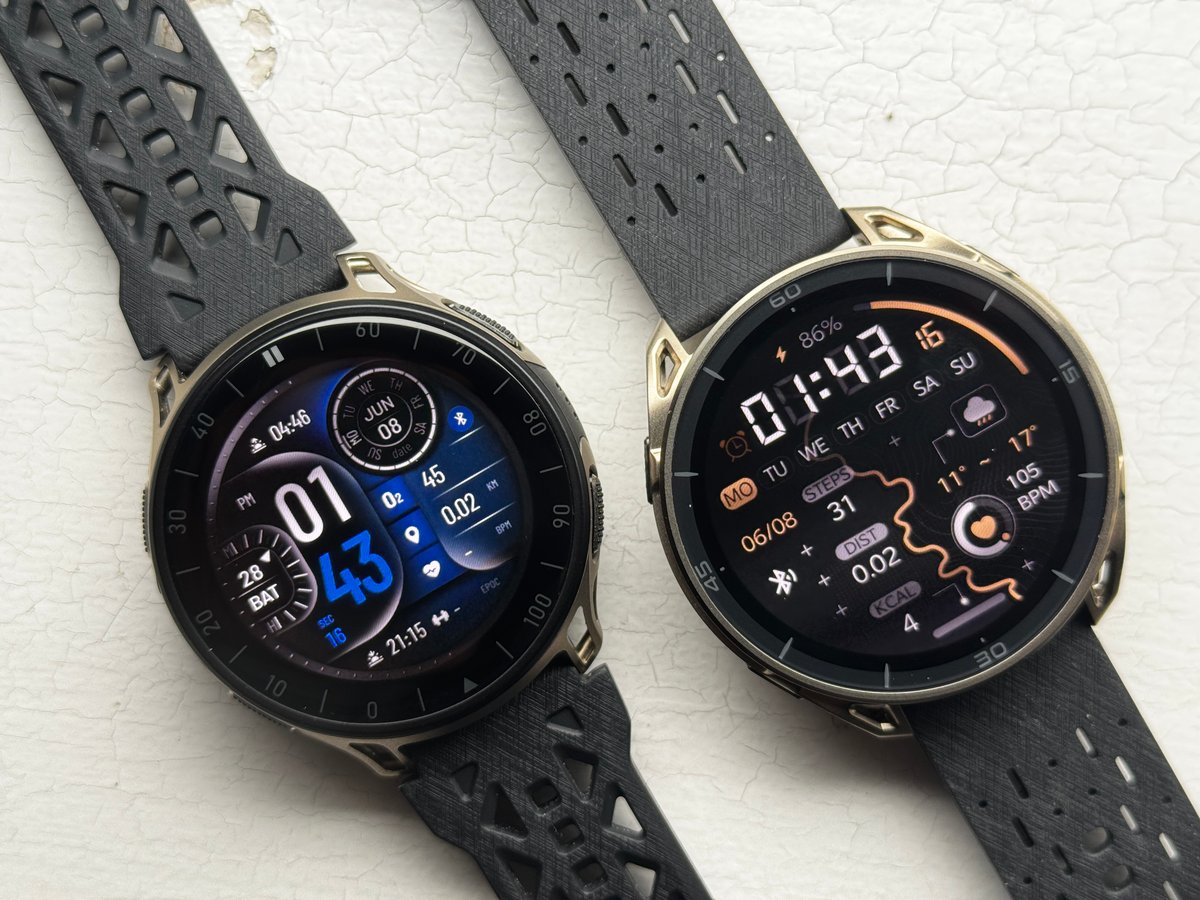
A community benchmark puts the Amazfit Cheetah 2 Ultra at the top of the Zepp OS range, but its lead comes from faster storage rather than faster calculation.
Background
Amazfit’s launch release on 13 May 2026 claims the Cheetah 2 Ultra renders maps 2.5 times faster and refreshes them 12 times faster than before, and Amazfit made the same claim at the June launch of the Balance 3. The user-run ZeppBench results put Cheetah 2 Ultra top at 1,093, but calculation scores barely move between models, and its lead comes from two of the three storage tests.
| Watch | Total score | Calculations | Local storage | EasyStorage | Large files |
|---|---|---|---|---|---|
| Cheetah 2 Ultra | 1,093 | n/a | 804 | 498 | 402 |
| Balance 3 | 967 | 2,639 | 777 | 305 | 326 |
| Bip 6 | 963 | 2,633 | 866 | 357 | 274 |
| T-Rex 3 Pro | 896 | 2,442 | 659 | 372 | 184 |
| Balance 2 | 863 | 2,606 | 562 | 278 | 277 |
| T-Rex Ultra 2 | 860 | n/a | n/a | n/a | n/a |
| T-Rex 3 | 755 | n/a | n/a | n/a | n/a |
| Active 2 | 401 | n/a | n/a | n/a | n/a |
Source: ZeppBench community database
A Reddit post by u/oa_i credits the faster maps to 8 MB of on-chip memory in the “S” revision chips (ZPS3044S in Balance 3 and HS3s in Cheetah 2 Ultra), up from about 2.5 MB. It’s a good theory, but it comes from a Redditor, not Zepp. The same post claims the Cheetah 2 Pro’s HS3 chip misses out and that the Ultra’s chip cleans up GPS tracks in canyons and forests. I’m not convinced by either.
What it means
The hard numbers say the newest Amazfit chips aren’t any faster at number-crunching than a Balance 2. What has improved is how fast the watch moves data in and out of memory and storage, which fits Amazfit’s own claims about map rendering, since maps are the heaviest data job a watch does. The memory theory makes sense, but the benchmark doesn’t test maps at all. Bip 6 scores almost the same as Balance 3, yet Amazfit recently blamed memory for limiting Bip 6 updates, so the headline score clearly misses something.
Nothing changes for owners. For buyers, Amazfit’s map claims apply only to the Balance 3 and Cheetah 2 Ultra, so anyone who leans on maps mid-run should stick to those two. Ignore the GPS claim. Satellite tracking runs on a separate positioning chip, and the Cheetah 2 Ultra scored 85% in the5krunner’s 10-mile accuracy test – pretty darn good but not the very best.
Why Garmin maps still lag
Garmin has the opposite problem. Its maps are vector, not raster, so the watch draws every road, path and contour line from raw data each time you pan or zoom. COROS sends pre-drawn image tiles instead, which take far less processing. The Fenix 8 Pro does that drawing on a 2020 processor with 5MB of RAM, compared with about 37MB on the chip COROS, Suunto, and Polar use. The Fenix 9 Pro has 50% more RAM, but in my map lag tests it still took up to 6 seconds to pan with layers on and up to 15 seconds to redraw when zoomed out. The Amazfit T-Rex Ultra 2, on Amazfit’s older chip, passed the same test comfortably.
Quick answers
Which Amazfit watch has the fastest processor?
Cheetah 2 Ultra has the highest community ZeppBench score at 1,093, ahead of Balance 3 at 967. Its lead comes from storage speed, and calculation scores are almost the same across recent models.
Does Cheetah 2 Ultra have more memory than Balance 2?
Probably. A Reddit analysis puts it at 8 MB of on-chip memory against about 2.5 MB on older chips, though Amazfit doesn’t say.
Related: Cheetah 2 Ultra review, Cheetah 2 Ultra vs Cheetah 2 Pro, Balance 3 vs Balance 2, and the Amazfit hub.
Source and original research by: the5krunner and r/amazfit.
Last Updated on 3 November 2026 by tfk the5krunner
Small things I always use
- Garmin 90-degree charging adapter: Charges your Garmin from any USB-C cable. Essential when travelling. I use one.
- Body Glide: The blue anti-chafe stick swimmers and runners carry. I use it.
- Speedo earplugs: Fewer ear infections and no cold-water dizziness. I use them.
- Dryrobe Advance: My winter changing robe for open-water swims. I use one. A cheaper option is the AONYIYI changing robe.
- Maurten: Race fuel that stays easy on the stomach. I use them.
- Beet It Sport nitrate shots: Beetroot shots I take in the days before a race. I use them.
- Garmin charging puck: The quickest way to top up before a session. I use one.
- Injinji: Toe socks that stop rubbing, so you run more. I use them.
- Ultimate toe protectors: Stop black toenails on long runs. They work. I use them.
- Compressport R2 v2 calf sleeves: My calf sleeves of choice. I use them.
- Cellucor C4: My pre-workout before hard sessions.
- TPU tubes: Schwalbe Aerothan, Tubolito and Pirelli SmarTube. Light, tiny spares. I use all three.
- G8 insoles: Adjustable insoles that are good. I use them.
- Cycplus Cube: A 97g electric pump that gets a road tyre rideable in two minutes. I carry one. 5% off with code THE5KRUNNER.
Watches and sensors
- Polar H10: My daily driver for waking HRV.
- Polar Verity Sense: My backup arm-worn HR sensor.
- Nomad bedside charger: Charges my iPhone and Apple Watch overnight. I use it, and many of their bands.
- Train.Red: The best muscle oxygen sensor I’ve used.
- Tymewear: Accurate heart rate and reliable ventilatory zones. I use it to pace endurance rides over an hour.
- Garmin Forerunner 970: A pro-grade triathlon watch. I use this.
- Apple Watch Ultra 4: My daily smartwatch. No phone needed on rides.
- Garmin Fenix 9 Pro: I’ve just bought one.
On the bike
- Continental GP5000 for everyday riding, and Aero 111 on the front for special occasions.
- Helmets: Specialized S-Works Evade 3 for road riding, and Rudy Project Wing for TT-style races. I use both.
- Ravemen FR300: A front light that mounts under your Garmin or Wahoo. I use one.
- Ravemen FR1000: The light and the computer mount in one unit, so nothing else goes on the bars. Better than mine.
- Ravemen FR1500SE: 1,500 lumens hanging under your Garmin, for proper night rides.
- Ravemen FR1100SE: 1,100 lumens under your Garmin, and up to 46 hours on slow flash.
- Ravemen FR500: A brighter FR300 with the same mount.
- Wahoo TRACKR Radar: I use it on one bike and Varia on the other. They perform the same.
- Garmin Varia RTL515: Radar that warns you of cars from behind. I use this model.
- Wahoo ELEMNT Roam 3: The bike computer that’s easy to use. I use mine on most rides.
- Favero Assioma Pro RS2: Accurate power pedals that swap easily between bikes. I use this model.
Home and indoor training
- NPE Runn: Makes my basic treadmill smart, sending more accurate speed and distance to my watch and Zwift. I use it.
- Google Wifi: Keeps Zwift connected in my pain cave. I use it.
- Apple TV 4K: Zwift on the big screen. I use two.
- Google Nest Doorbell (wired, 2nd gen): My video doorbell, running in both Google Home and Apple Home. I use it.
Health, recovery and sleep
- FreeStyle Libre 3 Plus: Shows how my blood sugar responds to diet.
- hDrop: Measures my sweat loss in summer and indoors.
- Fourth Frontier Zone: Checks my heart under load in hard sessions.
- Kineon MOVE+: Red and infrared light for sore knees, Achilles and other joints after hard training. I use it.
- Oura Ring 5: My partner’s recovery tracker of choice.
- Eight Sleep: A cooling mattress cover my partner and I use nightly.
Reader-Powered Content

This content is not sponsored. It’s mostly me behind the labour of love, which is this site, and I appreciate everyone who supports it.
Support the site: Follow (free, fewer ads) · Subscribe (paid, ad-free) · Buy Me A Coffee
Written by real people, with AI assistance. Fact-checked and verified for originality. See the Editorial Policy. FTC: Affiliate Disclosure — some links pay commission. As an Amazon Associate, I earn from qualifying purchases.
tfk is the founder and author of the5krunner, an independent endurance sports technology publication. With 20 years of hands-on testing of GPS watches and wearables, and competing in triathlons at an international age-group level, tfk provides in-depth expert analysis of fitness technology for serious athletes and endurance sport competitors. See the gear tfk uses. ID
