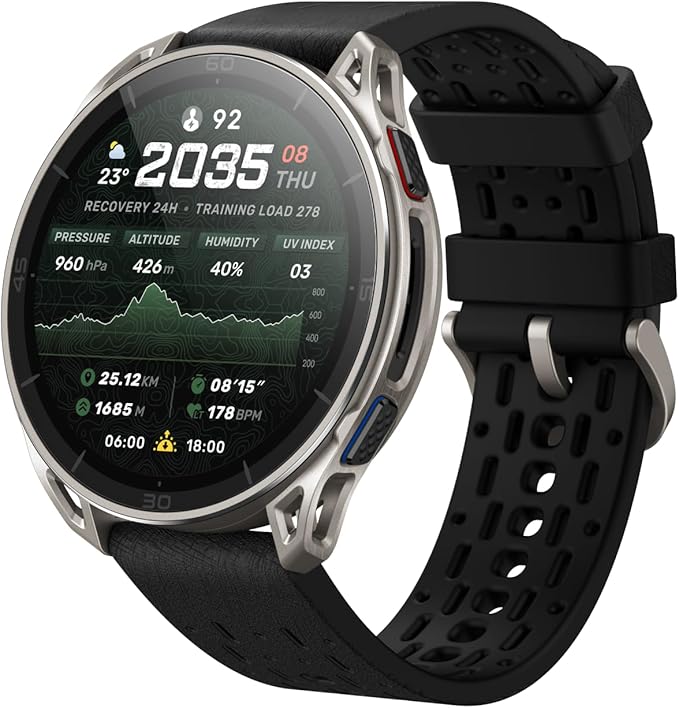
The Cheetah 2 Ultra is the watch Amazfit should have built first. The Cheetah 2 Pro launched only a few weeks earlier in April 2026 with premium materials and one puzzling decision: a smallish 1.32″ display inside a 48mm case. The Ultra fixes that. A 1.5″ display in a 47.4mm case means the black bezel area is proportionally smaller. The watch simply looks better on the wrist. That is not a trivial consideration if you are forking out $599.00/£599.90.
Beyond aesthetics, the case for the Ultra over the Pro comes down to two things: battery life and trail running. The 780 mAh battery, compared to the Pro’s 540 mAh, is a genuine step up. Real-world GPS testing projected 55 hours in full-accuracy mode, nearly double the Pro’s 31-hour claim. If battery endurance shapes how you choose a watch, that number settles the argument. For trail runners, the Ultra adds Trail Running mode with terrain load factor, full-colour contour maps, and the Elevation Overview feature. The Pro has none of these.
For road runners, marathon and half-marathon runners who stay on tarmac, duathletes, and general training, the Pro’s feature set is identical to the Ultra’s. You are paying £150 for a bigger screen, a bigger battery, and a flashlight with more modes. The buying decision depends on your wrist size, the terrain you’ll be in, and how much aesthetics matter to you day to day.
Heads up: this is a media loaner, and the brand does not pay for the review. If you want to support the truly independent work here, please buy from one of the affiliated links or become a supporter. I’ve been a GB Age-Group multisport athlete for over 15 years and am currently in training for a Hyrox. For me, sports tech makes my sport more interesting and enjoyable – hence this site.
Listen to the discussion
Amazfit Cheetah 2 Ultra Review: Trail Watch Tested
The most complete watch Amazfit has built. But is it worth £600?
The Cheetah 2 Ultra improves on the Pro across every measurable dimension: GPS accuracy up from 73% to 85%, heart rate consistently excellent on road, trail, and in the gym, and a battery that projects to 55 hours in full-accuracy GPS mode. The trail-specific features, Trail Running mode, terrain load factor, Elevation Overview, full-colour contour maps, work and are genuinely useful. However, the Garmin Forerunner 970 is a formidable benchmark at the same price, nevertheless, the Ultra earns its place on your wrist if battery endurance and daily wearability matter as much as raw depth of features.
Pros
- Titanium bezel, frame and buttons with sapphire glass represent the best Amazfit build quality to date
- 1.5-inch AMOLED in a 47.4mm case offers better proportions than the Pro
- Premium design works as a daily watch, not just for sports
- The 55-hour GPS battery projection is great for a premium AMOLED watch at this price
- Full-colour topographic contour maps with fast rendering – faster than Garmin when you need it
- Dedicated Trail Running mode with real trail features
- Elevation Overview for route climb planning
- HR accuracy is excellent across road cycling, trail running, and the gym
- GPS improved meaningfully over the Cheetah 2 Pro (85% vs 73% in one benchmark test)
- TrainingPeaks, Runna, and Intervals.icu sync
- HYROX mode and triathlon support
- LED torch with red, SOS, and Boost modes
Cons
- Garmin Forerunner 970 remains the stronger sports watch at the same price
- GPS still trails the best Garmin and COROS implementations
- Cheetah 2 Pro delivers most of the core experience for £150 less
- Visual rerouting on the map is not working reliably in testing
- The VO2max estimate appeared 5-7 points low during testing
- Strap quality below the standard of the rest of the build
- Trail navigation software is less mature than Garmin ClimbPro and PacePro
- The Zepp ecosystem is still behind Garmin Connect in depth (not usability)
User Review
( votes)What is new? Ultra vs Cheetah 2 Pro
The hardware differences are covered in detail in the Ultra vs Pro comparison on this site. In brief: larger display (1.5 vs 1.32 inch), larger battery (780 vs 540 mAh), doubled storage (64GB vs 32GB), faster CPU (HS3S vs HS3), upgraded flashlight adding red, SOS, and Boost modes to the Pro’s plain white, full-colour topographic contour maps, Trail Running mode with terrain load factor, and the Elevation Overview navigation feature. Training metrics, health monitoring, app integrations, and Zepp Coach are identical across both models.
The full Amazfit Cheetah 2 Ultra specifications are set out separately.
What’s new versus the original Cheetah Pro (2023)? A: essentially everything.
The titanium frame and components replace the polymer body, sapphire glass replaces mineral glass, physical buttons replace the rotating crown, and three years of Zepp OS development have been accumulated. The original Cheetah Pro review is on the site for historical context.
Build, Screen, and Ergonomics
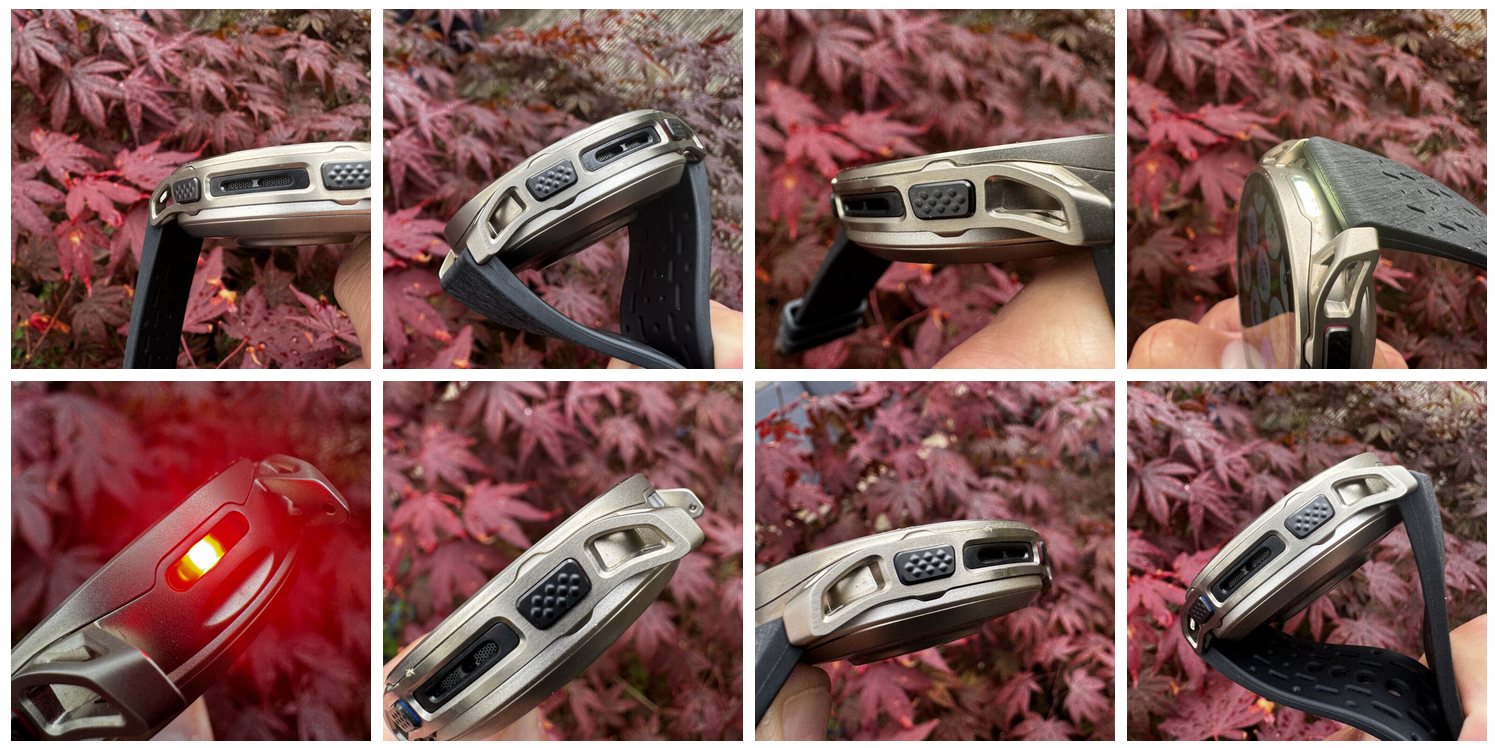
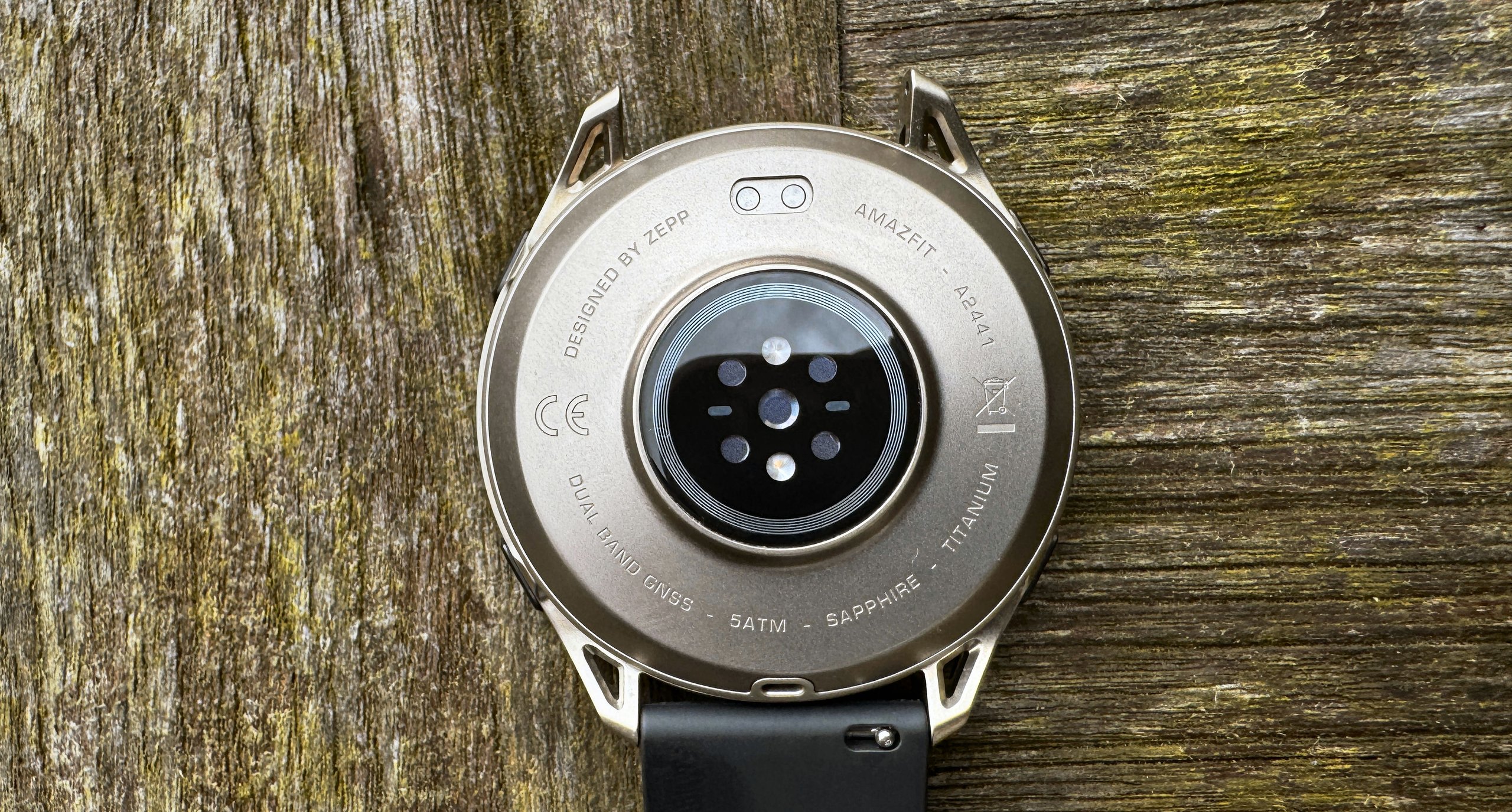
The build quality matches the Pro: a titanium bezel, frame, back cover and buttons, a sapphire lens, a textured action button, and distinctive industrial lugs. It’s the same materials, but there are subtle design differences on the case and buttons.
The Ultra weighs 52g, compared to the Pro’s 45.6g. In practice, the extra 6.4g is undetectable in daily wear.
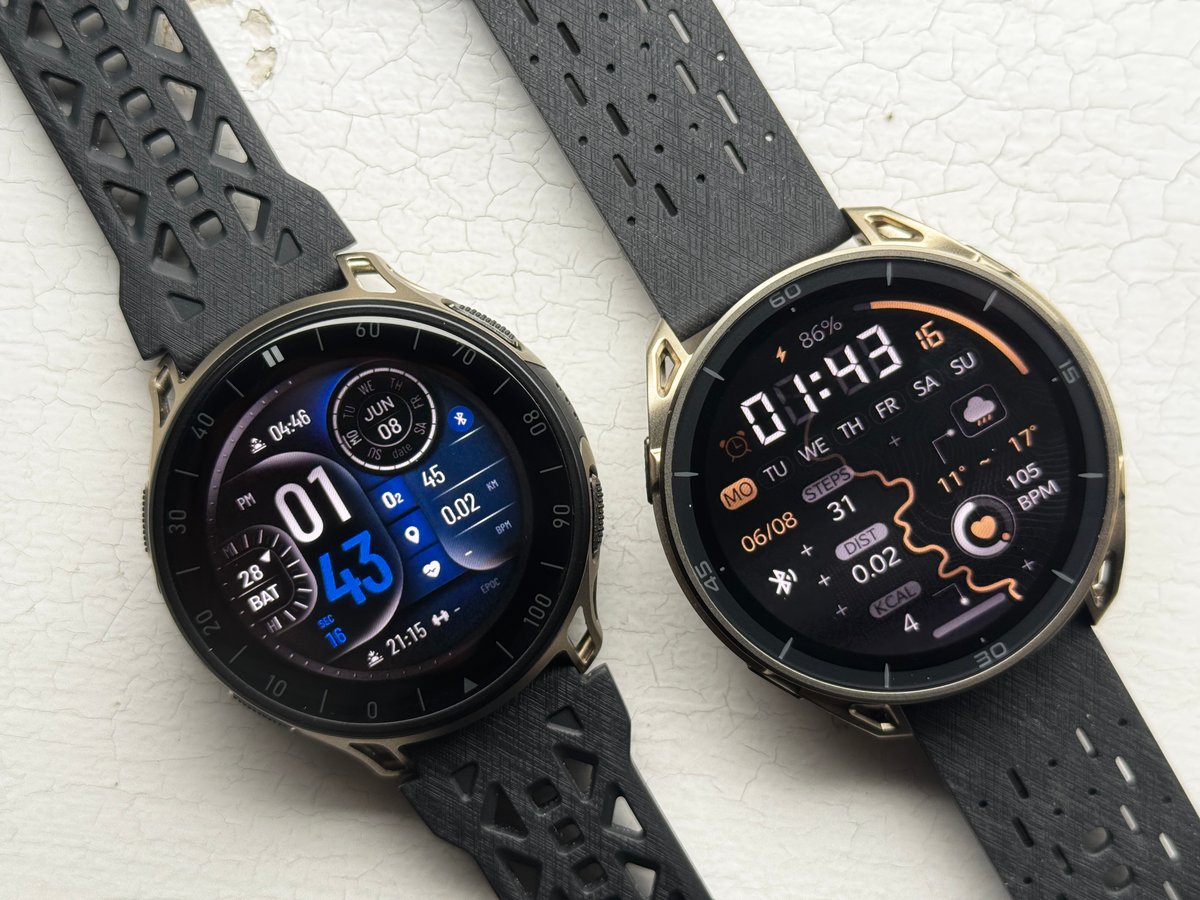
The 1.5-inch AMOLED at 480×480 pixels and 3,000 nits is the display that the Cheetah line needed, which the Pro didn’t give. The proportions work in a way the Pro’s do not; the bezel-to-display ratio is more flattering, good actually. And the UI fills the screen naturally. The display is responsive and smoothly redrawn, among the best I have used on any watch, and notably better than on most Garmin map screens. It benefits from the HS3S chip’s additional headroom, which you notice when rendering those maps.
The design of the supplied 22mm rubber strap matches the case better than the Pro’s 20mm. Strap quality remains the weakest element of the build. You might instead like the extra strap made from a looped material. I’ts Ok. They’re both OK, but I’d personally change them.
How I Tested
Several weeks of testing across road running, trail running, road cycling, HYROX simulation, and gym sessions, against Garmin Forerunner 970, Garmin HRM600, Fourth Frontier Zone ECG chest strap, TymeWear VitalPro, Whoop MG, Polar Verity SENSE, Stryd, and other references.
GPS Accuracy
The Cheetah 2 Ultra scores 85% (upgraded, correcting an earlier error) on the standardised 10-mile GPS accuracy test, better than the Cheetah 2 Pro (73%), on a par with the Amazfit T-Rex 3 and Balance 2, behind Coros at 88%, and behind the Garmin Forerunner 970 at 92%. The chipset is suspected to be one of Airoha’s latest dual-frequency units, the same family used by Coros. There is scope for firmware improvement beyond the current baseline.
Test breakdown: Easy sections 91%, Medium 81%, Hard 81% (edited). The watch let itself down slightly in a tunnel where dead reckoning only mostly worked, in a narrow alley with high walls on both sides, and immediately adjacent to a tall building, conditions where multipath rejection and degraded signal quality separate great from excellent performance. Other dual-frequency watches in this test show the same multipath behaviour in those specific urban geometry conditions, so this is a sensor-class characteristic rather than an Amazfit-specific failure.
Standardised Test Route: Detail
Here are the route visuals, which show the overall route and a few GPS points of interest. Cheetah is the purple line.
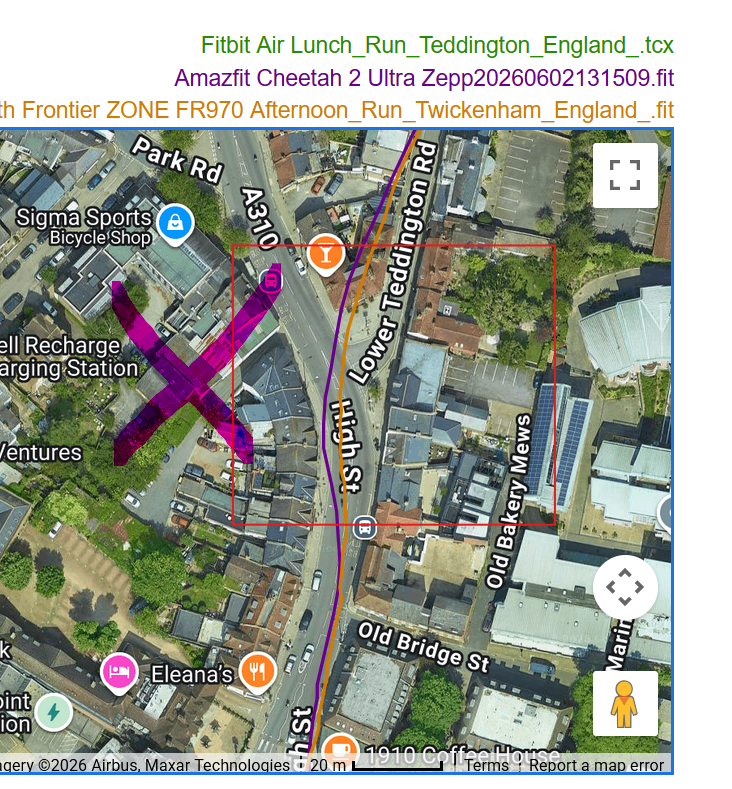
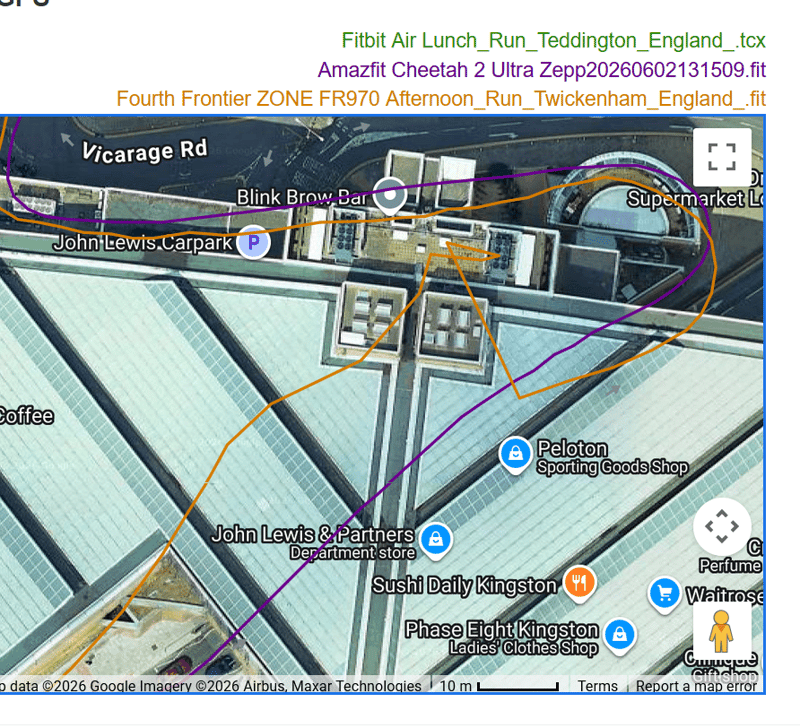
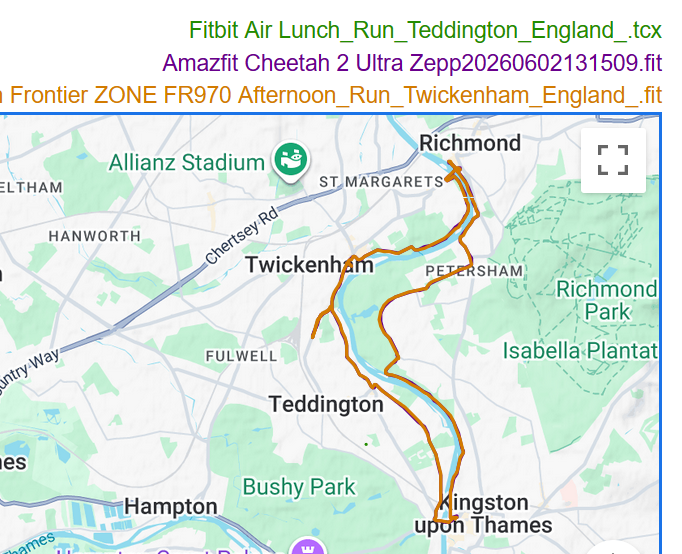
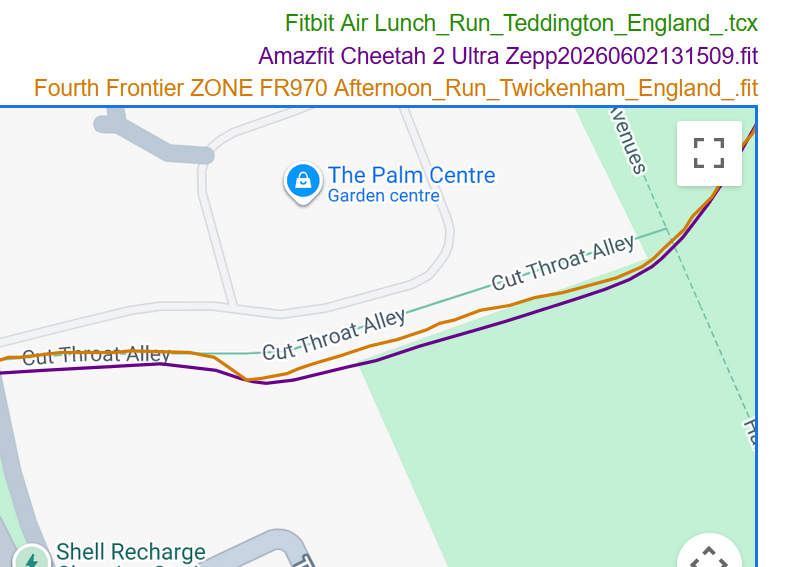
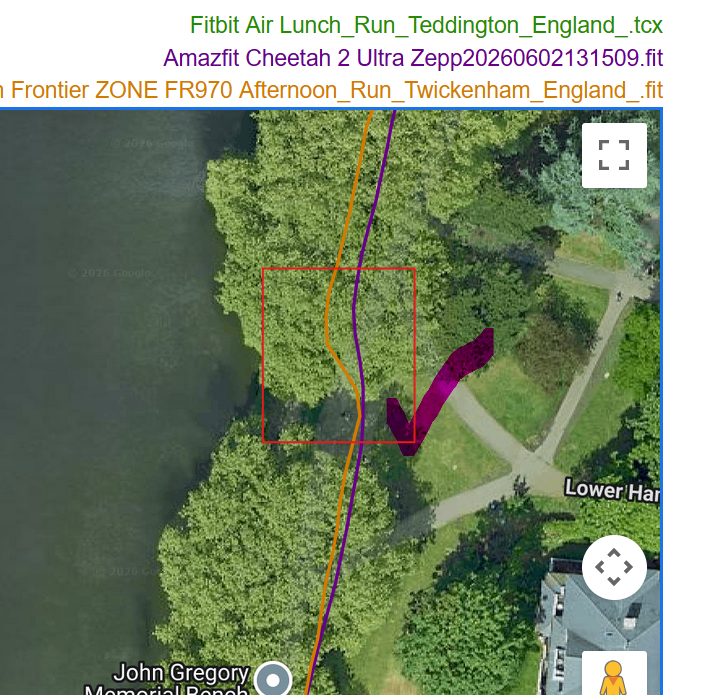
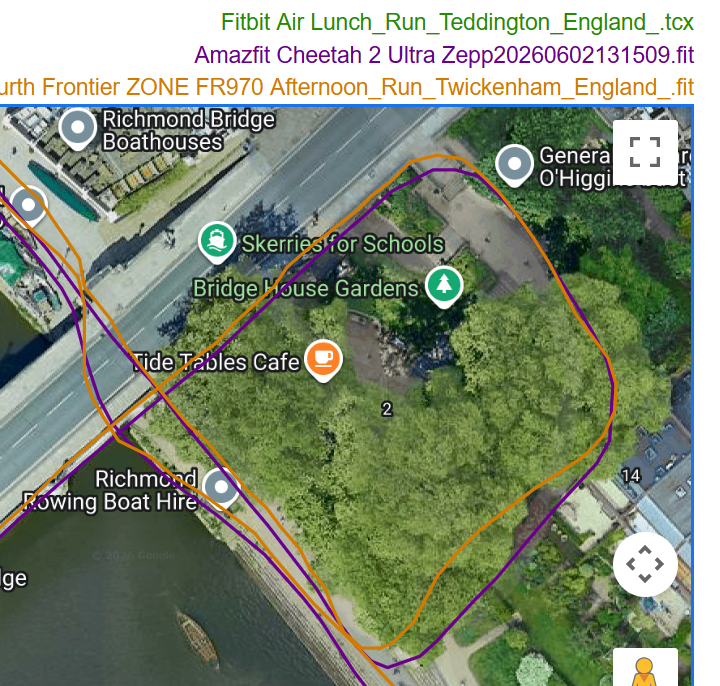
The 85% score is good, and the score was predictably lowest on the harder sections. A few points of note:
- Cutthroat Alley: the line runs parallel to the actual alley. In years gone by, every device would have failed badly here, but this is a pretty good showing. Downscored because it is in the wrong place.
- Track change: a switch between two parallel tracks, three metres apart, one metre higher, and under a heavy tree canopy. Devices rarely get the sharp switch. Cheetah does here.
- Top-notch loop under the bridge: trees, tunnel, and walls, very hard to get right, and most don’t. Cheetah does.
- Multipath error: reflected signals near a building wall are not eliminated by dual-frequency devices here. The reflection point is 3m away, not the 30m these chipsets require. All watches fail this point.
- Dead reckoning: in the tunnel, Garmin wanders, while Cheetah’s accelerometer does a reasonable job of holding a broadly correct position since the last known good GPS fix.
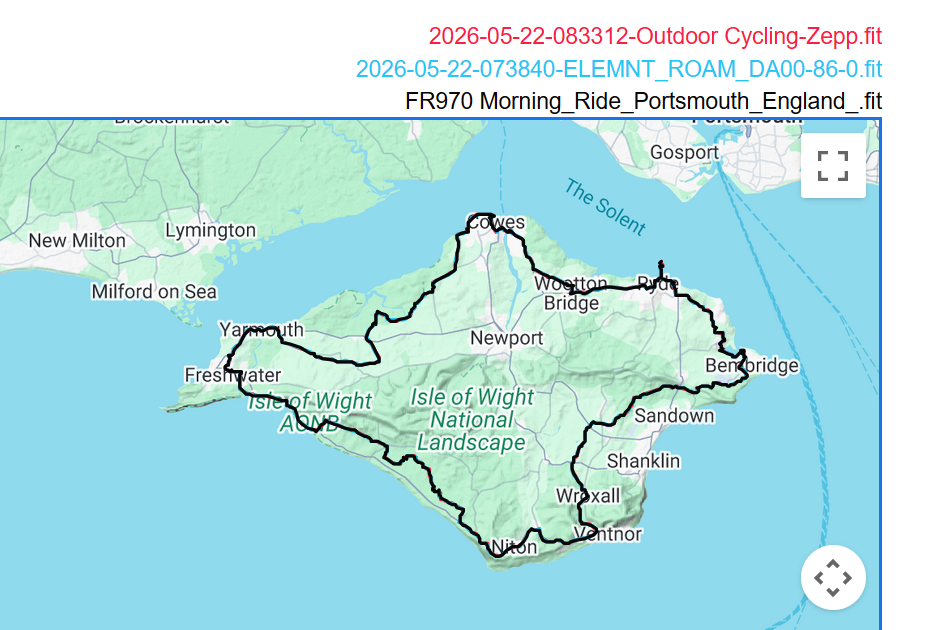
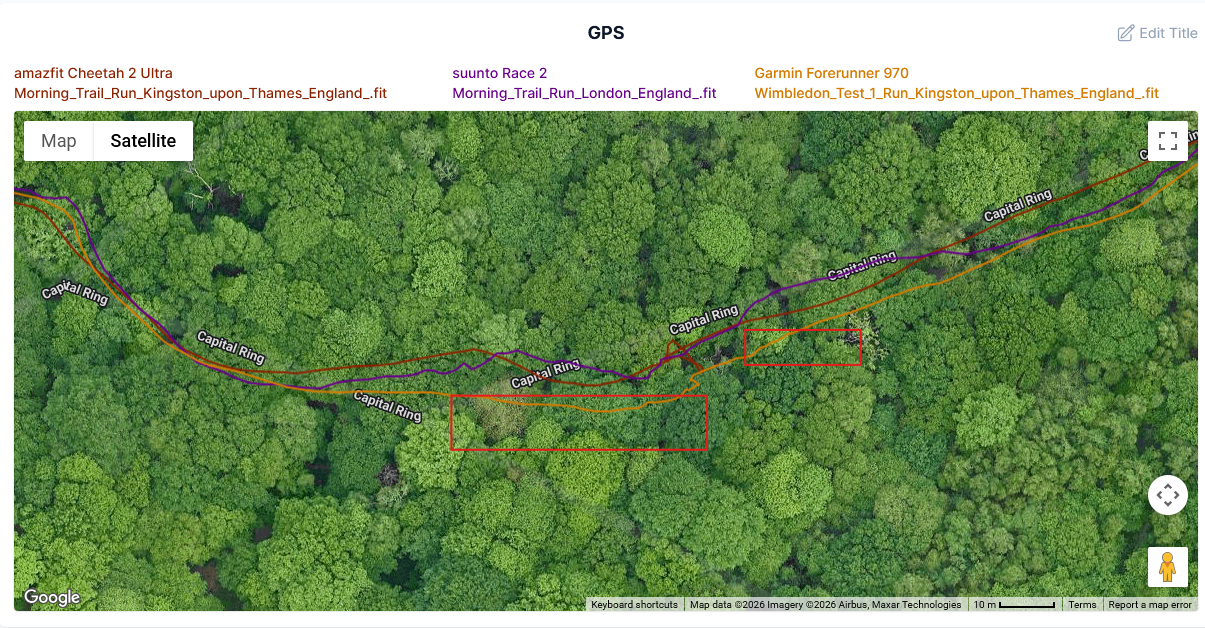
On a 100km road cycling loop on the Isle of Wight in open conditions, the Cheetah 2 Ultra matched the Forerunner 970 in GPS-only mode track-for-track, with minor drift on some corners: a 9/10 result. On the Wimbledon trail run, GPS was better than average, with small deviations that would not cause navigational problems on a known route. Full data from both sessions is in the IoW battery test and the elevation overview trail test.
In normal to harder GPS reception conditions, the Cheetah 2 Ultra is sufficiently accurate for almost all training purposes.
Open Water Swim Accuracy
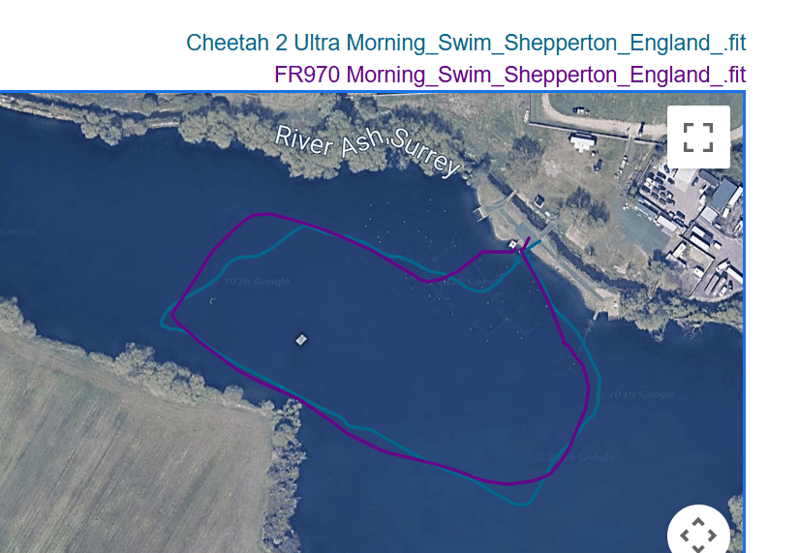
The device I used for my toe float didn’t record, so there is no third-device comparison. The Cheetah definitely cuts the last corner to the top of the image, but elsewhere it plots a more accurate, non-smoothed route compared to the Garmin Forerunner 970, which cuts the corners to the bottom right. On this test, the Garmin is more acceptable to me.
Cycling GPS Accuracy
For a whole lap of the Isle of Wight cycling, there was nothing to report about the Cheetah’s GPS accuracy, admittedly in easy conditions. On the overview map, only major discrepancies would show up when zoomed out this far, but there was nothing to show even at the deepest zoom level.
Optical Heart Rate Accuracy
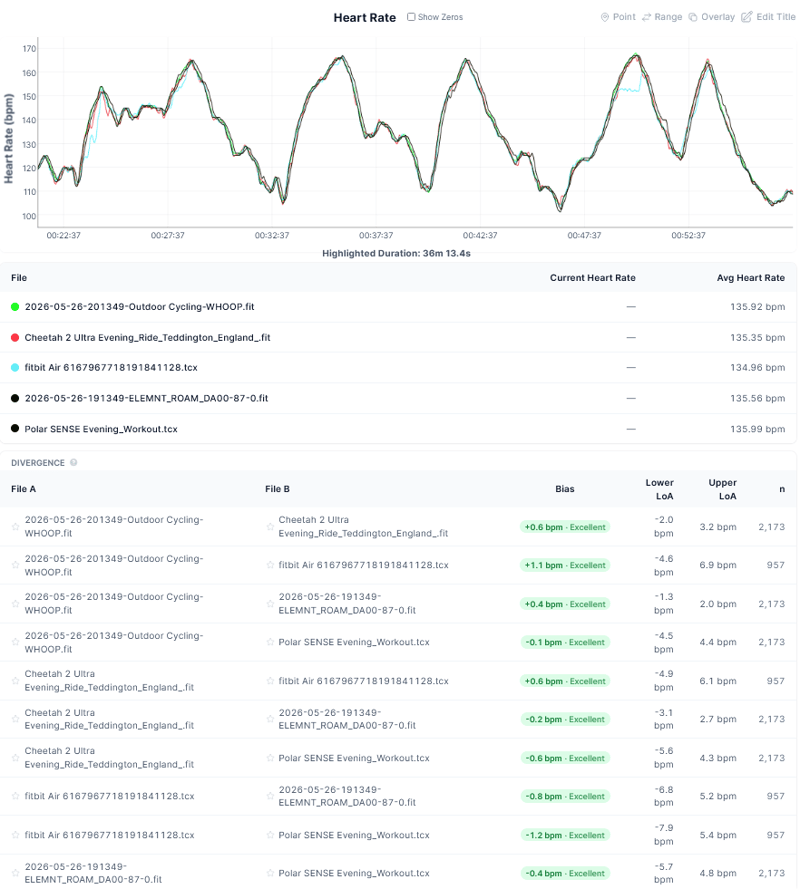
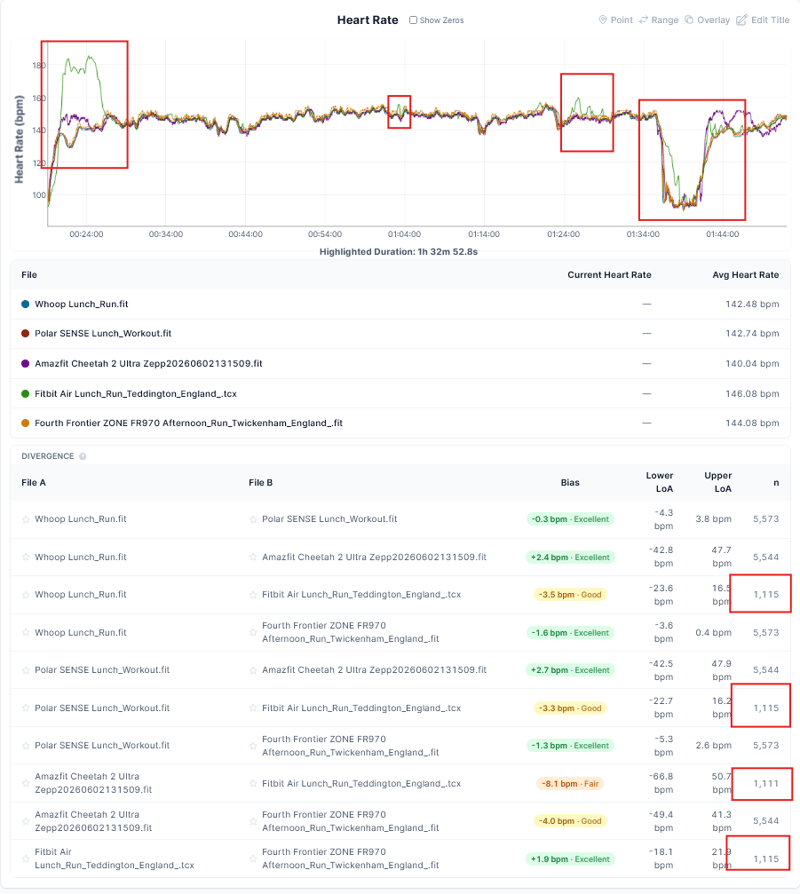
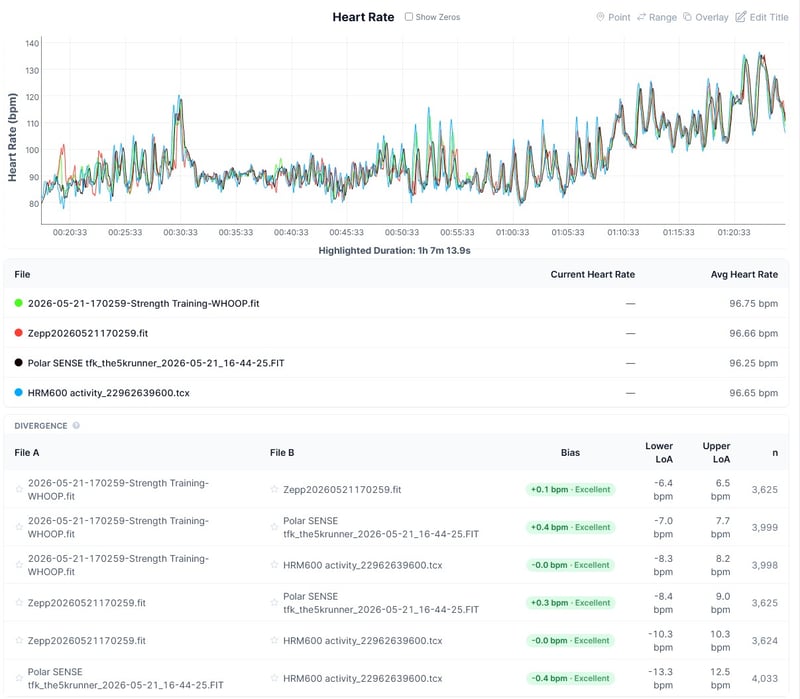
Six sessions I’ve written about. Five Excellent, one Good. The single Good result came from the hardest running session, in the worst conditions. That is a fair summary of where the Cheetah 2 Ultra’s optical HR sits for me (n=1).
Here is more detail for each test:
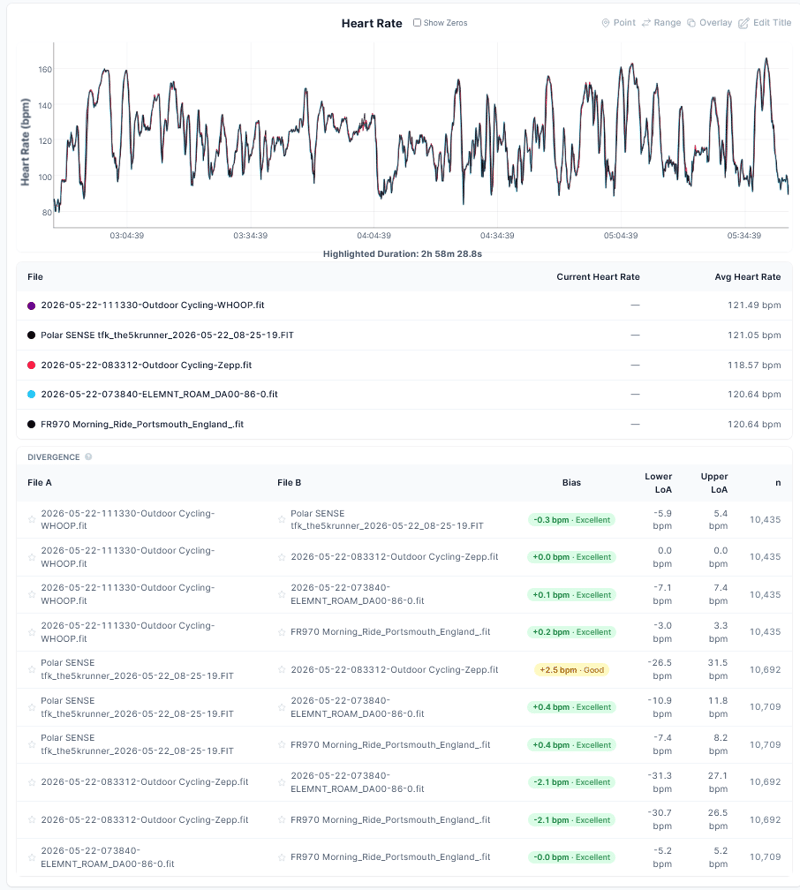
- IoW road cycling, 100km, hot: Steady-state road cycling at moderate intensity. Bias 0.0 to -2.1 bpm against Whoop MG, Polar Verity SENSE, and Garmin/ELEMNT. DCRainmaker Analyzer: mostly Excellent, one Good. Reliable, with minor underestimation.
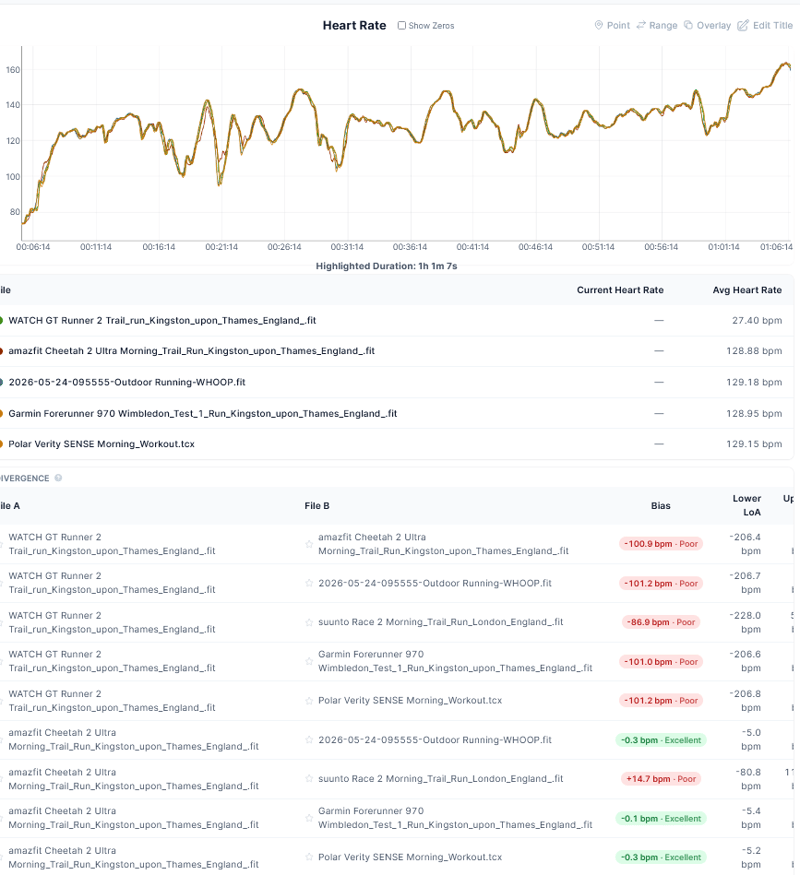
- Wimbledon trail run, 10k, 33°C: Bias under 0.3 bpm against TymeWear VitalPro, Polar Verity SENSE, and Whoop MG. Results: Excellent across all three. The strongest result in the series was aided by warm conditions and the relatively controlled effort of a recovery-pace trail run.
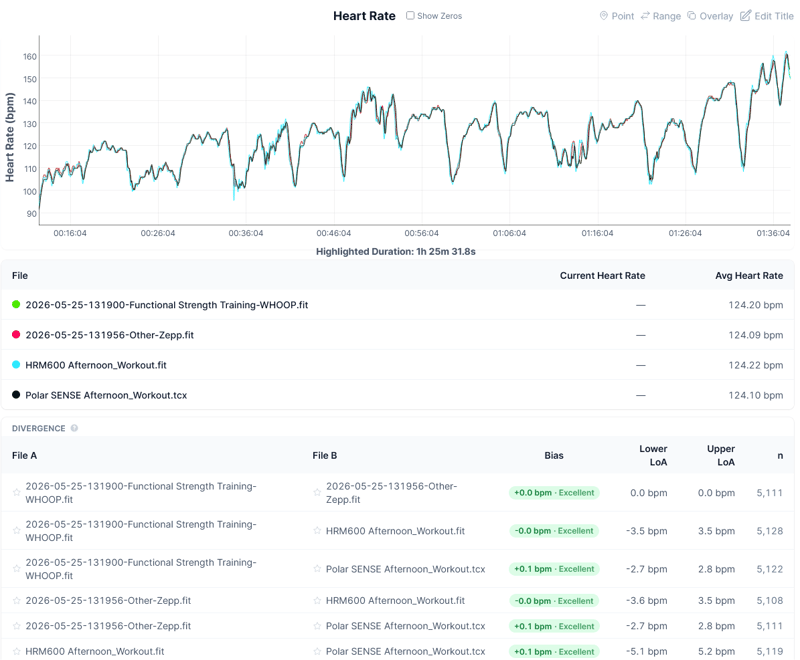
- HYROX simulation, gym, 33°C: Bias +0.0 to -0.9 bpm against Whoop MG, HRM600, and Polar Verity SENSE. Excellent across all three. Conditions favoured the sensor: warm, mostly steady-state Z2-Z3 effort, limited wrist movement on most stations.
- Bike sprint HR test, road, 32°C: Bias -0.2 bpm against ELEMNT/TymeWear VitalPro reference. Limits of Agreement ±3 bpm. Excellent. The tightest LoA of the series. Higher intensity than the steady-state tests, which makes this result more demanding.
- Stormy half-marathon run: Bias -4.0 bpm, Good. Limits of Agreement -49.4 to +41.3 bpm. A hard run in difficult conditions, lightning, hailstones, and the most realistic test of the sensor under sporting pressure. The wide LoA indicates the Cheetah 2 Ultra struggled during the hardest efforts. The honest counterpoint to the clean steady-state results.
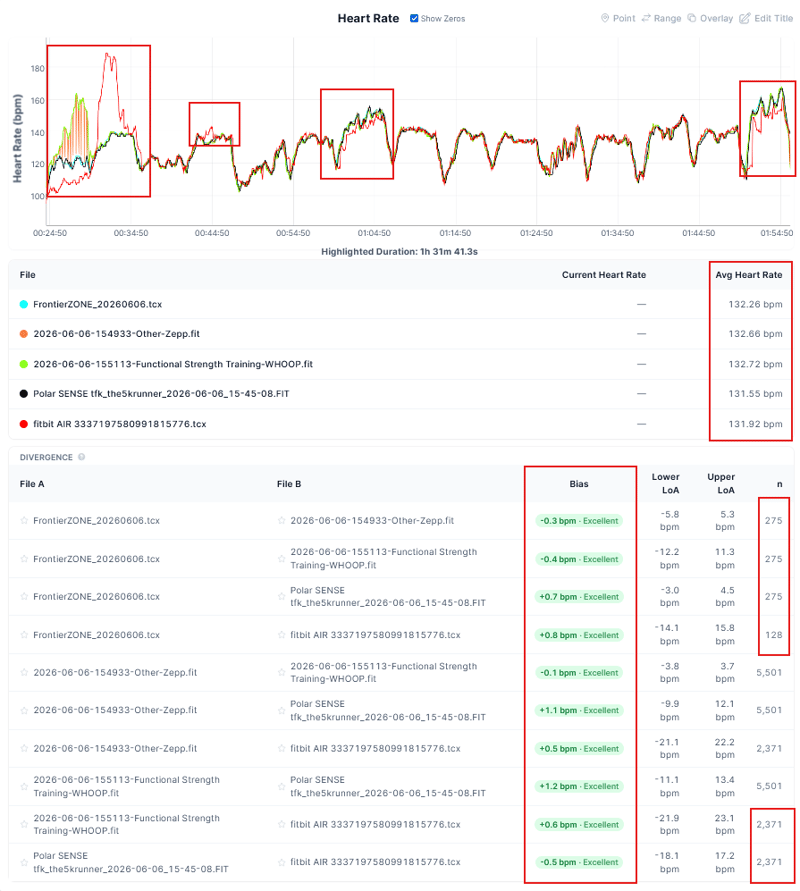
- HYROX simulation with runs, gym, evening: Bias -0.1 bpm vs Whoop MG, +1.1 bpm vs Polar Verity SENSE. Excellent. A harder session than test 3: two hours, including runs to and from the gym and 1km efforts between stations. One shared over-read on the ski erg alongside Whoop, both returning to the correct value within the same interval, suggesting a common motion-artefact response rather than a sensor failure.
The visual chart is the easiest way to see agreement between devices. These six charts correspond to the bullets above.
Elevation Accuracy
I have not looked in detail at how Cheetah handles elevation.
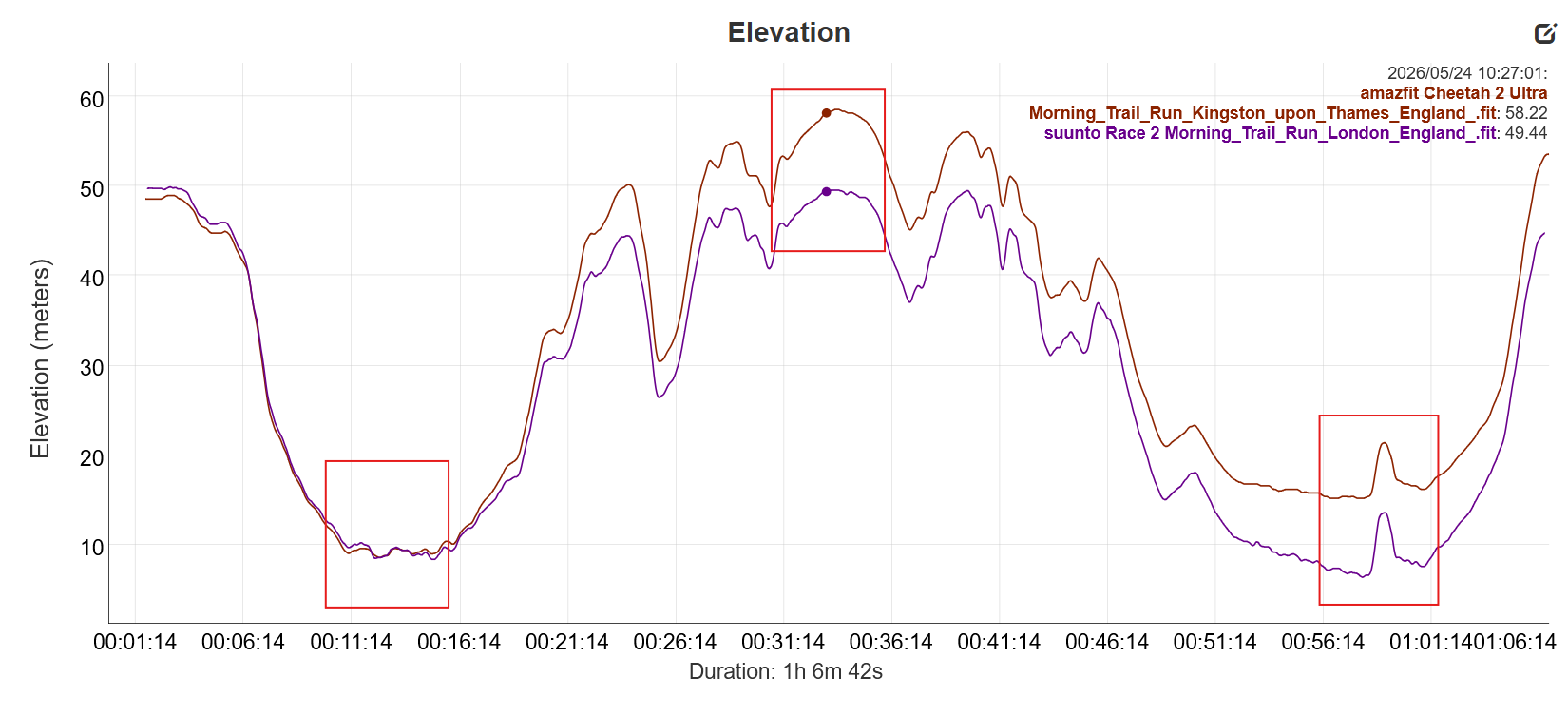
On this single hour-long trail run, something odd is clearly shown here. There is no third device to identify the outlier. Both devices start in agreement but diverge by about 10m within half an hour. The start and end points of the run are at the same location, so the elevation at both should match, suggesting Cheetah is more accurate at +3m than the Suunto at -6m. The most plausible explanation is a periodic 3D fix from Suunto, triggered by a bad GPS reading around the 20-minute mark, with no subsequent correction. Weather is not a factor.
Battery Life
Summary: Real-world GPS projection: 10% charge in 5.5 hours in Accurate mode with all satellites, brightness above 50%, and AOD off, equating to approximately 55 hours. Amazfit claims 33 hours in Trail Running mode with full map rendering and the higher display load that entails. Those additional power demands account for the gap between the real-world projection and the Trail mode claim. In daily smartwatch use, three days without access to a charger raised no concern. Amazfit claims up to 14 days in basic mode; there is no reason to dispute the order of magnitude.
My main long-duration test was a recreational lap of the Isle of Wight. The Cheetah 2 Ultra lost 10% of its charge over five and a half hours in Accurate GPS mode, from 100% to 90%, giving an estimated 55 hours of full life: comfortably ahead of the Forerunner 970’s 26-hour GPS-only rating and the Wahoo Roam 3’s 20-plus hours.
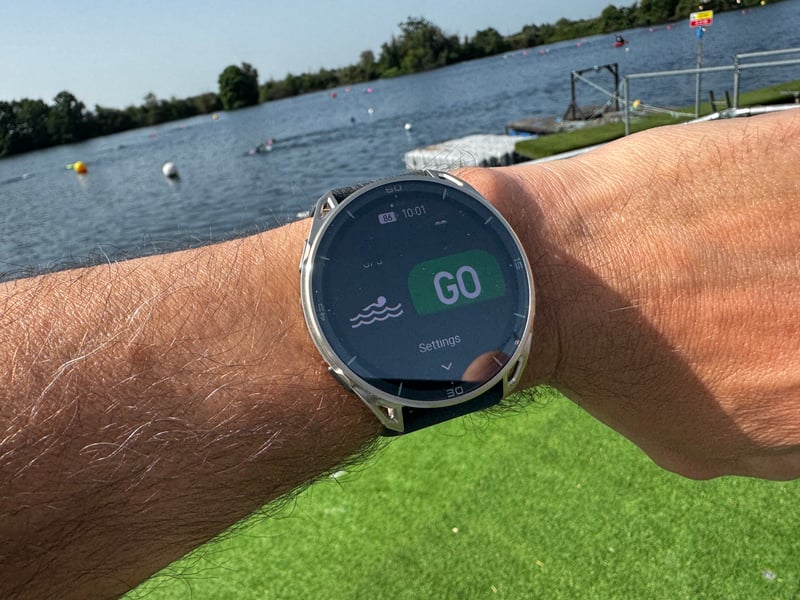
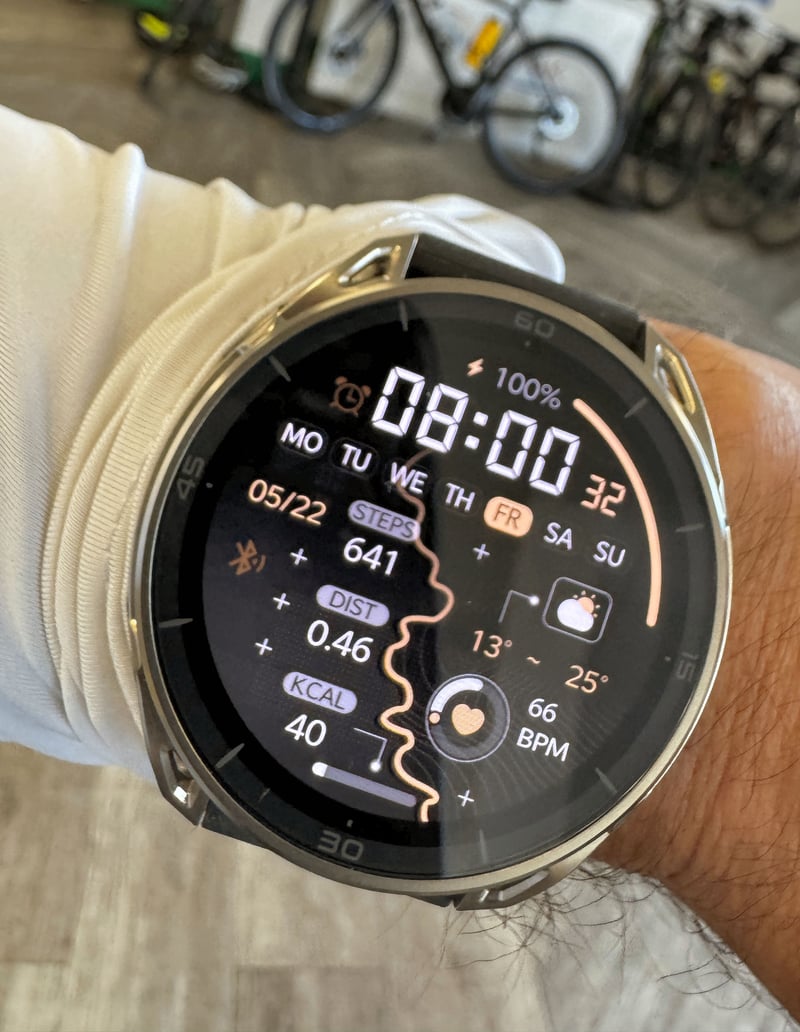
I took these starting images before setting off from Ryde while the overnight red-filter colour was still active, it returned to normal very soon after. Brightness was set to just over 50%, timeout to 15 seconds, and always-on was disabled (unintentionally, but that’s what happened). GPS was set to Accurate mode, using all satellites.
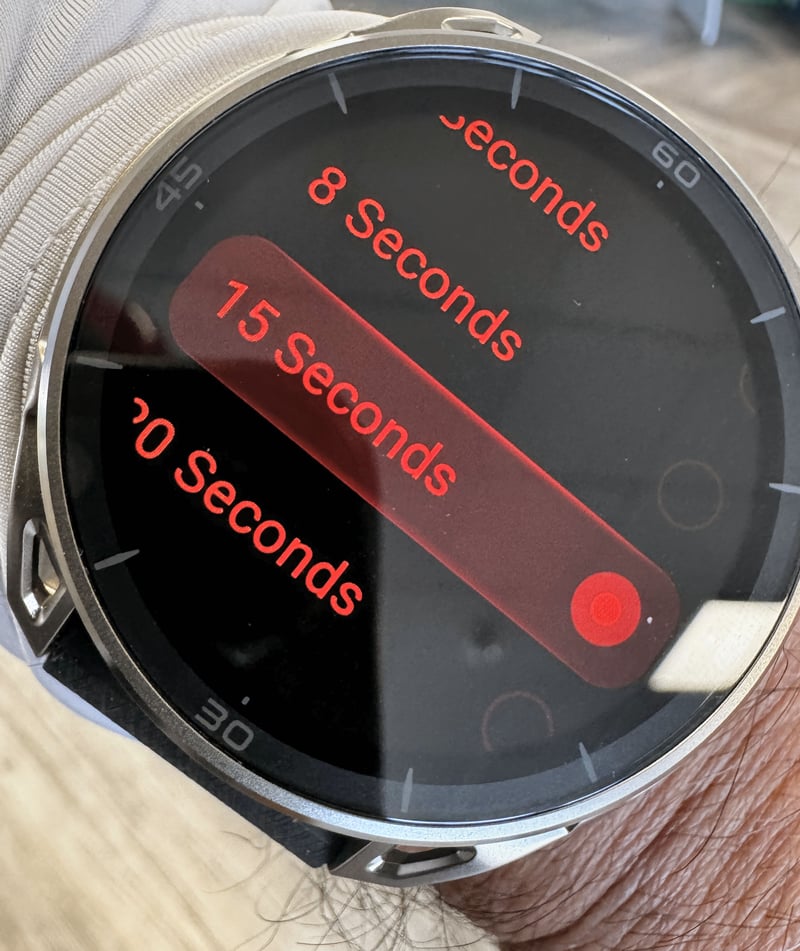
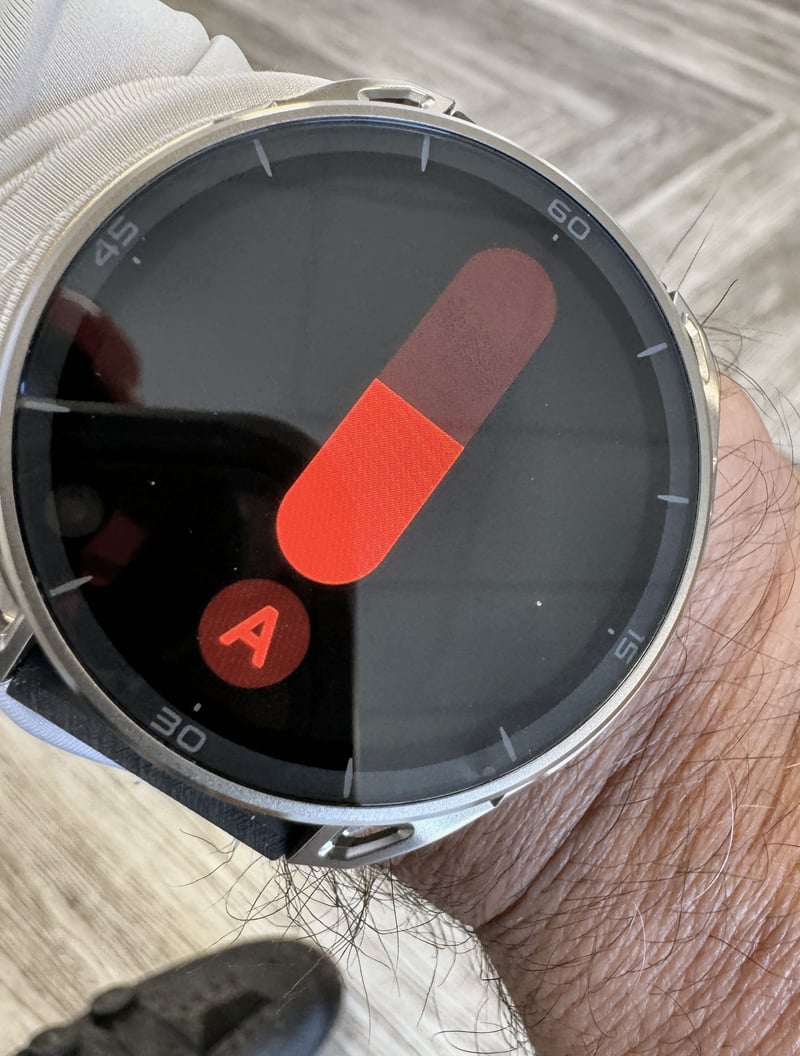
Interestingly, I checked the Cheetah before going to bed the night before, and it showed 100% charge. More than eight hours later, it was still showing 100%. There are a few plausible explanations: the watch has excellent overnight battery management, the battery gauge is not perfectly calibrated, or Amazfit intentionally ships new watches with a conservatively calibrated 100%, meaning there is a small built-in reserve. Most watch companies do something similar.
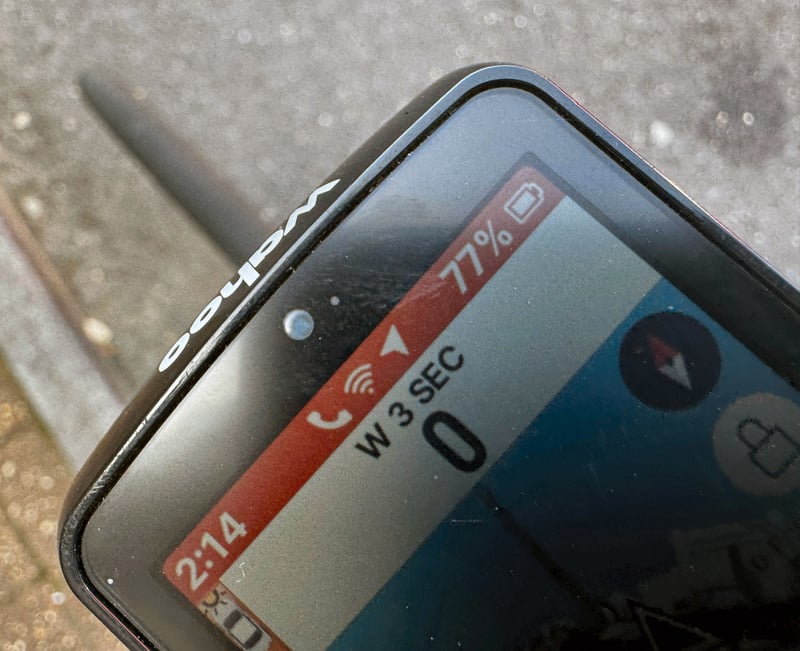
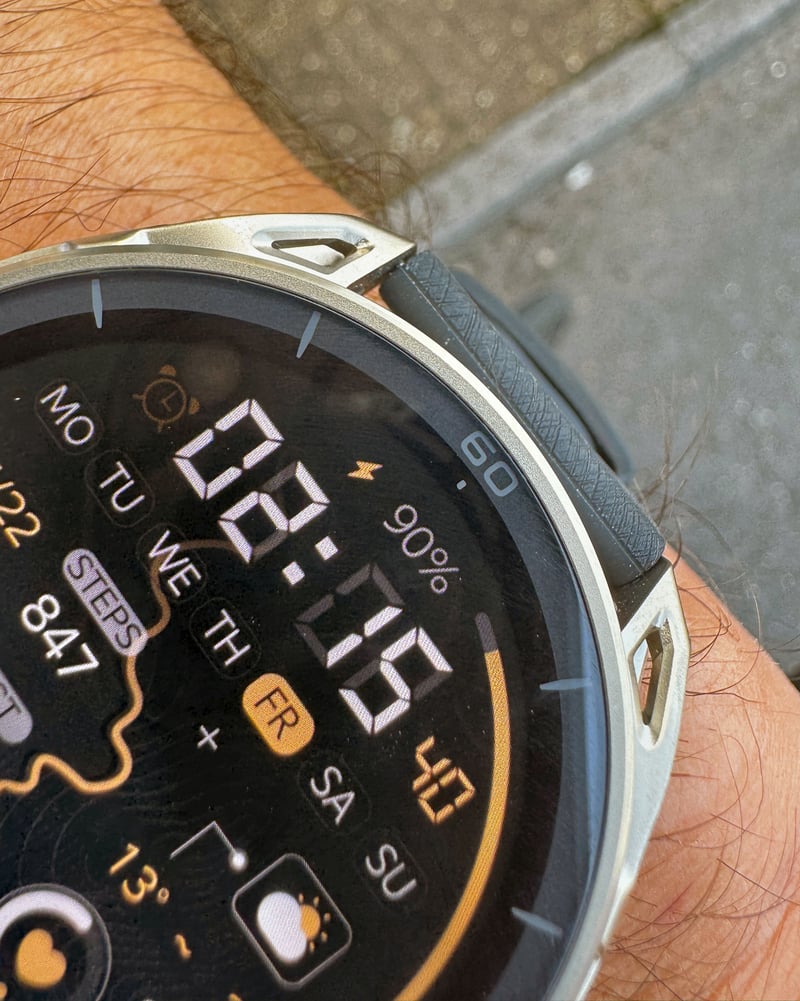
The Cheetah does not log battery state to FIT files, so photographs were the only evidence available. I came prepared!
Starting charge: 100%. Finishing charge: 90%. That is a 10% loss over five and a half hours, which projects to a 55-hour GPS battery life (claimed up to 60), well ahead of the competition here.
Trail Running Mode and Elevation Overview
This is the Ultra’s defining feature set over the Pro, and the primary reason trail runners would choose it over the cheaper sibling.
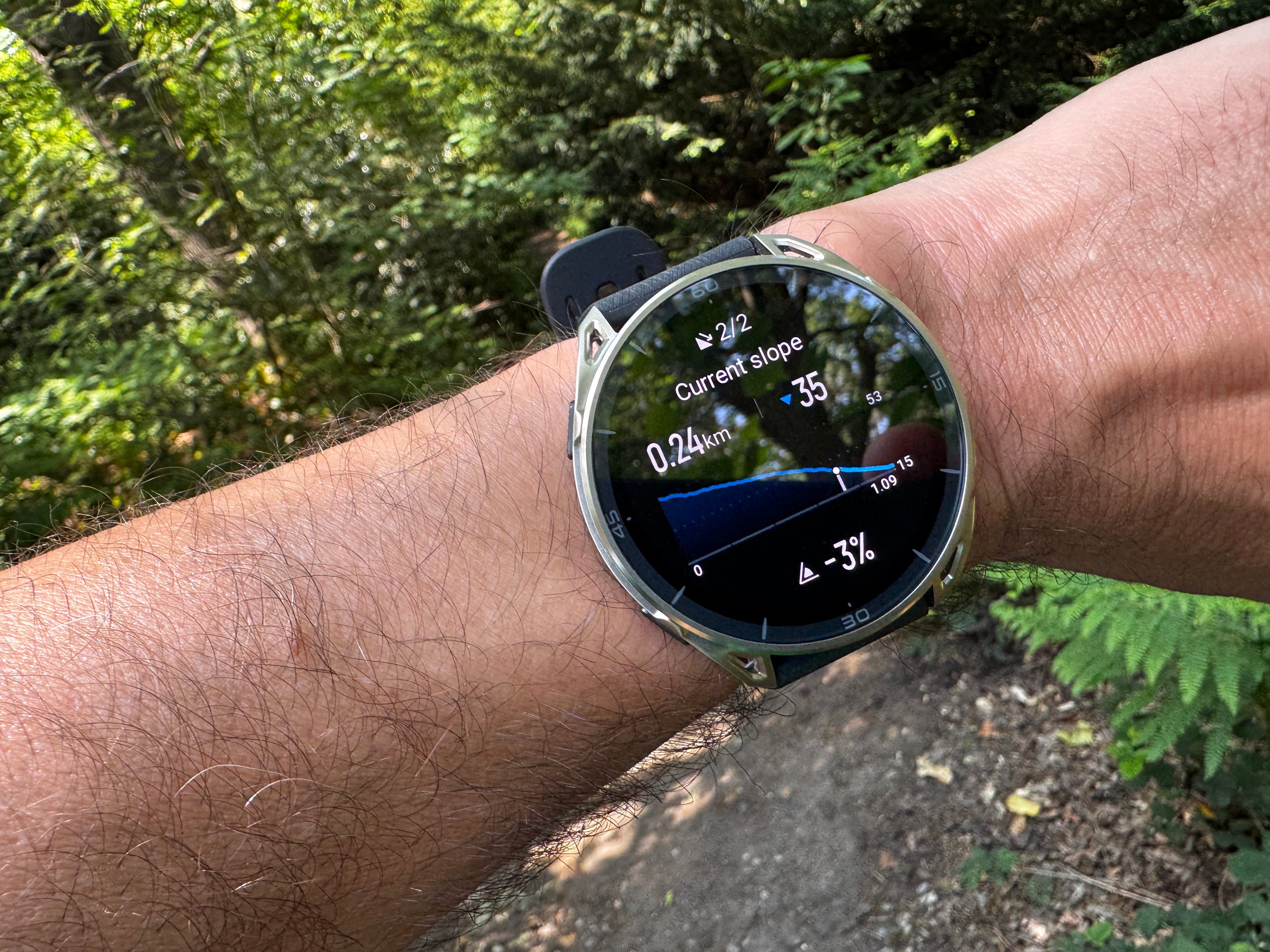
Route setup: Zepp App > Workout Tab > Create Route, send to device, then on the watch: Sports Profile > Settings > Navigation > My Route > Choose Route. Straightforward once you know where to look; the manual route-creation step isn’t in an obvious place.
The Elevation Overview breaks a pre-loaded route into individual climbs and descents, colour-codes each segment by severity, and shows a dedicated screen for each hill segment: slope type, length, progress, start and end elevations, and average grade. The metrics are fixed, and the screen cannot be configured (yet). Rivals use vertical grade-shading bars that are easier to read at a glance. Garmin ClimbPro has more depth and a longer track record but was launched in a far buggier state than Amazfit’s first offering here.
The Elevation Overview is a functional, genuinely useful first step and likely to develop further.
Rerouting: verbal prompts for deliberately wrong turns appeared to be responded to correctly in testing. Visual rerouting on the map did not update reliably. Amazfit claims on-device rerouting without a phone. In my opinion, re-routing needs clarifying. I’m not entirely sure what I’m seeing or what I should be seeing during rerouting.
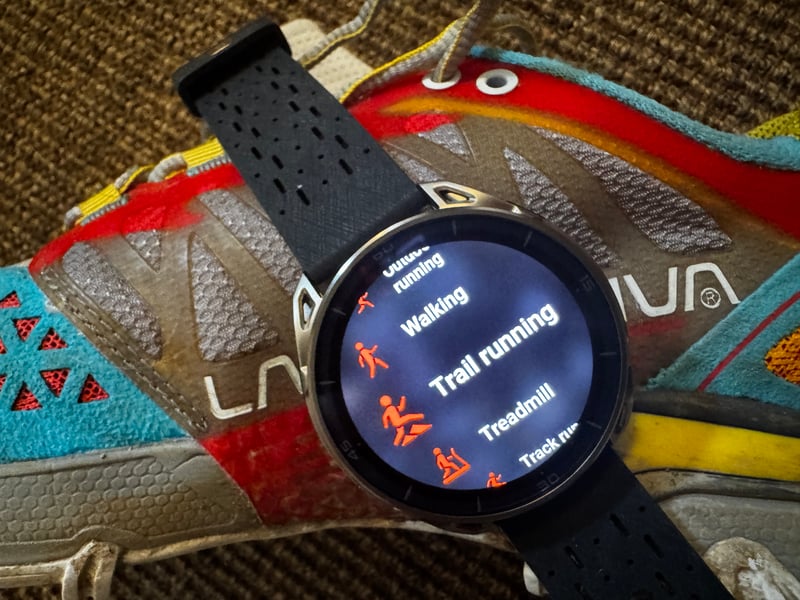
Trail Running mode adds terrain load factor, a training load calculation that accounts for gradient and surface underfoot, not just pace and heart rate. It produces a more complete picture of effort on hilly terrain than a flat-pace calculation does, and the calculation’s transparency is useful even if the underlying algorithm is not fully disclosed. I’m not entirely convinced about this. Heart rate would take into account any extra difficulty, even if pace or normalised graded pace might not. so if Amazfit are trying to infer muscular strain as well as cardio load, then I would say this is not the correct approach (but I don’t think they are doing that).
Training Metrics: Power, Threshold, VO2max, Recovery
The Cheetah 2 Ultra carries the same training metrics suite as the Pro: lactate threshold, running power, ground contact time, vertical oscillation, stride length, VO2max, and race time predictors. These are the same features running the same algorithms.
- Lactate threshold: after several weeks of varied training data, the watch eventually settled on an auto-calibrated value of 162 bpm. That figure is what I believe to be correct, within ±2 bpm. The system requires a meaningful amount of workout history before the auto-estimate stabilises; the first-estimate zones are unreliable. If you have an established LTHR from field or laboratory testing, override manually at the start.
- VO2max: the figure is 5-7 points lower than what training performance would imply for me. Cross-referencing vDOT speeds from 1km intervals and 60-minute Zone 3 efforts against the race-time predictors, the numbers do not add up at the stated VO2max.
- Recovery time: broadly sensible in behaviour across the test period.
Pool swimming was not tested on the Cheetah 2 Ultra as part of this review. The watch supports swim tracking; for pool metric detail from the same platform, see the Cheetah 2 Pro review.
Zepp Coach, Training Plans, and Software
The software platform is the same as the Pro. Zepp Coach provides adaptive training plans from 5K to marathon, adjusting to your fitness and schedule. Third-party integrations with TrainingPeaks, Runna, Intervals.icu, and Strava are functional. The Zepp app has matured into a credible ecosystem, not at Garmin Connect’s depth, but a reasonable alternative for athletes whose data lives on Strava or Runna rather than in a proprietary platform.
The on-watch UI is notably responsive. Menus, workout screens, and map display all benefit from the HS3S chip’s additional processing headroom. This is one of the smoother non-Garmin interfaces I have tested.
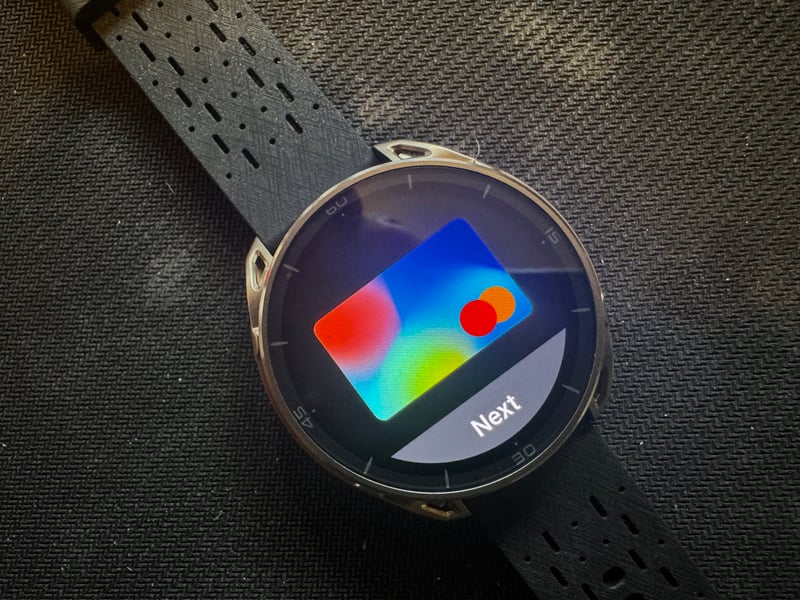
Zepp Pay (contactless payments) is supported. Setting up for me required a Curve Mastercard; the enrolment process uses a normal landscape-oriented photo capture, but my card was portrait, so I had to do it manually. Then the approval process was notably more awkward than Apple Pay’s and required a retry, taking about 5 minutes in total. Once set up, NFC payment works as quickly as on other devices, with a double press of the top-right button. One irritation: a PIN is required to use the watch rather than being required at the time of the first transaction, which adds friction for general use compared to other implementations (works similarly to Apple, not as hassle-free as Garmin).
Maps and Navigation
Full-colour topographic contour maps are the Ultra’s upgrade over the Pro’s standard offline maps. Maps are downloaded to the device via the Zepp app. Rendering is fast — noticeably so compared with competitors at similar price points, and the HS3S chip is the likely explanation. The map UI is responsive when zooming and panning mid-activity.
Turn-by-turn navigation worked reliably on the Wimbledon trail run. Voice prompts appear to respond to wrong turns, though visual rerouting on the map did not update reliably. Definitely do not depend on visual rerouting for navigation on unfamiliar routes until this is resolved via firmware.
The Competition
At £599.90, the Cheetah 2 Ultra is priced alongside the Garmin Forerunner 970. On features, the FR970 wins: better GPS accuracy (92% vs 85%), a deeper trail software stack in PacePro, ClimbPro, and UltraRun aid-station support, and a more mature ecosystem. The only rational case for the Ultra over the FR970 is battery life, looks, and ease of use. On everything else, the FR970 is the better sports watch at the same price.
The Ultra differs in aesthetics and daily wearability. The FR970 is a sports watch that looks like one. The Cheetah 2 Ultra, in titanium with a sapphire lens and a 1.5-inch AMOLED, is a watch you might wear to work or to dinner. Amazfit is making the same premium-materials argument that Polar made a few years ago with the Vantage V3 and Ignite range. Polar’s experience suggests that the market for sports watches justified by materials rather than features is smaller than the brand had hoped. The Ultra is making a similar bet.
At £450, the Cheetah 2 Ultra would be a straightforward recommendation for trail runners. Even then it would be competing against discounted prior-generation Garmin hardware that outperforms it on specialist sport metrics that matter to some serious athletes. The buyer it finds most naturally is an Amazfit loyalist or someone who simply prefers the look and wants a long battery life.
The more honest comparison is the Suunto Race 2 (£499). Both are premium-materials trail watches targeting buyers who want something more wearable than a pure sports instrument. The Suunto has a better third-party app ecosystem for technically-minded athletes; the Zepp app has a more polished UX. The Suunto is £100 cheaper. The Ultra has significantly more battery.
The Coros Apex 4 (£449) achieves better GPS accuracy in the same longitudinal 10-mile test (88% vs 85%) and costs £150 less. It lacks the Ultra’s materials and display quality. The Garmin Fenix 8 (RRP from £819, widely discounted) is one benchmark for trail running (alongside Enduro); the Ultra undercuts it on price but concedes on every detailed aspect of trail-specific features.
For road-only runners, the Cheetah 2 Pro at £449.90 offers 90% of the Ultra’s capabilities. It is also probably £50 too expensive at list price, but that is a separate conversation.
Verdict
The Cheetah 2 Ultra makes a stronger case than the Pro. The GPS score improves meaningfully from the Pro’s 73% to 85%. Heart rate across six test sessions: road cycling, trail running, gym HYROX, bike sprints, a second harder HYROX, and a stormy interval run, returns five Excellent results and one Good. The single Good came in the hardest conditions: intervals in a lightning storm. For steady-state and moderate-intensity training, the sensor is reliable. At least it was for me, n=1.
The battery projection is the most impressive in this price bracket, aside from specialist ultra devices. The display finally fits the case. The trail-specific features: Trail Running mode, terrain load factor, Elevation Overview; are functional, genuinely useful, and likely to improve with future firmware updates.
At £599.90, the Garmin Forerunner 970 is a comparable benchmark, though not marketed as a trail-running watch per se. Garmin’s software lead is real and measurable. The Ultra does not win that comparison on sporting merit alone. It wins it if you want a watch that works in training, holds up for 50-plus hours in the field, and does not look out of place off the trail.
- Buy it if you trail run, want 50-plus hours of GPS battery life, or want premium sports-watch materials without paying Fenix 8 money.
- Do not buy it if: you run exclusively on roads — the Cheetah 2 Pro does the same job for £150 less. Or if outright GPS and software performance is the deciding factor, in which case the Forerunner 970 at the same price is the answer.
Amazfit Cheetah 2 Ultra price: where to buy
The Amazfit Cheetah 2 Ultra has a list price of $599.00 / £599.90.

Quick answers
Is the Amazfit Cheetah 2 Ultra worth £150 more than the Cheetah 2 Pro?
For trail runners, yes — Trail Running mode, full-colour contour maps, and the Elevation Overview are exclusive to the Ultra, as is the 780 mAh battery that projects to 55 hours of GPS. For road runners, no. The feature set is identical, and the Pro’s 31-hour GPS claim is sufficient for almost any road event. The Ultra also has a larger, better-proportioned display, which matters if you wear the watch all day.
How does the Amazfit Cheetah 2 Ultra compare to the Garmin Forerunner 970?
At the same price, the FR970 leads in GPS accuracy (92% vs 85%) and trail software depth — PacePro, ClimbPro, and UltraRun aid-station support are more mature than Amazfit’s equivalents. The Ultra leads in battery life (55hr GPS projection vs the FR970’s 26-hour GPS-only rating) and, arguably, in aesthetics. If raw performance data is the deciding factor, the FR970 wins. If battery and daily wearability matter, the Ultra makes a case.
Will the Cheetah 2 Pro get Trail Running mode via a firmware update?
Amazfit has not said. Trail Running mode, the full-colour contour maps, and faster map rendering may be gated to the HS3S chip in the Ultra rather than available to the HS3 chip in the Pro. It is also possible that the separation is a commercial rather than a hardware decision. Amazfit has not clarified either way.
What GPS chipset does the Amazfit Cheetah 2 Ultra use?
The chipset is suspected to be an Airoha dual-frequency unit, based on the watch’s behaviour in standardised GPS testing. Amazfit has not officially confirmed the chipset. Coros uses the same Airoha family and achieves 88% in this test, suggesting there is firmware scope for the Ultra to improve beyond its current 85%.
How accurate is the Amazfit Cheetah 2 Ultra heart rate?
Across six test sessions — road cycling, trail running, two HYROX simulations, a road bike sprint test, and a hard interval run — the Cheetah 2 Ultra returned five Excellent results and one Good. The Good result came during a stormy interval run, the hardest session in the series. In steady-state and moderate-intensity training, optical HR accuracy is reliable. For interval work at or above threshold, a chest strap remains the more dependable option.
Is the Amazfit Cheetah 2 Ultra waterproof?
The Cheetah 2 Ultra has a 5 ATM water resistance rating and supports swim tracking. Pool swimming was not tested as part of this review. For swim metric detail from the same Zepp platform, see the Cheetah 2 Pro review.
For the full Amazfit range, accuracy data and Zepp Health analysis: Amazfit sports watch guide.
Last Updated on 3 October 2026 by tfk the5krunner
Small things I always use
- Garmin 90-degree charging adapter: Charges your Garmin from any USB-C cable. Essential when travelling. I use one.
- Body Glide: The blue anti-chafe stick swimmers and runners carry. I use it.
- Speedo earplugs: Fewer ear infections and no cold-water dizziness. I use them.
- Dryrobe Advance: My winter changing robe for open-water swims. I use one. A cheaper option is the AONYIYI changing robe.
- Maurten: Race fuel that stays easy on the stomach. I use them.
- Beet It Sport nitrate shots: Beetroot shots I take in the days before a race. I use them.
- Garmin charging puck: The quickest way to top up before a session. I use one.
- Injinji: Toe socks that stop rubbing, so you run more. I use them.
- Ultimate toe protectors: Stop black toenails on long runs. They work. I use them.
- Compressport R2 v2 calf sleeves: My calf sleeves of choice. I use them.
- Cellucor C4: My pre-workout before hard sessions.
- TPU tubes: Schwalbe Aerothan, Tubolito and Pirelli SmarTube. Light, tiny spares. I use all three.
- G8 insoles: Adjustable insoles that are good. I use them.
- Cycplus Cube: A 97g electric pump that gets a road tyre rideable in two minutes. I carry one. 5% off with code THE5KRUNNER.
Watches and sensors
- Polar H10: My daily driver for waking HRV.
- Polar Verity Sense: My backup arm-worn HR sensor.
- Nomad bedside charger: Charges my iPhone and Apple Watch overnight. I use it, and many of their bands.
- Train.Red: The best muscle oxygen sensor I’ve used.
- Tymewear: Accurate heart rate and reliable ventilatory zones. I use it to pace endurance rides over an hour.
- Garmin Forerunner 970: A pro-grade triathlon watch. I use this.
- Apple Watch Ultra 4: My daily smartwatch. No phone needed on rides.
- Garmin Fenix 9 Pro: I’ve just bought one.
On the bike
- Continental GP5000 for everyday riding, and Aero 111 on the front for special occasions.
- Helmets: Specialized S-Works Evade 3 for road riding, and Rudy Project Wing for TT-style races. I use both.
- Ravemen FR300: A front light that mounts under your Garmin or Wahoo. I use one.
- Wahoo TRACKR Radar: I use it on one bike and Varia on the other. They perform the same.
- Garmin Varia RTL515: Radar that warns you of cars from behind. I use this model.
- Wahoo ELEMNT Roam 3: The bike computer that’s easy to use. I use mine on most rides.
- Favero Assioma Pro RS2: Accurate power pedals that swap easily between bikes. I use this model.
Home and indoor training
- NPE Runn: Makes my basic treadmill smart, sending more accurate speed and distance to my watch and Zwift. I use it.
- Google Wifi: Keeps Zwift connected in my pain cave. I use it.
- Apple TV 4K: Zwift on the big screen. I use two.
- Google Nest Doorbell (wired, 2nd gen): My video doorbell, running in both Google Home and Apple Home. I use it.
Health, recovery and sleep
- FreeStyle Libre 3 Plus: Shows how my blood sugar responds to diet.
- hDrop: Measures my sweat loss in summer and indoors.
- Fourth Frontier Zone: Checks my heart under load in hard sessions.
- Oura Ring 5: My partner’s recovery tracker of choice.
- Eight Sleep: A cooling mattress cover my partner and I use nightly.
Reader-Powered Content

This content is not sponsored. It’s mostly me behind the labour of love, which is this site, and I appreciate everyone who supports it.
Support the site: Follow (free, fewer ads) · Subscribe (paid, ad-free) · Buy Me A Coffee
Written by real people, with AI assistance. Fact-checked and verified for originality. See the Editorial Policy. FTC: Affiliate Disclosure — some links pay commission. As an Amazon Associate, I earn from qualifying purchases.

tfk is the founder and author of the5krunner, an independent endurance sports technology publication. With 20 years of hands-on testing of GPS watches and wearables, and competing in triathlons at an international age-group level, tfk provides in-depth expert analysis of fitness technology for serious athletes and endurance sport competitors. See the gear tfk uses. ID

I don’t entirely agree with: “Cons: Cheetah 2 Pro delivers most of the core experience for £150 less.”
Differences: the C2 Pro has
only 32GB
has the older/slower HS3 CPU
strap only 20mm (looks very small on this watch)
no trail run mode
no colored elevation overview
only 1,32″ display (in a bigger case)
only 540 mAH battery
I think this are a lot of arguments for a £150 more. But that´s perhaps only me. A cheaper alternative as the C2 Pro could perhaps be the Balance 3 (with additionally has 10 ATM/dive).