HyCoach: What Hundreds of HYROX Events Tell Us About Race Performance
Most HYROX athletes know their finishing time. Some know their station splits. Very few know where they actually lost time relative to comparable athletes, or which transition cost them the most.
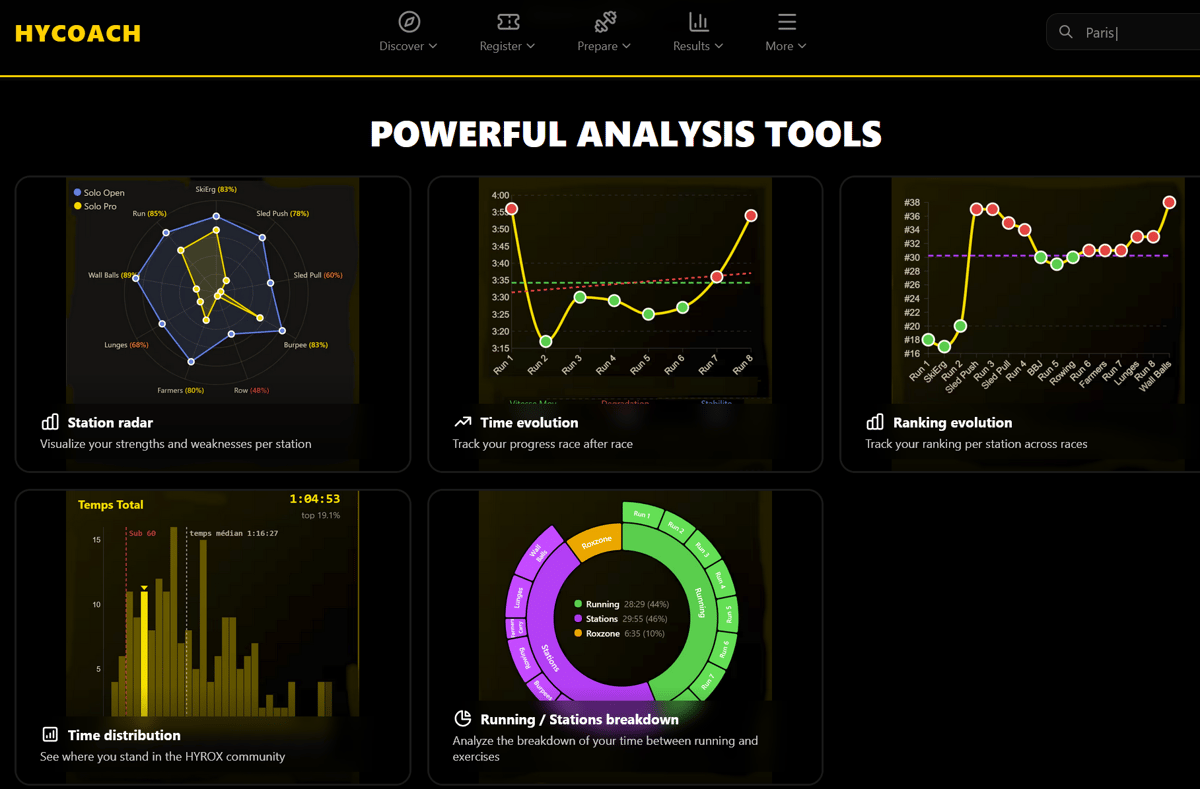
HyCoach aggregates official HYROX results across 350+ events, 9 seasons, and 30 countries — close to a million individual performances. The dataset covers every open, pro, and doubles category, broken down by station, run segment, and transition. The tool is free.
The problem it addresses
HYROX publishes results, but the official platform does not offer comparative analytics. You can see your wall ball time. You cannot see how your wall ball time compares to athletes with a similar overall finish, or whether your sled push is unusually slow relative to your ski erg. The gap between raw results and actionable insight is where HyCoach sits.
If you have ever finished a HYROX and wondered whether to spend your next training block on rowing or running, without data to support that decision, this is the tool that answers the question.
How it works
Go to hycoach.ai and search for your name. HyCoach pulls your full race history and breaks it into a performance profile. Each station and run segment is benchmarked against the distribution for your category and division, so you see exactly where you sit — percentile-level.
The analysis includes:
- Station-by-station benchmarking. Your ski erg, sled push, burpee broad jumps, wall balls, rowing, farmers carry, sandbag lunges, and sled pull — each one rated against athletes in the same bracket.
- Run segment analysis. HYROX has eight run laps between stations, and pacing across them varies enormously. HyCoach shows whether your lap times degrade, by how much, and how that compares to the field.
- Transition tracking. The time between finishing a run and starting a station (and vice versa) is often invisible. HyCoach surfaces it. For many athletes, transitions account for more lost time than any single weak station.
- Multi-race progression. If you have raced more than once, HyCoach shows improvement (or regression) across seasons, by station.
What the data reveals at scale
Some of the broader findings from the dataset are worth noting for anyone training for HYROX. They align closely with the first peer-reviewed physiological study of HYROX, published in Frontiers in Physiology in 2025, which identified aerobic capacity as the primary performance determinant.
- Sled push is the highest-variance station. The gap between a median sled push and a poor one is larger than for any other exercise, particularly in heavier divisions.
- Run pacing degrades predictably after station 5 (rowing). The average athlete’s later laps are 10–20% slower than their first few, but top finishers hold within 5%.
- Transition time accounts for up to 5% of total race time for most age-group athletes. At the elite end, it is negligible.
Who it is for
HyCoach is useful if you race HYROX and want to make training decisions based on data rather than feel. It does not prescribe a training plan — it identifies where the time is and lets you or your coach decide how to address it. The tool is free, web-based, and requires no account to use. For a full overview of the HYROX technology ecosystem, see the HYROX Sports Tech Hub.
Quick answers
Is HyCoach free to use?
Yes. HyCoach is free and requires no account or registration. Go to hycoach.ai, search for your name, and your performance profile loads immediately.
Which HYROX categories does HyCoach cover?
HyCoach covers all competitive categories: open, pro, and doubles (mixed and same-sex). Results are benchmarked within each category and division, so comparisons are like-for-like.
How current is the data?
The dataset spans 9 seasons and 350+ events across 30 countries, drawn from official HYROX results. Coverage is updated as new events are processed.
Can I use HyCoach if I have only raced once?
Yes. Single-race analysis is fully supported. The multi-race progression feature becomes available once you have results from two or more events, but station benchmarking and transition analysis work from your first race.
Does HyCoach show transitions, or only station and run times?
All three are covered. Transition time, the gap between finishing a run segment and starting the next station, is surfaced explicitly. For many age-group athletes this is one of the larger sources of avoidable time loss.
Can my coach access my HyCoach profile?
Any profile is publicly searchable by name. There is no login requirement, so a coach can search for an athlete’s name directly and view the same performance breakdown.
HyCoach shows I am weak on sled push. How do I address that?
HyCoach identifies where the time is; it does not prescribe training. That is intentional. The output is designed to feed into a coaching conversation or your own programme design. The data tells you the problem is sled push. How you address it depends on your wider training load, equipment access, and race calendar.
Is the benchmarking adjusted for event difficulty or venue?
Benchmarking is against the distribution for your category and division across the full dataset. Venue-specific difficulty factors are not currently broken out, so an unusually fast or slow course may affect where individual splits sit relative to your overall result.
What is the difference between HyCoach and the official HYROX results platform?
The official platform at results.hyrox.com publishes your raw splits. HyCoach adds the comparative layer, showing where each split sits within the distribution for your category, how your pacing changes across run laps, and how much time transitions cost you. The two sources are complementary.
Can my coach access my HyCoach profile?
Any profile is publicly searchable by name. There is no login requirement, so a coach can search for an athlete’s name directly and view the same performance breakdown.
HyCoach shows I am weak on sled push. How do I address that?
HyCoach identifies where the time is; it does not prescribe training. That is intentional. The output is designed to feed into a coaching conversation or your own programme design. The data tells you the problem is sled push. How you address it depends on your wider training load, equipment access, and race calendar.
Is the benchmarking adjusted for event difficulty or venue?
Benchmarking is against the distribution for your category and division across the full dataset. Venue-specific difficulty factors are not currently broken out, so an unusually fast or slow course may affect where individual splits sit relative to your overall result.
What is the difference between HyCoach and the official HYROX results platform?
The official platform at results.hyrox.com publishes your raw splits. HyCoach adds the comparative layer, showing where each split sits within the distribution for your category, how your pacing changes across run laps, and how much time transitions cost you. The two sources are complementary.
Author: Bob@Hycoach, edited by the5krunner
More: hycoach.ai
The previous Indie Spotlight covered Square Wheels Cycling.
Last Updated on 3 October 2026 by tfk the5krunner
Small things I always use
- Garmin 90-degree charging adapter: Charges your Garmin from any USB-C cable. Essential when travelling. I use one.
- Body Glide: The blue anti-chafe stick swimmers and runners carry. I use it.
- Speedo earplugs: Fewer ear infections and no cold-water dizziness. I use them.
- Dryrobe Advance: My winter changing robe for open-water swims. I use one. A cheaper option is the AONYIYI changing robe.
- Maurten: Race fuel that stays easy on the stomach. I use them.
- Garmin charging puck: The quickest way to top up before a session. I use one.
- Injinji: Toe socks that stop rubbing, so you run more. I use them.
- Ultimate toe protectors: Stop black toenails on long runs. They work. I use them.
- Compressport R2 v2 calf sleeves: My calf sleeves of choice. I use them.
- Cellucor C4: My pre-workout before hard sessions.
- TPU tubes: Schwalbe Aerothan, Tubolito and Pirelli SmarTube. Light, tiny spares. I use all three.
- G8 insoles: Adjustable insoles that are good. I use them.
- Cycplus Cube: A 97g electric pump that gets a road tyre rideable in two minutes. I carry one. 5% off with code THE5KRUNNER.
Watches and sensors
- Polar H10: My daily driver for waking HRV.
- Polar Verity Sense: My backup arm-worn HR sensor.
- Nomad bedside charger: Charges my iPhone and Apple Watch overnight. I use it, and many of their bands.
- Train.Red: The best muscle oxygen sensor I’ve used.
- Tymewear: Accurate heart rate and reliable ventilatory zones. I use it to pace endurance rides over an hour.
- Garmin Forerunner 970: A pro-grade triathlon watch. I use this.
- Apple Watch Ultra 4: My daily smartwatch. No phone needed on rides.
- Garmin Fenix 9 Pro: I’ve just bought one.
On the bike
- Continental GP5000 for everyday riding, and Aero 111 on the front for special occasions.
- Helmets: Specialized S-Works Evade 3 for road riding, and Rudy Project Wing for TT-style races. I use both.
- Ravemen FR300: A front light that mounts under your Garmin or Wahoo. I use one.
- Wahoo TRACKR Radar: I use it on one bike and Varia on the other. They perform the same.
- Garmin Varia RTL515: Radar that warns you of cars from behind. I use this model.
- Wahoo ELEMNT Roam 3: The bike computer that’s easy to use. I use mine on most rides.
- Favero Assioma Pro RS2: Accurate power pedals that swap easily between bikes. I use this model.
Home and indoor training
- NPE Runn: Makes my basic treadmill smart, sending more accurate speed and distance to my watch and Zwift. I use it.
- Google Wifi: Keeps Zwift connected in my pain cave. I use it.
- Apple TV 4K: Zwift on the big screen. I use two.
- Google Nest Doorbell (wired, 2nd gen): My video doorbell, running in both Google Home and Apple Home. I use it.
Health, recovery and sleep
- FreeStyle Libre 3 Plus: Shows how my blood sugar responds to diet.
- hDrop: Measures my sweat loss in summer and indoors.
- Fourth Frontier Zone: Checks my heart under load in hard sessions.
- Oura Ring 5: My partner’s recovery tracker of choice.
- Kineon MOVE+: Red light therapy for niggles. It works.
- Eight Sleep: A cooling mattress cover my partner and I use nightly.
Reader-Powered Content

This content is not sponsored. It’s mostly me behind the labour of love, which is this site, and I appreciate everyone who supports it.
Support the site: Follow (free, fewer ads) · Subscribe (paid, ad-free) · Buy Me A Coffee ❤️
Written by real people, with AI assistance. Fact-checked and verified for originality. See the Editorial Policy. FTC: Affiliate Disclosure — some links pay commission. As an Amazon Associate, I earn from qualifying purchases.
tfk is the founder and author of the5krunner, an independent endurance sports technology publication. With 20 years of hands-on testing of GPS watches and wearables, and competing in triathlons at an international age-group level, tfk provides in-depth expert analysis of fitness technology for serious athletes and endurance sport competitors. ID
