Garmin Elevate 4.1: Two Sensor Tiers and What It Means for Future Garmins
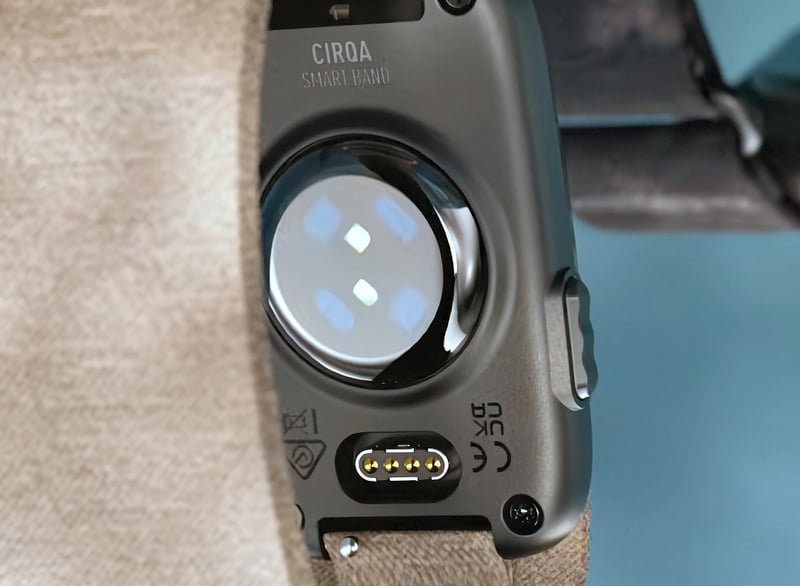
Garmin’s own product walkthrough video describes the CIRQA as having “a new Gen 4 with skin temperature heart rate sensor”. Gen 4.1 is more descriptive, since Garmin has not given it a distinct name. Skin temperature has been an Elevate Gen 5 exclusive since 2023, so a Gen 4 sensor that carries it is genuinely a new variant. The more interesting question is what Garmin’s decision to use it on the CIRQA rather than the Elevate Gen 5 suggests about the sensor roadmap for cheaper devices going forward. Full specifications are at the Garmin CIRQA specs page.
Listen to the discussion
What changed from Gen 4 to Gen 4.1
The Elevate Gen 4 optical array is Garmin’s established mid-tier sensor, used in the Vivosmart 5 and earlier Forerunner models. At launch, the Gen 4.1 variant adds skin temperature sensing as a continuous overnight measurement, and it’s plausible that other capabilities could be later enabled by a firmware switch.
Skin temperature metrics require approximately three days of sleep data to establish a personal baseline before the metric appears in Garmin Connect. Once it does, it feeds into sleep quality tracking, women’s health monitoring, and recovery metrics. It also enables Natural Cycles compatibility, which requires the skin temperature data for fertility tracking. So, it’s a seemingly incongruous metric that adds important knock-on capabilities.
Breathing Variations, which monitors possible instances of sleep apnea and breathing disturbance, also takes three days to baseline. They require Pulse Ox to be enabled and are off by default, since continuous SpO2 monitoring reduces battery life. Garmin has not published a battery life figure with Pulse Ox enabled.
Why not Gen 5?
The Garmin Index Sleep Monitor, launched in June 2025 at $169, carries the Elevate Gen 5. The CIRQA costs $199.99 with Gen 4.1. A device that costs $30 more ships with a generation-older sensor.
Garmin has since given a reason. Product manager Chrissy Wheeler told Forbes that the newer sensor was avoided because of module size: “The reason we didn’t go for the very latest one is the size of the module.” The Gen 5 sensor, on this account, would have made the band thicker. That explanation does not hold, because the Index Sleep Monitor carries Gen 5 at 7.8mm and the CIRQA is 9mm. Garmin already ships the newer sensor in a thinner device. The full argument is here.
The most plausible reading is component costs. The CIRQA targets 10 days of battery life across a full activity and recovery feature set, which is a different engineering brief from the Index Sleep Monitor’s sleep-only profile. Allocating component budget to the battery cell rather than the sensor generation is a defensible trade-off, though it remains a trade-off.
One explanation doing the rounds is that Gen 5’s main advantage is medically certified ECG, which Garmin judged unnecessary at this price. That argument does not survive contact with Garmin’s own product line. The Index Sleep Monitor carries Gen 5 without ECG, so Garmin is perfectly willing to ship the newer sensor with that capability switched off.
The accuracy difference is also more than a rounding error. Gen 5 measures better during cycling, in cold conditions, in bent-wrist positions such as weightlifting, and where external light leaks into the sensor. Optical heart rate performance varies considerably by individual physiology and by sport, so there will be people and modalities where the gap is wider still. Those comparisons were made against the standard Gen 4 rather than this variant, so the CIRQA needs its own testing before anything definitive can be said.
What this means for cheaper Garmins
CIRQA inevitably establishes the Elevate Gen 4.1 as a sensor for the next few years. The implication is that Garmin now has two/three meaningful sensor tiers: Gen 4.1 for cost-constrained or battery-prioritised devices, Gen 5 for mid-range and sleep-focused hardware, and Gen 6 for future flagships (which may wholly replace Gen 5).
The next Vivosmart is a likely candidate for Gen 4.1.
The EDA question
CIRQA’s trademark filings across the US, Canada and the UK listed physical and emotional stress as separate sensing categories, which strongly pointed toward EDA sensing. Garmin launched without it and the specification sheet lists only the optical heart rate sensor, Pulse Ox and an accelerometer. Stress must only be derived from HRV, not from electrodermal activity.
Thus, either the trademark language was conservative future-proofing that covers a broader range of possible stress metrics including HRV-derived ones, or the hardware carries EDA electrode contacts that Garmin has not yet enabled via firmware. The trademark analysis remains on record. A firmware update that activates EDA would not require a new device.
Battery implications
The CIRQA delivers 10 days of battery life on Gen 4.1 with Pulse Ox off (presumably with per-second recording), and that is made possible due to the lack of onboard GPS, display, or Wi-Fi. Perhaps the 4.1 sensor also has other battery-consumption improvements over its predecessor. Skin temperature will add a negligible continuous draw as a passive thermal measurement. Pulse Ox is the only sensor that materially changes battery life when enabled, which is why Garmin ships it disabled!
For context, the Fenix 8 delivers up to 18 days with all-day heart rate monitoring and no GPS. The CIRQA’s 10-day figure reflects the addition of continuous Pulse Ox readiness, skin temperature overnight, and the full Connect feature set running on a band form factor without the watch’s larger cell. Whether Gen 4.1 actually costs CIRQA accuracy is now answered directly: the full review found it excellent in the gym, yoga and cycling, with failures specific to open water swimming and running intervals rather than a general sensor weakness.
Garmin CIRQA Smart Band
Screenless health and fitness band (no subscription required)
 +other retailers
Quick answers
What is Garmin Elevate Gen 4.1?
Gen 4.1 is this site’s shorthand for Garmin’s Gen 4 optical sensor with skin temperature added. Garmin has not given the variant a distinct name. It is the sensor used in the CIRQA Smart Band, launched July 2026.
How does Gen 4.1 differ from Elevate Gen 5?
The Elevate Gen 5 is a newer sensor generation used in devices including the Index Sleep Monitor. The CIRQA’s Gen 4.1 is a modified Gen 4 with skin temperature added. Published comparisons between Gen 4 and Gen 5 found Gen 5 more accurate during cycling, in cold conditions and in bent-wrist positions, but those tests predate Gen 4.1. As a new variant it requires its own testing before any definitive comparison can be made.
Does the Garmin CIRQA have an EDA sensor?
No. Garmin’s specification sheet lists only the optical heart rate sensor, Pulse Ox and an accelerometer. Stress is derived from HRV. The trademark filings listed emotional stress sensing separately from physical stress, which pointed toward EDA, but Garmin launched without it. The hardware may carry EDA capability not yet enabled via firmware.
How does skin temperature affect battery life on the CIRQA?
Skin temperature is a passive thermal measurement with minimal continuous power draw. It does not materially reduce the 10-day battery life. Pulse Ox is the sensor that reduces battery life when enabled, which is why Garmin ships it off by default.
Will Gen 4.1 appear in other Garmin devices?
Garmin has not announced further Gen 4.1 devices. The CIRQA establishes it as a shipping sensor variant in the portfolio, which makes entry-level watches and bands plausible future targets. Garmin has historically rolled new sensor variants down through the product range over one to two years.
Last Updated on 11 October 2026 by tfk the5krunner
Small things I always use
- Garmin 90-degree charging adapter: Charges your Garmin from any USB-C cable. Essential when travelling. I use one.
- Body Glide: The blue anti-chafe stick swimmers and runners carry. I use it.
- Speedo earplugs: Fewer ear infections and no cold-water dizziness. I use them.
- Dryrobe Advance: My winter changing robe for open-water swims. I use one. A cheaper option is the AONYIYI changing robe.
- Maurten: Race fuel that stays easy on the stomach. I use them.
- Beet It Sport nitrate shots: Beetroot shots I take in the days before a race. I use them.
- Garmin charging puck: The quickest way to top up before a session. I use one.
- Injinji: Toe socks that stop rubbing, so you run more. I use them.
- Ultimate toe protectors: Stop black toenails on long runs. They work. I use them.
- Compressport R2 v2 calf sleeves: My calf sleeves of choice. I use them.
- Cellucor C4: My pre-workout before hard sessions.
- TPU tubes: Schwalbe Aerothan, Tubolito and Pirelli SmarTube. Light, tiny spares. I use all three.
- G8 insoles: Adjustable insoles that are good. I use them.
- Cycplus Cube: A 97g electric pump that gets a road tyre rideable in two minutes. I carry one. 5% off with code THE5KRUNNER.
Watches and sensors
- Polar H10: My daily driver for waking HRV.
- Polar Verity Sense: My backup arm-worn HR sensor.
- Nomad bedside charger: Charges my iPhone and Apple Watch overnight. I use it, and many of their bands.
- Train.Red: The best muscle oxygen sensor I’ve used.
- Tymewear: Accurate heart rate and reliable ventilatory zones. I use it to pace endurance rides over an hour.
- Garmin Forerunner 970: A pro-grade triathlon watch. I use this.
- Apple Watch Ultra 4: My daily smartwatch. No phone needed on rides.
- Garmin Fenix 9 Pro: I’ve just bought one.
On the bike
- Continental GP5000 for everyday riding, and Aero 111 on the front for special occasions.
- Helmets: Specialized S-Works Evade 3 for road riding, and Rudy Project Wing for TT-style races. I use both.
- Ravemen FR300: A front light that mounts under your Garmin or Wahoo. I use one.
- Wahoo TRACKR Radar: I use it on one bike and Varia on the other. They perform the same.
- Garmin Varia RTL515: Radar that warns you of cars from behind. I use this model.
- Wahoo ELEMNT Roam 3: The bike computer that’s easy to use. I use mine on most rides.
- Favero Assioma Pro RS2: Accurate power pedals that swap easily between bikes. I use this model.
Home and indoor training
- NPE Runn: Makes my basic treadmill smart, sending more accurate speed and distance to my watch and Zwift. I use it.
- Google Wifi: Keeps Zwift connected in my pain cave. I use it.
- Apple TV 4K: Zwift on the big screen. I use two.
- Google Nest Doorbell (wired, 2nd gen): My video doorbell, running in both Google Home and Apple Home. I use it.
Health, recovery and sleep
- FreeStyle Libre 3 Plus: Shows how my blood sugar responds to diet.
- hDrop: Measures my sweat loss in summer and indoors.
- Fourth Frontier Zone: Checks my heart under load in hard sessions.
- Oura Ring 5: My partner’s recovery tracker of choice.
- Eight Sleep: A cooling mattress cover my partner and I use nightly.
Reader-Powered Content

This content is not sponsored. It’s mostly me behind the labour of love, which is this site, and I appreciate everyone who supports it.
Support the site: Follow (free, fewer ads) · Subscribe (paid, ad-free) · Buy Me A Coffee
Written by real people, with AI assistance. Fact-checked and verified for originality. See the Editorial Policy. FTC: Affiliate Disclosure — some links pay commission. As an Amazon Associate, I earn from qualifying purchases.
tfk is the founder and author of the5krunner, an independent endurance sports technology publication. With 20 years of hands-on testing of GPS watches and wearables, and competing in triathlons at an international age-group level, tfk provides in-depth expert analysis of fitness technology for serious athletes and endurance sport competitors. See the gear tfk uses. ID

Does anyone know if the skin temperature baseline is synced between multiple devices?
I have my doubts whether this is even possible (especially with a Gen5 and Gen4 device) which would mean that you can’t just switch between the band and a watch on a day to day basis.
No preorder for me until this is clarified / solved.
you mean if there were conflicting baselines from different device sources.
good quesiton
idk the answer.
I think forerunner 70/170 also features a gen 4.1 sensor, which came before cirqa
Correction: 170 does have a skin tem sensor but 70 does not
it has a temp sensor but i believe it is different to what we see on elevate
I think I’m mistaken both doesnt have a skin temperature sensor
Hidden EDA electrode contacts seems highly unlikely. If they were going to have electrodes seems like they can double as electrodes for ECG. Maybe the Fenix 9 will get them? EDA might also benefit from knowing how much pressure the watch is pressing against the skin to get consistent readings. (see “Pressure Compensation for Wrist-Based Pulse Spectrometry”)
For info on what EDA can do: https://research.google/blog/what-does-electrodermal-sensing-reveal-insights-from-the-pixel-watch-fitbit-sense-2/