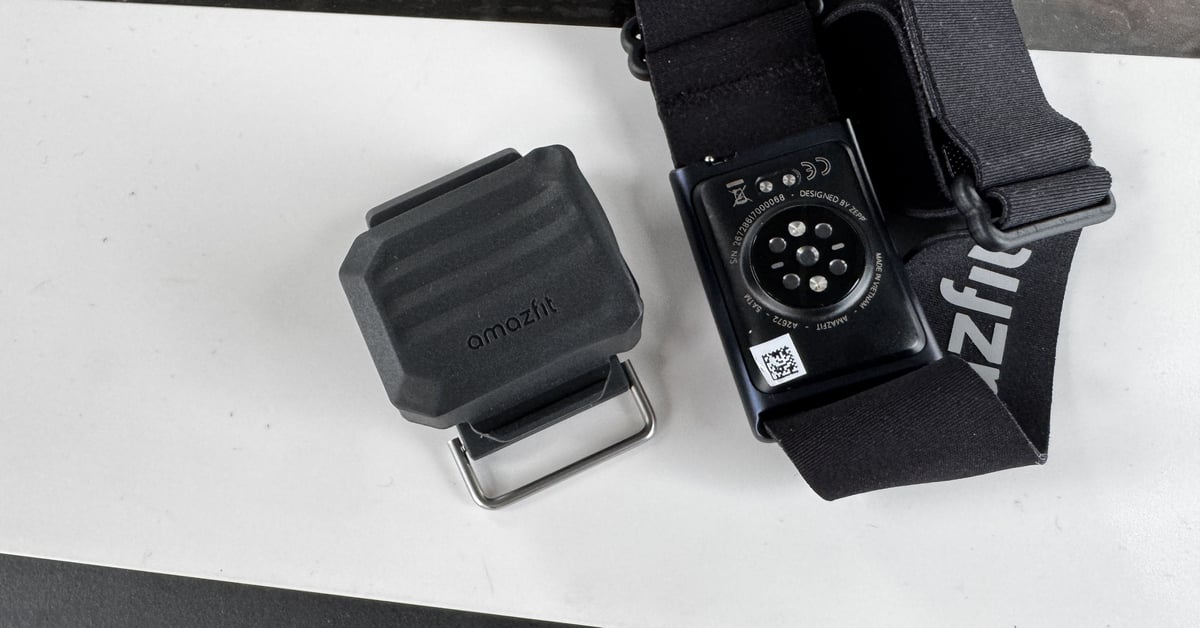
Amazfit Helio Strap Pro vs Helio Strap: what’s new and should you upgrade?
Amazfit launched the Helio Strap Pro at the HYROX World Championship in Stockholm this week. At $199.99, it costs twice as much as the original Helio Strap. Most of the wrist strap hardware is unchanged. Here is what you are actually paying for.
For a full technical breakdown of the new system, including an exclusive interview with Jimmy Kennedy, Director of Products for Hybrid Training at Amazfit, see the Helio Strap Pro hands-on first look.
What’s the same
The core sensor module is essentially identical between generations. Both carry the BioTracker 6.0 optical PPG sensor. Battery capacity is 232 mAh on both; the battery size is almost certainly identical. Charging is magnetic and takes under two hours. Water resistance is 5 ATM on both. The wristband is 22mm nylon with the same 145-205mm size range. Both use Bluetooth 5.2 and a rotor vibration motor.
The dimensions of the core module are within a fraction of a millimetre of each other between the two generations: 33.96 x 24.29mm on both.
What changed in the wrist module
The Gen 1 Helio Strap has a 6-axis IMU: an accelerometer and a gyroscope. The Pro’s Helio Core Motion HR adds a geomagnetic sensor, making it a full 9-axis IMU. The additional axes improve orientation awareness and movement classification across workout modes.
LifeLoad & HybridCharge appear on both via firmware update to Zepp, so that is not a differentiator between the two. The wrist module is also lighter: the Gen 1 ships assembled with the strap at 20g; the Pro core module is listed at 11.4g. The difference likely reflects the Gen 1 weight, including the assembled strap, whereas the Pro figure covers only the core module.
The waist module: what it adds
The Helio Core Motion is a 9-axis IMU worn at the centre of the waist. When combined with the wrist sensor and a compatible watch, it generates a motion signature for each exercise. It cross-references these signatures to estimate the muscular load per station. The system classifies movements against a trained library, applies a coefficient based on whether the movement is whole-body or isolated, and uses speed and acceleration data to estimate mechanical work.
In HYROX specifically, station weights are fixed by the competition rules, which removes the one variable that sensors cannot otherwise measure. After a session, the Zepp app delivers a cardio/muscle exertion split, per-station movement evaluation, and natural-language feedback for each of the eight stations. In Amazfit’s launch materials, the system showed an example of the detection of a 20% drop in sled push drive frequency after 25 metres and identified lateral sway as lower body muscular fatigue under load.
The muscular load data also feeds into HybridCharge, completing the readiness score with a component no other Amazfit device can currently provide.
The HYROX limitation
The waist module works only in HYROX Race and HYROX Simulation modes at launch. Outside those modes, it is completely inactive and does not support any health or activity monitoring. General gym, CrossFit, and open hybrid training get no benefit from the waist module today. Amazfit’s own support documentation confirms broader workout mode support is coming, with no timeline given. The wrist module works independently across 50+ sports modes.
At launch, the full system, watch plus arm sensor plus waist sensor, works only with the Balance 3 and Balance Ultra. Support for additional watches is confirmed as coming.
Price and availability
The Helio Strap Pro is $199.99 for the full bundle, including both modules, wristband, armband, waist clip, and charging head. The original Helio Strap was $99.99 and is currently out of stock. Pre-orders are expected to ship by 25 June 2026. No subscription is required for any feature.
Should you upgrade?
If you race or train for HYROX, yes. It is a significant and innovative upgrade. The waist module delivers per-station muscular load analysis that no mainstream consumer wearable currently provides autonomously. The fixed station weights in HYROX simplify load estimation compared with open-ended gym environments, where resistance varies, making the calculation more precise in a race context than in any other setting.
If you do not do HYROX, the case is weak right now. The wrist module upgrades are real but modest: a 9-axis vs 6-axis IMU, skin temperature monitoring, and LifeLoad. HybridCharge is already on Gen 1 via firmware. The position is to wait until Amazfit confirms a timeline for general gym support on the waist module before upgrading.
New buyers have no choice: Gen 1 is out of stock.
Quick answers
What is the price of the Amazfit Helio Strap Pro?
$199.99 in the US. The original Helio Strap was $99.99 and is currently out of stock.
Does the Helio Strap Pro require a subscription?
No subscription is required for any feature, including HybridCharge, LifeLoad, HYROX modes, and all health tracking.
Which watches are compatible with the Helio Strap Pro?
Balance 3 and Balance Ultra at launch. The full three-device system, watch plus arm sensor plus waist sensor, requires one of these two watches. Support for additional Amazfit watches has been confirmed, with no timeline given.
Does the waist sensor work for general gym training?
Not at launch. The Helio Core Motion waist sensor is currently limited to HYROX Race and HYROX Simulation modes. Outside those modes, it is completely inactive. Broader workout support is confirmed to be coming, with no timeline.
What is the battery life of the Helio Strap Pro?
The Helio Core Motion HR arm sensor lasts up to 11 days on a single charge. The Helio Core Motion waist sensor lasts up to 44 days, which reflects its limited active use outside HYROX sessions.
Is the Helio Strap Pro worth upgrading to from the original Helio Strap?
For HYROX athletes, yes. The waist module delivers per-station muscular load analysis that justifies the price difference. For general gym and hybrid athletes, the case is weak until Amazfit extends support for waist sensors to broader workout modes.
What sensors does the Helio Strap Pro add over the original?
The wrist module gains a geomagnetic sensor, making it a 9-axis IMU compared to the 6-axis IMU in Gen 1, and a skin temperature sensor. LifeLoad is also new. The Helio Core Motion waist sensor is entirely new to the Pro system.
Can the Helio Strap Pro broadcast heart rate to other devices?
Yes. It broadcasts real-time heart rate via Bluetooth to compatible Amazfit watches, cycling computers, fitness equipment, and supported training apps, including treadmills.
What third-party apps does the Helio Strap Pro sync with?
Strava, TrainingPeaks, Runna, adidas Running, komoot, Relive, Apple Health, and Google Fit.
Does the Helio Strap Pro work without an Amazfit watch?
The Helio Core Motion HR arm sensor works independently to track health, sleep, and HybridCharge, and supports 50+ workout modes without a watch. The waist sensor requires a Balance 3 or Balance Ultra to function at all.
What is the difference between Helio Core Motion HR and Helio Core Motion?
The Helio Core Motion HR is an arm- or wrist-worn sensor with optical heart rate monitoring, a 9-axis IMU, skin temperature, and 50+ workout modes. The Helio Core Motion is the waist-worn module with a 9-axis IMU only, active exclusively in HYROX Race and HYROX Simulation modes, with a 44-day battery life.
Does the Helio Strap Pro waist sensor have a heart rate sensor?
The waist module contains BioTracker 6.0 PPG hardware, but it is not used for health tracking or active outside HYROX modes at launch.
Last Updated on 29 June 2026 by the5krunner
My favourite kit and nutrition
- Garmin Fenix 9 Pro — I’ve just bought one.
- Injinji – Runners protect your toes. Avoid discomfort and minor injury. Run more. Run faster. I use them.
- Garmin 90-degree charging adapter — A small keyring adapter you can use anywhere. Essential when away. I use one.
- Garmin charging puck — the fastest and most reliable way to top up your Garmin before a session. I use one.
- Ravemen FR300 — Front light that mounts directly under your Garmin or Wahoo head unit. Keeps your bars clean and your beam pointed where it matters. I use one.
- Body Glide – The blue anti-chafe stick that all swimmers and many runners use. I use it.
- Maurten — The race nutrition trusted by elite athletes. Gels and drink mixes engineered to be easy on the stomach. I use them.
- Garmin Varia RTL515 — A radar rear light that alerts you to vehicles approaching from behind. Pairs with your Edge or Wahoo. I use this model.
- Favero Assioma Pro RS2 — The power-meter pedals most serious cyclists choose. Accurate, easy to move between bikes. I use this model.
- Garmin Forerunner 970 — A serious choice for a pro-grade triathlon watch. I use this.
- Polar H10 — My daily driver for accurate, waking HRV readings.
- Wahoo ELEMNT Roam 3 — The bike computer that has the feature Garmin lacks: usability. I use mine on most rides.
Reader-Powered Content

This content is not sponsored. It’s mostly me behind the labour of love, which is this site, and I appreciate everyone who supports it.
Support the site: Follow (free, fewer ads) · Subscribe (paid, ad-free) · Buy Me A Coffee ❤️
All articles are written by real people, fact-checked, and verified for originality. See the Editorial Policy. FTC: Affiliate Disclosure — some links pay commission. As an Amazon Associate, I earn from qualifying purchases.
tfk is the founder and author of the5krunner, an independent endurance sports technology publication. With 20 years of hands-on testing of GPS watches and wearables, and competing in triathlons at an international age-group level, tfk provides in-depth expert analysis of fitness technology for serious athletes and endurance sport competitors. ID
