A wearable can record a night’s sleep while a food diary records the previous day’s meals. The practical question is how those two histories relate. A late dinner followed by a poor night can be memorable, but one occasion provides little evidence about a recurring habit.
KeepEatClean is an iPhone app for exploring eating habits alongside personal wearable history. It combines meal logging with Apple Health or WHOOP data and makes the learning period part of the experience.
How It Works
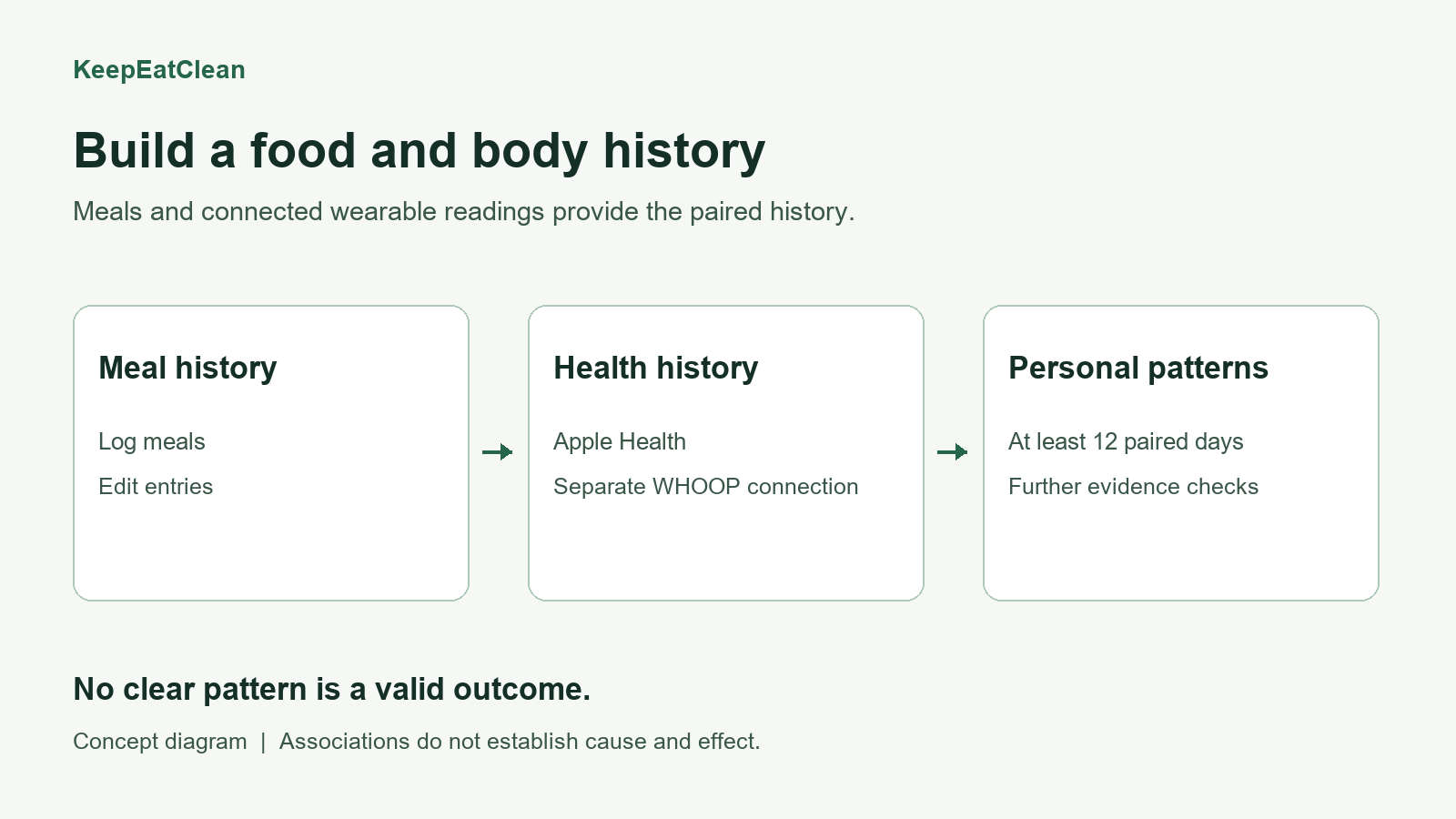
TL;DR: users log meals, connect Apple Health or WHOOP, and build paired food-and-health days. Food × Body explores associations involving nutrition, meal timing, sleep and recovery. At least 12 usable paired days and further evidence checks are required before a finding can appear.
Photo logging and editable entries help build and correct the food record. Supported health connections supply the other side of the history. Available measurements depend on the connected source, device, and permissions.
The useful question might be whether earlier dinners are associated with different next-day sleep in that person’s records. The app needs both sides of the comparison; elapsed calendar days alone don’t provide enough usable history.
Why the learning state matters
The paired-day minimum gives users a concrete explanation for an app that is still learning. A new connection or a few logged meals cannot establish a personal pattern on its own.
Twelve paired days are a minimum, not a promised result date. Further checks assess whether a comparison has enough supporting evidence. The app can show insufficient information, or enough history without a clear pattern. More consistent logging creates more opportunities to explore patterns but does not guarantee a finding.
When a supported association appears, it describes a relationship in the person’s records. It does not establish that a meal or habit caused an outcome, or that changing the habit will improve recovery.
A numerical example of the minimum
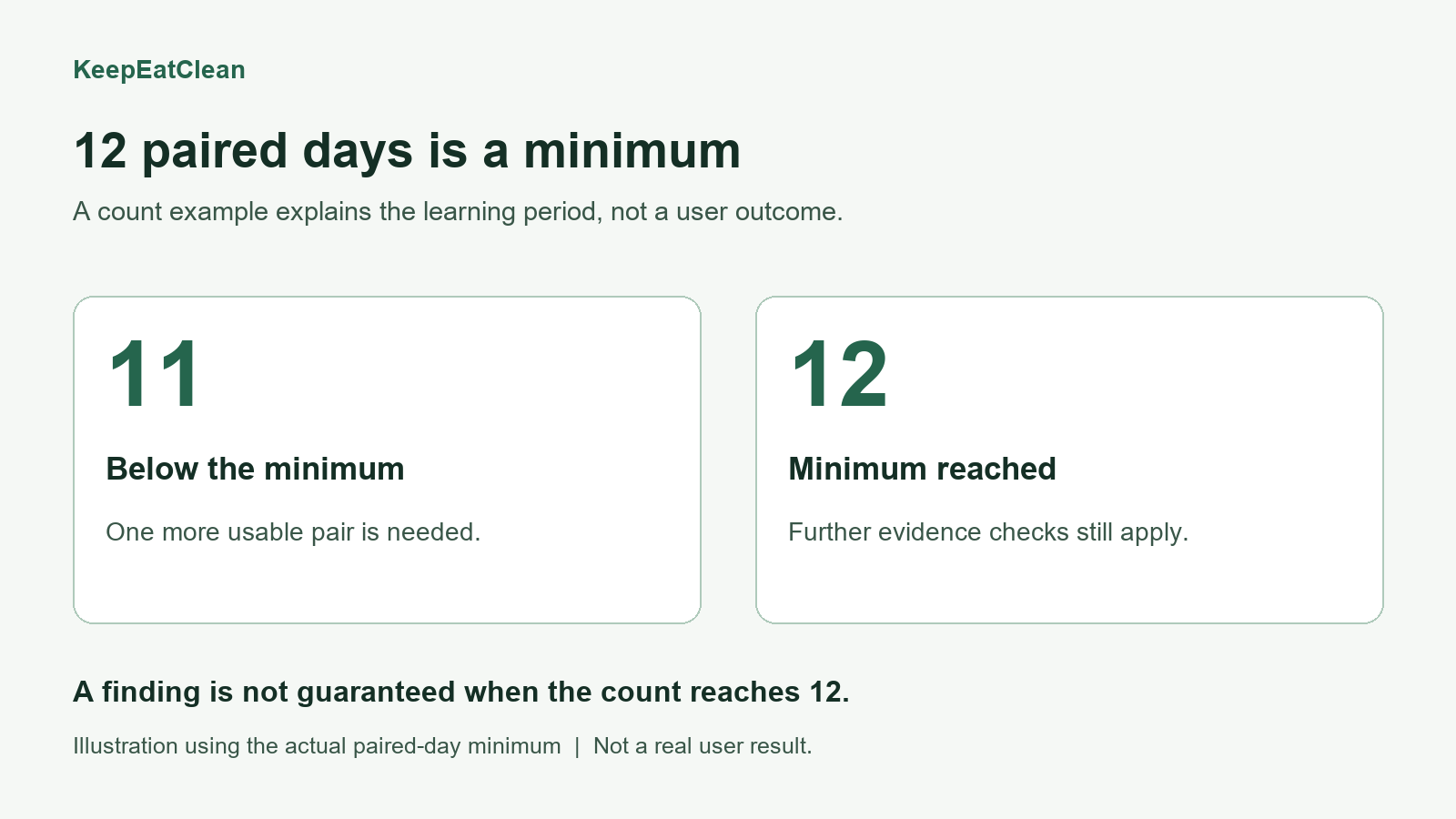
This illustration uses the actual minimum of 12 paired days. It is not a reported user result.
For a particular food-and-health comparison, 11 usable pairs remain one pair below the minimum: 12 minus 11 equals 1. Logging another meal only helps that comparison if the required health data also forms a usable pair.
With one additional qualifying pair, the comparison reaches 12. It has cleared the sample-count minimum, but the remaining evidence checks still apply. The outcome may be a supported association or no clear pattern. Reaching 12 therefore cannot be translated into a promised improvement in sleep or recovery.
Integrations and compatibility
Apple Health connects supported health history to the iPhone app through Apple’s own HealthKit framework. Apple Watch data comes through Apple Health; KeepEatClean is not a standalone watchOS app.
WHOOP has a separate connection for sleep and recovery data, an alternative route into the same kind of comparison that Apple is reportedly building a competing band to challenge. Available measures vary by source and permissions, so a reader should not assume every connected wearable supplies the same measurements.
Starting a personal history
The app is available on the App Store with a free tier and an optional Pro subscription. The public listing provides current purchase information and screenshots.
Users can begin by connecting a supported health source and recording meals consistently, correcting entries when needed. The aim is to build a history that can support useful questions about everyday eating habits over time. The approach sits alongside other Apple Health apps this site has covered that turn on-device data into context rather than a single score, including Cortisol+ and SportVitals.
Quick answers
How many paired days are needed before a finding appears?
You need at least 12 usable paired food-and-health days, plus further evidence checks. Twelve days do not guarantee a finding. Missing data or a comparison without a clear signal can leave the app learning or without a supported pattern.
Which wearable connections does the app support?
Apple Health and WHOOP are the supported connections. Apple Watch data is read through Apple Health. The available measures depend on the source and permissions.
Can a pattern prove that a meal caused better sleep?
No. Food × Body explores associations in personal history. Those observations can help identify habits worth considering, but they do not establish cause and effect or guarantee a health improvement.
Related reading
- Correlate: Recovery Scores From the Apple Watch You Already Wear
- Cortisol+ puts Apple Health stress signals in context
- SportVitals: transparent training load and HRV for Apple Watch
Author: Elyas Tas, founder of KeepEatClean, edited by the5krunner.
Last Updated on 29 September 2026 by the5krunner
Small things I always use
- Garmin 90-degree charging adapter: Charges your Garmin from any USB-C cable. Essential when travelling. I use one.
- Body Glide: The blue anti-chafe stick swimmers and runners carry. I use it.
- Speedo earplugs: Fewer ear infections and no cold-water dizziness. I use them.
- Maurten: Race fuel that stays easy on the stomach. I use them.
- Garmin charging puck: The quickest way to top up before a session. I use one.
- Injinji: Toe socks that stop rubbing, so you run more. I use them.
- Cellucor C4: My pre-workout before hard sessions.
- TPU tubes: Schwalbe Aerothan, Tubolito and Pirelli SmarTube. Light, tiny spares. I use all three.
Watches and sensors
- Polar H10: My daily driver for waking HRV.
- Polar Verity Sense: My backup arm-worn HR sensor.
- Nomad bedside charger: Charges my iPhone and Apple Watch overnight. I use it, and many of their bands.
- Train.Red: The best muscle oxygen sensor I’ve used.
- Garmin Forerunner 970: A pro-grade triathlon watch. I use this.
- Apple Watch Ultra 4: My daily smartwatch. No phone needed on rides.
- Garmin Fenix 9 Pro: I’ve just bought one.
On the bike
- Continental GP5000 for everyday riding, and Aero 111 on the front for special occasions.
- Ravemen FR300: A front light that mounts under your Garmin or Wahoo. I use one.
- Wahoo TRACKR Radar: I use it on one bike and Varia on the other. They perform the same.
- Garmin Varia RTL515: Radar that warns you of cars from behind. I use this model.
- Wahoo ELEMNT Roam 3: The bike computer that’s easy to use. I use mine on most rides.
- Favero Assioma Pro RS2: Accurate power pedals that swap easily between bikes. I use this model.
Home and indoor training
- Google Wifi: Keeps Zwift connected in my pain cave. I use it.
- Apple TV 4K: Zwift on the big screen. I use two.
- Google Nest Doorbell (wired, 2nd gen): My video doorbell, running in both Google Home and Apple Home. I use it.
Health, recovery and sleep
- FreeStyle Libre 3 Plus: Shows how my blood sugar responds to diet.
- hDrop: Measures my sweat loss in summer and indoors.
- Fourth Frontier Zone: Checks my heart under load in hard sessions.
- Oura Ring 5: My partner’s recovery tracker of choice.
- Kineon MOVE+: Red light therapy for niggles. It works.
- Eight Sleep: A cooling mattress cover my partner and I use nightly.
Reader-Powered Content
This content is not sponsored. It’s mostly me behind the labour of love, which is this site, and I appreciate everyone who supports it.
Support the site: Follow (free, fewer ads) · Subscribe (paid, ad-free) · Buy Me A Coffee ❤️
Written by real people, with AI assistance. Fact-checked and verified for originality. See the Editorial Policy. FTC: Affiliate Disclosure — some links pay commission. As an Amazon Associate, I earn from qualifying purchases.
tfk is the founder and author of the5krunner, an independent endurance sports technology publication. With 20 years of hands-on testing of GPS watches and wearables, and competing in triathlons at an international age-group level, tfk provides in-depth expert analysis of fitness technology for serious athletes and endurance sport competitors. ID
