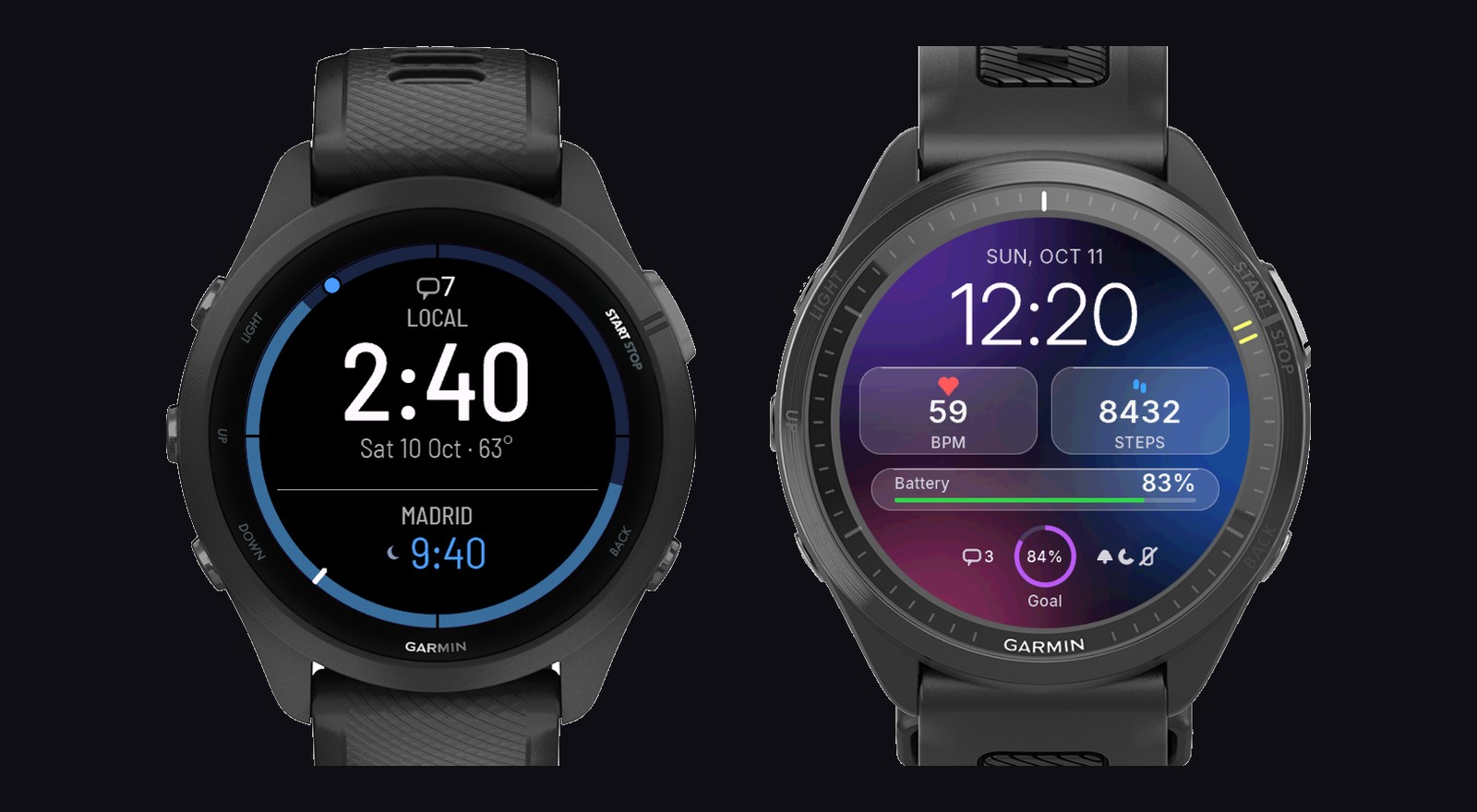
Twice a year a lot of Garmin watches show the wrong time in their second time zone. The watch itself is fine, because it takes its own local time from the phone, summer time included. The problem is the other city. Many watch faces store it as a fixed number of hours from UTC, so when London or New York changes its clocks, the face stays an hour out until the owner notices and opens the settings.
GMT, a Connect IQ watch face by independent developer Mario (MarioZ on the Connect IQ Store), carries the summer time rules for 50 cities inside the face, so the second zone moves by itself on the right night. The same rules run in two of his other faces, Glass Cards and Terminal, and they work the same on a 2017 Fenix 5 as on a Fenix 8. Each face is a one-time purchase after a 48-hour free trial, with no subscription.
A second time zone that is an hour wrong after the clocks change
A second time zone is a common request on a Garmin face, for travel, for family abroad or for work calls with another office. The usual way to set one up is an offset: London is UTC+0, Madrid UTC+1, New York UTC-5. That is right for only part of the year.
Europe moves to summer time on the last Sunday of March and back on the last Sunday of October, under the EU summer-time directive. The United States and Canada move on the second Sunday of March and the first Sunday of November, under US federal rules. Australia and New Zealand do the opposite, because their summer falls in the northern winter.
A face set to an offset in summer is therefore an hour wrong all winter, and the weeks when Europe and the US change on different dates catch out even owners who remember. This year Europe changes on 25 October and the US on 1 November.
How GMT works
TL;DR: GMT shows the time where the owner is in large digits, with the second city underneath, its name, a sun or moon for day or night there, and “+1” or “-1” when it is already another day. The second city is picked from a list of 50, and its summer time changes by itself. Everything is set in the Connect IQ app on the phone, by opening the face there and tapping Settings.
- The home city can be one of 50 cities with its own summer time rule, or a custom offset for anywhere else, including half-hour and quarter-hour zones such as India (+5:30) and Nepal (+5:45).
- A thin 24-hour ring around the edge shows day and night, with a dot for the second city and a line for local time, so owners can see whether someone is asleep before reading a number. It can be turned off, and it comes in four colour styles.
- A sun or moon sits next to the second time, and the owner decides what counts as daytime there.
- Both zones can be named. The local one says LOCAL by default and the second shows the city, or any label of up to ten characters such as HOME or OFFICE.
- The face has a dark or light theme, five accent colours, and 12-hour, 24-hour or watch-default time.
- A small extra next to the date can show temperature, heart rate, steps or watch battery, or nothing.
- Status icons for notifications, an alarm, do not disturb and a disconnected phone appear only when there is something to show.
- The always-on screen has three brightness levels.
- The face is in English and Spanish, set in Barlow, a typeface inspired by road and transit signs.
How the summer time rules work
Every city in the list carries two numbers: its normal offset from UTC and which of five rules it follows. The face works out the rest on the watch itself, from the current UTC time, without the phone or the internet.
- The United States and Canada rule covers Anchorage, Los Angeles, Vancouver, Denver, Chicago, New York and Toronto. Summer time runs from 2:00 local time on the second Sunday of March to 2:00 on the first Sunday of November.
- The Europe rule covers London, Dublin, Lisbon, Madrid, Paris, Berlin, Rome, Amsterdam, Zurich, Stockholm, Warsaw, Athens and Helsinki. Summer time runs from the last Sunday of March to the last Sunday of October, always at 1:00 UTC, so every European city changes at the same moment.
- The south-east Australia rule covers Sydney and Melbourne, from the first Sunday of October to the first Sunday of April.
- The New Zealand rule covers Auckland, from the last Sunday of September to the first Sunday of April.
- The no-summer-time rule covers Honolulu, Phoenix, Mexico City, Bogotá, Lima, Panama, Caracas, Santo Domingo, San Juan, Buenos Aires, São Paulo, Montevideo, Lagos, Johannesburg, Istanbul, Moscow, Riyadh, Dubai, Delhi, Bangkok, Singapore, Hong Kong, Beijing, Manila, Tokyo, Seoul and Brisbane.
The face checks the result once an hour, which is enough because every change happens on the hour. Before release, Mario wrote a second copy of the calculation and compared it with the time zone data built into Windows for every one of the 50 cities, every hour from January 2026 to the end of 2028. That is about 26,000 hours per city and six clock changes for each city that has summer time, and there were no differences.
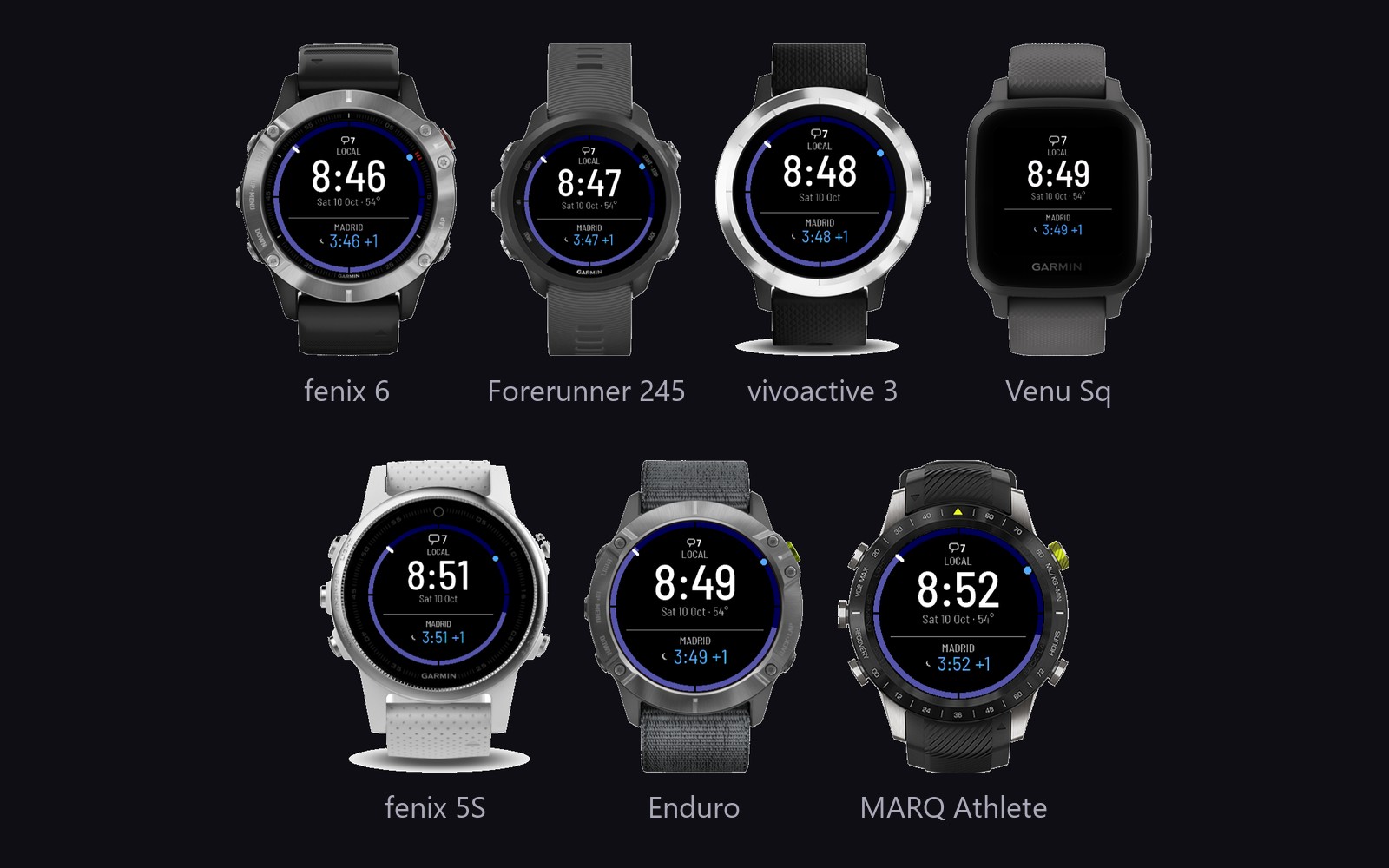
Mario says newer Garmin watches, from Connect IQ 3.3, can work out the local time at a map position, but older models cannot. GMT runs on 121 watches, including Fenix 5, Fenix Chronos, Forerunner 645 and 935 and vivoactive 3, none of which have that function. Carrying the rules in the face means the second zone behaves the same on every one of them.
For a city outside the 50, GMT and Glass Cards keep a custom offset, in hours from UTC plus :30 or :45 where needed. That offset does not change by itself, so if the place has summer time, the owner changes it by hand. Owners can ask for a city to be added, and if a country changes its rules, Mario updates the list in the face.
Worked example: London and New York in late October
Take a runner in New York with London as the second zone, set up in summer as UTC+1. This is what each face shows at noon UTC on three days around the change.
| Day (12:00 UTC) | New York | Real London time | Fixed UTC+1 face | GMT |
|---|---|---|---|---|
| Sat 24 Oct | 8:00 am | 1:00 pm | 1:00 pm | 1:00 pm |
| Mon 26 Oct | 8:00 am | 12:00 pm | 1:00 pm (wrong) | 12:00 pm |
| Mon 2 Nov | 7:00 am | 12:00 pm | 1:00 pm (wrong) | 12:00 pm |
On Sunday 25 October London goes back to UTC+0 while New York stays on summer time for another week, so for seven days the two cities are four hours apart instead of five. The fixed face is an hour fast from that Sunday and stays wrong after 1 November too, until someone edits it. GMT shows the right London time all the way through. The same four-hour gap returns in spring, from 14 to 28 March 2027.
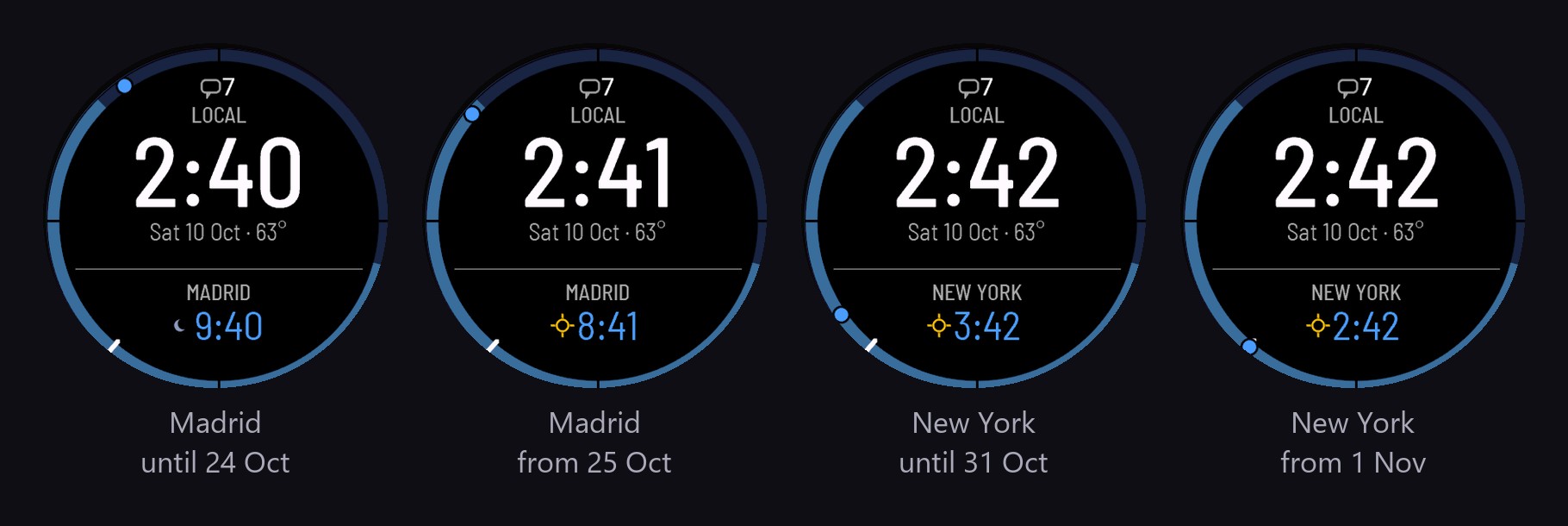
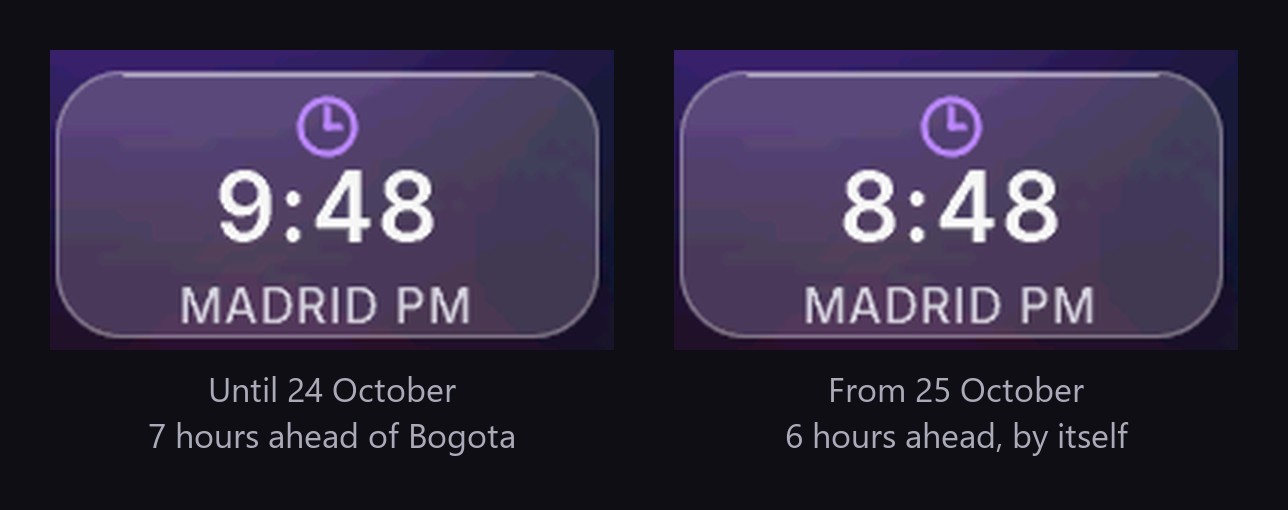
The screens below come from a watch on Bogotá time, which has no summer time. Madrid moves from seven to six hours ahead on 25 October, and New York moves from one hour ahead to the same time on 1 November.
Glass Cards: the same rules on a card
Glass Cards is Mario’s most-reviewed face, with 15 reviews on the Connect IQ Store averaging 4.9 stars as of 12 October 2026. It looks like a phone lock screen, with a large light time and two or four frosted cards over soft colour lights or pure black, and each card shows one of 24 kinds of data. One of them is the second time zone, with the same 50 cities and the same rules as GMT.
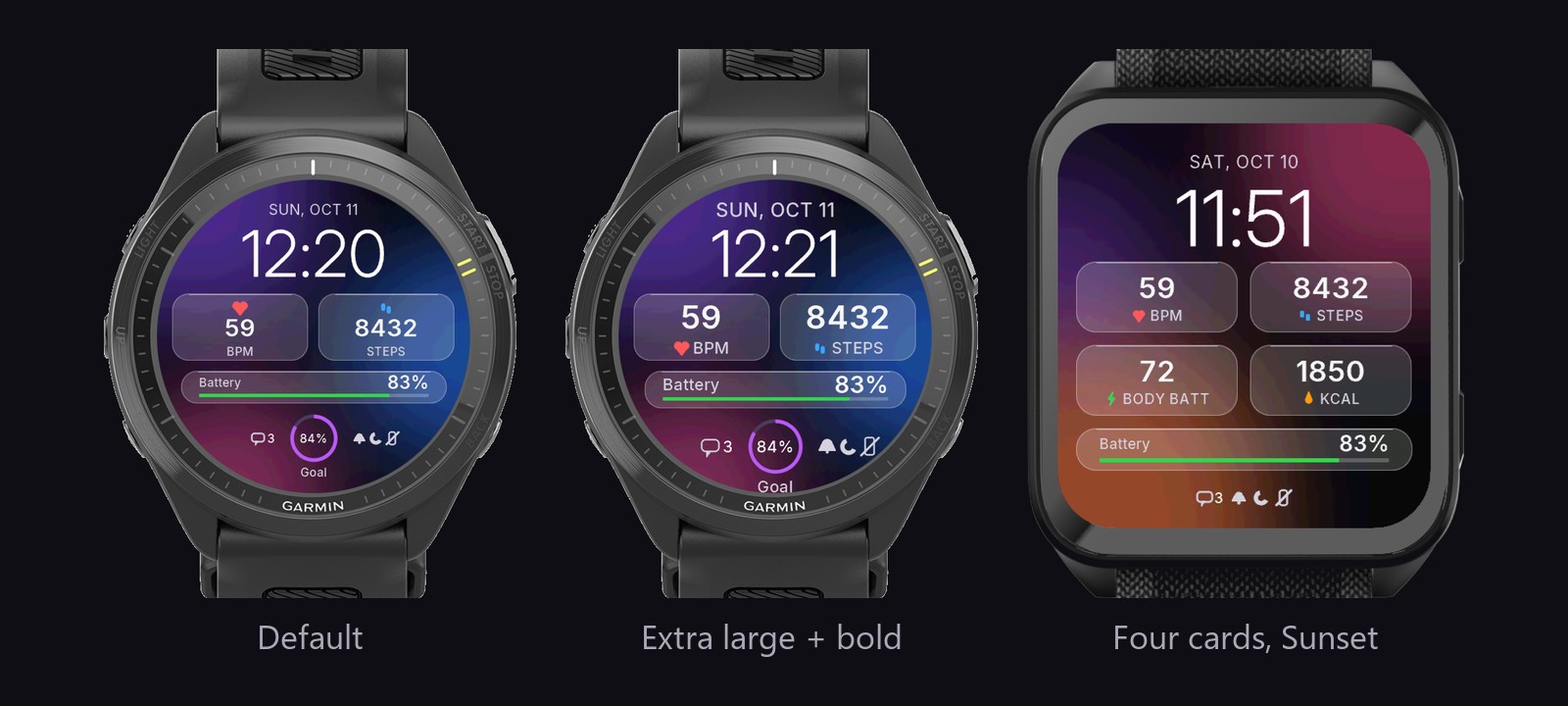
Mario built Glass Cards with testers from Reddit. Six days after it went live on 15 September, he offered free codes on r/GarminWatchFaces, and much of what the face does now came from those testers and from store reviews: a layout without the goal ring, card values on the always-on screen, active calories, feels-like temperature, a notifications card and a bold text option. The testers also showed that many owners never open the settings, which is why the options below are worth knowing.
- The 24 card options are heart rate, steps, Body Battery, calories, active calories, distance, floors, intensity minutes, altitude, temperature, feels-like temperature, sunrise and sunset, stress, Pulse Ox, recovery time, respiration, VO2 max, weekly running distance, sleep score, barometric pressure, the next calendar event, a second time zone, training status and the number of notifications waiting.
- There are four layouts: two cards with a bar and goal ring, four cards with a bar, two cards with a bar, or a bigger time.
- Text comes in Normal, Large or Extra large, plus bold text for owners who find thin type hard to read.
- Touching and holding a card opens the watch’s own screen for that data, on watches that support it.
- The always-on screen can show the card values at three brightness levels, or be switched off.
- The bottom bar and the goal ring can follow the battery, Body Battery, steps, floors or intensity minutes.
- The backgrounds are Aurora, Sunset, Ocean, Forest, black, or a colour that rotates every hour, in order or at random.
- Card icons, card labels, status icons and seconds can each be switched on or off.
Glass Cards runs on 51 AMOLED Garmin watches, from Venu 2 and vivoactive 5 to Forerunner 970, Fenix 8 and Fenix 9. It is AMOLED only by design, because the look depends on true black and smooth type.
Terminal, One Line and older watches
Terminal looks like a computer console, with monospaced text in phosphor green, amber, cyan or white. One of its lines can show the same 50-city second zone, and another can show a heart-rate graph of the last four hours with the lowest and highest values.
One Line is the simplest of the four, with very large digits for owners who mostly want to read the time at a glance. It does not have the second zone.
In October Mario brought these faces to older Garmin watches that rarely get new faces, after measuring the memory each one uses on them.
- GMT runs on 121 watches, including the Fenix 5, 5S and 5X and their Plus versions, Fenix Chronos, the Fenix 6 series, Enduro, MARQ (first generation), Forerunner 245, 645, 745, 935 and 945, Venu, Venu Sq, and vivoactive 3 and 4.
- Terminal and One Line run on 100 watches each, including the Fenix 5 Plus series, the Fenix 6 series, Forerunner 245, 745, 935 and 945, Venu, Venu Sq, and vivoactive 3 and 4.
- Glass Cards runs on 51 AMOLED watches.
The full, current list for each face is on its store page.
Trial, price and the QR unlock
All four faces are free for 48 hours and then a one-time purchase. GMT and One Line cost $0.99, and Glass Cards and Terminal cost $1.99. All 16 of Mario’s paid faces can be bought together for $6.99. There are no subscriptions and no ads.
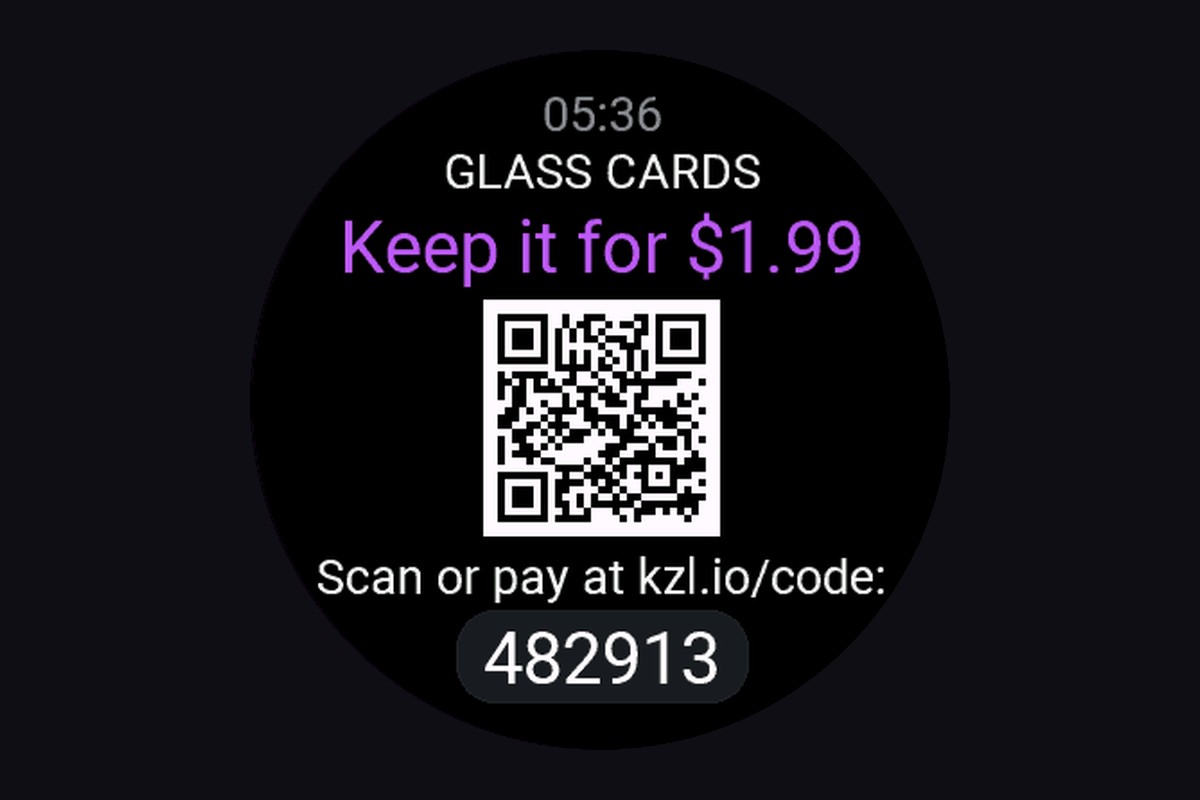
When the trial ends, the watch shows the name of the face, the price and, on screens 390 pixels or wider, a QR code. The watch generates the QR code itself with that watch’s unlock code already in it, so scanning it with a phone opens the payment page with nothing to type. The same code appears underneath for anyone who prefers to enter it at kzl.io/code, and smaller screens show the code alone.
Payment is handled by KiezelPay, a payment service used by many Connect IQ developers. The faces never see card details, and refunds go through KiezelPay. Owners who decide not to buy simply switch to another face, and nothing is charged.
Background
Mario is an independent developer in Colombia who publishes as MarioZ on the Connect IQ Store. Colombia has no summer time, so from Bogotá the gap to Madrid, London or New York changes twice a year while the local clock never does. All his faces are one-time purchases with a short free trial, every option sits in the settings rather than behind a second purchase, and he answers owners by email and on Reddit, where several of the features above were first requested.
More: GMT on the Connect IQ Store
Quick answers
Why can't a Garmin watch face just use the phone's time zone?
A Garmin watch face does use the phone’s time zone for local time, and the large time on GMT is that. What a face cannot do on every watch is ask for the time in another city by name. Newer watches can work it out from a map position, but older ones cannot, so GMT, Glass Cards and Terminal carry the rules for their 50 cities themselves and behave the same on every supported watch.
Does GMT need the phone or the internet to change for summer time?
No, GMT works out the change on the watch itself from the current UTC time and the city’s rule. It checks once an hour, which is enough because every clock change happens on the hour.
Which cities are supported?
GMT supports Honolulu, Anchorage, Los Angeles, Vancouver, Phoenix, Denver, Chicago, Mexico City, New York, Toronto, Bogotá, Lima, Panama, Caracas, Santo Domingo, San Juan, Buenos Aires, São Paulo, Montevideo, London, Dublin, Lisbon, Madrid, Paris, Berlin, Rome, Amsterdam, Zurich, Stockholm, Warsaw, Lagos, Athens, Helsinki, Johannesburg, Istanbul, Moscow, Riyadh, Dubai, Delhi, Bangkok, Singapore, Hong Kong, Beijing, Manila, Tokyo, Seoul, Brisbane, Sydney, Melbourne and Auckland.
What if my city is not on the list?
In GMT and Glass Cards, pick Custom offset and set the hours from UTC, with :30 or :45 if needed. That setting does not follow summer time, so it has to be changed by hand when the clocks change there. Owners can also ask Mario to add the city.
How much do GMT and Glass Cards cost?
Each face is free for 48 hours and then a one-time purchase, with GMT at $0.99 and Glass Cards at $1.99. All 16 of Mario’s paid faces cost $6.99 together, with no subscription.
Related reading
- Padel Smash: padel scoring on Garmin, called out loud
- Podl: podcasts synced between iPhone and Garmin
- Sugar Sense: Libre, Dexcom and Nightscout glucose on Garmin
Author: Mario (MarioZ), developer of GMT, Glass Cards and Terminal, edited by the5krunner.
If you enjoyed reading this, here is another in the Indie Spotlight series: Kiiro builds heart rate plans for Apple Watch runners.
Last Updated on 12 October 2026 by tfk the5krunner
Small things I always use
- Garmin 90-degree charging adapter: Charges your Garmin from any USB-C cable. Essential when travelling. I use one.
- Body Glide: The blue anti-chafe stick swimmers and runners carry. I use it.
- Speedo earplugs: Fewer ear infections and no cold-water dizziness. I use them.
- Dryrobe Advance: My winter changing robe for open-water swims. I use one. A cheaper option is the AONYIYI changing robe.
- Maurten: Race fuel that stays easy on the stomach. I use them.
- Garmin charging puck: The quickest way to top up before a session. I use one.
- Injinji: Toe socks that stop rubbing, so you run more. I use them.
- Ultimate toe protectors: Stop black toenails on long runs. They work. I use them.
- Compressport R2 v2 calf sleeves: My calf sleeves of choice. I use them.
- Cellucor C4: My pre-workout before hard sessions.
- TPU tubes: Schwalbe Aerothan, Tubolito and Pirelli SmarTube. Light, tiny spares. I use all three.
- G8 insoles: Adjustable insoles that are good. I use them.
- Cycplus Cube: A 97g electric pump that gets a road tyre rideable in two minutes. I carry one. 5% off with code THE5KRUNNER.
Watches and sensors
- Polar H10: My daily driver for waking HRV.
- Polar Verity Sense: My backup arm-worn HR sensor.
- Nomad bedside charger: Charges my iPhone and Apple Watch overnight. I use it, and many of their bands.
- Train.Red: The best muscle oxygen sensor I’ve used.
- Tymewear: Accurate heart rate and reliable ventilatory zones. I use it to pace endurance rides over an hour.
- Garmin Forerunner 970: A pro-grade triathlon watch. I use this.
- Apple Watch Ultra 4: My daily smartwatch. No phone needed on rides.
- Garmin Fenix 9 Pro: I’ve just bought one.
On the bike
- Continental GP5000 for everyday riding, and Aero 111 on the front for special occasions.
- Helmets: Specialized S-Works Evade 3 for road riding, and Rudy Project Wing for TT-style races. I use both.
- Ravemen FR300: A front light that mounts under your Garmin or Wahoo. I use one.
- Wahoo TRACKR Radar: I use it on one bike and Varia on the other. They perform the same.
- Garmin Varia RTL515: Radar that warns you of cars from behind. I use this model.
- Wahoo ELEMNT Roam 3: The bike computer that’s easy to use. I use mine on most rides.
- Favero Assioma Pro RS2: Accurate power pedals that swap easily between bikes. I use this model.
Home and indoor training
- NPE Runn: Makes my basic treadmill smart, sending more accurate speed and distance to my watch and Zwift. I use it.
- Google Wifi: Keeps Zwift connected in my pain cave. I use it.
- Apple TV 4K: Zwift on the big screen. I use two.
- Google Nest Doorbell (wired, 2nd gen): My video doorbell, running in both Google Home and Apple Home. I use it.
Health, recovery and sleep
- FreeStyle Libre 3 Plus: Shows how my blood sugar responds to diet.
- hDrop: Measures my sweat loss in summer and indoors.
- Fourth Frontier Zone: Checks my heart under load in hard sessions.
- Oura Ring 5: My partner’s recovery tracker of choice.
- Kineon MOVE+: Red light therapy for niggles. It works.
- Eight Sleep: A cooling mattress cover my partner and I use nightly.
Reader-Powered Content
This content is not sponsored. It’s mostly me behind the labour of love, which is this site, and I appreciate everyone who supports it.
Support the site: Follow (free, fewer ads) · Subscribe (paid, ad-free) · Buy Me A Coffee ❤️
Written by real people, with AI assistance. Fact-checked and verified for originality. See the Editorial Policy. FTC: Affiliate Disclosure — some links pay commission. As an Amazon Associate, I earn from qualifying purchases.
tfk is the founder and author of the5krunner, an independent endurance sports technology publication. With 20 years of hands-on testing of GPS watches and wearables, and competing in triathlons at an international age-group level, tfk provides in-depth expert analysis of fitness technology for serious athletes and endurance sport competitors. ID
