A training plan does not get a runner to the finish line on its own. It takes someone who knows the runner, notices when the week goes wrong and changes the training to match. A human coach does that, but a coach through TrainingPeaks costs $149 to $359 a month, and the top tier at CTS is $1,295 a month or more. A plan app costs about $20 a month, asks for a race and a goal time, and hands back a plan. The rest is left to the runner: reading their own workouts, deciding what to do after a missed run and moving sessions to fit the week.
Runsense started from research into what runners say is missing. The team analysed 165 running threads on Reddit and more than 1,800 comments. The gaps runners named most often, with both coaches and apps, were communication (64%), personalisation (61%), the relationship (55%) and adaptability (52%). The founder’s post has the full account.
Runsense is an iPhone coaching app that learns the whole runner, builds the training from today through the race and the recovery after it, and then talks to the runner every day. It reads every run and how the runner slept, asks how a session felt, and changes the plan when the week changes.
How Runsense works
TL;DR: Runsense asks about far more than a race date and goal time, plans the full build to the race and the recovery after it, and then coaches day by day. The plan changes as runs, sleep data and the runner’s own answers come in, and the coach explains every change.
Learning the runner
Runsense starts with the goal race, running history, current fitness, the days the runner can run, any gym or strength work, and what the rest of life asks of them. Most plan apps collect only the race distance, date and goal time.
Planning the build
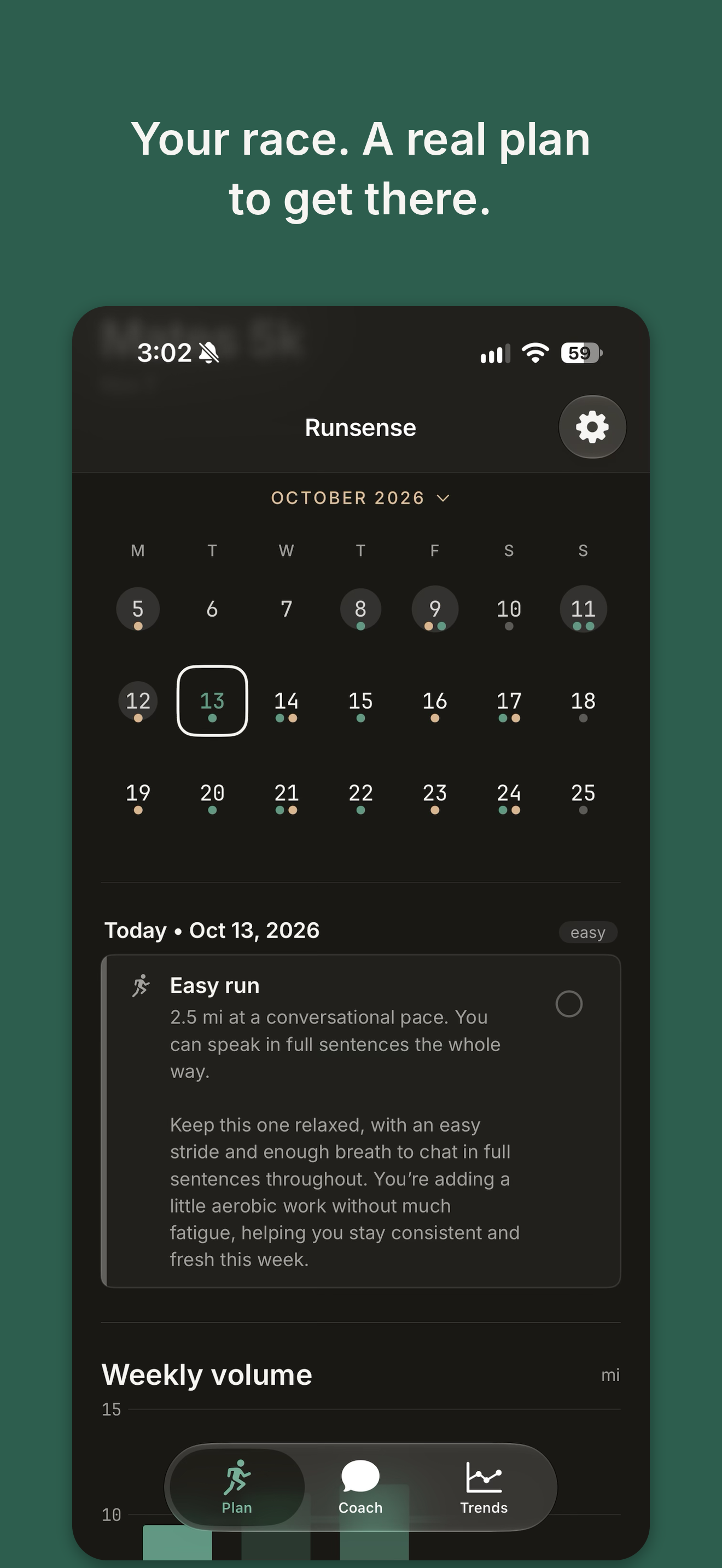
From that, Runsense designs the full arc of training the way a coach would, with the elements the goal needs: aerobic base, economy and speed, volume and fatigue resistance, and race-specific work. These are laid out in build weeks, cutback weeks and a taper, followed by recovery after the race. The length of the program comes from the race date, not the distance, so a 100K that is twenty weeks away gets twenty weeks.
Coaching day by day
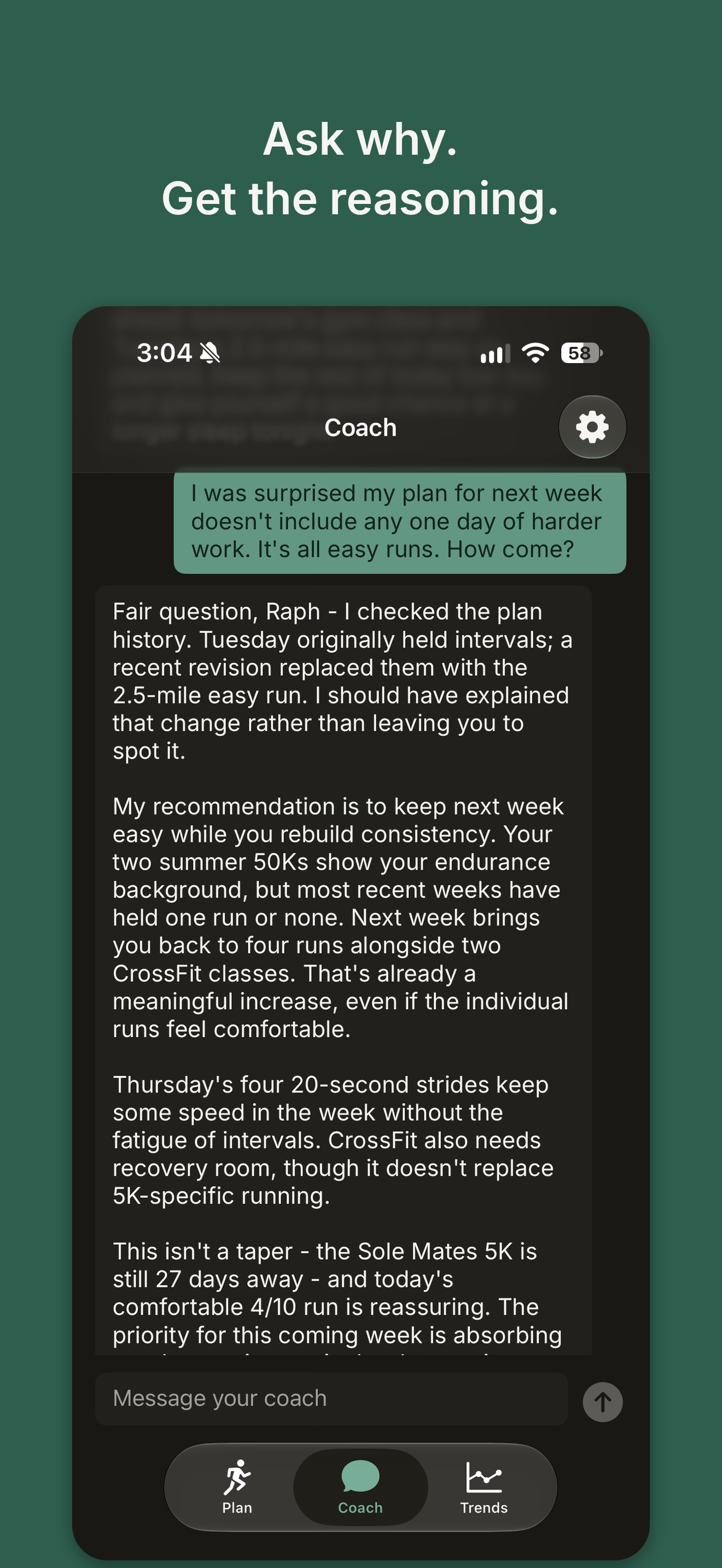
The coach sends the day’s session each morning. After a run it reads the recording and, when something is worth asking, asks how it felt, how hard it was from 1 to 10 and how the legs are. The runner can write at any time to move a session, ask why Thursday is intervals or say a week got away from them. The coach answers with its reasoning, and when the plan changes it says what moved. Runsense is built for every level, from a first 5K to a hundred-mile ultra.
Three moments from real training
These are three real exchanges between Runsense athletes and their coach, with names, races and places removed. In each, the coach made a call and said what to watch for.
A calf that stayed tight
A runner finished a 3.5-mile run with a hard half-mile in the middle and rated it 7 out of 10. They added that a twinge had hit the lower left calf the moment they sped up and stayed for the rest of the run. The coach said that was not a “just run through it” signal, cut the next day’s VO2 max intervals to an easy 2.4-mile run, and asked whether the pain was sharp or dull and whether it eased with running.
It had stayed, low in the calf. The coach took running off the plan and kept the swim, the walk and the gym work in for as long as they were pain-free. Over the next few days it asked how the calf felt walking around, kept running off while the tightness lingered, and added optional stretches and mobility work. On the sixth day the runner said the calf felt good. The coach put an easy run back on the plan with a clear rule: a little stiffness that loosens is fine, but if the calf turns sharp, stays in one spot or gets worse during the run, stop and send a message.
A 30-mile run, a late fade and a sweat test
Five weeks before a 100K, a runner’s watch sent in a 30-mile (48 km) trail run of 5 hours 27 minutes, in place of the 18 to 19 miles on the plan. The runner said it went better than their last 30-miler, the knee gave less trouble and they were probably behind on water and salt. The slowdown came after mile 26, when the knee started to bother them. The coach tied the late fade to the water and salt gap and made fuelling the thing to tune before race day. It cut the next day’s back-to-back run to 30 minutes easy, removed the add-on session, and asked about the location, character and severity of the knee pain.
Two days later the runner asked how to run a sweat test. The coach gave the method: weigh before and after an easy hour, measure what is drunk and note any toilet stop. Sweat loss is the weight lost plus the fluid drunk, minus any urine, with one pound of weight lost equal to about 16 fluid ounces.
| Sweat test | Conditions | Sweat loss |
|---|---|---|
| First run | Cool, 55°F (13°C) | About 12.6 fl oz (370 ml) an hour |
| Five days later | Warm, 78°F (26°C), gels counted | About 48 fl oz (1.4 litres) an hour |
The warm run lost nearly four times as much. The coach called the hot-day number the one that counts for race day and set a provisional drinking target, to be refined with a second hot-day test.
A runner who felt like a runner
A few weeks into a run/walk plan of one minute jogging and one minute walking for thirty minutes, a new runner wrote partway through a session that they felt great and that this was “amazing running now.” The coach told them it was a big moment, that the feeling of running starting to click is exactly what the plan aims for, and that they had earned it. It also nudged them not to chase extra speed or effort on the back of the feeling, because a runner starting from zero needs the new fitness to settle before intensity or duration go up.
When the legs and the watch disagree
Sometimes the data says tired and the runner says fine, or the other way round. A coach does not pick one by rule. They weigh both and say what they are leaning on.
In one case from the founder’s own training, his sleep data showed under six hours, well below his baseline, and his 3-mile run had already been moved back a day at his request. The coach’s message cited the short night and asked whether his legs felt comfortable or heavy, and whether he could speak in full sentences to the end of the run. He ran 3.7 miles, 0.7 over the plan, at 4 out of 10, and said his legs felt fine. The coach called that reassuring, left the plan as written and suggested giving himself a chance at a longer sleep that night.
What the coach reads and where it comes from
Runs
The coach reads distance, pace, heart rate and elevation for every run. How a run reaches it depends on the watch:
- COROS, Suunto, Polar and Strava connect directly. The runner signs in once inside the app, and runs arrive with the full recording.
- Apple Watch and Garmin runs reach the coach through Apple Health, which the runner allows at signup. Apple Health stays connected for everyone as a backup.
Apple Health data
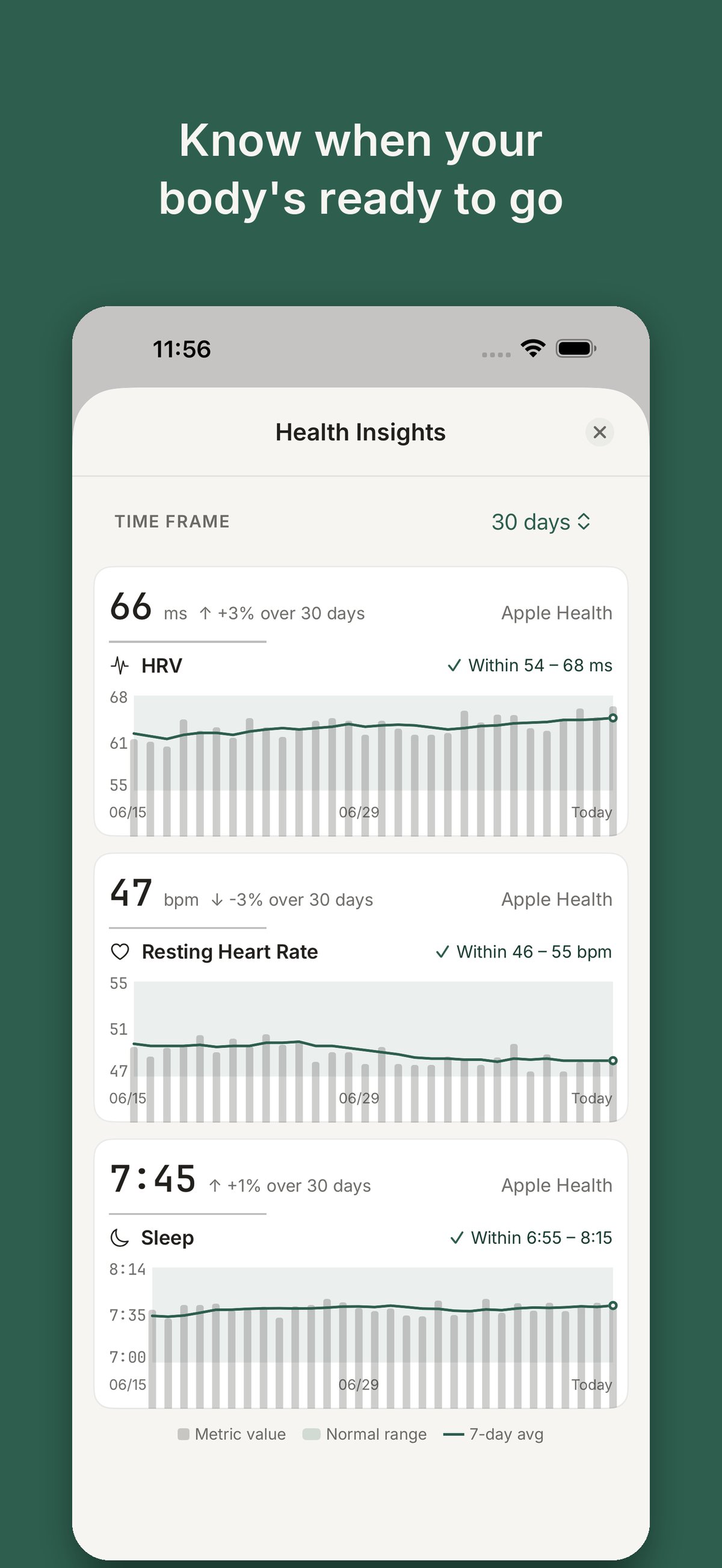
Runsense asks to read workouts, heart rate, resting heart rate, heart rate variability, sleep, walking and running distance, cycling distance, running power, cycling power and cadence, active energy, steps, and the GPS route for elevation.
Sleep, resting heart rate and HRV
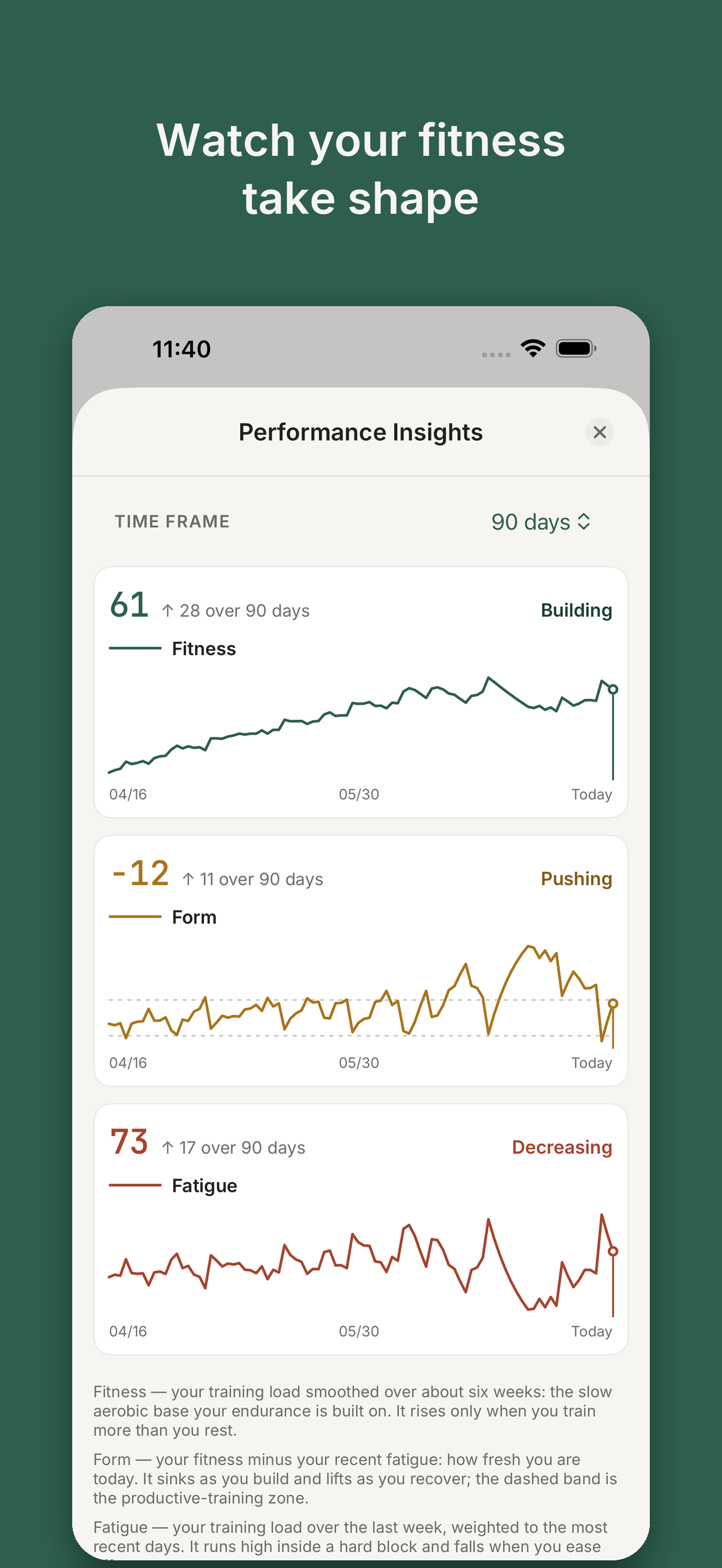
These come from the watch. After 30 days of data, the coach sets a normal range for each and responds when a new reading moves sharply or steadily away from it. The heart rate data also feeds the fitness, fatigue and form view built from the runner’s own training load.
What the runner says
The coach takes in the effort rating, how the legs feel and what happened on the run, along with anything else the runner mentions, such as stress at work or a poor night’s sleep. It keeps what the runner has shared, so the coaching builds on itself over a season.
Workouts on the watch
- On Apple Watch, each day’s session arrives in the Workout app with the warm-up, intervals and targets laid out, and it updates when the plan changes.
- On Suunto, the session arrives as a SuuntoPlus Guide.
- On Garmin, COROS and Polar watches, the runner reads the session in the app or the morning message.
Price
Runsense costs $8.99 a month or $69.99 a year in the US, and new members get the first two weeks free. Signup is in the Runsense iPhone app.
More: runsense.ai
Quick answers
Is the Runsense coach a person?
No, the coach is Runsense’s own software. It designs the program, explains each session, reads every run and reworks the plan when life changes, and it answers whenever the runner writes.
Does Runsense only work with Apple Watch?
No. Runs from COROS, Suunto, Polar and Strava connect directly, and Garmin runs arrive through Apple Health. Signup needs an iPhone, and only Apple Watch and Suunto watches receive each day’s structured workout.
What does Runsense do when the data and the runner disagree?
It weighs both and says which way it is leaning. When short sleep met legs that felt fine, the coach asked specific questions about the run, accepted the answers and left the plan as written.
When does Runsense start using HRV and resting heart rate?
After 30 days of watch data. The coach then sets a normal range for sleep, resting heart rate and HRV, and responds to sharp or sustained changes.
How much does Runsense cost?
New members get the first two weeks free. After that Runsense costs $8.99 a month or $69.99 a year in the US.
Related reading
- Kiiro builds heart rate plans for Apple Watch runners
- AthleteData: an AI coach for endurance athletes
- How Runna’s plans adapt
Author: Raph Crawford-Marks, founder of Runsense, edited by the5krunner.
If you enjoyed reading this, here is another in the Indie Spotlight series: Sympathetic turns a Polar H10 into a breathing coach.
Last Updated on 13 October 2026 by tfk the5krunner
Small things I always use
- Garmin 90-degree charging adapter: Charges your Garmin from any USB-C cable. Essential when travelling. I use one.
- Body Glide: The blue anti-chafe stick swimmers and runners carry. I use it.
- Speedo earplugs: Fewer ear infections and no cold-water dizziness. I use them.
- Dryrobe Advance: My winter changing robe for open-water swims. I use one. A cheaper option is the AONYIYI changing robe.
- Maurten: Race fuel that stays easy on the stomach. I use them.
- Garmin charging puck: The quickest way to top up before a session. I use one.
- Injinji: Toe socks that stop rubbing, so you run more. I use them.
- Ultimate toe protectors: Stop black toenails on long runs. They work. I use them.
- Compressport R2 v2 calf sleeves: My calf sleeves of choice. I use them.
- Cellucor C4: My pre-workout before hard sessions.
- TPU tubes: Schwalbe Aerothan, Tubolito and Pirelli SmarTube. Light, tiny spares. I use all three.
- G8 insoles: Adjustable insoles that are good. I use them.
- Cycplus Cube: A 97g electric pump that gets a road tyre rideable in two minutes. I carry one. 5% off with code THE5KRUNNER.
Watches and sensors
- Polar H10: My daily driver for waking HRV.
- Polar Verity Sense: My backup arm-worn HR sensor.
- Nomad bedside charger: Charges my iPhone and Apple Watch overnight. I use it, and many of their bands.
- Train.Red: The best muscle oxygen sensor I’ve used.
- Tymewear: Accurate heart rate and reliable ventilatory zones. I use it to pace endurance rides over an hour.
- Garmin Forerunner 970: A pro-grade triathlon watch. I use this.
- Apple Watch Ultra 4: My daily smartwatch. No phone needed on rides.
- Garmin Fenix 9 Pro: I’ve just bought one.
On the bike
- Continental GP5000 for everyday riding, and Aero 111 on the front for special occasions.
- Helmets: Specialized S-Works Evade 3 for road riding, and Rudy Project Wing for TT-style races. I use both.
- Ravemen FR300: A front light that mounts under your Garmin or Wahoo. I use one.
- Wahoo TRACKR Radar: I use it on one bike and Varia on the other. They perform the same.
- Garmin Varia RTL515: Radar that warns you of cars from behind. I use this model.
- Wahoo ELEMNT Roam 3: The bike computer that’s easy to use. I use mine on most rides.
- Favero Assioma Pro RS2: Accurate power pedals that swap easily between bikes. I use this model.
Home and indoor training
- NPE Runn: Makes my basic treadmill smart, sending more accurate speed and distance to my watch and Zwift. I use it.
- Google Wifi: Keeps Zwift connected in my pain cave. I use it.
- Apple TV 4K: Zwift on the big screen. I use two.
- Google Nest Doorbell (wired, 2nd gen): My video doorbell, running in both Google Home and Apple Home. I use it.
Health, recovery and sleep
- FreeStyle Libre 3 Plus: Shows how my blood sugar responds to diet.
- hDrop: Measures my sweat loss in summer and indoors.
- Fourth Frontier Zone: Checks my heart under load in hard sessions.
- Oura Ring 5: My partner’s recovery tracker of choice.
- Kineon MOVE+: Red light therapy for niggles. It works.
- Eight Sleep: A cooling mattress cover my partner and I use nightly.
Reader-Powered Content

This content is not sponsored. It’s mostly me behind the labour of love, which is this site, and I appreciate everyone who supports it.
Support the site: Follow (free, fewer ads) · Subscribe (paid, ad-free) · Buy Me A Coffee ❤️
Written by real people, with AI assistance. Fact-checked and verified for originality. See the Editorial Policy. FTC: Affiliate Disclosure — some links pay commission. As an Amazon Associate, I earn from qualifying purchases.
tfk is the founder and author of the5krunner, an independent endurance sports technology publication. With 20 years of hands-on testing of GPS watches and wearables, and competing in triathlons at an international age-group level, tfk provides in-depth expert analysis of fitness technology for serious athletes and endurance sport competitors. ID
