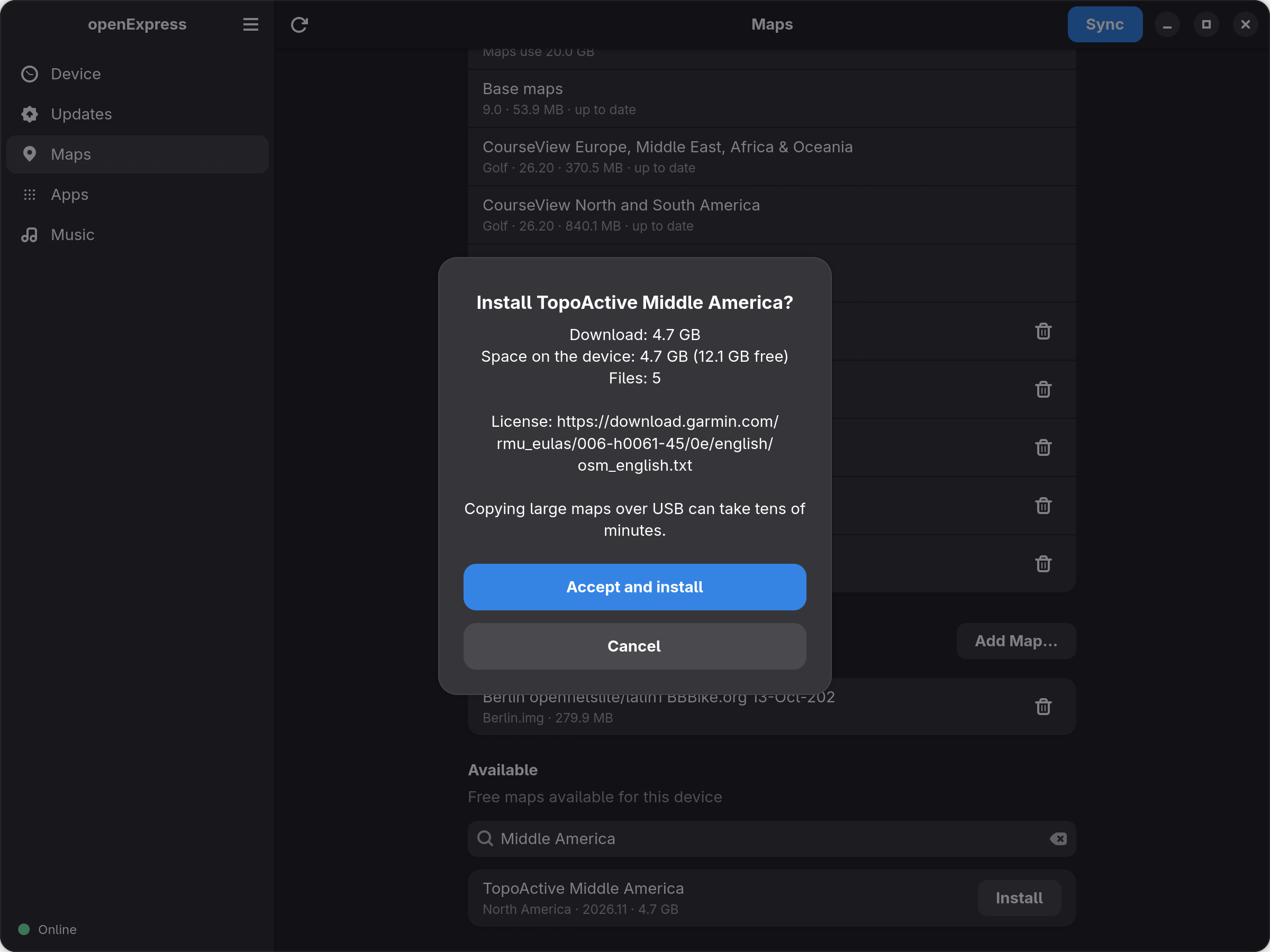
These are the ten Indie App Spotlight apps that readers rated highest this year, from a free Linux replacement for Garmin Express to a treadmill adapter that fixes indoor pace. The ranking is based on how readers responded to each article, not on my own opinion of the apps.
| App | Score | What it does |
|---|---|---|
| 1. openExpress | 96% | A free, open-source Linux app that does the jobs Garmin Express handles only on Windows and macOS, including updates, maps, and apps. |
| Why it did well: Garmin owners on Linux have had no official option, so the article met a need nobody else was serving. It scored highly on every measure, and its reading time was very high, helped by a worked example that follows a 4.7 GB map onto a watch step by step. | ||
| 2. Crystal Reborn | 91% | A rebuilt Garmin watch face with Body Battery, a full-colour always-on display and weather data. |
| Why it did well: Crystal is a name Garmin owners already know and search for. The original version was hugely popular, and I have used it in many of the images on this site. The article explains what changed in the rebuild, which gave existing fans a reason to come and look, and more readers engaged with it than with any other Indie article. | ||
| 3. QZ (qdomyos-zwift) | 87% | An open-source app that connects many indoor machines to Zwift, Peloton, Strava and Garmin. |
| Why it did well: Indoor riders and runners search for ways to make their equipment talk to their apps. The article explains plainly what QZ does and how, and Google kept sending those readers to it. | ||
| 4. FIT Dashboard | 87% | A free, open-source desktop app that analyses Garmin FIT files entirely on your own computer. |
| Why it did well: Readers who care about privacy found a clear reason to read on, because nothing leaves their machine. It did well on every measure, and its reading time was high. | ||
| 5. athletedata | 87% | An AI coach that connects Garmin, WHOOP, Oura and other platforms, then sends coaching through Telegram or WhatsApp. |
| Why it did well: Coaching that arrives as a message is an easy idea to grasp, and the article shows how it works in practice. It did well in Google search, and its reading time was high. | ||
| 6. RunBridge | 85% | A small USB adapter that passes a treadmill’s speed to a Garmin watch as a footpod signal. |
| Why it did well: Every treadmill runner knows the watch gets indoor pace wrong, and the article offers a simple fix. Its reading time was very high, the longest in the top ten. | ||
| 7. Type to Run Weekly Coach | 84% | An AI running coach that builds adaptive plans through conversation and syncs workouts to Garmin. |
| Why it did well: The article is frank that the plan asks the runner to report back after every session. That let readers judge quickly whether it suited them, and many engaged with it. | ||
| 8. SportVitals | 84% | Estimates training load, cycling VO2 max and running threshold from Apple Health data, calculated on the phone. |
| Why it did well: It explains how each number is worked out, which suits readers who don’t trust a score they can’t check. Its reading time was very high. | ||
| 9. Rack Strength | 83% | A Garmin app that syncs with the watch in real time to log every strength set. |
| Why it did well: Lifters go looking for a better way to track strength on a Garmin, and both Google and engaged readers favoured this article. It is short and names the gap that Garmin’s own strength mode leaves. | ||
| 10. WristTopo | 83% | An offline topographic map and turn-by-turn navigation app for the Apple Watch. |
| Why it did well: Hikers who want to leave the phone behind search for exactly this. The battery figures give them an honest answer, and the article’s reading time was high. | ||
How I scored them
I wanted a ranking that reflected engagement rather than raw traffic, because raw traffic is easily distorted. Older articles have had longer to collect readers, and a launch day can bring a spike that never repeats. So I built a composite score that strips those effects out.
- Same stage of life: every article is measured over the same period, from about one week to about five weeks after it went live. That skips the launch-day spike and gives older articles no head start.
- Several signals, not one: the score combines how often readers found the article through Google and clicked through, how many of them engaged with it, and how long they spent reading. Google search carries the most weight, because it shows people actively looking for what the app does. Reading time is described against all 80 Indie articles: very high is the top fifth, high the next fifth, medium the middle fifth and low the bottom two fifths.
- Ranked, not totalled: each article is ranked against the others on each signal before the signals are combined, so one freak result on a single measure can’t carry an article to the top.
The articles at the top share a few traits. They start with a problem the reader already has, they show the app solving it with a real example, and they are honest about the limits.
The surprise: Sugar Sense came 17th
I expected Sugar Sense to win. It had more reads than any other Indie article at the same stage, and its developer told me about plenty of sign-ups. On the composite score, it came 17th. So much for reviewer bias!
Plenty of readers engaged with it, but its reading time was low, well short of the top ten, and fewer of them arrived from Google search. Sign-ups happen on the developer’s side, so they don’t show in the5krunner’s data at all – maybe people were so impressed with the first 15 seconds that they clicked across and installed it, who knows! Sugar Sense clearly works for the people who need it.
Do you agree with the order? Try a few of the apps, and tell me in the comments below which one you think should have won and why.
Last Updated on 17 November 2026 by tfk the5krunner
Small things I always use
- Garmin 90-degree charging adapter: Charges your Garmin with any USB-C cable. Essential when travelling. I use one.
- Body Glide: The blue anti-chafing stick swimmers and runners carry. I use it.
- Speedo earplugs: Fewer ear infections and no cold-water dizziness. I use them.
- Dryrobe Advance: My winter changing robe for open-water swims. I use one. A cheaper option is the AONYIYI changing robe.
- Maurten: Race fuel that stays easy on the stomach. I use them.
- Beet It Sport nitrate shots: Beetroot shots I take in the days before a race. I use them.
- Garmin charging puck: The quickest way to top up before a session. I use one.
- Injinji: Toe socks that stop rubbing, so you run more. I use them.
- Ultimate toe protectors: Stop black toenails on long runs. They work. I use them.
- Compressport R2 v2 calf sleeves: My calf sleeves of choice. I use them.
- Cellucor C4: My pre-workout before hard sessions.
- TPU tubes: Schwalbe Aerothan, Tubolito and Pirelli SmarTube. Light, tiny spares. I use all three.
- G8 insoles: Adjustable arches, perfect position. I use them.
- Cycplus Cube: A 97g electric pump that gets a road tyre rideable in two minutes. I carry one. 5% off with code THE5KRUNNER.
Health, recovery and sleep
- Kineon MOVE+: Red and infrared light for sore knees, Achilles and other joints after hard training. I use it.
- FreeStyle Libre 3 Plus: Shows how my blood sugar responds to diet. Occasional use.
- hDrop: Measures my sweat loss in summer and indoors. I use it.
- Fourth Frontier Zone: Checks my heart under load in hard sessions.
- Oura Ring 5: My partner’s recovery tracker of choice.
- Eight Sleep: A cooling mattress cover my partner and I use nightly.
Watches and sensors
- Polar H10: My daily driver for waking HRV.
- Polar Verity Sense: My backup arm-worn HR sensor.
- Nomad bedside charger: Charges my iPhone and Apple Watch overnight. I use it, and many of their bands.
- Train.Red: The best muscle oxygen sensor I’ve used. Occasional use.
- Tymewear: Accurate heart rate and reliable ventilatory zones. I use it to pace endurance rides over an hour.
- Garmin Forerunner 970: A pro-grade triathlon watch. I use this.
- Apple Watch Ultra 4: My daily smartwatch. No phone needed on rides.
On the bike
- Continental GP5000 for everyday riding, and Aero 111 on the front for special occasions. I use both.
- Helmets: Specialized S-Works Evade 3 for road riding, and Rudy Project Wing for TT-style races. I use both.
- Ravemen FR300: A front light that mounts under your Garmin or Wahoo. I use one.
- Ravemen FR1000: The light and the computer mount in one unit, so nothing else goes on the bars. Better than mine.
- Ravemen FR1500SE: 1,500 lumens hanging under your Garmin, for proper night rides.
- Ravemen FR1100SE: 1,100 lumens under your Garmin, and up to 46 hours on slow flash.
- Ravemen FR500: A brighter FR300 with the same mount.
- Wahoo TRACKR Radar: I use it on one bike and Varia on the other. They perform the same.
- Garmin Varia RTL515: Radar that warns you of cars from behind. I use this model.
- Wahoo ELEMNT Roam 3: The bike computer that’s easy to use. I use mine on most rides.
- Favero Assioma Pro RS2: Accurate power pedals that swap easily between bikes. I use this model.
Home and indoor training
- NPE Runn: Makes my basic treadmill smart, sending more accurate speed and distance to my watch and Zwift. I use it.
- Google Wifi: Keeps Zwift connected in my pain cave. I use it.
- Apple TV 4K: Zwift on the big screen. I use two.
- Google Nest Doorbell (wired, 2nd gen): My video doorbell, running in both Google Home and Apple Home via Starling. I use it.
Reader-Powered Content

This content is not sponsored. It’s mostly me behind the labour of love, which is this site, and I appreciate everyone who supports it.
Support the site: Follow (free, fewer ads) · Subscribe (paid, ad-free) · Buy Me A Coffee
Written by real people, with AI assistance. Fact-checked and verified for originality. See the Editorial Policy. FTC: Affiliate Disclosure — some links pay commission. As an Amazon Associate, I earn from qualifying purchases.
tfk is the founder and author of the5krunner, an independent endurance sports technology publication. With 20 years of hands-on testing of GPS watches and wearables, and competing in triathlons at an international age-group level, tfk provides in-depth expert analysis of fitness technology for serious athletes and endurance sport competitors. See the gear tfk uses. ID
