Best Garmin Fenix 2026: which model to buy — and whether to wait
The Fenix 9 is expected in September 2026, weeks away. Anyone who wants the best-featured Fenix should wait. Buying a Fenix 8 Pro at full price now makes no sense. The base Fenix 8 at a significant discount is the only Fenix purchase that is defensible right now, and only for buyers who need a watch immediately.
Regulatory filings from June-August 2026 cover five Garmin model numbers that align with Fenix 9 AMOLED, Fenix 9 MIP Solar, Fenix E 2, Enduro 4, and a satellite-equipped Fenix 9 Pro. The September window is consistent with Garmin’s two-year cadence from the Fenix 8 launch in August 2024. Fenix division sales have declined for two consecutive quarters per Garmin’s Q2 2026 earnings, increasing commercial pressure to launch on time. The full evidence is on the Fenix 9 filing analysis page.
Who should wait
Anyone who wants the most capable Fenix should wait. The Fenix 9 will carry a fresh two-year major-feature update window from launch. At launch, Fenix 8 prices will drop. The Fenix 8 Pro at its current full price represents the worst possible time to buy: within weeks of being superseded, at a price that will fall significantly on the day the Fenix 9 is announced.
Who can buy now
The only case for buying now is the base Fenix 8 at a meaningful discount, for a buyer who needs a watch in the next two to three weeks and cannot wait. The base Fenix 8 is already discounted and will drop further at the Fenix 9 announcement. At those prices the training platform, maps, sensors, and GPS are fully current and the one-year reduction in update window versus the Fenix 9 is an acceptable tradeoff for the saving.
The Fenix lineup as it stands
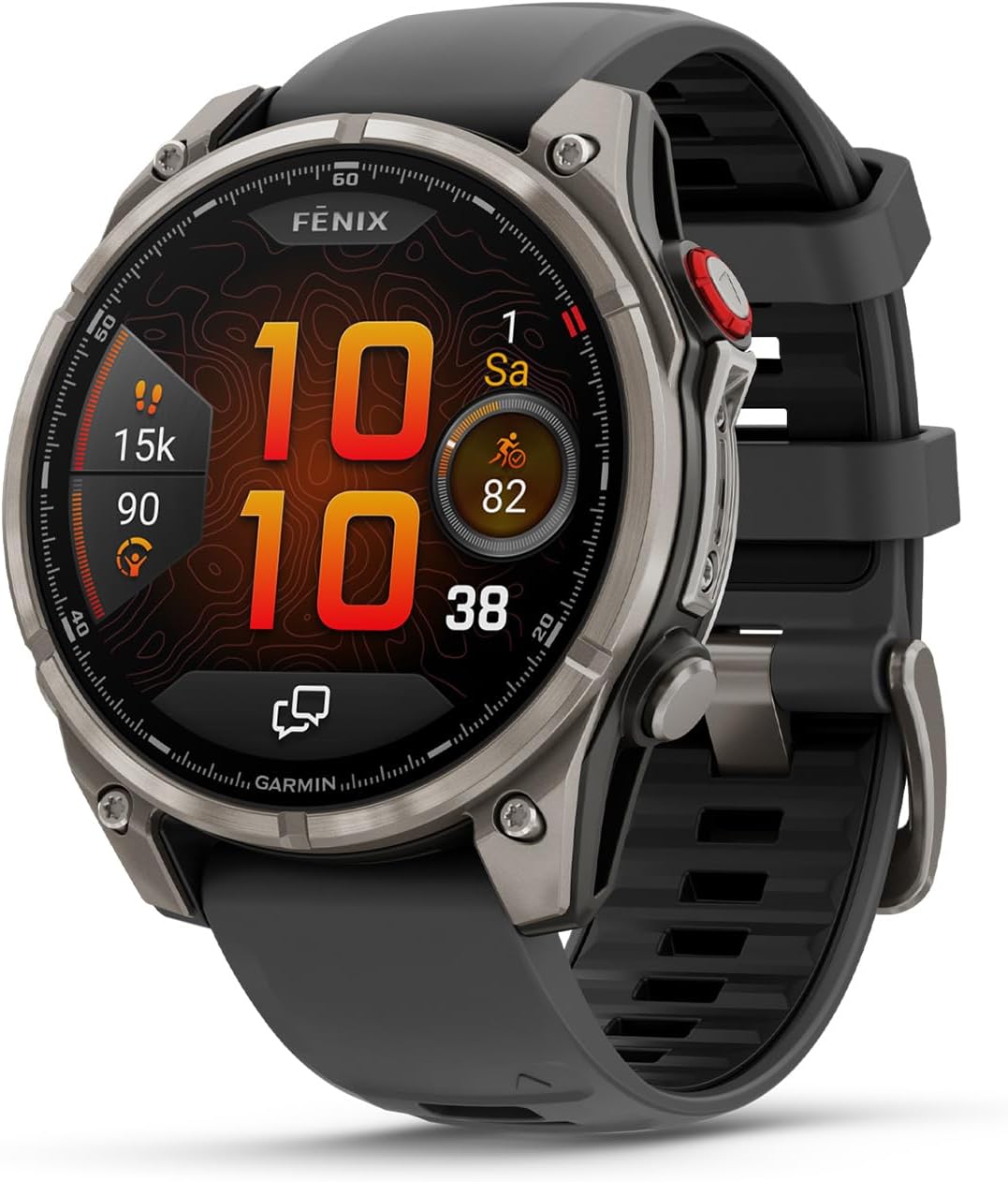
- Fenix 8 (August 2024): base model, 43mm/47mm/51mm, AMOLED or MIP Solar. Elevate Gen 5 sensor, dual-frequency multi-band GPS with SatIQ, full training platform, TopoActive maps, ECG, skin temperature, LED flashlight, speaker, mic, 10ATM, 32GB storage. Available discounted.
- Fenix E (August 2024): 47mm only, single-band GPS, Elevate Gen 4 sensor (no ECG, no skin temperature), stainless steel bezel with Gorilla Glass (not sapphire, no titanium option), no flashlight, no speaker, no mic, no inductive dive buttons, 16GB storage. Full TopoActive maps and complete Garmin training software. $799 at launch — only $200 less than the Fenix 8 AMOLED for meaningfully less hardware. The site’s own review described it as essentially a rebranded Epix Gen 2 at a price difficult to justify.
- Fenix 8 Pro AMOLED (September 2025): adds inReach satellite SOS and Garmin’s LTE implementation over the base Fenix 8. Brighter AMOLED at approximately 2,000 nits. At full price, a poor buy with the Fenix 9 weeks away.
- Fenix 8 Pro MicroLED (September 2025): $1,999, 51mm only, 10 days battery in smartwatch mode against 27 days on the AMOLED Pro. Avoid regardless of timing.
The Fenix E: maps yes, but hardware compromises make it a hard sell
The Fenix E does carry full TopoActive maps and the complete Garmin training software platform — those are genuine strengths. The hardware gaps are the problem. Single-band GPS means meaningful accuracy loss in urban canyons, dense tree cover, and any environment where the Fenix 8’s dual-frequency SatIQ would lock on cleanly. The Elevate Gen 4 sensor lacks ECG and skin temperature. The Gorilla Glass lens will scratch where the Fenix 8’s sapphire will not. There is no flashlight, no speaker, no mic.
At $799 versus $999 for the Fenix 8, the saving is $200. For most athletes that gap does not justify the GPS downgrade alone, let alone the accumulated hardware differences. The Fenix 8 at a significant discount closes that gap further. The Fenix E is the correct choice only for a buyer who specifically needs TopoActive maps and the Fenix software platform, cannot stretch to the Fenix 8, and does not need dual-frequency GPS or the premium case materials.
The MicroLED: why the most expensive model is not the best choice
The Fenix 8 Pro MicroLED at $1,999 carries the brightest display ever put in a Garmin at 4,500 nits. The battery cost makes it the wrong choice at any point in the cycle. Smartwatch battery life is 10 days on the MicroLED against 27 days on the AMOLED Pro 51mm. With always-on display enabled, MicroLED drops to 4 days against 15 days on the AMOLED. GPS battery life is 44 hours on the MicroLED against 53 hours on the AMOLED. That is 30-40% less runtime overall, with up to 70% less in always-on modes, in a 51mm-only 93g case at double the price of the AMOLED Pro.
The site’s own Fenix 8 Pro spec page describes it as an over-engineered luxury tier that few athletes actually need. That assessment stands regardless of Fenix 9 timing.
Fenix 8 vs Fenix 8 Pro: the satellite and LTE premium is narrow for most buyers
The Fenix 8 Pro adds inReach satellite SOS messaging, Garmin’s LTE implementation, and a brighter AMOLED display over the base Fenix 8. Every other capability is identical: same Gen 5 sensor, same dual-frequency GPS, same maps, same dive rating, same flashlight. For most athletes, neither the satellite messaging nor the LTE justifies the price premium.
The satellite SOS matters for athletes who genuinely go off-grid: mountaineers, backcountry skiers, solo trail runners in remote terrain without cellular coverage. For everyone else it is insurance they will never need.
The LTE case is weaker still. Garmin’s LTE implementation is restrictive by design: it covers LiveTrack, messaging via the Garmin Messenger app, weather, and calls through a paired phone number. It does not deliver independent watch functionality in the way Apple Watch LTE does, where the watch operates as a fully autonomous device for calls, data, music streaming, and app use without a phone present. If independent LTE capability is what you actually want from a connected watch, the Apple Watch is the correct platform, not the Fenix 8 Pro. On the Fenix 8 Pro, LTE is a useful safety and tracking feature for athletes who train far from their phone. It is not a smartwatch platform upgrade.
For any athlete who does not go off-grid and does not need LiveTrack or Garmin Messenger over cellular, the base Fenix 8 at a discount delivers the same training experience at a significantly lower price. The update window started one year earlier — that is the honest cost.
Fenix 8 or Forerunner 970?
For runners and triathletes, the Forerunner 970 is the better daily watch: 56g versus 73g for the Fenix 8 47mm AMOLED, same training platform, same Gen 5 sensor, same GPS, same sapphire and titanium construction. The Fenix 8 adds 10ATM dive rating, larger size options, and solar variants. For a runner who does not dive or need solar, those additions carry weight without matching value. See the best Garmin Forerunner guide for the full comparison.
Fenix 7 on deeper discount
The Fenix 7 launched January 2022 and is well past its major-feature update window. At a deep discount it remains a capable outdoor watch with maps and solar options. The same value logic applies as for the base Fenix 8 versus the Pro, only extended: greater saving, shorter remaining update life, older sensor hardware.
Reviews and further reading
- Garmin Fenix 8 review | Buy
- Garmin Fenix E review
- Garmin Fenix 8 Pro specs
- Fenix 9 filing analysis: dates and evidence
- Garmin Fenix hub
- Best Garmin Forerunner — for runners weighing Fenix vs Forerunner
- Best Garmin watch

Best-of guides
Explore the full resource library
This site covers endurance sport technology across a range of dedicated reference sections. Each one collects the most relevant articles, tests, and analysis on its topic in one place.
Buyer guides
- Best sports watch — tested recommendations by sport and athlete type: triathlon, running, marathon, cycling, hiking, and women
- Best Garmin watch — Forerunner versus Fenix by series, sport, and budget
- Best wearables — recovery trackers, heart rate monitors, running power meters, and female athlete tech
- Best cycling products — computers, smart trainers, power meters, and cycling heart rate monitors
Brand and product guides
- Amazfit — the full Amazfit range from Balance to Cheetah to T-Rex, accuracy tests, HYROX partnership, and Zepp Health analysis
- Apple Watch — athlete-first coverage of Apple Watch across running, cycling, and triathlon
- COROS — watches, features, and firmware across the full COROS range
- Garmin — the company, the platform and the full range, and the starting point for choosing across every Garmin product line
- Garmin Edge — bike computers from entry-level navigation to flagship endurance and mountain biking
- Garmin Fenix — every model, feature, and firmware development for Garmin's flagship outdoor watch
- Garmin Fenix 8 Series — which variant to buy, upgrade advice, accuracy data, and the full Fenix 8 review and firmware coverage
- Garmin Forerunner — the full Forerunner line covered from entry level to triathlon flagship
- Garmin Instinct — rugged GPS watches for endurance and adventure athletes
- Garmin Features Explained — how Garmin's metrics work, from Training Load and Body Battery to Race Predictor and HRV Status
- Google Fitbit — Fitbit Air, Google Health, Pixel Watch and the Wear OS platform
- Polar — watches, sensors, Polar Flow and training science across the full Polar range
- Suunto — Race, Vertical, Run and the SuuntoPlus ecosystem
- Strava — features, privacy, segments, and how Strava fits into a serious training setup
- Wahoo — KICKR trainers, ELEMNT bike computers, and the Wahoo ecosystem
- WHOOP — strain, recovery, sleep and the full WHOOP ecosystem
Specifications database
- Full Specifications Database — detailed spec sheets, battery life, sensor lists and generation-on-generation comparisons for current Garmin, COROS, Amazfit, Samsung, Google Fitbit, Huawei, Polar, Suunto, Wahoo and Apple Watch models
Glossary
- Sports Technology Glossary — non-branded terminology across running, cycling, swimming, triathlon, hiking, strength training, HYROX, sensors, ecosystems, and brands
Sport and topic guides
- Running Watches — how to choose by discipline: road racing, trail, track, beginner, and multisport
- Triathlon and Multisport Technology — watches, sensors, and race-day tools for swimmers, cyclists, and runners
- HYROX — training science, race analysis, and technology for the functional fitness race format
- parkrun — technology, training, and performance for the weekly 5K
- Hiking Technology — navigation, safety, and trail tech for walkers and hikers
- Heart Rate Monitoring — optical sensors, chest straps, accuracy comparisons, and how to set training zones
- GPS Accuracy — how satellite systems perform across brands, terrains, and conditions
- Sports Watch Battery Life — battery claims, real-world tests, and how to manage battery life across Garmin, Apple, Amazfit and Coros
- Recovery Trackers — WHOOP, Oura, and the science of readiness scoring
- Female Athlete Tech — wearables, physiology, and performance for female endurance athletes, covering cycle-synced training, RED-S, HR accuracy, and VO2max
- Sports Science — peer-reviewed research on HRV, VO2max, lactate threshold, running power, wearable accuracy, and supplementation
- Testing Methodology — how this site tests GPS accuracy, heart rate, battery life, and other performance claims
Content series
- Release Radar — confirmed launches, leaks, and rumours across Garmin, Apple, COROS, Polar, Suunto, and Wahoo
- Deep Dive Feature Files — weekly firmware feature updates across all brands (bug fixes excluded)
- Fix Files — weekly firmware bug fix tracking across all brands
