How HYROX Elite 15 athletes train: seven weekly schedules and what you can take from them
The HYROX World Championships begin this Thursday. The seven athletes whose training weeks appear below are among the fastest in the sport. You already train over 10 hours a week. Charlie Botterill trains 25 to 27 hours. Joanna Wietrzyk, current world record holder at 54 minutes 25 seconds, runs threshold sessions before HYROX-specific work on the same day. These volumes will injure most age-group athletes who attempt them directly.
What the schedules do offer is structural logic based on sports science. The sequencing of quality sessions, the placement of station work, the relationship between strength and running, the role of aerobic machine work as active recovery: these patterns hold at lower volumes and are worth understanding.
The athletes
- Charlie Botterill | Elite 15 | Weekly volume: 25 to 27 hours
- Hidde Weersma | European Champion | PB: 52m 42s
- Joanna Wietrzyk | Current World Record | PB: 54m 25s
- Emilie Dahmen | Elite 15 | PB: 58m 24s
- Rich Ryan | Elite 15 | PB: 53m 57s
- Linda Meier | World Champion 2025 | PB: 58m 56s
- Paralympian David Wetherill | Elite adaptive HYROX athlete
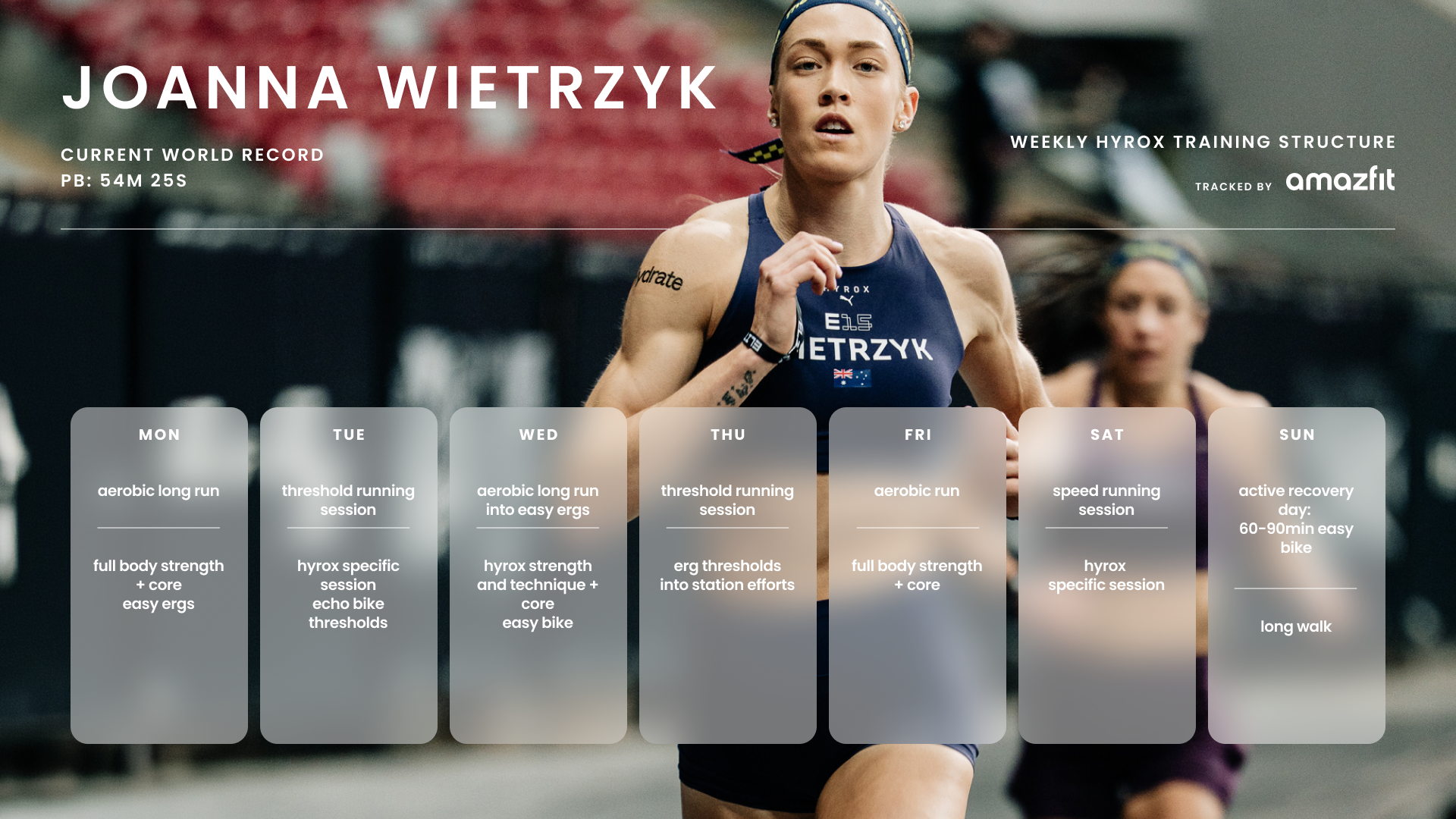
Joanna Wietrzyk: a week in detail
Joanna Wietrzyk holds the women’s individual Pro world record at 54 minutes 25 seconds, set at the Warsaw Major in April 2026. She completed an unprecedented clean sweep of all four Elite 15 Majors in the 2025/26 season. Her week illustrates the structural logic that runs through every schedule here: running quality in the morning, station and strength work after, aerobic base threaded through the recovery slots, and walking on Sunday.
- Mon AM: Aerobic long run
- Mon PM: Full body strength, core, easy ergs
- Tue AM: Threshold running session
- Tue PM: HYROX-specific session plus Echo bike thresholds
- Wed AM: Aerobic long run into easy ergs
- Wed PM: HYROX strength and technique, core, easy bike
- Thu AM: Threshold running session
- Thu PM: Erg thresholds into station efforts
- Fri AM: Aerobic run
- Fri PM: Full body strength, core
- Sat AM: Speed running session
- Sat PM: HYROX-specific session
- Sun AM: 60 to 90 min easy bike
- Sun PM: Long walk
The full weekly schedules of the other six athletes are at the end of this article.
What the structure tells you
Several patterns appear across all seven schedules regardless of total volume. I’m analysing what the athletes have given here rather than offering training advice; you’ll need to take into account progression and periodisation beyond what a one-week schedule shows.
Running quality comes first in the day. Every athlete who runs intervals or threshold work places it in the morning slot. Station work, ergs, and strength follow in the late afternoon. Running is the largest single predictor of HYROX performance for most athletes, and it demands a fresh neuromuscular system. For self-coached athletes, this offers a practical principle for varying your sessions: alternate your hard running days with your hard station days rather than stacking both into the same block.
Aerobic machine work fills the recovery slots. Tuesday and Thursday in particular tend to carry long, easy bike or erg sessions rather than complete rest. Easy aerobic work at this level drives cardiovascular adaptations while avoiding the negative load effects of an equivalent running volume. For age-group athletes, many find that it maintains routine and promotes recovery without adding impact stress.
Station work is never placed before a quality run on the same day. In every schedule where both appear, the run comes first. Sled work, wall balls, and burpee broad jumps create neuromuscular fatigue that compromises running mechanics if sequenced the other way.
Strength training clusters around lower-intensity run days or follows station work. Full body strength appears on brick days for Hidde and on aerobic run days for Jo. Grouping strength sessions on non-quality days reduces interference, as acute metabolic fatigue from resistance training can blunt the signalling pathways necessary for aerobic adaptations.
Most athletes concentrate their highest loads into two or three key quality days each week. Hard running and hard HYROX work do not appear on consecutive days across any of the seven schedules. The distribution varies, but the gap between quality sessions, like every other endurance sport, allows for adaptation (recovery).
Zones differ between disciplines. True threshold-derived heart rate zones will differ by discipline (the HR reserve formula is not multi-modal). Your zone 2 heart rate on the ski erg will not be the same number as your zone 2 heart rate on the run. Posture and the muscles you recruit in each discipline will affect your threshold HR for that discipline. Before you can train and perform at the right intensity, you need to establish your zones on each piece of equipment separately. That requires testing, not assumption. This site’s science-based HYROX training guide covers zone application for the format in detail.
Train your weaknesses. The schedules above reflect years of accumulated volume on every HYROX discipline. For most age-group athletes, the bigger gains are available on the stations they shy away from. If your wall ball is unreliable or your ski erg is weak, those are the areas where structured practice yields the biggest percentage improvements. The athletes at this level are refining their performance by small margins. Most recreational HYROX competitors are still in the phase where deliberate work on a single weak station can take minutes off a finish time.
Recovery is active and specific. Several athletes explicitly include zone 1 work and walking in their weekly structure. Linda Meier has zone 1 cross-training on Friday. Jo Wietrzyk ends Sunday with a long walk. Low-intensity activity may reduce perceived stiffness, maintain movement quality, and provide an aerobic stimulus with minimal recovery cost. Walking in particular is underrated as a recovery tool for athletes who train as hard as these seven do.
Heat training and sauna are worth your attention. David Wetherill opens his week with a swim and sauna. The science behind this is more substantial than most athletes realise. Repeated heat exposure increases plasma volume, typically within three to five days of consistent sessions, thereby raising stroke volume and reducing cardiovascular strain at a given submaximal workload. Longer-term exposure improves thermoregulatory efficiency and microvascular perfusion (now you know!). These cardiovascular adaptations overlap with some produced by altitude training, though the mechanisms differ. Properly executed, regular sessions lasting 20 to 30 minutes at temperatures above 80 degrees Celsius, repeated over several weeks, produce measurable gains without increasing training load. The peer-reviewed evidence base is substantial: Périard et al. (Physiological Reviews 2021) is the definitive review. The CORE 2 body temperature sensor review on this site covers the practical protocol and what the adaptation metrics show in real training.
Emilie Dahmen is the exception worth noting. Her schedule is the most conservative in terms of volume and includes a full rest day midweek and a complete day off on Sunday. She is also the athlete whose structure most closely approximates that of a serious age-group athlete.
Quick answers
How many days a week do elite HYROX athletes train?
Most Elite 15 athletes train twice a day on most days of the week. Charlie Botterill reaches a total weekly volume of 25 to 27 hours. Emilie Dahmen’s schedule is the most conservative, with one full rest day and one day off per week. Age-group athletes should not attempt to replicate these volumes directly.
What training zones should I use for HYROX?
Your zone targets are discipline-specific. The heart rate corresponding to zone 2 on the ski erg will differ from zone 2 on the run, because active muscle mass, posture, and venous return all shift the numbers between modalities. Each piece of equipment requires its own threshold assessment before zone-based training is meaningful.
Does sauna use actually improve HYROX performance?
The underlying science is well established. Heat adaptation increases plasma volume within three to five days of consistent sessions, raises stroke volume, and lowers heart rate at a given submaximal workload. Longer-term exposure improves thermoregulatory efficiency. These adaptations can improve endurance performance both in hot conditions and, to a lesser extent, in temperate ones, though effects vary between individuals and protocols.
Should I train the disciplines I am worst at?
For most age-group athletes, yes. Elite athletes at this level are refining small margins across a discipline set they have trained for years. Most recreational competitors have a weak station or two where deliberate practice returns far more than additional running volume. Identify your slowest station from your last race result and build at least one dedicated session per week around it.
How important is running in HYROX training?
Running accounts for 8km of every HYROX race and is the largest single predictor of finishing time for most athletes. The Elite 15 schedules treat running quality sessions as the non-negotiable anchor of the training week. Station work is scheduled around running, not the other way around.
Full weekly schedules
Charlie Botterill | Elite 15 | Weekly volume: 25 to 27 hours
- Mon AM: Running intervals, 30 to 45 min at 3:20 to 3:25 per km
- Mon PM: HYROX station-focused session plus lower body strength
- Tue AM: 2 hours easy ski, bike or row
- Tue PM: 2 hours easy ski, bike or row
- Wed AM: Running intervals, 30 to 45 min at 3:20 to 3:25 per km, plus bike intervals 30 to 45 min at zone 4
- Wed PM: Sled-specific work
- Thu AM: 2 hours easy bike
- Thu PM: Upper body strength
- Fri AM: Competition work: 40 to 60 min run or Echo bike at zone 4 plus wall balls
- Fri PM: ERG intervals, 30 to 40 min at race pace, plus lower body strength
- Sat: 2 to 3 sessions, heavy CrossFit-style metcons and EMOMs
- Sun: 1 to 2 hours zone 1 bike
Hidde Weersma | European Champion | PB: 52m 42s
- Mon AM: Easy run
- Mon PM: Ergs
- Tue AM: Long brick, bike plus run
- Tue PM: Full body strength
- Wed AM: HYROX volume
- Wed PM: Easy run
- Thu AM: Interval run
- Thu PM: Ergs
- Fri AM: Long bike
- Fri PM: Full body strength
- Sat AM: HYROX threshold
- Sat PM: Easy run
- Sun AM: HYROX technique
- Sun PM: Free choice
Emilie Dahmen | Elite 15 | PB: 58m 24s
- Mon AM: Easy run
- Mon PM: Intensive HYROX training
- Tue AM: Full body strength
- Tue PM: HYROX easy session
- Wed AM: Interval training
- Wed PM: Rest
- Thu AM: Easy run
- Thu PM: Easy cardio
- Fri AM: Intensive HYROX training
- Fri PM: Easy cardio
- Sat AM: Interval training
- Sat PM: Full body strength
- Sun: Day off
Rich Ryan | Elite 15 | PB: 53m 57s
- Mon AM: Aerobic C2 bike
- Mon PM: HYROX strength
- Tue AM: HYROX quality session: 3x 2km at threshold, 75 sec rest; Echo bike every 5 min equals 25 wall balls, every 10 min equals burpee broad jumps 30m; total 45 min
- Tue PM: Single block
- Wed AM: Long aerobic run
- Wed PM: C2 bike
- Thu AM: Aerobic machines
- Thu PM: General strength
- Fri AM: HYROX quality session: 2 rounds of ski, row, sled push, run, sled pull, bike; every 8 min: Echo bike calories, farmers carry, burpee broad jumps, remaining time running
- Fri PM: Single block
- Sat AM: Easy aerobic run
- Sat PM: Easy machines
- Sun: Warm-up, 2 rounds of row, run, Echo bike, cool-down
Linda Meier | World Champion 2025 | PB: 58m 56s
- Mon AM: Easy bike
- Mon PM: Mobility and stretching
- Tue AM: Threshold row
- Tue PM: Threshold running
- Wed AM: Strength training
- Wed PM: Zone 2 workout
- Thu AM: Interval bike
- Thu PM: HYROX threshold
- Fri AM: Weight training
- Fri PM: Zone 1 cross training
- Sat AM: VO2max running
- Sat PM: Rest
- Sun AM: HYROX workout
- Sun PM: Rest
Paralympian David Wetherill | Elite adaptive HYROX athlete
- Mon AM: Active recovery, swim and sauna
- Mon PM: Run club, light, 3km
- Tue AM: Bike intervals
- Tue PM: Strength training, mobility and stretching
- Wed AM: HYROX and CrossFit intervals
- Wed PM: Run club, 5km
- Thu AM: Longer swim sets
- Thu PM: Strength training
- Fri: HYROX and CrossFit intervals, single block
- Sat AM: Parkrun, 5km
- Sat PM: Strength training
- Sun: Long bike session
Explore the full resource library
This site covers endurance sport technology across a range of dedicated reference sections. Each one collects the most relevant articles, tests, and analysis on its topic in one place.
Buyer guides
- Best sports watch — tested recommendations by sport and athlete type: triathlon, running, marathon, cycling, hiking, and women
- Best Garmin watch — Forerunner versus Fenix by series, sport, and budget
- Best wearables — recovery trackers, heart rate monitors, running power meters, and female athlete tech
- Best cycling products — computers, smart trainers, power meters, and cycling heart rate monitors
Brand and product guides
- Amazfit — the full Amazfit range from Balance to Cheetah to T-Rex, accuracy tests, HYROX partnership, and Zepp Health analysis
- Apple Watch — athlete-first coverage of Apple Watch across running, cycling, and triathlon
- COROS — watches, features, and firmware across the full COROS range
- Garmin — the company, the platform and the full range, and the starting point for choosing across every Garmin product line
- Garmin Edge — bike computers from entry-level navigation to flagship endurance and mountain biking
- Garmin Fenix — every model, feature, and firmware development for Garmin's flagship outdoor watch
- Garmin Fenix 8 Series — which variant to buy, upgrade advice, accuracy data, and the full Fenix 8 review and firmware coverage
- Garmin Forerunner — the full Forerunner line covered from entry level to triathlon flagship
- Garmin Instinct — rugged GPS watches for endurance and adventure athletes
- Garmin Features Explained — how Garmin's metrics work, from Training Load and Body Battery to Race Predictor and HRV Status
- Google Fitbit — Fitbit Air, Google Health, Pixel Watch and the Wear OS platform
- Polar — watches, sensors, Polar Flow and training science across the full Polar range
- Suunto — Race, Vertical, Run and the SuuntoPlus ecosystem
- Strava — features, privacy, segments, and how Strava fits into a serious training setup
- Wahoo — KICKR trainers, ELEMNT bike computers, and the Wahoo ecosystem
- WHOOP — strain, recovery, sleep and the full WHOOP ecosystem
Specifications database
- Full Specifications Database — detailed spec sheets, battery life, sensor lists and generation-on-generation comparisons for current Garmin, COROS, Amazfit, Samsung, Google Fitbit, Huawei, Polar, Suunto, Wahoo and Apple Watch models
Glossary
- Sports Technology Glossary — non-branded terminology across running, cycling, swimming, triathlon, hiking, strength training, HYROX, sensors, ecosystems, and brands
Sport and topic guides
- Running Watches — how to choose by discipline: road racing, trail, track, beginner, and multisport
- Triathlon and Multisport Technology — watches, sensors, and race-day tools for swimmers, cyclists, and runners
- HYROX — training science, race analysis, and technology for the functional fitness race format
- parkrun — technology, training, and performance for the weekly 5K
- Hiking Technology — navigation, safety, and trail tech for walkers and hikers
- Heart Rate Monitoring — optical sensors, chest straps, accuracy comparisons, and how to set training zones
- GPS Accuracy — how satellite systems perform across brands, terrains, and conditions
- Sports Watch Battery Life — battery claims, real-world tests, and how to manage battery life across Garmin, Apple, Amazfit and Coros
- Recovery Trackers — WHOOP, Oura, and the science of readiness scoring
- Female Athlete Tech — wearables, physiology, and performance for female endurance athletes, covering cycle-synced training, RED-S, HR accuracy, and VO2max
- Sports Science — peer-reviewed research on HRV, VO2max, lactate threshold, running power, wearable accuracy, and supplementation
- Testing Methodology — how this site tests GPS accuracy, heart rate, battery life, and other performance claims
Content series
- Release Radar — confirmed launches, leaks, and rumours across Garmin, Apple, COROS, Polar, Suunto, and Wahoo
- Deep Dive Feature Files — weekly firmware feature updates across all brands (bug fixes excluded)
- Fix Files — weekly firmware bug fix tracking across all brands
Last Updated on 29 June 2026 by the5krunner
My favourite kit and nutrition
- Garmin Fenix 9 Pro — I’ve just bought one.
- Injinji – Runners protect your toes. Avoid discomfort and minor injury. Run more. Run faster. I use them.
- Garmin 90-degree charging adapter — A small keyring adapter you can use anywhere. Essential when away. I use one.
- Garmin charging puck — the fastest and most reliable way to top up your Garmin before a session. I use one.
- Ravemen FR300 — Front light that mounts directly under your Garmin or Wahoo head unit. Keeps your bars clean and your beam pointed where it matters. I use one.
- Body Glide – The blue anti-chafe stick that all swimmers and many runners use. I use it.
- Maurten — The race nutrition trusted by elite athletes. Gels and drink mixes engineered to be easy on the stomach. I use them.
- Garmin Varia RTL515 — A radar rear light that alerts you to vehicles approaching from behind. Pairs with your Edge or Wahoo. I use this model.
- Favero Assioma Pro RS2 — The power-meter pedals most serious cyclists choose. Accurate, easy to move between bikes. I use this model.
- Garmin Forerunner 970 — A serious choice for a pro-grade triathlon watch. I use this.
- Polar H10 — My daily driver for accurate, waking HRV readings.
- Wahoo ELEMNT Roam 3 — The bike computer that has the feature Garmin lacks: usability. I use mine on most rides.
Reader-Powered Content

This content is not sponsored. It’s mostly me behind the labour of love, which is this site, and I appreciate everyone who supports it.
Support the site: Follow (free, fewer ads) · Subscribe (paid, ad-free) · Buy Me A Coffee ❤️
All articles are written by real people, fact-checked, and verified for originality. See the Editorial Policy. FTC: Affiliate Disclosure — some links pay commission. As an Amazon Associate, I earn from qualifying purchases.

tfk is the founder and author of the5krunner, an independent endurance sports technology publication. With 20 years of hands-on testing of GPS watches and wearables, and competing in triathlons at an international age-group level, tfk provides in-depth expert analysis of fitness technology for serious athletes and endurance sport competitors. ID
