Garmin CIRQA Band gets heart rate right almost everywhere it matters, and wrong in exactly the two places most reviews never test: open water swimming and hard running intervals.
In gym circuits, yoga and outdoor cycling, when worn on my wrist, it typically matched four other reference devices to within a beat, and even more closely when worn on the biceps. Step count, calorie estimates and sleep tracking, the metrics that matter most for buyers who just want an activity tracker rather than a sports watch, were all at sensible levels and are covered in full below too.
At $199.99 / £179.99 / €199.99 with an optional subscription, CIRQA undercuts a year of WHOOP but asks for you to spend twice as much as on Fitbit Air.
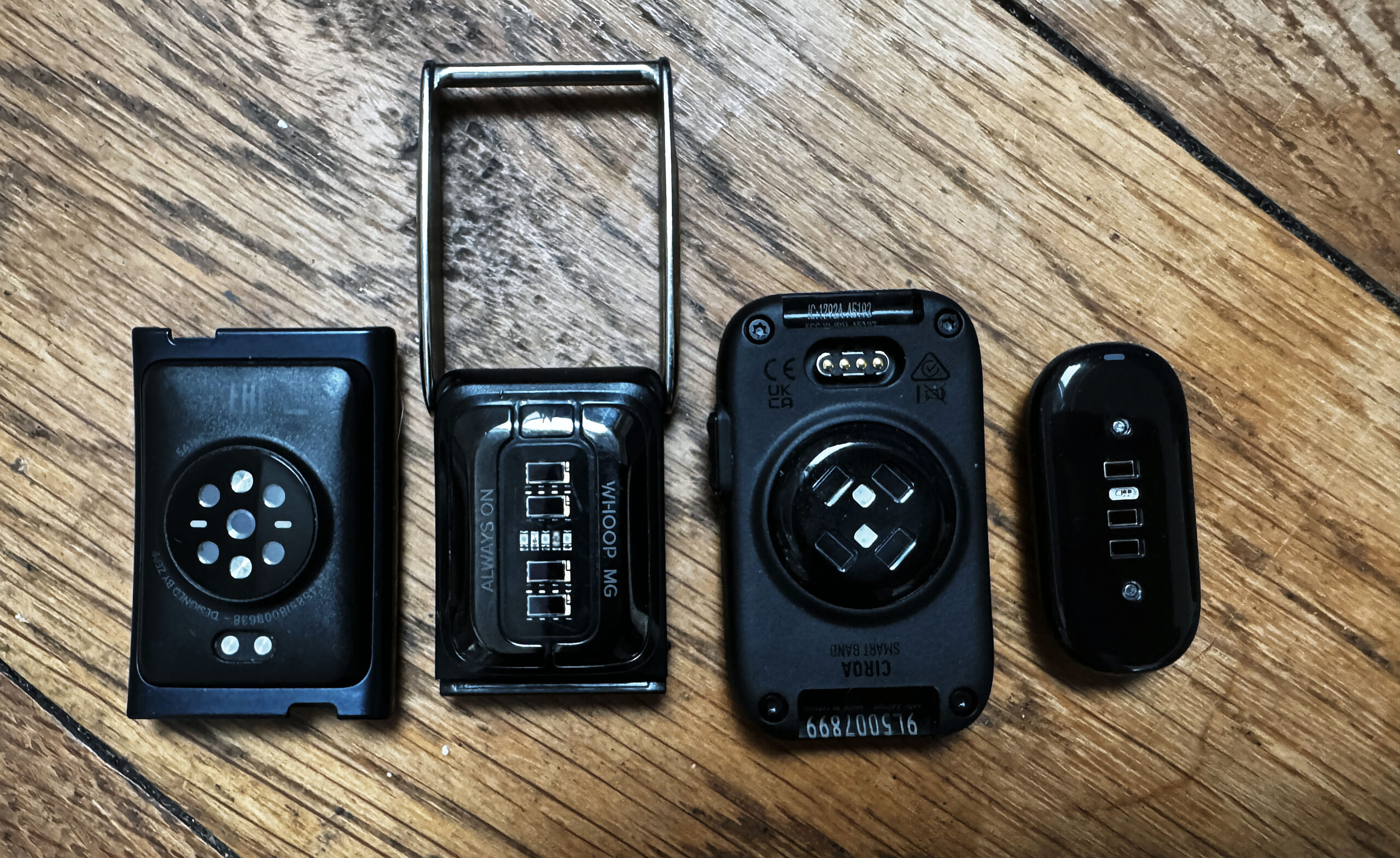
The band itself is comfortable and well made. The one hardware compromise that won’t be fixed with a firmware update is the sensor generation: Garmin’s own Index Sleep Monitor, CIRQA’s predecessor, shipped with a newer sensor over a year earlier.
Garmin CIRQA Band
Garmin CIRQA Band: excellent everywhere except the wrist
Garmin CIRQA Band works as a cheap, no-subscription entry into Garmin’s recovery ecosystem, a standalone activity tracker for 24/7 heart rate and sleep data without a watch, or a complementary sensor for existing Garmin watch owners. Wherever you fit, the heart rate accuracy holds up: excellent in the gym, in yoga, on the bike and on the biceps. Wrist wear suits everyday use; for anything demanding, biceps wear is the safer choice.
Pros
- Excellent heart rate accuracy in the gym, in yoga, on the bike and on the biceps in intervals, matching independent references
- No compulsory subscription for core health, sleep and training metrics
- Physical button and broadcast-over-ANT+/Bluetooth that fully screenless rivals don’t offer
- Comfortable to wear, and the CIRQA pod fits inside my old Whoop 4.0 bicep sleeve for upper-arm wear
- Cheaper upfront than a year of Whoop, with a wider Garmin Connect feature set than Fitbit Air
Cons
- Wrist-worn heart rate fails specifically in open water swimming and fast running intervals
- Module is too long for wrists under about 6.5 inches
- Elevate “Gen 4.1” sensor is a generation behind Garmin’s own Index Sleep Monitor
- Battery Saver disables almost everything the device is bought for, including heart rate itself
How I tested
Daily testing over several weeks: an open-water swim, a running interval test, a HYROX gym simulation, a flow yoga session, an outdoor bike ride, and a repeat interval test with CIRQA moved to the biceps. All intensity ranges are covered, and one-off tests were designed for calories, sleep, and steps. Each test result below states its own reference devices and setup. Sleep, steps and calories were tested separately, detailed in their own sections.
Design and fit
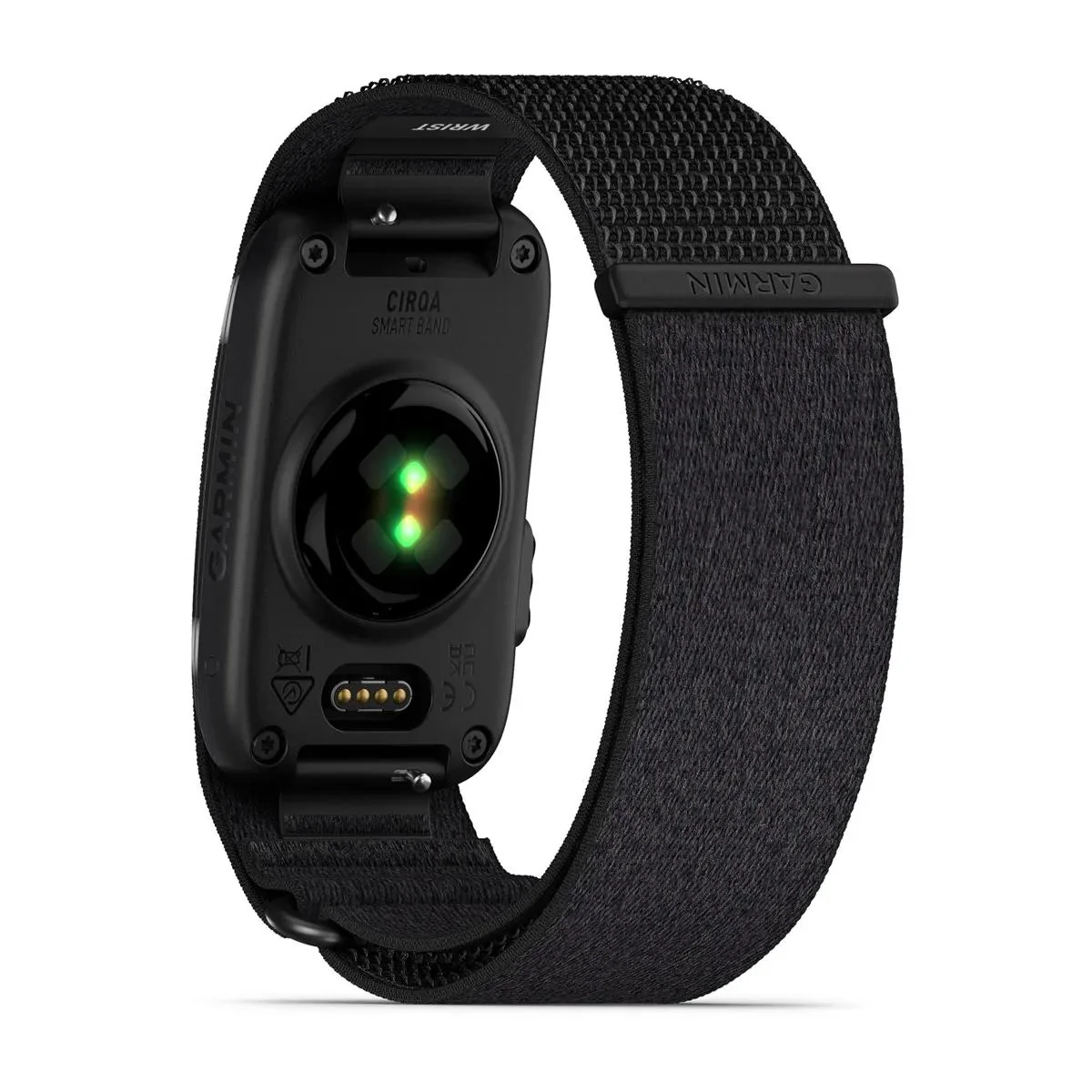
CIRQA is comfortable and well made, though it doesn’t look as premium as a WHOOP. The single physical button is customisable and genuinely useful for sports logging: it starts and stops an activity without opening the phone. The status LED is harder to see than it should be. It sits low on the module, and whilst bright enough to see, it can sometimes be obscured. Swapping straps is extremely fiddly. The quick-release pins work, but the strap material and the small pins make the change awkward compared with a standard watch strap swap – WHOOP straps are far easier to change.
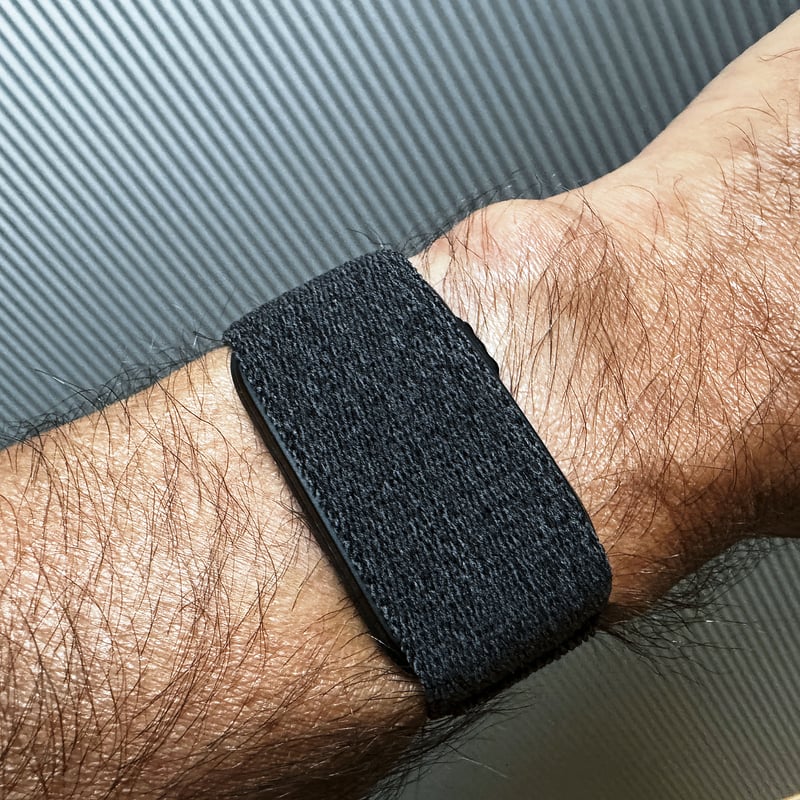
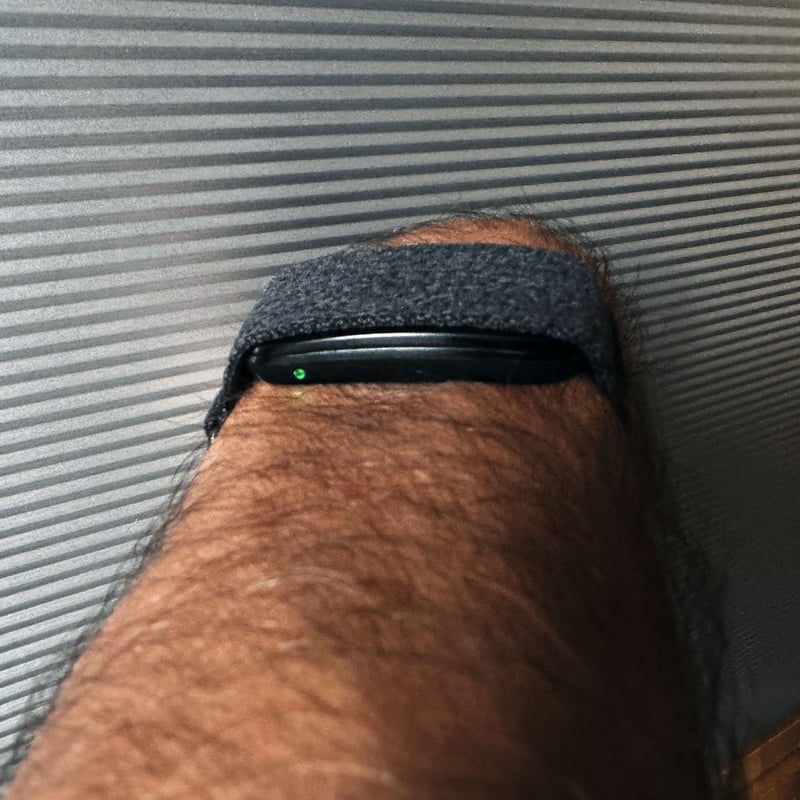
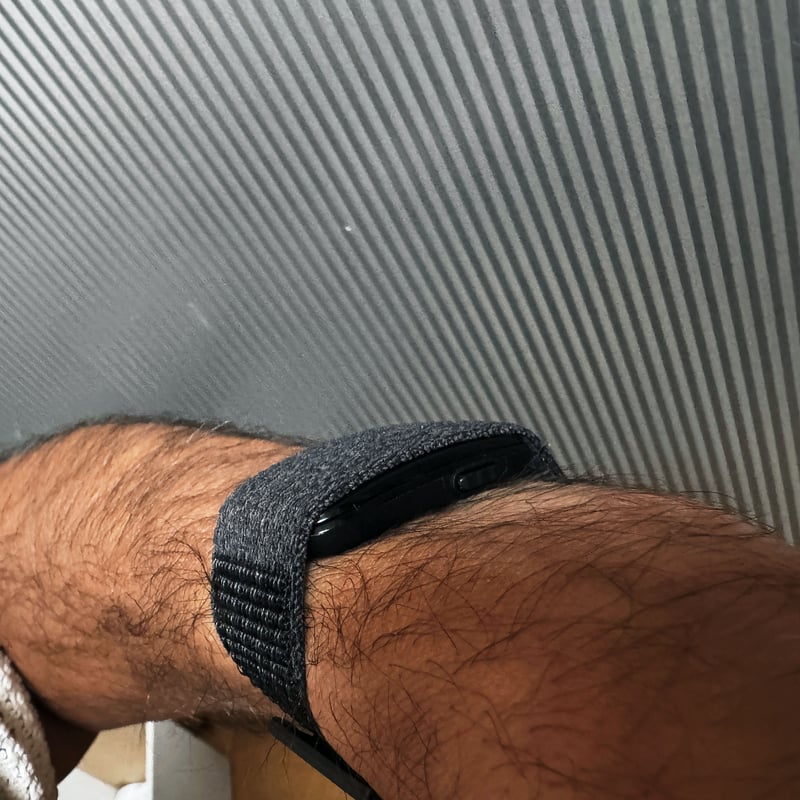
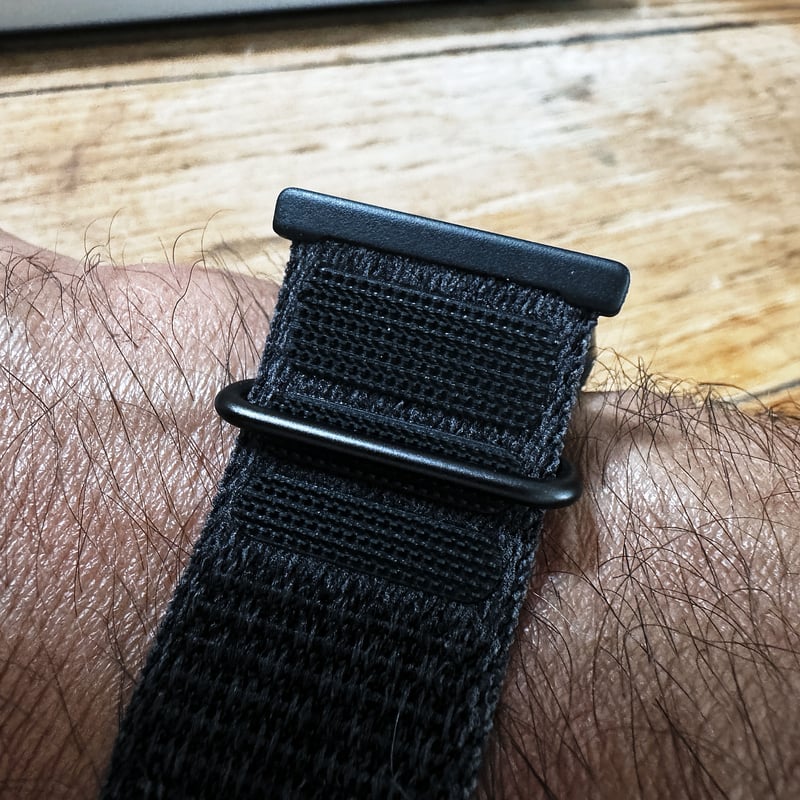
The module itself is 35% longer than a WHOOP 5.0/MG and covers 52% more skin, though it is 15% thinner and 22% lighter. On a 7-inch wrist circumference, it looks great. If you have a 6.5-inch wrist or lower, the module starts to overhang the curve of the wrist rather than sitting flat, which is where it starts to look wrong and where the sensor may lose even contact with the skin and let light in. Moving it to the biceps, a flatter, larger surface, removes the size problem almost entirely, and the CIRQA pod also fits neatly inside my old WHOOP 4.0 bicep sleeve, saving me from paying Garmin’s separate $59.99 upper arm band.
Battery
Garmin does not write battery charge status to the CIRQA’s FIT file, so there is no way to pull precise discharge rates from the activity data itself. With Pulse Ox left off, and one to two hours of sport a day, the band reaches at least a week of use without difficulty, at least it did for me. That’s somewhere in line with Garmin’s stated “up to 10 days”, which may assume lighter use. Connected GPS over Bluetooth, continual Bluetooth syncing and Pulse Ox both cut battery life noticeably, and Garmin gives no figure for that on its own specification sheet. Because CIRQA only runs its sensor at full fidelity once it detects a workout has started, rather than continuously as WHOOP does, drain scales with how much time is actually spent working out: a week with more or longer workouts than mine will burn through the battery faster, which is a plausible reason real-world results vary between reviewers.
Battery Saver is not a setting to leave on. Garmin’s own manual describes it as disabling heart rate, start activity, auto activity detection and the pulse oximeter, leaving only the accelerometer for step counting. Everything the sensor exists to measure stops. Disabling heart rate also removes VO2 max, sleep tracking, intensity minutes and all-day stress as a consequence. Treat it as a mode for a flight or a weekend without a charger, not a way to extend everyday use.
Price and Garmin Connect+
CIRQA launched at $199.99 / £179.99 / €199.99, with the Connect+ subscription not required for the core health, sleep and training feature set.
The extra you might pay for Garmin Connect+ covers guided breathwork, manual laps, Garmin Coach strength plans, and Garmin Active Intelligence. Garmin removed the live heart rate paywall within days of launch after criticism. The remaining Connect+ features stay behind the subscription.
Sensor history
CIRQA carries Garmin’s Elevate “Gen 4.1“, a modified Gen 4 with added skin temperature sensing, rather than the newer Gen 5. Garmin’s Index Sleep Monitor, the device CIRQA replaces, shipped over a year earlier with Gen 5. Garmin’s stated reason for the older sensor, keeping the module thin, is an odd claim, as the Index Sleep Monitor, is thinner with the newer sensor. Published Gen 4 versus Gen 5 comparisons found Gen 5 more accurate in cold conditions, in bent-wrist positions and during cycling, though those comparisons predate this specific Gen 4.1 variant. The Index Sleep Monitor tracked sleep only, on the upper arm. CIRQA adds all-day tracking, a full training feature set, and a choice of wrist or upper arm wear, at a lower price than its predecessor commanded at launch.
What’s included and what’s not
The physical button is the standout hardware difference against every rival here. Onboard GPS is missing on every device in this category. It also lacks the on-demand ECG found in WHOOP’s MG tier.
| Feature | Garmin CIRQA | WHOOP (MG) | Fitbit Air | Polar Loop 2 | Amazfit Helio Strap (Pro) |
|---|---|---|---|---|---|
| Price | $199.99 | From $199/yr | $99.99 | $199 | $99.99 ($199.99 Pro) |
| Subscription | Optional | Mandatory | Optional | None | Optional |
| Battery life | 10 days | 14 days | 7 days | 8 days | 7 to 11 days (waist pod 40+) |
| Screen | No | No | No | No | No |
| On-device GPS | No | No | No | No | No |
| Physical button | Yes | No | No | No | No |
| Onboard ECG | No | Yes (MG) | No, background AFib detection only | No | No |
| SpO2 / Pulse Ox | Yes | Yes | Yes | No | Yes |
| Skin temperature | Yes | Yes | Yes |
Hardware present, inactive |
Yes (Pro model motion sensor) |
| Official bicep band | Yes, $59.99 | Yes | No at launch | No | Yes |
| Open water swim tracking | Pool only, no open water | Yes | Yes, tested Fair to Poor |
Limited / No dedicated open-water mode |
Partial / Limited |
Accuracy Testing
The most important metric for CIRQA to get right is heart rate, since most of Garmin’s more advanced metrics downstream depend on it, as do its sports competencies both as a standalone recorder and as a wrist-based HR source for, say, a bike computer. Also important is its role as a fitness tracker, where more traditional metrics like sleep, calories, and steps come into play for those buying for that purpose.
Garmin then brings many of these metrics together with its insights into readiness and body battery, which may have dubious scientific foundations but are loved by many.
Heart rate accuracy
Test #1: open-water swim, wrist
Two 15-minute efforts at a bit below threshold, recorded by Apple Watch Ultra 3 (left wrist), CIRQA (right wrist), Polar Sense (right biceps) and WHOOP MG (left biceps). The HRM 600 failed to record.
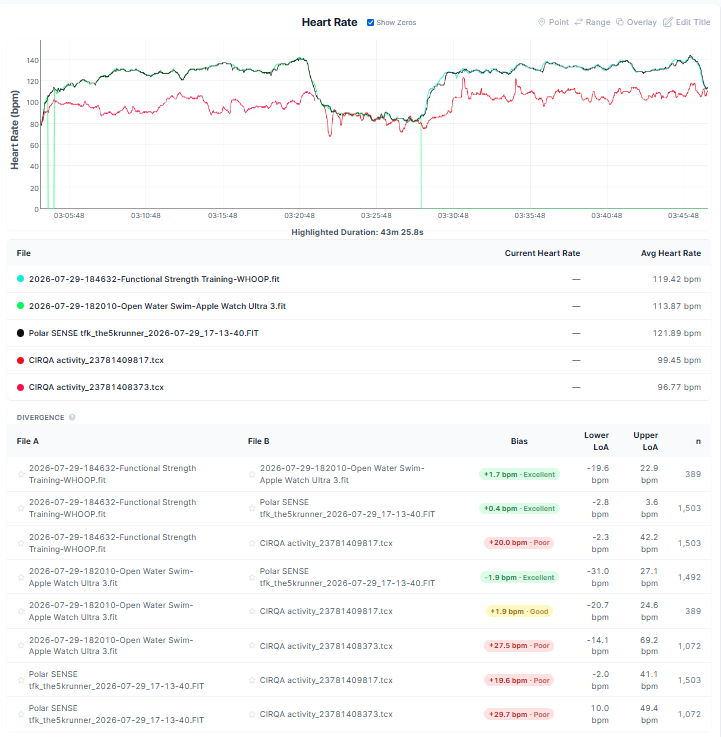
Polar Sense (121.89bpm), WHOOP (119.42bpm), and Apple Watch Ultra 3 (113.87bpm) agreed closely. CIRQA’s two split files averaged 99.45bpm and 96.77bpm, roughly 20 to 30bpm below the other three, and were rated Poor. CIRQA was worn correctly and under a wetsuit to hold it firmly in place; the under-reading was more likely a motion artefact than a fit problem.
Test #2: running intervals, wrist
Five reps of three minutes on the Thames towpath, against Frontier X Plus, Apple Watch Ultra 3, Fitbit Air, Amazfit Helio and Polar Sense. This tests the response to rapid changes in effort.
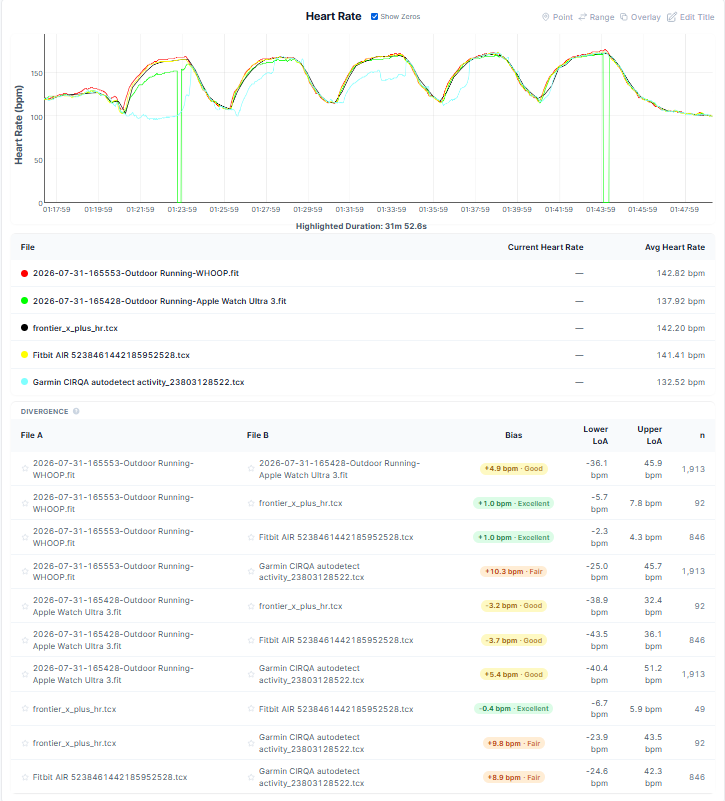
WHOOP and Fitbit Air agreed most closely, with a +1.0 bpm bias and limits of agreement of −2.3 to +4.3 bpm across 846 matched observations. CIRQA underestimated heart rate at the start of four of the five reps, with the largest positive bias of any device on test at roughly 9 to 10 bpm and the widest limits of agreement. The band also slipped slightly too close to the wrist bone during the session – an occasional problem for me when a wrist band is initially worn ‘correctly’.
Test #3: HYROX gym simulation, wrist
CIRQA on the lower forearm, Amazfit Balance 3 on the other wrist, Fitbit Air inverted alongside CIRQA, WHOOP MG on the biceps, HRM 600 cached on a Forerunner 970 recording in the locker. This tests the effect of complex wrist movements and gripping.
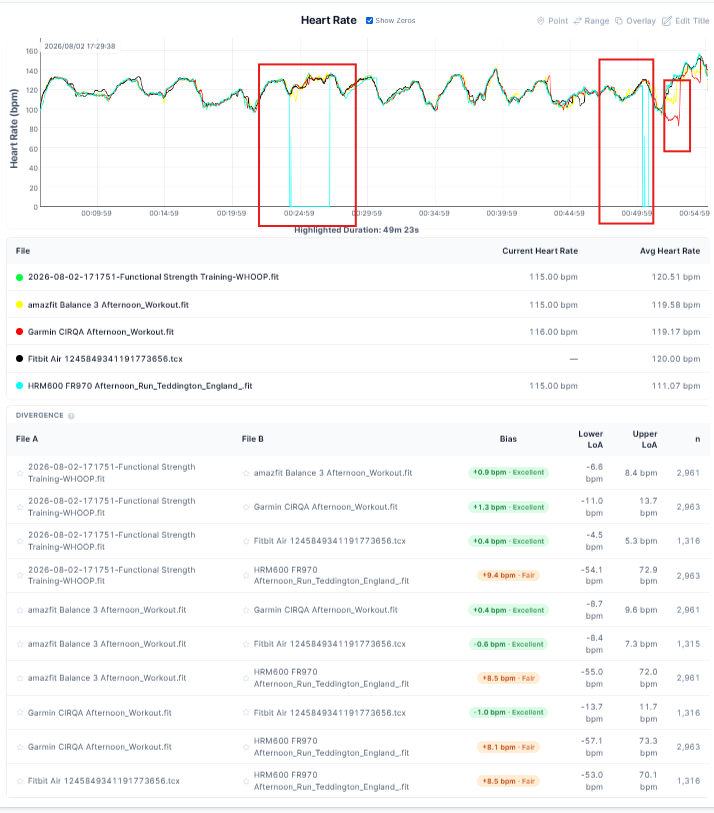
- vs WHOOP: +1.3bpm bias, Excellent
- vs Amazfit Balance 3: +0.4bpm bias, Excellent
- vs Fitbit Air: −1.0bpm bias, Excellent
All three optical trackers diverged from the HRM 600 (roughly +8bpm bias, Fair), which suffered two dropouts. CIRQA showed a visible lag starting the final wall balls station, the one clear error in an otherwise excellent session. I was surprised that CIRQA performed well at several stations involving tight gripping actions that potentially restrict blood flow to the wrist.
Test #4: flow yoga, wrist
CIRQA on the right wrist, HRM 600 on a Forerunner 970, WHOOP MG on the biceps, Fitbit Air and Apple Watch Ultra 3 on the left wrist. This tested quite extreme movements and positions held for several seconds.
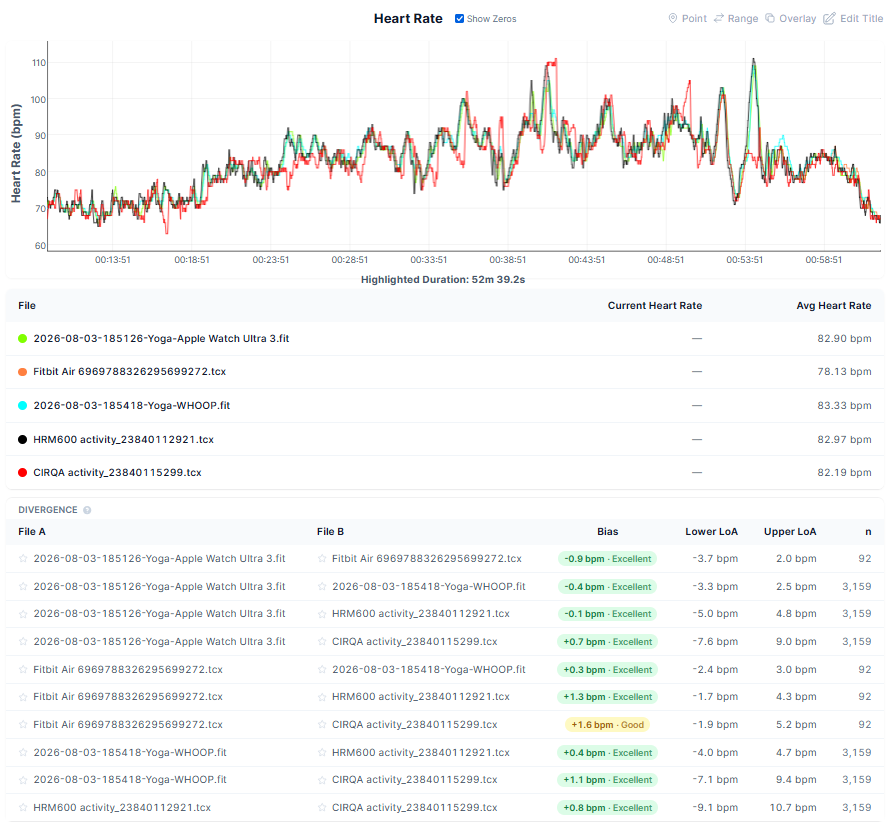
- vs HRM 600: +0.8bpm bias, Excellent (LoA −9.1 to +10.7bpm, n=3,159)
- vs WHOOP: +1.1bpm bias, Excellent (LoA −7.1 to +9.4bpm)
- vs Apple Watch Ultra 3: +0.7bpm bias, Excellent (LoA −7.6 to +9.0bpm)
- vs Fitbit Air: +1.6bpm bias, Good (LoA −1.9 to +5.2bpm, low n=92)
Average heart rate was close to the reference (CIRQA 82.19bpm vs HRM 600 82.97bpm). The wider limits of agreement are typical for optical sensors even in low-movement sessions, and the mean bias stayed small throughout.
Test #5: outdoor cycling, wrist
CIRQA on the right wrist, separated from an inverted Fitbit Air. Tymewear VitalPro on a Wahoo as the chest-strap reference, WHOOP MG on the biceps, Polar Loop 2 and Amazfit Helio Strap on the left wrist.
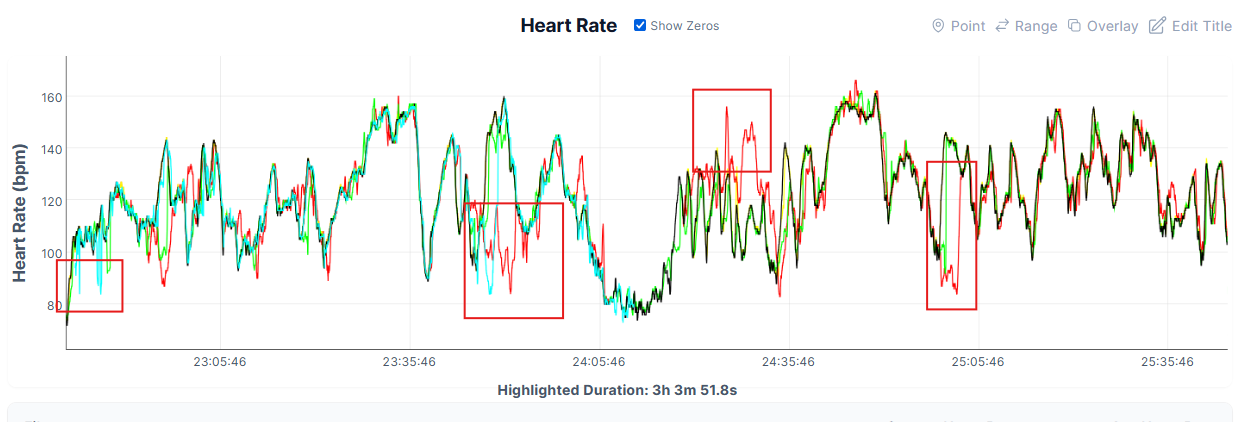
Chart colour key: black = Tymewear VitalPro (reference), red = Polar Loop 2, blue = Garmin CIRQA, green = Fitbit Air, yellow = WHOOP MG.
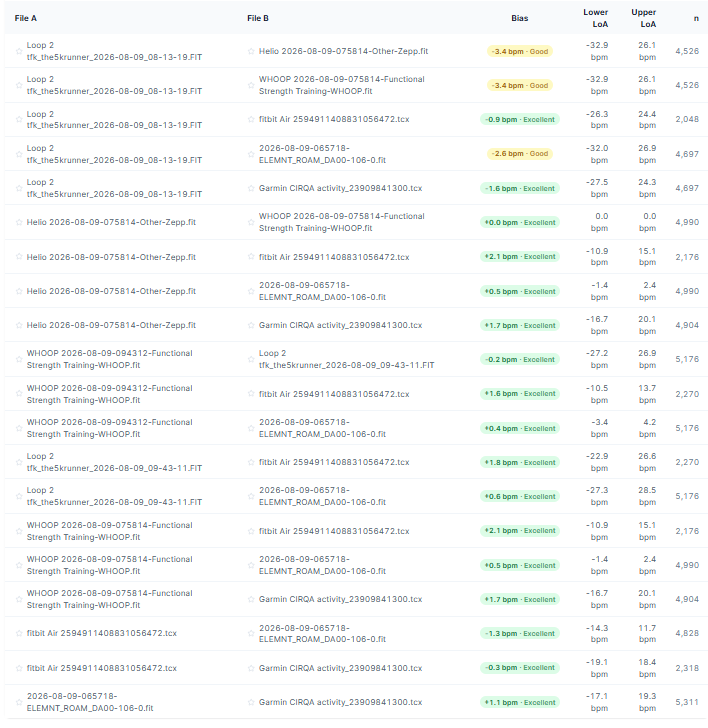
- vs Tymewear VitalPro: +1.1bpm bias, Excellent (LoA −17.1 to +19.3bpm, n=5,311)
- vs Amazfit Helio Strap: +0.5bpm bias, Excellent (tight LoA)
- vs WHOOP MG: +0.5bpm bias, Excellent (tight LoA)
- vs Fitbit Air: −1.3bpm bias, Excellent
- vs Polar Loop 2: −2.6bpm bias outbound, +0.6bpm return leg
One significant under-reading period from CIRQA plus two smaller under-reads near the start, otherwise a close enough track against the chest-strap reference.
Test #6: running intervals, biceps
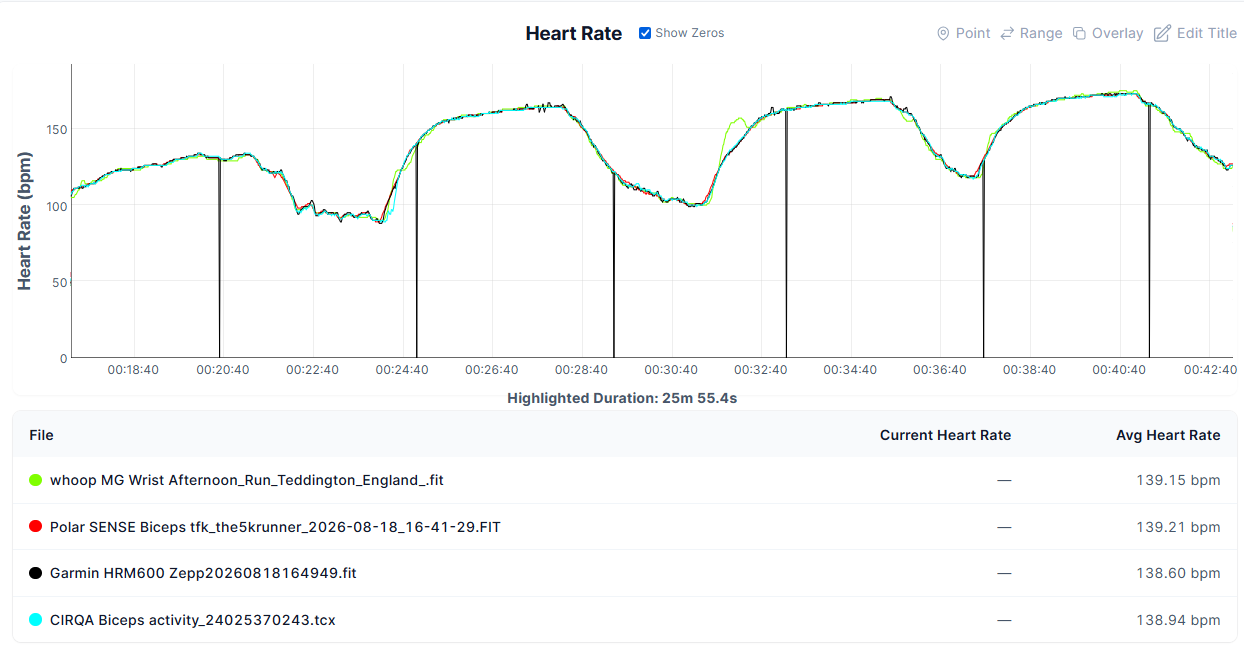
The same interval structure as Test #2, moved to the biceps, against Garmin HRM 600, Polar Sense and wrist-worn WHOOP MG. WHOOP MG versus CIRQA showed a bias of +0.2bpm, Polar Sense versus CIRQA +0.3bpm, and HRM 600 versus CIRQA −0.3bpm, all rated Excellent with tight limits of agreement. The only anomalies were a brief false peak on the wrist-worn WHOOP and six short dropouts on HRM600.
Sleep
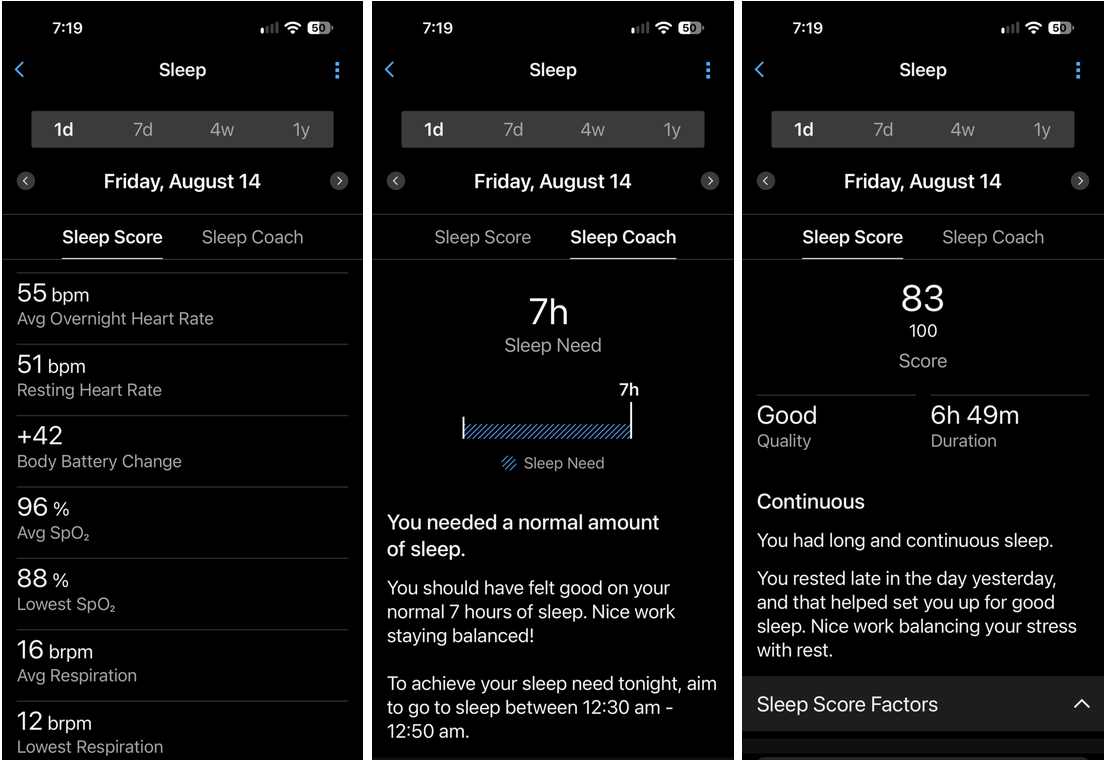
Across a 15-night parallel test against a Eight Sleep, Amazfit Helio, Fitbit Air, Polar Loop 2 and WHOOP MG, CIRQA’s resting heart rate and breathing rate were the most reliable metrics.
Sleep stage breakdown showed no consistent agreement with the other devices, which is typical of all consumer sleep trackers rather than a CIRQA-specific weakness.
Breathing rate: CIRQA typically reads 1.3 breaths per minute higher, usually within about 1.4 breaths on any given night.
HRV is read consistently higher than every comparator: every night against Eight Sleep, and all but one night against WHOOP. This points to an algorithmic difference in how each brand calculates HRV rather than measurement noise, so it is best used to track a personal trend rather than compared against another brand’s number.
Deep sleep showed no consistent directional bias, averaging only an 8-minute gap against Eight Sleep, though single nights swung 40 to 80 minutes either way. CIRQA’s restorative sleep figure (deep plus REM) is mathematically identical to its own deep-plus-REM total every night, so it is a calculation rather than an independent measurement.
REM sleep: CIRQA vs Eight Sleep. Over 14 nights, CIRQA came in higher on 12 of them, by an average of 48 minutes. The biggest gaps: 6 August, CIRQA said 142 minutes, Eight Sleep said 24; 1 August, CIRQA said 104 minutes, Eight Sleep said 1.
CIRQA’s sleep score averaged 14 points higher than Eight Sleep’s and 18 points higher than Amazfit’s, closer to Fitbit (7 points) and Polar. Each brand runs its own scoring formula, so absolute scores aren’t interchangeable across devices, even on a shared 0 to 100 scale.
DC Rainmaker’s test of a similar device set reached broadly the same conclusions, differing on HRV.
Steps
A 500-step manual count (run twice) and two separate full days of mixed activity, run across four devices and two wear positions, put CIRQA’s step count consistently on the high side.
| Device | Placement | 500-step test 1 | 500-step test 2 | Day test 1 | Day test 2 |
|---|---|---|---|---|---|
| Garmin CIRQA | Wrist | 507 | — | 11,319 | — |
| Fitbit Air | Wrist | 499 | — | 11,278 | — |
| Garmin CIRQA | Biceps | — | 511 | — | 6,083 |
| WHOOP | Biceps | 514 | 513 | 11,402 | — |
| Amazfit Helio | Biceps | 504 | — | — | — |
| Polar Loop | Wrist | — | 508 | — | — |
| Apple Watch Ultra 3 | Wrist | — | 493 | — | — |
| WHOOP | Wrist | — | — | — | 5,998 |
| Polar Loop | Biceps | — | — | 11,296 | — |
| Amazfit Helio | Wrist | — | — | — | 5,961 |
| Fitbit Air | Biceps | — | — | — | 5,934 |
CIRQA overcounted in each controlled 500-step test it appeared in, on both the wrist and the biceps. No device sat in both 500-step tests to allow a single “most consistent” claim across both; Fitbit Air was closest to the actual count in test 1 (499 vs 500), and Apple Watch Ultra 3 was closest in test 2 (493 vs 500).
The two-day tests are separate sessions with different total step counts (roughly 11,300 versus roughly 6,000). These include workouts, dog walks, shuffling around the kitchen(!), going up stairs, driving, moving one arm but not the other, and many other day-to-day activities, all of which could introduce different sources of error for any device.
Calories
Calorie totals were logged over two separate days with significant exercise, one built around a bike ride and one around a run, using connected GPS to record the workout wherever possible.
| Device | Placement | Bike day | Run day |
|---|---|---|---|
| WHOOP | Biceps | 3,002 | 3,177 |
| Garmin CIRQA | Wrist | 3,118 | 3,474 |
| Amazfit Helio | Wrist | 3,310 | 3,174 |
| Polar Loop | Biceps | 3,387 | 3,446 |
No two devices agree, and the ranking is not stable between the two days. CIRQA read second-lowest on the bike day and highest on the run day, the largest swing of any device in the table. Calorie counts from any wrist or biceps wearable are estimates derived from heart rate and motion, not measurements, and this data shows why treating any single figure as exact is a mistake regardless of brand.
Auto-detect and firmware
Automatic activity detection was inconsistent across the test period but generally good. Long workouts are split when there are notable pauses (e.g. for coffee stops)
These are some specific issues that were not typical
- On 2 August, CIRQA completely failed to auto-detect a 60-minute bike ride, though it recorded a yoga session correctly the same day.
- Later in testing, auto-detect worked reliably, with the one consistent exception recurring when a Garmin watch was also worn: CIRQA did not auto-detect an activity in that case even when set as the primary device (possibly intended behaviour)
- A missed or late-detected activity isn’t just a logging inconvenience: extending the timeframe afterwards in Garmin Connect does not retrieve heart rate data for the gap, since the sensor only runs at full fidelity once it believes a workout has started.
Garmin has issued no firmware update for CIRQA since its initial release on 24 July 2026. The fixes that have landed since launch- the removal of the live heart rate paywall and the resolution of a Strava sync failure- were both delivered through updates to Connect rather than through a firmware update to the band itself.
Known issues
Community reports on Garmin Forums and Reddit, gathered separately from this site’s own controlled testing above, point to two widely reported problems worth flagging. The optical sensor can stop responding after charging and does not resume until the band is powered off in the Garmin Connect app and back on via the button, with no warning shown even though it reports as connected and synced. The smart alarm has also been reported resetting its own repeat schedule, reverting from a weekdays setting to a one-off after firing. Garmin will almost certainly fix these. For the fuller, ongoing list, see Garmin CIRQA: All the Bugs So Far.
The competition – reasons to buy something else
Here is a link to a detailed five-way comparison covering price, aesthetics, app quality and sport detection against WHOOP, Polar Loop, Fitbit Air and Amazfit Helio Strap Pro in full. Here’s the summary:
| Factor | Garmin CIRQA | WHOOP MG | Fitbit Air | Polar Loop 2 | Amazfit Helio Strap Pro |
|---|---|---|---|---|---|
| Price | $199.99, no subscription | From $199/yr, subscription mandatory | $99.99, subscription optional | $199.99, no subscription | $99.99 ($199.99 Pro), subscription optional |
| App quality | Garmin Connect: mature, deep training data, complex to navigate | The benchmark app in this group for coaching and recovery depth | Google Health: clean and simple; AI coaching needs a subscription | Polar Flow: does a basic job well, a dated interface | Zepp App: solid, less polished than Garmin or WHOOP |
| Sport detection | Physical button plus good auto-detection | No button; class-leading auto-detection | No button; good auto-detection | No button; decent auto-detection | No button; decent detection, more advanced in the Pro pods |
| Battery | 10 days | 14 days | 7 days | 8 days | 7 to 11 days on the arm; a separate waist pod claims 40+ |
| Why it exists | A complementary purchase or gateway into Garmin Connect or advanced step tracker | Excellence and status, at a price | Google’s route to your data for its AI model, sized and priced for the mass market. Or advanced step tracker | A cheaper WHOOP alternative or advanced step tracker. | Another cheaper WHOOP alternative or advanced step tracker; the Pro tier uniquely adds per-station HYROX muscular load data |
The dedicated comparison also covers aesthetics, band options and market positioning for each device in a bit more depth.
Verdict
- Buy it if you already use Garmin Connect, want 24/7 recovery and sleep data without wearing a watch, and are willing to wear it on the biceps for sport.
- Buy it if you want one device to log your training for cycling, gym circuits, yoga or walking in generally ‘steady states’ where wrist wear proved reliable here.
- Do not buy it if your sport involves fast, repeated arm movement (like swimming) or rapid changes in heart rate (like interval running); wrist accuracy is what suffered in this testing. Accuracy is modality- and person-dependent, so results may vary for you.
- Do not buy it if the more polished hardware feel of WHOOP and its superior app matters more to you than saving on a subscription.
- Do not buy it if you are outside the Garmin ecosystem and don’t need advanced training metrics; Fitbit Air offers comparable step and sleep tracking for less money, in a clean app.
Garmin CIRQA Smart Band
Screenless health and fitness band (no subscription required)
 +other retailers
Quick answers
Is the Garmin CIRQA accurate for heart rate?
Yes, in most situations. Wrist-worn CIRQA matched independent references within about a beat in a HYROX gym simulation, a yoga session and an outdoor bike ride. It failed specifically in an open-water swim and during fast running intervals, both on the wrist. Moved to the biceps, it matched three references within half a beat in a repeat interval test.
Should I wear the Garmin CIRQA on the wrist or the biceps?
For steady-state activity, gym circuits, cycling, yoga, walking, wrist wear performed as well as any rival tested. For swimming or fast running intervals, move it to the biceps, where it matched three independent references within half a beat in this site’s testing.
Does the Garmin CIRQA need a Garmin Connect+ subscription?
No. Core health, sleep and training metrics are free. Connect+ gates guided breathwork, live heart rate graphs during a workout, manual lap, Garmin Coach strength plans and Garmin Active Intelligence. Garmin removed the original launch paywall on live heart rate within days of release.
How does the Garmin CIRQA compare to WHOOP MG?
CIRQA costs less upfront and has no subscription, compared with WHOOP’s $199/year. WHOOP has the more polished hardware, a longer 14-day battery life, an onboard ECG on the MG tier and a stronger app. CIRQA’s biceps heart rate accuracy matched WHOOP’s own wrist results in this site’s testing, and its physical button is an advantage no WHOOP model offers.
How big is the Garmin CIRQA module?
The module is 35% longer than a WHOOP 5.0/MG and covers 52% more skin, though it is 15% thinner and 22% lighter, complete with band. It sits flat on a 7-inch wrist. Below roughly a 6.5-inch wrist, it runs onto the curve of the wrist rather than sitting flat.
Does the Garmin CIRQA have GPS?
No onboard GPS. Distance and pace during outdoor activities come from connected GPS through a paired phone, the same approach used by every screenless band in this category.
Can the Garmin CIRQA track open water swimming?
It supports pool swimming only, despite its 5 ATM water rating. In this site’s own open-water swim test, wrist-worn CIRQA under-read heart rate by roughly 20 to 30bpm against three other devices, the single worst result recorded across every test in this review.
The Garmin sports tech guide covers the full range of watches and bands, including CIRQA’s place in the wider Garmin ecosystem.
Last Updated on 24 August 2026 by the5krunner
My favourite kit and nutrition
- Garmin Fenix 9 Pro — I’ve just bought one.
- Injinji – Runners protect your toes. Avoid discomfort and minor injury. Run more. Run faster. I use them.
- Garmin 90-degree charging adapter — A small keyring adapter you can use anywhere. Essential when away. I use one.
- Garmin charging puck — the fastest and most reliable way to top up your Garmin before a session. I use one.
- Ravemen FR300 — Front light that mounts directly under your Garmin or Wahoo head unit. Keeps your bars clean and your beam pointed where it matters. I use one.
- Body Glide – The blue anti-chafe stick that all swimmers and many runners use. I use it.
- Maurten — The race nutrition trusted by elite athletes. Gels and drink mixes engineered to be easy on the stomach. I use them.
- Garmin Varia RTL515 — A radar rear light that alerts you to vehicles approaching from behind. Pairs with your Edge or Wahoo. I use this model.
- Favero Assioma Pro RS2 — The power-meter pedals most serious cyclists choose. Accurate, easy to move between bikes. I use this model.
- Garmin Forerunner 970 — A serious choice for a pro-grade triathlon watch. I use this.
- Polar H10 — My daily driver for accurate, waking HRV readings.
- Wahoo ELEMNT Roam 3 — The bike computer that has the feature Garmin lacks: usability. I use mine on most rides.
Reader-Powered Content

This content is not sponsored. It’s mostly me behind the labour of love, which is this site, and I appreciate everyone who supports it.
Support the site: Follow (free, fewer ads) · Subscribe (paid, ad-free) · Buy Me A Coffee ❤️
All articles are written by real people, fact-checked, and verified for originality. See the Editorial Policy. FTC: Affiliate Disclosure — some links pay commission. As an Amazon Associate, I earn from qualifying purchases.
tfk is the founder and author of the5krunner, an independent endurance sports technology publication. With 20 years of hands-on testing of GPS watches and wearables, and competing in triathlons at an international age-group level, tfk provides in-depth expert analysis of fitness technology for serious athletes and endurance sport competitors. ID

Do not buy if you want log strenght training without Garmin Connect+. Only recognize first exercise…
Great review! I’m on the first “buy it if” bullet point, but I also have a 6.5” wrist. Maybe I should wait for gen2?
Q: Should you buy it?
A1: Of course especially when you find the size to big so that Garmin can sell you their ring before they release a revised Circa 2.
A2: Of course so that you, when asked if that’s a Whoop on your wrist can awkwardly admit that you are too cheap or poor for a Whoop!
A2: Of course as it lets you ditch your index sleep and add it to the evergrowing pile of gadgets you don’t use anymore for the excitment of your partner.
A3: Of course since it allows you to properly track your steps during the day. Afterall everyone knows that steps are the make and break for the Kona qualification.
A4: Of course because who doesn’t like to beta test for a multi billion corp while paying MSRP.
Who cares about the accuracy issues? It’s a secondary / peripheral device for your watch or cycling computer and not a stand alone device. No two thoughts about it. Don’t think even Garmin would claim it is (Haven’t read any of their marketing mumbo-jumbo though.). It’s not a Whoop afterall. See the autodetect. Or the lack thereof. 😉 If you train seriously it’s chest strap and powermeter. Period. P E R I O D! And for the folk that find the evil chest straps sooooo uncomfortable: Velominati rule #5!
Seriously though, I’d be seriously pi***d at Garmin if I had already bought the index sleep when the circa is basically what everyone wanted. But Garmin is good at milking their fanboys and customers. The circa is a long awaited product but it’s too big and at the same time Garmin teases a ring which will of course be released before a revised Circa 2 with a smaller form factor many people demand.
I don’t like the MSRP and the quick release fixation on the inside of the band. Looks highly fiddly. But as with all Garmin devices, let it cook for a year worth of updates and the retail price to drop and it’s worth a look.
i think the price is Ok. yes the release mechanism and also the LED should be improved. Garmin will fix the software bugs eventually.