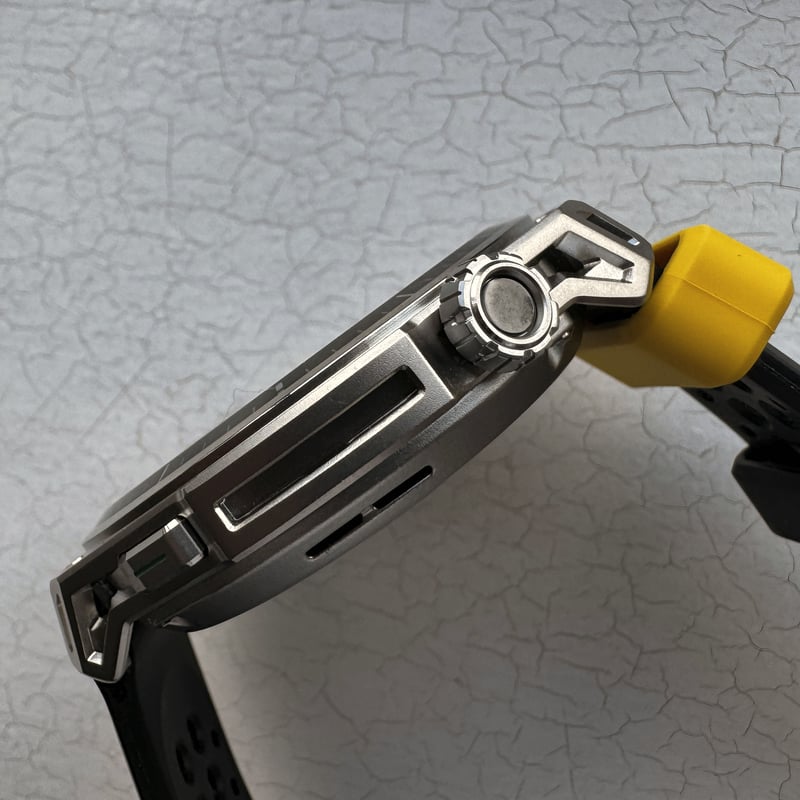
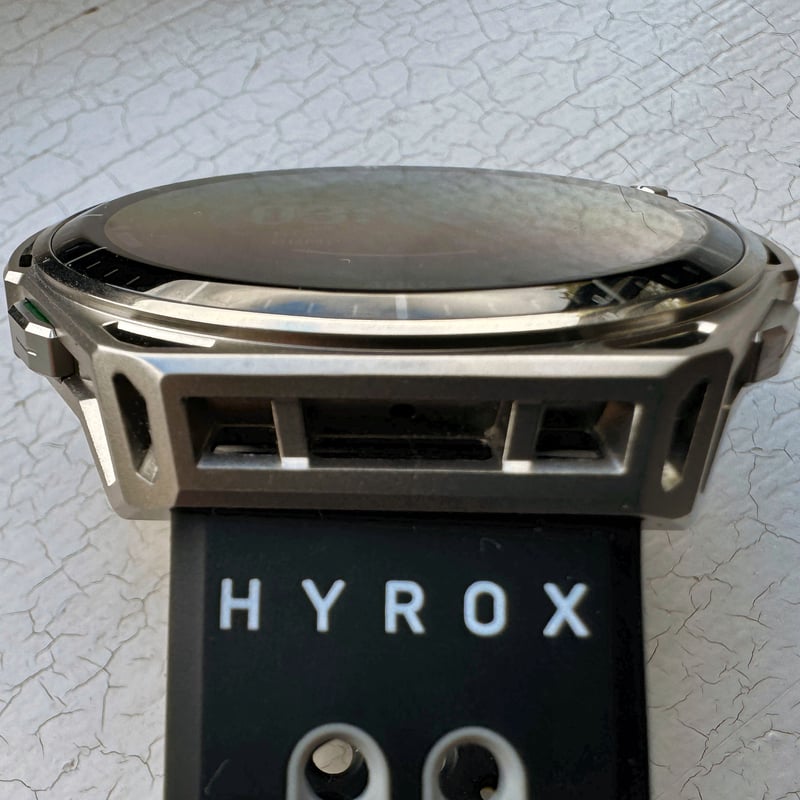
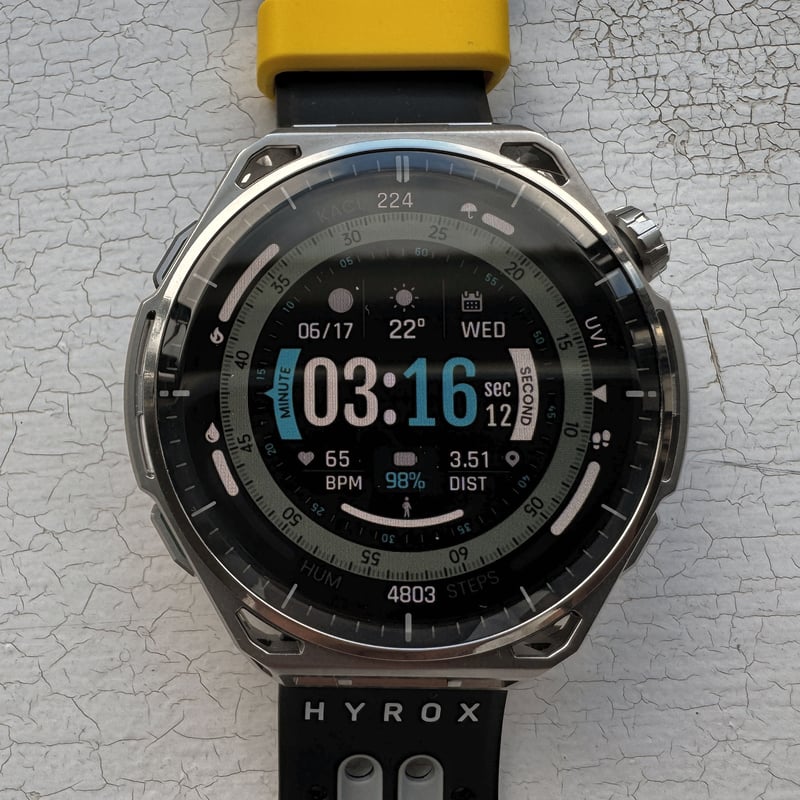
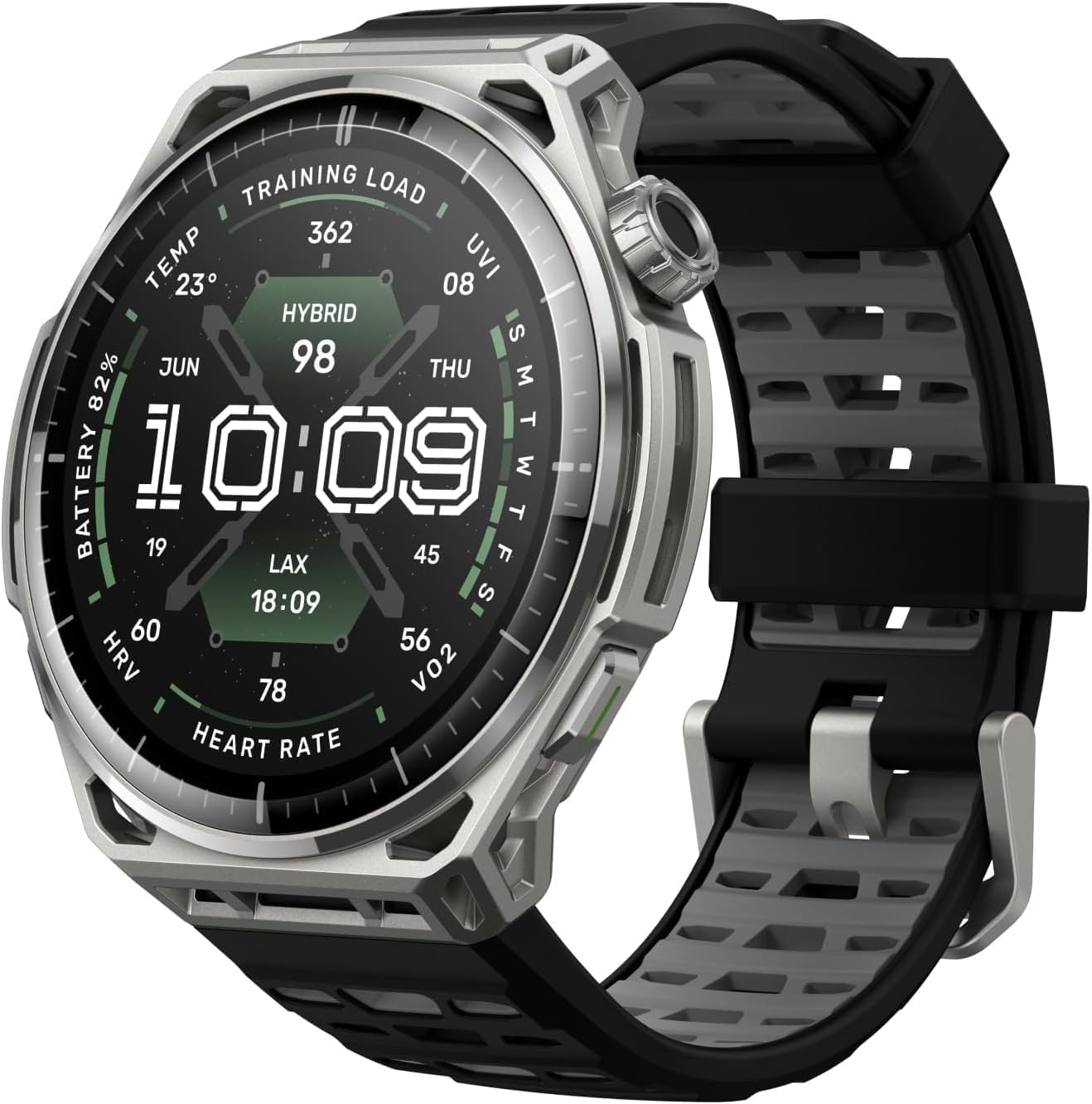
Amazfit Balance 3 Swimming Accuracy and FORM Swim Technique Coaching
It was 34 degrees, so I went to the outdoor pool. Half the pool was taken by aqua aerobics, the water was unusually warm, and I had the Amazfit Balance 3 on one wrist and the FORM Smart Swim 2 LT Goggles.
FORM Swim: the Time to Neutral metric
With a watch, you will never get real-time technique stats in front of your eyes as you swim. Nor will a watch give you head-angle or roll metrics. The FORM Smart Swim 2 LT does both.
Today I looked at the time-to-neutral metric: how quickly you return your gaze to the bottom of the pool after glancing to the side to breathe.
When I reviewed the FORM graphics, this metric was among my worst. I was about 80% of the way to the end of Level 4 in a 5-level scoring system. After breathing, my head has learned to meander back down rather than proactively snap back. There is a sliding scale in your field of vision indicating the optimal speed of return, and you get a tick each time you achieve it.
As always, after half an hour of trying, a lot was learnt, but little had permanently changed. I was able to correct it easily enough when I thought about it. The change made me swim faster, not through any reduction in drag but by quickening my breathing and stroke rate. Whether I could sustain that higher rate routinely is another matter. A permanent change needs to become second nature.
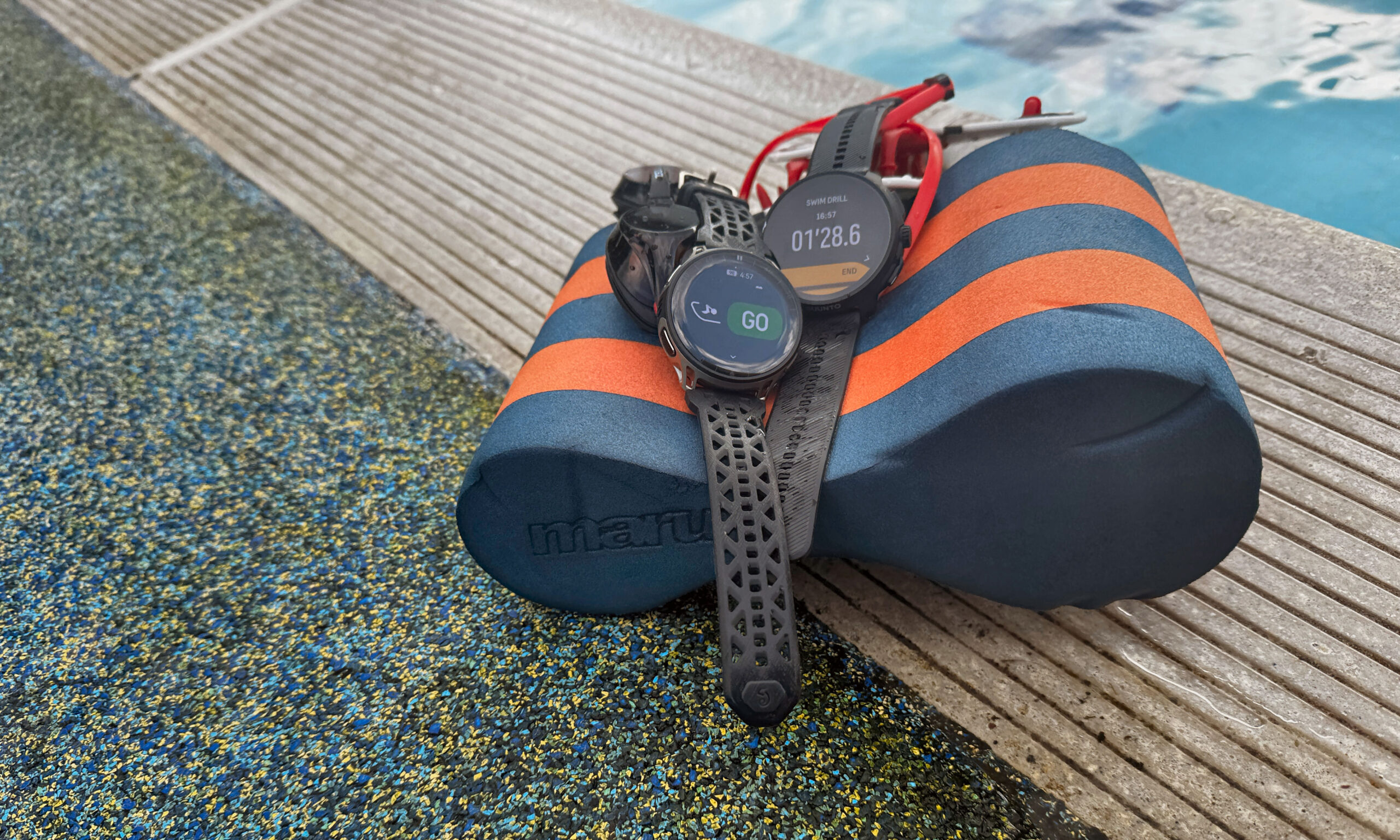
Was the Amazfit Balance 3 accurate in measuring HR while swimming?
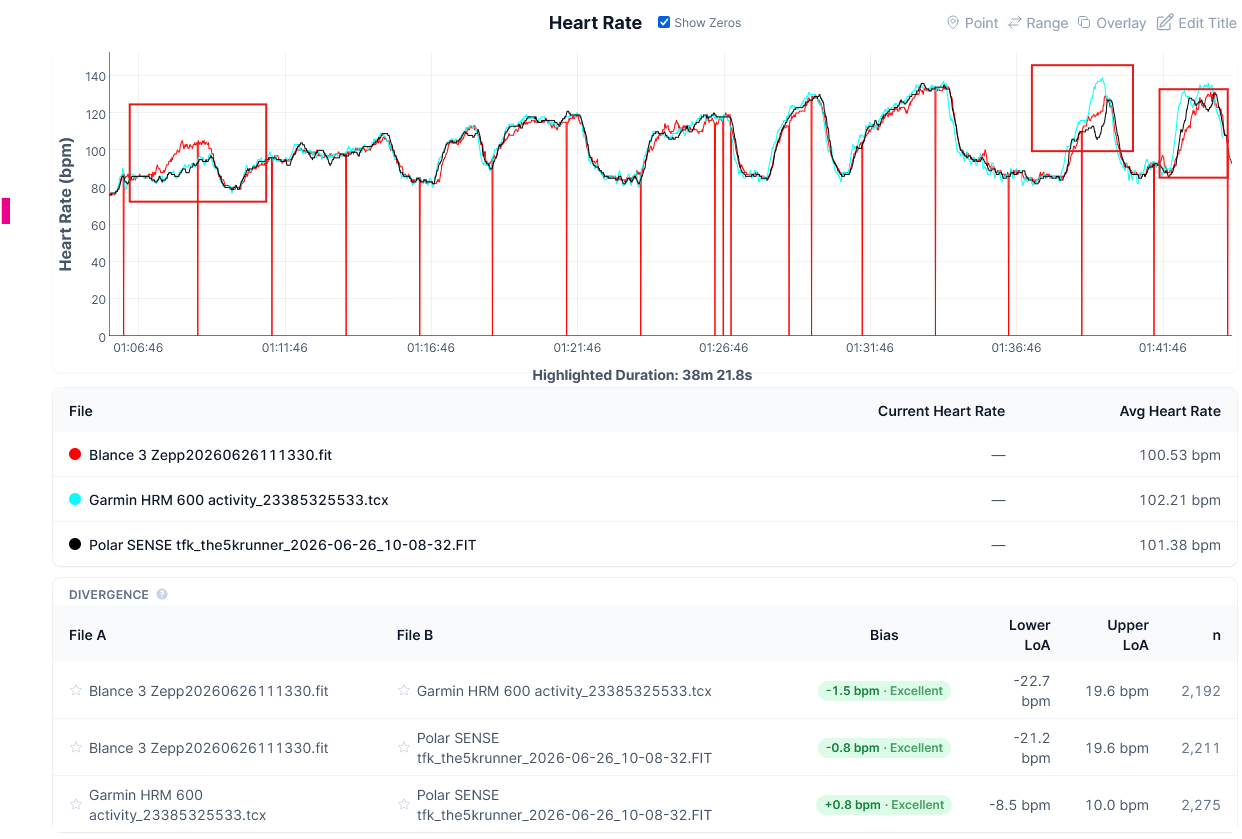
Garmin HRM 600 and Polar SENSE are the most accurate. They show the tightest agreement (bias: +0.8 bpm; LoA: -8.5 to 10.0 bpm). The Balance 3 has larger spreads than both (LoA approximately 40 bpm wide, biases of -1.5 and -0.8 bpm), indicating lower accuracy, but unusual dropouts and slight overreporting at the start cause this.
The more interesting finding is the HRM 600. It likely overestimated the two harder efforts toward the end. Not by much, but overestimating heart rate means the effort is classified in a higher zone, with a disproportionate physiological impact (higher TRIMP, CTL, and ATL). The overestimation in Zone 1 by the Balance 3, in some respects, is irrelevant, although its dropouts are not. The dropout affects the data depending on how the app handles it: if it treats it as zero, that is wrong. If it averages the missing data with the points before and after, the resulting value will likely be accurate.
Lap counting and stroke detection
I only did front crawl, and both watches identified that correctly. Both were 100% accurate on length and distance counting, with a custom pool length of 36m set for Hampton Outdoor Pool. That is a better result than many watches deliver, and having the FR970 as a cross-check gives the result weight.

Quick answers
Is the Amazfit Balance 3 good for swimming?
Lap counting and stroke detection were both accurate in testing at a 36m outdoor pool. HR accuracy showed some dropouts and minor overreporting in low-intensity zones, but was sufficiently accurate for training purposes.
Does the Amazfit Balance 3 support custom pool lengths?
Yes. A custom pool length of 36m was set for Hampton Outdoor Pool, and both length counting and distance tracking were 100% accurate.
Last Updated on 29 June 2026 by the5krunner
My favourite kit and nutrition
- Garmin Fenix 9 Pro — I’ve just bought one.
- Injinji – Runners protect your toes. Avoid discomfort and minor injury. Run more. Run faster. I use them.
- Garmin 90-degree charging adapter — A small keyring adapter you can use anywhere. Essential when away. I use one.
- Garmin charging puck — the fastest and most reliable way to top up your Garmin before a session. I use one.
- Ravemen FR300 — Front light that mounts directly under your Garmin or Wahoo head unit. Keeps your bars clean and your beam pointed where it matters. I use one.
- Body Glide – The blue anti-chafe stick that all swimmers and many runners use. I use it.
- Maurten — The race nutrition trusted by elite athletes. Gels and drink mixes engineered to be easy on the stomach. I use them.
- Garmin Varia RTL515 — A radar rear light that alerts you to vehicles approaching from behind. Pairs with your Edge or Wahoo. I use this model.
- Favero Assioma Pro RS2 — The power-meter pedals most serious cyclists choose. Accurate, easy to move between bikes. I use this model.
- Garmin Forerunner 970 — A serious choice for a pro-grade triathlon watch. I use this.
- Polar H10 — My daily driver for accurate, waking HRV readings.
- Wahoo ELEMNT Roam 3 — The bike computer that has the feature Garmin lacks: usability. I use mine on most rides.
Reader-Powered Content

This content is not sponsored. It’s mostly me behind the labour of love, which is this site, and I appreciate everyone who supports it.
Support the site: Follow (free, fewer ads) · Subscribe (paid, ad-free) · Buy Me A Coffee ❤️
All articles are written by real people, fact-checked, and verified for originality. See the Editorial Policy. FTC: Affiliate Disclosure — some links pay commission. As an Amazon Associate, I earn from qualifying purchases.
tfk is the founder and author of the5krunner, an independent endurance sports technology publication. With 20 years of hands-on testing of GPS watches and wearables, and competing in triathlons at an international age-group level, tfk provides in-depth expert analysis of fitness technology for serious athletes and endurance sport competitors. ID
