Kineon MOVE+ Review: Red Light Therapy That Is Built Properly
I have now tested two red light therapy devices against similar problems, a few months apart. Both worked. The PRUNGO FluxGo worked, the Kineon MOVE+ worked, and the results were nearly identical. That’s the key finding – Red Light Therapy works, it’s real. What separates the two devices is how easy the hardware around the therapy is to use, and the MOVE+ is the better-built product by a clear margin.
Red light therapy works from repeated use. A device you have to fight with to switch on, adjust, and get in the right place is not used. On that score, the MOVE+ wins, and the reason is a surprisingly well-thought-through strap-and-pod system rather than anything to do with the light. That said, you pay quite a premium for a good strap.
Heads Up: Kineon supplied the MOVE+ free of charge. UK list price is £479 – 15% discount code is THE5KRUNNER
Kineon MOVE+: the verdict up front
The MOVE+ replicated virtually every PRUNGO result I recorded a few months back: chronic lower back pain, an acute muscle strain, and DOMS after a hard session. It then added a new fix, tennis elbow, where the relief the next morning was notable and gone by the end of the week.
Buy the MOVE+ if you have a specific joint or soft-tissue problem and will genuinely use it daily for six weeks. The evidence for laser photobiomodulation in knees is the strongest in the category, and this is the device built to sit on one.
Do not buy it for general wellness, for treating a whole back at once, or if you are the sort of person who buys recovery kit and then leaves it in a drawer. At £479, that is an expensive drawer-filler.
Kineon MOVE+ Summary Review
Kineon MOVE+ Summary Review
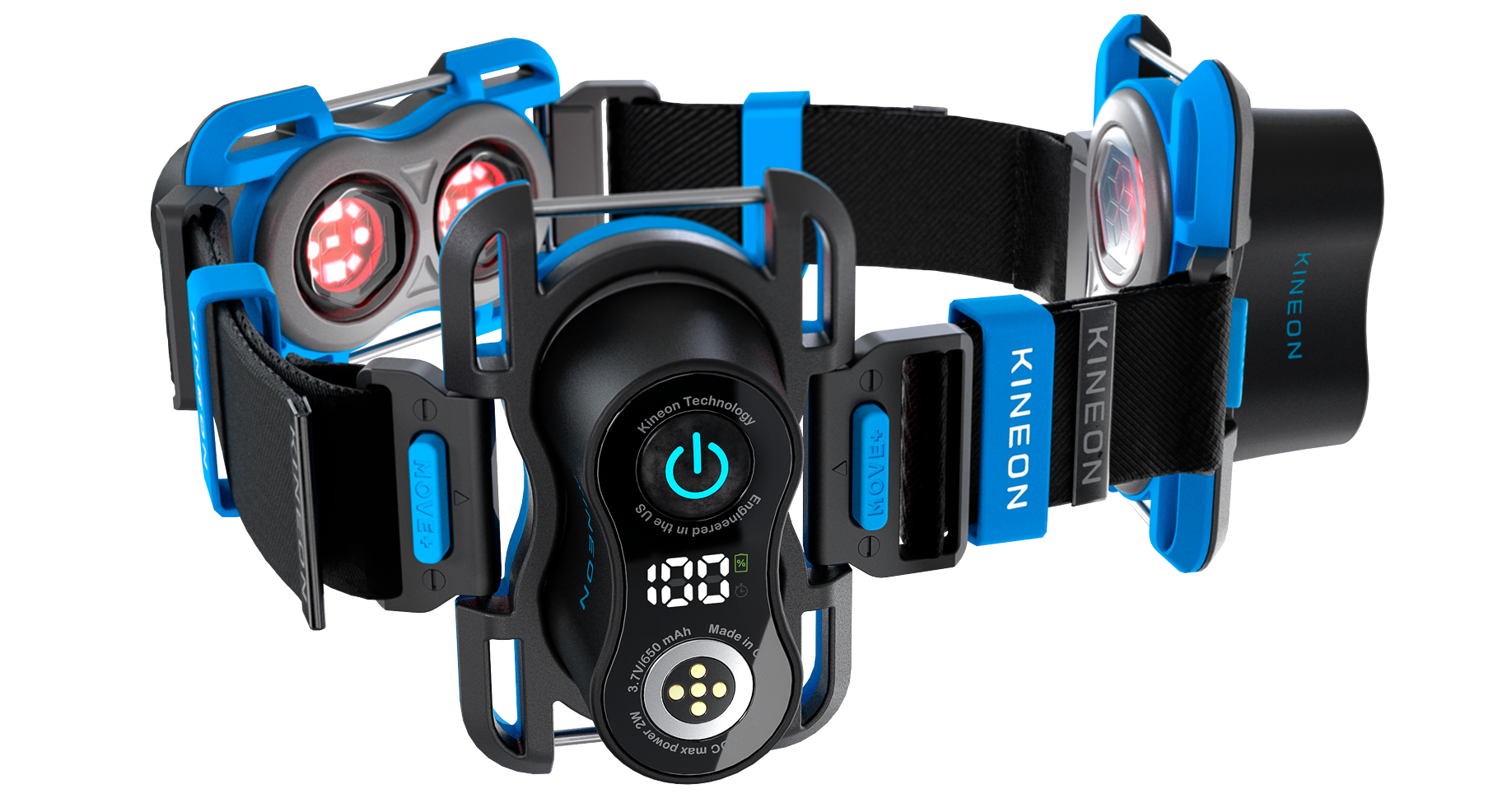
The Kineon MOVE+ delivers the same light (photobiomodulation) as rivals in the same category. What separates it is the hardware. Three pods carrying 660nm LEDs and 808nm class 1 lasers clip into holders that attach to straps, Garmin QuickFit-style, and the holder rotates 90 degrees to reach awkward joints. The device stops itself when the selected dose is delivered.
Every result from the PRUNGO FluxGo test was replicated: back pain, calf strain, DOMS. Tennis elbow was the new one, and the relief was notable the next morning.
Red light therapy only works if you keep at it, and the MOVE+ is the device you will still be using in week six. At £479, it costs roughly double PRUNGO’s sale price, and the carry case has no battery.
Pros
- Modular pod and strap system: clips are fast, positive and audible, and the holder rotates ninety degrees
- Auto-off at the selected dose: the device enforces the fluence rather than trusting you to remember
- Honest dosing figures: Kineon publishes the duty cycle, so 12, 24 and 36 J/cm² can be verified
808nm class 1 lasers: the joint trial literature is predominantly laser, not LED - Build quality: pods have real weight, and the fit and finish is a class above PRUNGO
- Pod runtime: 3 to 3.5 hours per pod against PRUNGO’s 75 minutes
- Results replicated: every PRUNGO finding reproduced, plus tennis elbow
Cons
- Carry case has no battery: mains power required to charge anything, whereas PRUNGO gives five recharges off-grid at half the price
- Battery life overstated: Kineon claims around 4 hours per pod, I measured 3 to 3.5
- Price: £479 buys roughly two PRUNGO FluxGo units on sale
- Elasticated straps: stretch will degrade, and there is no stated service life
- Not for large areas: three pods do not cover the whole back, face or scalp
- Marketing claims do not quite survive checking
User Review
( votes)Kineon MOVE+: what is right with the design
The design is the reason to buy this over the cheaper PRUNGO.
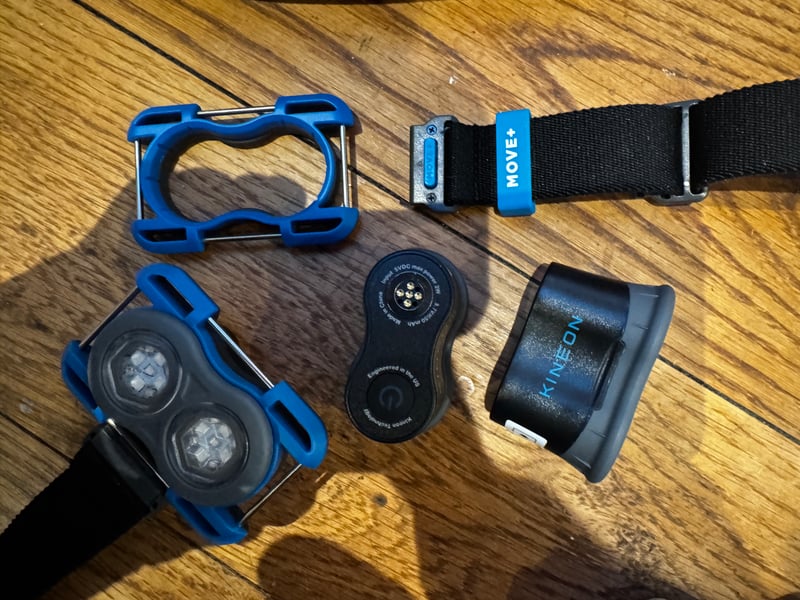
There are three pods, three holders, and three straps. A pod clips into a holder with an audible click and sits there snugly. The holder then clips to the strap the way a Garmin QuickFit strap attaches to a watch: quick, positive, and with no doubt that it has engaged. After a month of fighting PRUNGO’s velcro straps, this came as a relief.
The system is modular. Run one, two, or three pods on a strap. With three pods you can treat three areas at once if you split them. Strap length adjusts easily. The holder also ‘rotates’ through ninety degrees with connectors on each side.
The pods themselves have a reassuring weight and feel well-made. The front carries the two LED and laser arrays. The back has the on button and the charging terminal. Press to start, press to stop, and it stops on its own once the dose is delivered. One button can simultaneously turn all three on or off.
Kineon MOVE+: what is wrong with the design
One real problem, one concern.
The carry case is not a power bank. The three pods sit in a cradle inside it and clip in magnetically, and the case charges them from a USB-C cable. Unplug it from the mains, and nothing charges. Contrast that to PRUNGO’s case, which holds a 5,000 mAh battery and gives five full recharges away from a socket, and PRUNGO is the cheaper device. For a product sold on portability, this is the clearest thing Kineon has got wrong.
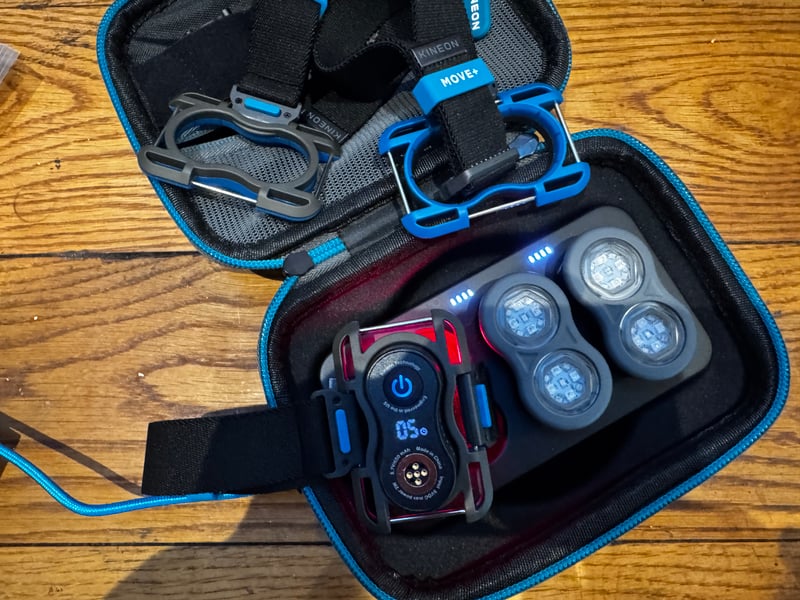
The pod runtime softens the blow. Each pod runs long enough for roughly a fortnight of daily fifteen-minute sessions between charges, so in practice you rarely need the case away from home. It still should not be missing. There is also a button on the case that flashes the red lights during charging and shows the charge state of each pod.
The minor concern is the straps. They are elasticated, and the elasticity loses its stretch. I cannot simulate two years of wear in six weeks, but that is where I would expect this device to age, and Kineon does not state a service life or sell obvious replacements.
Kineon MOVE+: specifications
Each pod carries eight 660nm deep red LEDs and ten 808nm class 1 VCSEL laser diodes. The LEDs run at 20mW each for 160mW per pod, the lasers at 5mW each for 50mW per pod. That gives an LED irradiance around 80 mW/cm² and a laser irradiance around 50 mW/cm².
| Parameter | Detail |
|---|---|
| Configuration | 3 pods, 2 emission areas per pod, 3 straps, 3 holders |
| Wavelengths | 8 x 660nm LEDs and 10 x 808nm class 1 lasers per pod |
| Duty cycle | LED 50 per cent, laser 80 per cent |
| Fluence | 12 J/cm² at 5 minutes, 24 J/cm² at 10 minutes, 36 J/cm² at 15 minutes |
| Claimed depth | LED around 2mm, laser 5 to 6cm |
| Sessions | 5, 10 or 15 minutes, maximum twice daily |
| Pod dimensions | 59 x 37 x 37 mm |
| Battery, claimed | Around 4 hours continuous per pod, 3.5 hour recharge |
| Battery, measured | 3 to 3.5 hours continuous per pod |
| Regulatory | FDA registered, not FDA approved |
Lithium cells do not improve with age, so treat the measured figure as the ceiling.
Kineon MOVE+: the dose, and why it can be checked
Kineon publishes 12 J/cm² for a five-minute session, 24 J/cm² for ten minutes, and 36 J/cm² for fifteen minutes. Those numbers are correct. I checked them, and the fifteen-minute default falls within the 10 to 70 J/cm² range associated with joints and tendons in the literature.
The check is only possible because Kineon states that its LEDs pulse rather than run flat-out and are on half the time. Almost nobody else in this market says so. Take a rival’s headline power figure and its session length, multiply them, and you will land on a dose roughly double the light actually reaching you. Kineon gives you the numbers to catch that. The red light therapy guide shows the detailed working.
Kineon MOVE+: how I tested it
I repeated the PRUNGO protocol. The point of repeating it was to see whether a second device on the same or similar body parts produced similar results. It did.
Chronic lower back pain
The PSOAS-linked lower back pain that PRUNGO improved by around 70 per cent had crept back in over the last few weeks and MOVE+’s treatment responded in the same way and on the same timescale. Some improvement was noticeable the morning after the first treatment.
Calf and DOMS
Same protocol, same outcomes. DOMS after a hard bike session was reduced when I performed red light therapy on one side – it’s just obvious it’s working when you do treat one side and leave the other to repair normally.
Tennis elbow
This was the new test. My first attempt to mount a pod across the elbow was uncomfortable and didn’t seem to hit the right spot, so I began drafting a complaint in my head that the device needed a 90-degree mount of some sort. Then I found that the holder already effectively rotates ninety degrees. A minute later, a better-positioned pod was running, and the relief the following morning was notable (it would likely have been the same mounted either way, but the way I did it was more comfortable).
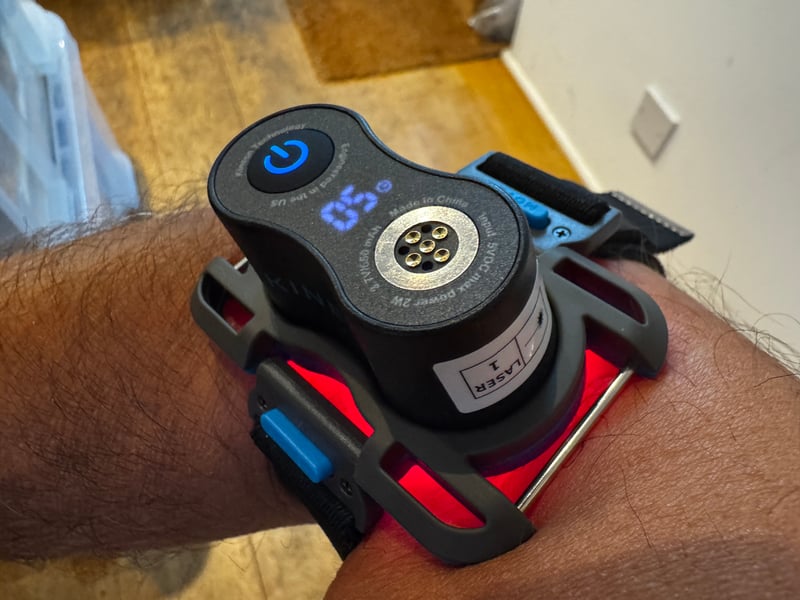
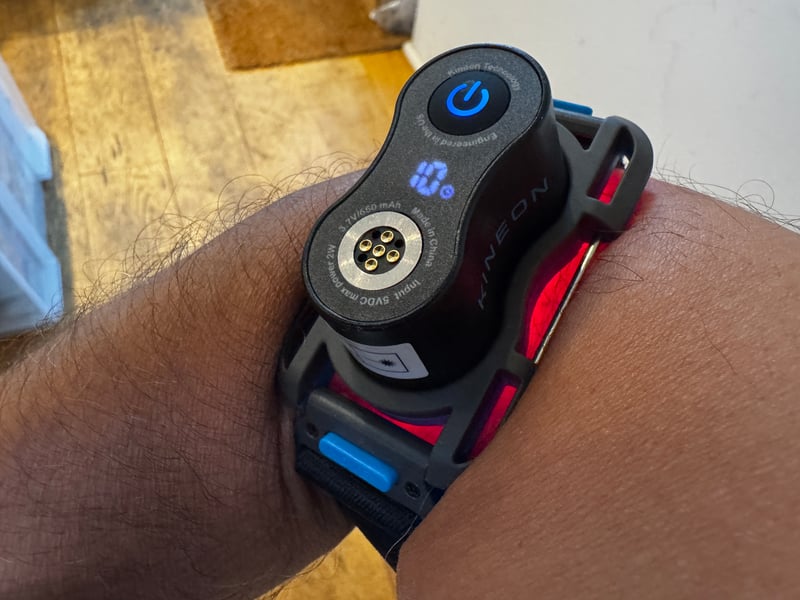
Two devices from two manufacturers, run on the same body against the same problems, produced very similar results. That is as far as I can take the testing. The published evidence takes it further, specifically for knees, a common running and cycling injury.
Kineon MOVE+ against the PRUNGO FluxGo
| Feature | Kineon MOVE+ | PRUNGO FluxGo |
|---|---|---|
| Wavelengths | 660nm LED, 808nm laser | 660nm LED, 850nm polarised laser |
| Mounting | Modular holders, QuickFit-style clips, 90-degree rotation | Thin velcro straps, fiddly, slip during movement |
| Dose control | Stops at the selected dose | Manual mode selection |
| Pod runtime | 3 to 3.5 hours | Around 75 minutes |
| Case battery | None, mains required | 5,000 mAh, 5 recharges |
| Build quality | Superior | Adequate |
| Price | £479 list | £233 on sale, £467 list |
Kineon MOVE+: claims I would not repeat
Kineon’s affiliate material includes percentage figures that don’t quite align with the papers they cite.
The claim of a 50 per cent cut in osteoarthritis pain “in ten days” comes from a study that measured improvement at the tenth and twelfth treatment. Treatments are not days, and Kineon does not say how far apart the study spaced them.
The 78 per cent figure is associated with patellar tendinopathy, a knee problem. The only 78 per cent I can find in Kineon’s own material comes from a trial on rotator cuff surgery, which is a shoulder.
The claim of an 89 per cent average reduction in pain has no source I can find.
The 2019 BMJ Open meta-analysis on knee osteoarthritis is a real result from real placebo-controlled trials, and a 2023 dosimetry study in Biomedical Optics Express modelled this wrap format against a conventional phototherapy device. Kineon has better evidence than most of this market and does not need to embellish it.
Finally, the device is FDA-registered. It is not FDA-approved, whatever you read elsewhere.
Kineon MOVE+ price: where to buy
UK list is £479. US list is $699, usually discounted to $499. The discount code THE5KRUNNER takes 15 per cent off, permanently. The two devices list at a similar price: the PRUNGO FluxGo has an RRP of £467, though it frequently sells for around £233. What the extra Kineon money buys is build quality, a mounting system that works first time every time, and a device that enforces its own dose.
Buy via the the5krunner Kineon affiliate link to support the site at no additional cost.
Kineon MOVE+
660nm LED and 808nm laser joint therapy
 +other retailers
Take Out
The therapy is settled: it worked for me on two devices. The question with the MOVE+ is only ever the hardware and the price. The hardware is excellent. The price is high, and the missing case battery is a genuine miss on a device sold as portable.
In summary: the same therapy as PRUNGO, built better, priced higher.
Quick answers
Does the Kineon MOVE+ actually work?
In my testing it did. It produced the same results as the PRUNGO FluxGo across chronic lower back pain, an acute calf strain and DOMS, and gave notable overnight relief on a tennis elbow. Two devices from two manufacturers, tested on the same body, produced the same outcomes for me.
What dose does the Kineon MOVE+ deliver?
12 J/cm² at five minutes, 24 J/cm² at ten minutes and 36 J/cm² at fifteen minutes. The fifteen-minute session sits inside the 10 to 70 J/cm² range the literature associates with deep tissue. Kineon publishes its duty cycle, which most of the market does not, so the figures can be checked.
Is the Kineon MOVE+ better than the PRUNGO FluxGo?
The therapy appears equivalent. The hardware is not. Kineon’s modular strap and pod system is faster, more secure and more adaptable, and the device stops itself at the selected dose. PRUNGO counters with a carry case that recharges the pods away from mains power, and it costs roughly half as much on sale.
How long does the Kineon MOVE+ battery last?
Kineon claims around four hours of continuous use per pod. I measured three to three and a half. At fifteen minutes a day that is still around a fortnight between charges. The carry case has no battery of its own, so charging needs mains power.
Is the Kineon MOVE+ FDA approved?
No. It is FDA registered, which is a listing rather than an assessment of effectiveness. No at-home red light therapy device holds full FDA approval. Product pages and review sites use registered, cleared and approved interchangeably, and the three mean different things.
Last Updated on 3 October 2026 by tfk the5krunner
Small things I always use
- Garmin 90-degree charging adapter: Charges your Garmin from any USB-C cable. Essential when travelling. I use one.
- Body Glide: The blue anti-chafe stick swimmers and runners carry. I use it.
- Speedo earplugs: Fewer ear infections and no cold-water dizziness. I use them.
- Dryrobe Advance: My winter changing robe for open-water swims. I use one. A cheaper option is the AONYIYI changing robe.
- Maurten: Race fuel that stays easy on the stomach. I use them.
- Garmin charging puck: The quickest way to top up before a session. I use one.
- Injinji: Toe socks that stop rubbing, so you run more. I use them.
- Ultimate toe protectors: Stop black toenails on long runs. They work. I use them.
- Compressport R2 v2 calf sleeves: My calf sleeves of choice. I use them.
- Cellucor C4: My pre-workout before hard sessions.
- TPU tubes: Schwalbe Aerothan, Tubolito and Pirelli SmarTube. Light, tiny spares. I use all three.
- G8 insoles: Adjustable insoles that are good. I use them.
- Cycplus Cube: A 97g electric pump that gets a road tyre rideable in two minutes. I carry one. 5% off with code THE5KRUNNER.
Watches and sensors
- Polar H10: My daily driver for waking HRV.
- Polar Verity Sense: My backup arm-worn HR sensor.
- Nomad bedside charger: Charges my iPhone and Apple Watch overnight. I use it, and many of their bands.
- Train.Red: The best muscle oxygen sensor I’ve used.
- Tymewear: Accurate heart rate and reliable ventilatory zones. I use it to pace endurance rides over an hour.
- Garmin Forerunner 970: A pro-grade triathlon watch. I use this.
- Apple Watch Ultra 4: My daily smartwatch. No phone needed on rides.
- Garmin Fenix 9 Pro: I’ve just bought one.
On the bike
- Continental GP5000 for everyday riding, and Aero 111 on the front for special occasions.
- Helmets: Specialized S-Works Evade 3 for road riding, and Rudy Project Wing for TT-style races. I use both.
- Ravemen FR300: A front light that mounts under your Garmin or Wahoo. I use one.
- Wahoo TRACKR Radar: I use it on one bike and Varia on the other. They perform the same.
- Garmin Varia RTL515: Radar that warns you of cars from behind. I use this model.
- Wahoo ELEMNT Roam 3: The bike computer that’s easy to use. I use mine on most rides.
- Favero Assioma Pro RS2: Accurate power pedals that swap easily between bikes. I use this model.
Home and indoor training
- NPE Runn: Makes my basic treadmill smart, sending more accurate speed and distance to my watch and Zwift. I use it.
- Google Wifi: Keeps Zwift connected in my pain cave. I use it.
- Apple TV 4K: Zwift on the big screen. I use two.
- Google Nest Doorbell (wired, 2nd gen): My video doorbell, running in both Google Home and Apple Home. I use it.
Health, recovery and sleep
- FreeStyle Libre 3 Plus: Shows how my blood sugar responds to diet.
- hDrop: Measures my sweat loss in summer and indoors.
- Fourth Frontier Zone: Checks my heart under load in hard sessions.
- Oura Ring 5: My partner’s recovery tracker of choice.
- Kineon MOVE+: Red light therapy for niggles. It works.
- Eight Sleep: A cooling mattress cover my partner and I use nightly.
Reader-Powered Content

This content is not sponsored. It’s mostly me behind the labour of love, which is this site, and I appreciate everyone who supports it.
Support the site: Follow (free, fewer ads) · Subscribe (paid, ad-free) · Buy Me A Coffee ❤️
Written by real people, with AI assistance. Fact-checked and verified for originality. See the Editorial Policy. FTC: Affiliate Disclosure — some links pay commission. As an Amazon Associate, I earn from qualifying purchases.
tfk is the founder and author of the5krunner, an independent endurance sports technology publication. With 20 years of hands-on testing of GPS watches and wearables, and competing in triathlons at an international age-group level, tfk provides in-depth expert analysis of fitness technology for serious athletes and endurance sport competitors. ID

Do you think, or is there any literature, that this kind of device could work for bursitis (near the Achille’ insertion n the heel) ?
Oh excuse me, my message was a bit…steep.
Thanks for this, once again, very detailed analysis of some sporty device which get a bit further from the usual geekerie we’re used to see 🙂
yes it should do (based on Googling RLT)
I was surprised at that answer as a bursa is a sac of fluid. So the RLT must help the stuff around the sac that causes the fluid build up?
the other issue on the ankle is that it will be a very awkawrd place to put a device onto (any device, not just this)
the message was fine!! not steep!
This sounds like placebo effect. Are you comfortable that their cited studies are sound and performed independently?