Adaptive training has a quiet problem. An adaptive plan is good at deciding what an athlete should do and bad at letting the athlete disagree. Threshold workouts show it most clearly, because coaches, clubs and books rewrite them more than any other session.
A typical case: an athlete’s plan has a threshold workout on Tuesday, 4×8 minutes at 95 to 100% of FTP with 3 minutes easy between. On Monday evening the club coach suggests 3×12 instead, because the target event has long climbs. The athlete edits the session in their calendar and rides it. The next morning the plan has quietly regenerated Tuesday’s slot, or treats the 3×12 as an unexplained overload and eases off Wednesday and Thursday.
The athlete learns one of two lessons: don’t touch the plan, or the plan doesn’t listen. Neither is good for training. IntervalCoach, an AI training coach founded in the Netherlands, has added a workout builder to deal with exactly this.
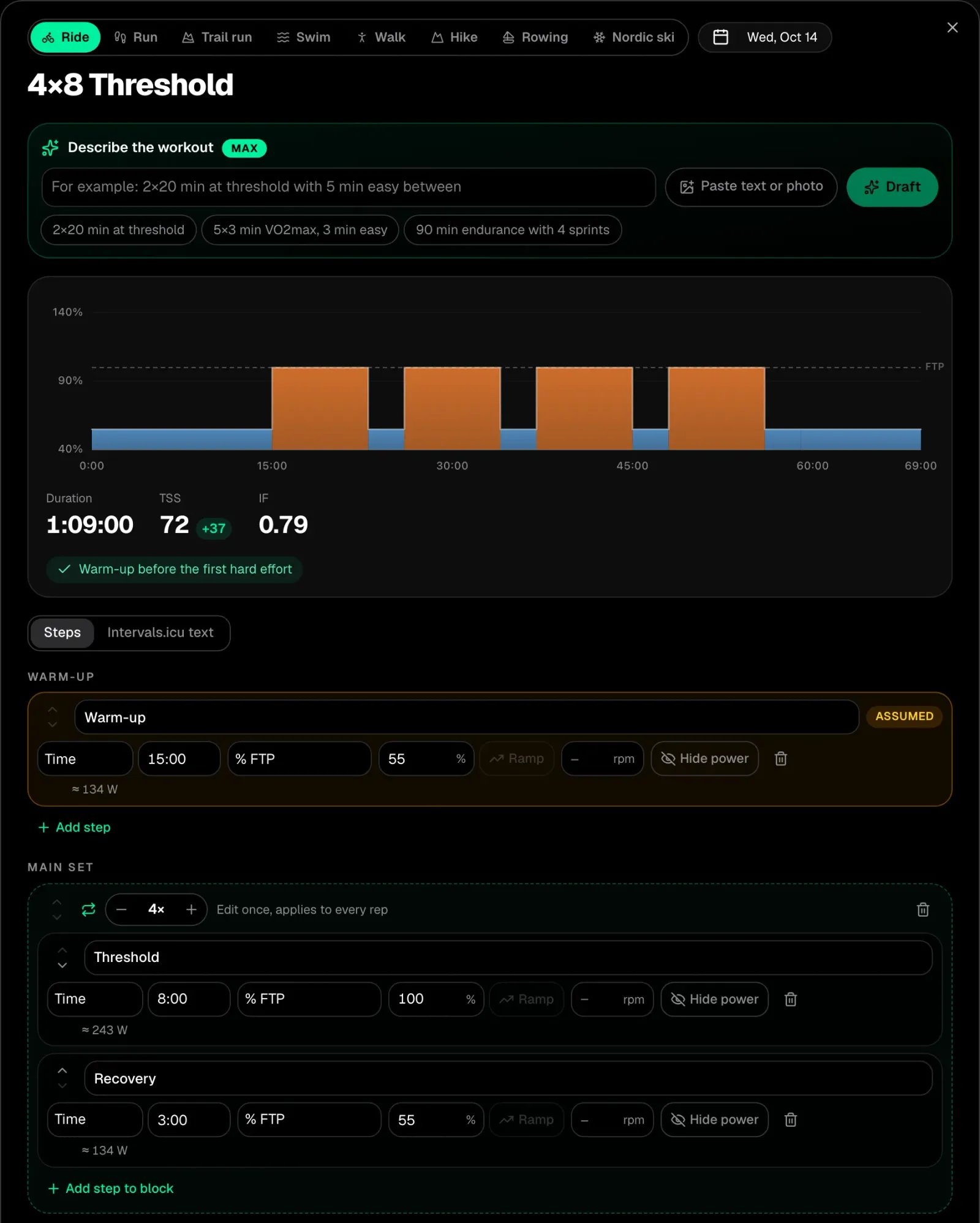
What changing a threshold workout changes
A one-line edit moves the numbers more than it looks. For a rider with an FTP of 246 W:
| Session | Duration | Time at threshold | Training load (TSS) |
|---|---|---|---|
| Planned: 4×8 min, 3 min easy | 69 min | 32 min | About 69 |
| Club version: 3×12 min, 4 min easy | 73 min | 36 min | About 76 |
| Shorter day: 2×12 min | 57 min | 24 min | About 55 |
The club version trains the same threshold system with longer intervals, four more minutes at threshold and about 10% more training load. The 2×12 is what the same athlete might choose after a bad night. Both are reasonable, as long as the rest of the week knows which one happened.
A workout builder inside the plan
TL;DR: In IntervalCoach the athlete edits the planned session itself. The chart, duration, TSS and intensity update against what the plan expected, and the saved session stays in the plan, which rebalances the rest of the week around it.
The athlete opens Tuesday’s session, chooses Edit workout and changes the reps from 4×8 to 3×12. Steps inside a repeat are edited once and apply to every rep. While they edit, the chart, duration, TSS and intensity update next to the original and next to what the plan expected for that day. Short checks flag what people forget when they edit at 22:00, such as a missing warm-up or a recovery too short for the rep length.
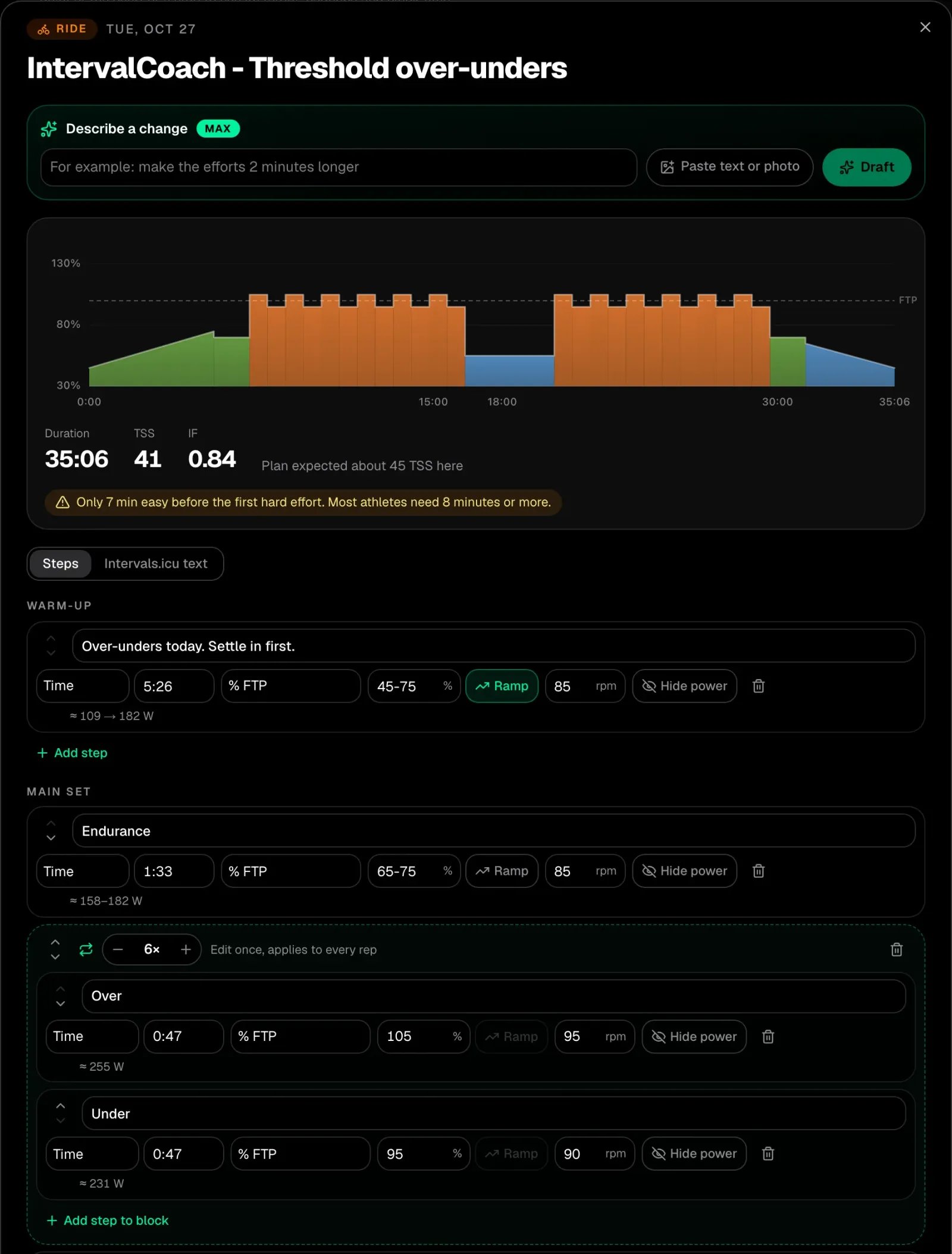
Targets can be set the way the athlete thinks about them:
- % FTP, watts or power zones.
- Pace, including a typed pace such as 4:30 per km.
- % of maximum heart rate or % of lactate threshold heart rate.
- Feel.
Steps run by time, by distance, or until the athlete presses lap, which suits a hill rep that ends at the top rather than on the clock. Hide power is there for Zwift sessions ridden on feel.
Saving without breaking the week
Two things happen when the athlete saves.
First, the edit replaces the same calendar entry instead of creating a new one. That keeps the workout syncing to a Garmin, Wahoo or Zwift, and lets the ride pair with the planned session afterwards.
Second, the session now belongs to the athlete. Later plan updates keep it as it is and reconcile the rest of the week around it. The extra 7 TSS of the club version is accounted for in the days that follow, the way a coach would account for it, instead of being overwritten the next time the plan refreshes.
When the session is on paper
The other common case is a session that exists only as a photo of a whiteboard or a page in a book. On the Max plan the athlete can describe the workout in words, such as “4×8 min at threshold with 3 min easy between”, or add the photo, and the builder writes the steps.
Anything the builder had to assume is marked. If the description never mentioned a warm-up, the warm-up it added is flagged as assumed so the athlete checks it before saving. That marking matters more than the drafting: a generated workout that silently invents a 20-minute warm-up looks just as finished as one that was asked for, and the athlete has no way to tell them apart.
Limits
- A repeat inside another repeat, steps that use a custom zone, an unusual target type, or a workout of more than 60 steps open read-only, with a route to edit them in Intervals.icu. Text cues set there are kept.
- The builder covers rides, runs, trail runs, swims, walks, hikes, rowing and Nordic ski, on the web and in the iPhone and Android apps.
- Editing and building are on every plan, including free. Describing a workout in words or from a photo needs Max.
Why it matters
An adaptive plan is only as good as its willingness to be overruled. Athletes and their coaches will always know things the plan doesn’t: a course profile, a group ride, a niggle that hasn’t shown up in the HRV yet. For anyone comparing AI cycling coaches or looking for a TrainingPeaks alternative, the useful test is whether an app adapts to the athlete’s decisions as well as to their data.
The workout builder launched on 15 October 2026 alongside a redesign of the app.
More: IntervalCoach’s refreshed app and workout builder
Quick answers
Does IntervalCoach overwrite a workout the athlete has edited?
No. An edited session belongs to the athlete, so later plan updates keep it and rebalance the rest of the week around it instead of replacing it.
Do edited IntervalCoach workouts still sync to Garmin, Wahoo and Zwift?
Yes. The edit replaces the same calendar entry instead of creating a new one, so the workout keeps syncing and the ride pairs with the planned session afterwards.
Can IntervalCoach build a workout from a photo?
Yes, on the Max plan. The athlete describes the session in words or adds a photo of a whiteboard or book page, and the builder writes the steps, flagging anything it had to assume, such as a warm-up.
Is the IntervalCoach workout builder free?
Editing and building workouts are available on every plan, including free. Describing a workout in words or from a photo needs the Max plan.
Which sports does the IntervalCoach workout builder support?
Rides, runs, trail runs, swims, walks, hikes, rowing and Nordic ski, on the web and in the iPhone and Android apps.
Related reading
- Fit File Forge: 120 classic workouts ready for Garmin
- Blocks: an AI-native training platform for endurance athletes
- Best smart trainer
Author: Martijn Russchen, founder of IntervalCoach, edited by the5krunner.
If you enjoyed reading this, here is another in the Indie Spotlight series: Massiv keeps logging gym sets when the phone is out of range.
Last Updated on 16 October 2026 by tfk the5krunner
Small things I always use
- Garmin 90-degree charging adapter: Charges your Garmin from any USB-C cable. Essential when travelling. I use one.
- Body Glide: The blue anti-chafe stick swimmers and runners carry. I use it.
- Speedo earplugs: Fewer ear infections and no cold-water dizziness. I use them.
- Dryrobe Advance: My winter changing robe for open-water swims. I use one. A cheaper option is the AONYIYI changing robe.
- Maurten: Race fuel that stays easy on the stomach. I use them.
- Garmin charging puck: The quickest way to top up before a session. I use one.
- Injinji: Toe socks that stop rubbing, so you run more. I use them.
- Ultimate toe protectors: Stop black toenails on long runs. They work. I use them.
- Compressport R2 v2 calf sleeves: My calf sleeves of choice. I use them.
- Cellucor C4: My pre-workout before hard sessions.
- TPU tubes: Schwalbe Aerothan, Tubolito and Pirelli SmarTube. Light, tiny spares. I use all three.
- G8 insoles: Adjustable insoles that are good. I use them.
- Cycplus Cube: A 97g electric pump that gets a road tyre rideable in two minutes. I carry one. 5% off with code THE5KRUNNER.
Watches and sensors
- Polar H10: My daily driver for waking HRV.
- Polar Verity Sense: My backup arm-worn HR sensor.
- Nomad bedside charger: Charges my iPhone and Apple Watch overnight. I use it, and many of their bands.
- Train.Red: The best muscle oxygen sensor I’ve used.
- Tymewear: Accurate heart rate and reliable ventilatory zones. I use it to pace endurance rides over an hour.
- Garmin Forerunner 970: A pro-grade triathlon watch. I use this.
- Apple Watch Ultra 4: My daily smartwatch. No phone needed on rides.
- Garmin Fenix 9 Pro: I’ve just bought one.
On the bike
- Continental GP5000 for everyday riding, and Aero 111 on the front for special occasions.
- Helmets: Specialized S-Works Evade 3 for road riding, and Rudy Project Wing for TT-style races. I use both.
- Ravemen FR300: A front light that mounts under your Garmin or Wahoo. I use one.
- Wahoo TRACKR Radar: I use it on one bike and Varia on the other. They perform the same.
- Garmin Varia RTL515: Radar that warns you of cars from behind. I use this model.
- Wahoo ELEMNT Roam 3: The bike computer that’s easy to use. I use mine on most rides.
- Favero Assioma Pro RS2: Accurate power pedals that swap easily between bikes. I use this model.
Home and indoor training
- NPE Runn: Makes my basic treadmill smart, sending more accurate speed and distance to my watch and Zwift. I use it.
- Google Wifi: Keeps Zwift connected in my pain cave. I use it.
- Apple TV 4K: Zwift on the big screen. I use two.
- Google Nest Doorbell (wired, 2nd gen): My video doorbell, running in both Google Home and Apple Home. I use it.
Health, recovery and sleep
- FreeStyle Libre 3 Plus: Shows how my blood sugar responds to diet.
- hDrop: Measures my sweat loss in summer and indoors.
- Fourth Frontier Zone: Checks my heart under load in hard sessions.
- Oura Ring 5: My partner’s recovery tracker of choice.
- Eight Sleep: A cooling mattress cover my partner and I use nightly.
Reader-Powered Content

This content is not sponsored. It’s mostly me behind the labour of love, which is this site, and I appreciate everyone who supports it.
Support the site: Follow (free, fewer ads) · Subscribe (paid, ad-free) · Buy Me A Coffee ❤️
Written by real people, with AI assistance. Fact-checked and verified for originality. See the Editorial Policy. FTC: Affiliate Disclosure — some links pay commission. As an Amazon Associate, I earn from qualifying purchases.
tfk is the founder and author of the5krunner, an independent endurance sports technology publication. With 20 years of hands-on testing of GPS watches and wearables, and competing in triathlons at an international age-group level, tfk provides in-depth expert analysis of fitness technology for serious athletes and endurance sport competitors. ID
