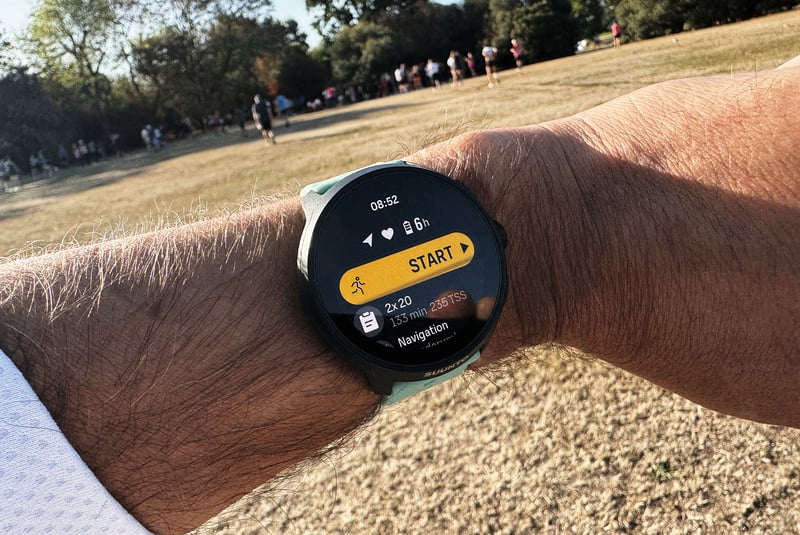
Forerunner 70 costs £219.99 / $249.99 and Suunto Run 2 costs £265 / $349 for the 4GB model. The extra £45 in the UK and $100 in the US buys free offline maps, dual-band GPS, a stainless steel bezel and offline music storage. Forerunner 70 gives you Garmin’s training tools for less, and its GPS was the best of any single-frequency watch I have tested.
Choose Run 2 if you want maps on your wrist, a sturdier case and a heart rate sensor that tracked closely in every one of my tests. Choose Forerunner 70 if you want Garmin’s training guidance, the wider Garmin ecosystem and the lower price. Both are covered in full in my Forerunner 70 review and my Suunto Run 2 review.
Maps and navigation
The Run 2 includes free worldwide offline maps on both the 4GB and 64GB models. The 64GB model simply has more room for map regions and music. Installing maps over Wi-Fi is oddly confusing the first time, but the maps themselves are not restricted.
Forerunner 70 has no onboard maps and no ClimbPro. It can follow a breadcrumb course, and Android users get Google Maps turn-by-turn directions on the wrist. For a runner who explores new routes or trails, this is the biggest difference between the two watches, and Run 2 wins it clearly.
Run 2 also has a barometric altimeter. Forerunner 70 works out elevation from GPS alone, and its elevation profile on my ride was more jagged than Garmin’s pricier Forerunner 170. That is adequate for most runners but not for long hikes or ultras.
Training tools
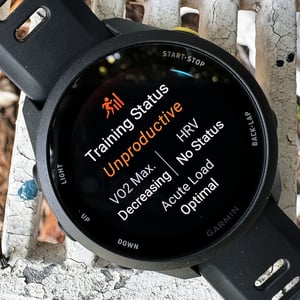
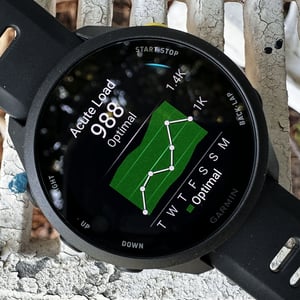
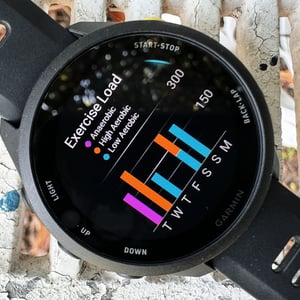
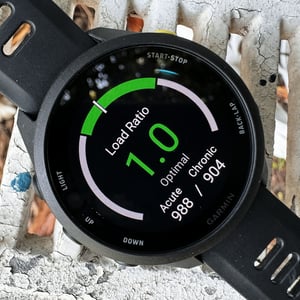
Forerunner 70 has the deeper training toolkit. Training Readiness and Training Status tell you whether to push or rest, HRV Status and Body Battery track recovery, and Garmin Coach builds adaptive plans, including run-and-walk plans for newer runners. It also adds wrist-based Running Power and Running Dynamics, a Quick Workouts generator, PacePro race pacing and a Race Predictor. Garmin hasn’t offered a watch at this price with these tools before.
Run 2 is lighter on coaching but has some features Garmin lacks at this price. Suunto’s AI Coach generates and adjusts training plans from your progress. ZoneSense uses heart rate variability from a chest strap to move your Zone 2 and Zone 4 limits as you tire on a long run, which suits an advanced runner. EnergySense shows how much energy you have left at your current pace, though it is beta and running-only. Ghost Runner paces you against a previous best.
Run 2 has two limits to know about. SuuntoPlus Guides work only if you create them manually, and guides linked to outside services such as TrainingPeaks show as incompatible. Run 2 also has no access to the SuuntoPlus Sports Apps store that Suunto’s pricier watches have. Forerunner 70 wins on breadth.
Sensors, safety and smart features
Forerunner 70 pairs with ANT+ and Bluetooth sensors, including heart rate straps, footpods, cycling lights and cycling radar, but not power meters or smart trainers. Run 2 has Bluetooth and Wi-Fi but not ANT+. Forerunner 70 also has incident detection and LiveTrack location sharing, and it runs the Connect IQ Store for watch faces and apps.
Run 2 stores MP3 files for offline music through drag and drop, with no streaming. Forerunner 70 has no music storage. Neither watch has contactless payments or a cellular connection. Run 2 has fewer watch faces than rivals, whereas Garmin lets you download many more, although its out-of-the-box faces mostly look poor.
Design and comfort
Run 2 has a 46mm case at 35g with a stainless steel bezel, Gorilla Glass and a 1.32-inch AMOLED screen that reaches 2,000 nits. It has a digital crown and two buttons alongside the touchscreen. Forerunner 70 has a 43mm fibre-reinforced polymer case at 40g, a 1.2-inch AMOLED screen and five buttons plus touch. I found the Forerunner 70 screen scratches easily, and the watch feels plastic, while Run 2 is lighter despite the larger case.
Both watches are 5 ATM water resistant. I also found Suunto’s menus easier to use than Garmin’s, which have more complexity than the job needs, and I found Garmin’s setup and app navigation more frustrating.
Tested accuracy
Both watches tracked well in my testing. Run 2 scored 90% in my standard 10-mile GPS test, and its heart rate bias stayed under 1 bpm across eight sessions. Forerunner 70 recorded the best result of any single-frequency watch I have tested, and its heart rate bias stayed within about 1 bpm in every session.
Heart rate
Bias is the average difference from the reference sensor, and the limits show how far readings strayed in either direction. The two watches are close to level in running and cycling.
| Test | Reference | Suunto Run 2 | Forerunner 70 |
|---|---|---|---|
| Long steady tempo run | Polar Sense | 0.0 bpm (-1.5 to +1.5) | 0.0 bpm (-1.4 to +1.3) |
| Long steady tempo run | Chest strap (HRM 600) | -0.1 bpm (-2.0 to +1.9) | -0.1 bpm (-2.3 to +2.2) |
| Outdoor cycling | Polar Sense | +0.2 bpm (-2.7 to +3.0) | 0.0 bpm (-2.8 to +2.8) |
| Outdoor cycling | Chest strap | +0.1 bpm (-3.6 to +3.8) | +0.4 bpm (-3.3 to +4.1) |
Neither wrist sensor suits arm-heavy strength sessions. Forerunner 70’s weakest result was an upper-body weights session, with spikes from arm and wrist movement. Another tester found Run 2 missed a meaningful number of heart rate peaks in similar work. My Run 2 leg and core session was fine, but a chest strap is the safe choice for serious cycling and triathlon training with either watch.
GPS
The two reviews used different routes and references, so the table shows each watch’s own deviation rather than a head-to-head.
| Watch | Test | Deviation |
|---|---|---|
| Suunto Run 2 | Running track, 4 laps in Lane 2 | -8m |
| Suunto Run 2 | Kingston parkrun | 0m |
| Suunto Run 2 | Wimbledon Common trail, under trees | -40m |
| Forerunner 70 | Bushy Park parkrun | +7m |
| Forerunner 70 | Suburban grid, against a Stryd footpod | 0m |
| Forerunner 70 | Ride to Windsor | +83m |
Run 2’s trail result came in 40m under the average of other devices under tree cover. Forerunner 70’s tracks drift near tall buildings, where I would add a footpod such as Stryd for pace. The Windsor ride figure is measured against the average of three other devices.
Battery life
| Mode | Suunto Run 2 | Forerunner 70 |
|---|---|---|
| Daily use, claimed | Up to 10 days | Up to 13 days |
| GPS, claimed | Up to 24 hours (multi-band) | Up to 23 hours (GPS-only), 16 hours (All-Systems) |
| GPS, my tests | About 15 to 16 hours with a bright screen and always-on display | 18.6 hours average over four recordings |
Forerunner 70 averaged less than Garmin’s 23-hour claim, although I did not record which satellite mode it used in its four tests. Run 2 matched Suunto’s claim on default settings and dropped to about 15 to 16 hours with my brighter settings.
The brand behind each watch
Garmin has the broadest third-party ecosystem in the sector and now owns TrainingPeaks, but it makes no written promise about how long it will keep supporting a watch you already own. Suunto returned to profit in 2025 after a loss the year before, handled its one earlier platform migration carefully, and is weaker on data export and published science. Both brands are covered on their own pages: Garmin and Suunto.
| Factor | Garmin Forerunner 70 | Suunto Run 2 |
|---|---|---|
| Apps on the watch | Connect IQ Store for watch faces and apps | No app store on this watch; manually created SuuntoPlus Guides only |
| Training platforms | Garmin owns TrainingPeaks | TrainingPeaks guides show as incompatible on Run 2 |
| Warranty | 1 year in the US by policy; 2 years in the UK and EU under consumer law | 2 years worldwide by policy |
| Battery and repair | Battery is excluded from warranty; paid refurbished exchange after warranty | Battery covered for 1 year or 300 charges; paid repair through authorised service centres |
| Software updates | Five releases between May and October 2026 | Too new to judge; the original Run had 11 updates in its first 16 months |
| Company | Profitable across five business segments, with billions in cash | Back in profit in 2025; owned by Liesheng since 2022, which turned a $13.9m loan into equity in March 2026 |
Brand pros and cons at a glance:
- Garmin pro: the broadest third-party ecosystem, and ownership of TrainingPeaks.
- Garmin con: no written commitment on how long it supports a watch you own.
- Suunto pro: a 2-year warranty worldwide, and an authorised repair network.
- Suunto con: weaker than its rivals on data export and published science.
Price and where to buy
Forerunner 70 launched at £219.99 / $249.99. Run 2 costs £265 / $349 for 4GB and £299 / $399 for 64GB. Forerunner 70 is Garmin’s cheapest running watch, and Run 2 is Suunto’s entry price for a current-generation model. Full specifications are on the Forerunner 70 specs page and the Run 2 specs page, and the manufacturers list them on Garmin’s Forerunner 70 page and Suunto’s Run 2 page. See the current Run 2 price in my Run 2 price section.
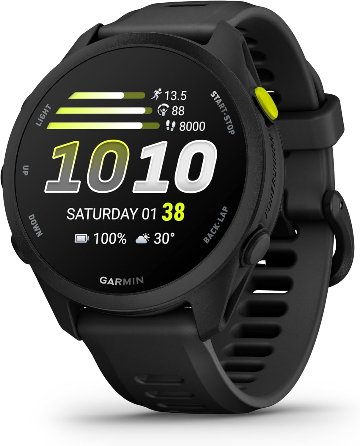
Garmin Forerunner 70
GPS running watch
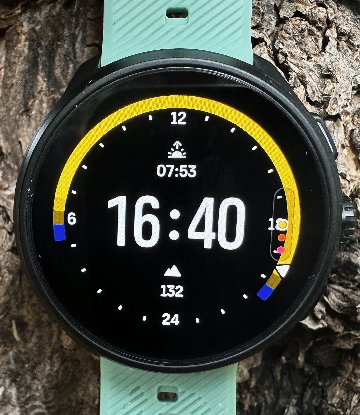
Suunto Run 2
Stainless steel bezel, 1.32" AMOLED (2,000 nits), dual-band GPS, 10-day battery.
Which should you buy?
- Buy Run 2 if you run new routes or trails and want maps on the wrist, or if you want the sturdier case, offline MP3 music and a barometric altimeter.
- Buy Forerunner 70 if you want Training Readiness, Garmin Coach plans and Running Power, if you already use Garmin Connect, or if you want to spend about £45 less.
- Look at Forerunner 170 if you need Garmin Pay, an altimeter and power meter support. See my Forerunner 170 review.
- Look at Suunto’s pricier watches if you want the SuuntoPlus app store. See Race 3S, Race 2 or Run 2: which one to buy.
For the whole range, see the best Garmin Forerunner guide.
Quick answers
Does the Garmin Forerunner 70 or Suunto Run 2 have maps?
Suunto Run 2 has free worldwide offline maps on both its 4GB and 64GB versions. Forerunner 70 has no onboard maps and no ClimbPro. On Android, it can show Google Maps turn-by-turn directions on the wrist.
Which is more accurate, Forerunner 70 or Suunto Run 2?
Both were accurate in my testing. Run 2 scored 90% in my standard 10-mile GPS test, and Forerunner 70 was the best single-frequency watch I have tested. Heart rate bias stayed within about 1 bpm for both in running and cycling.
Which has better battery life, Forerunner 70 or Suunto Run 2?
Forerunner 70 lasts longer in everyday use, at up to 13 days against up to 10 days for Run 2. In GPS mode Suunto claims 24 hours and Garmin claims 23 hours in GPS-only mode. In my tests, Run 2 managed about 15 to 16 hours with a bright always-on screen, and Forerunner 70 averaged 18.6 hours.
Which has better training features?
The Forerunner 70 has a broader set, including Training Readiness, Training Status, Garmin Coach plans, wrist-based Running Power, and Running Dynamics. Run 2 has Suunto AI Coach plans, ZoneSense, EnergySense in beta and Ghost Runner.
Can the Forerunner 70 or Suunto Run 2 play music?
Run 2 stores MP3 files for offline playback and has no streaming. Forerunner 70 has no music storage. Neither watch has contactless payments.
Does the Suunto Run 2 work with TrainingPeaks?
Not for guides. In my testing, SuuntoPlus Guides linked to outside providers such as TrainingPeaks show as incompatible on Run 2, and only manually created guides work.
Last Updated on 17 November 2026 by tfk the5krunner
Small things I always use
- Garmin 90-degree charging adapter: Charges your Garmin with any USB-C cable. Essential when travelling. I use one.
- Body Glide: The blue anti-chafing stick swimmers and runners carry. I use it.
- Speedo earplugs: Fewer ear infections and no cold-water dizziness. I use them.
- Dryrobe Advance: My winter changing robe for open-water swims. I use one. A cheaper option is the AONYIYI changing robe.
- Maurten: Race fuel that stays easy on the stomach. I use them.
- Beet It Sport nitrate shots: Beetroot shots I take in the days before a race. I use them.
- Garmin charging puck: The quickest way to top up before a session. I use one.
- Injinji: Toe socks that stop rubbing, so you run more. I use them.
- Ultimate toe protectors: Stop black toenails on long runs. They work. I use them.
- Compressport R2 v2 calf sleeves: My calf sleeves of choice. I use them.
- Cellucor C4: My pre-workout before hard sessions.
- TPU tubes: Schwalbe Aerothan, Tubolito and Pirelli SmarTube. Light, tiny spares. I use all three.
- G8 insoles: Adjustable arches, perfect position. I use them.
- Cycplus Cube: A 97g electric pump that gets a road tyre rideable in two minutes. I carry one. 5% off with code THE5KRUNNER.
Health, recovery and sleep
- Kineon MOVE+: Red and infrared light for sore knees, Achilles and other joints after hard training. I use it.
- FreeStyle Libre 3 Plus: Shows how my blood sugar responds to diet. Occasional use.
- hDrop: Measures my sweat loss in summer and indoors. I use it.
- Fourth Frontier Zone: Checks my heart under load in hard sessions.
- Oura Ring 5: My partner’s recovery tracker of choice.
- Eight Sleep: A cooling mattress cover my partner and I use nightly.
Watches and sensors
- Polar H10: My daily driver for waking HRV.
- Polar Verity Sense: My backup arm-worn HR sensor.
- Nomad bedside charger: Charges my iPhone and Apple Watch overnight. I use it, and many of their bands.
- Train.Red: The best muscle oxygen sensor I’ve used. Occasional use.
- Tymewear: Accurate heart rate and reliable ventilatory zones. I use it to pace endurance rides over an hour.
- Garmin Forerunner 970: A pro-grade triathlon watch. I use this.
- Apple Watch Ultra 4: My daily smartwatch. No phone needed on rides.
On the bike
- Continental GP5000 for everyday riding, and Aero 111 on the front for special occasions. I use both.
- Helmets: Specialized S-Works Evade 3 for road riding, and Rudy Project Wing for TT-style races. I use both.
- Ravemen FR300: A front light that mounts under your Garmin or Wahoo. I use one.
- Ravemen FR1000: The light and the computer mount in one unit, so nothing else goes on the bars. Better than mine.
- Ravemen FR1500SE: 1,500 lumens hanging under your Garmin, for proper night rides.
- Ravemen FR1100SE: 1,100 lumens under your Garmin, and up to 46 hours on slow flash.
- Ravemen FR500: A brighter FR300 with the same mount.
- Wahoo TRACKR Radar: I use it on one bike and Varia on the other. They perform the same.
- Garmin Varia RTL515: Radar that warns you of cars from behind. I use this model.
- Wahoo ELEMNT Roam 3: The bike computer that’s easy to use. I use mine on most rides.
- Favero Assioma Pro RS2: Accurate power pedals that swap easily between bikes. I use this model.
Home and indoor training
- NPE Runn: Makes my basic treadmill smart, sending more accurate speed and distance to my watch and Zwift. I use it.
- Google Wifi: Keeps Zwift connected in my pain cave. I use it.
- Apple TV 4K: Zwift on the big screen. I use two.
- Google Nest Doorbell (wired, 2nd gen): My video doorbell, running in both Google Home and Apple Home via Starling. I use it.
Reader-Powered Content

This content is not sponsored. It’s mostly me behind the labour of love, which is this site, and I appreciate everyone who supports it.
Support the site: Follow (free, fewer ads) · Subscribe (paid, ad-free) · Buy Me A Coffee
Written by real people, with AI assistance. Fact-checked and verified for originality. See the Editorial Policy. FTC: Affiliate Disclosure — some links pay commission. As an Amazon Associate, I earn from qualifying purchases.
tfk is the founder and author of the5krunner, an independent endurance sports technology publication. With 20 years of hands-on testing of GPS watches and wearables, and competing in triathlons at an international age-group level, tfk provides in-depth expert analysis of fitness technology for serious athletes and endurance sport competitors. See the gear tfk uses. ID
