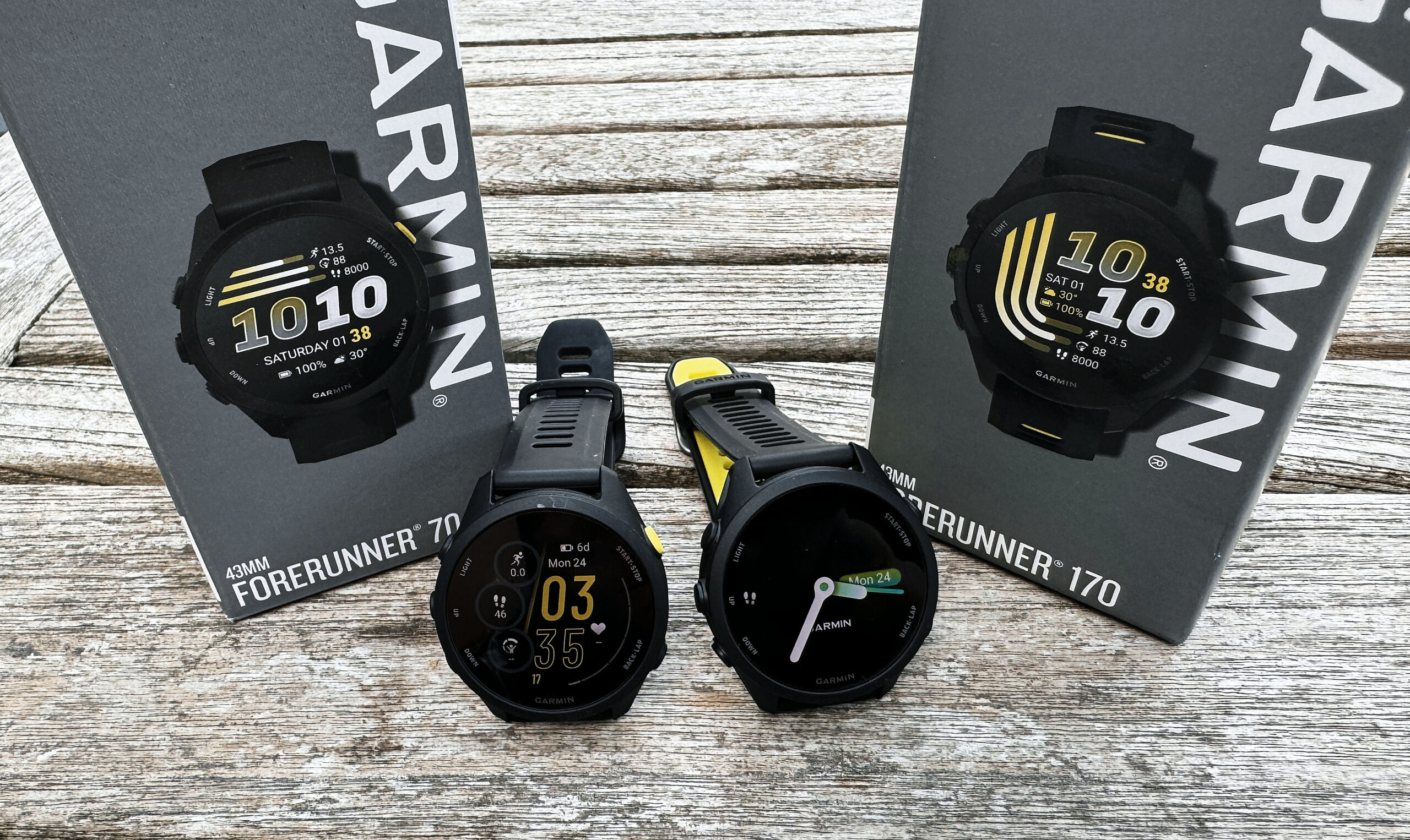
Garmin Forerunner 170 review: parkrun tested, is this beginner overkill?
Don’t be confused by the Garmin Forerunner 170 sitting near the bottom of the company’s running range; it is a highly competent piece of kit that is easily better than any sports watch from 10 years ago. What you have to worry about is whether it’s overkill for your needs, which it certainly is if your weekly plan consists of a trip to the gym, an hour jog and a Saturday 5k parkrun.
This model uses previous-generation internals, not the latest tech, but they’re still accurate as shown by my extensive testing below. What you are paying for with the ‘Garmin Tax’ is access to some of the more advanced running and recovery features inside the world’s most extensive sports ecosystem: Garmin Connect. Connect is somewhat unwieldy and complex to use, so if simplicity is your thing, change your brand search to Apple, Polar, or Suunto.
Heads Up: I have no connection with Garmin whatsoever and bought these with my own money.
Garmin Forerunner 170
Garmin Forerunner 170: capable enough to grow into, at a price
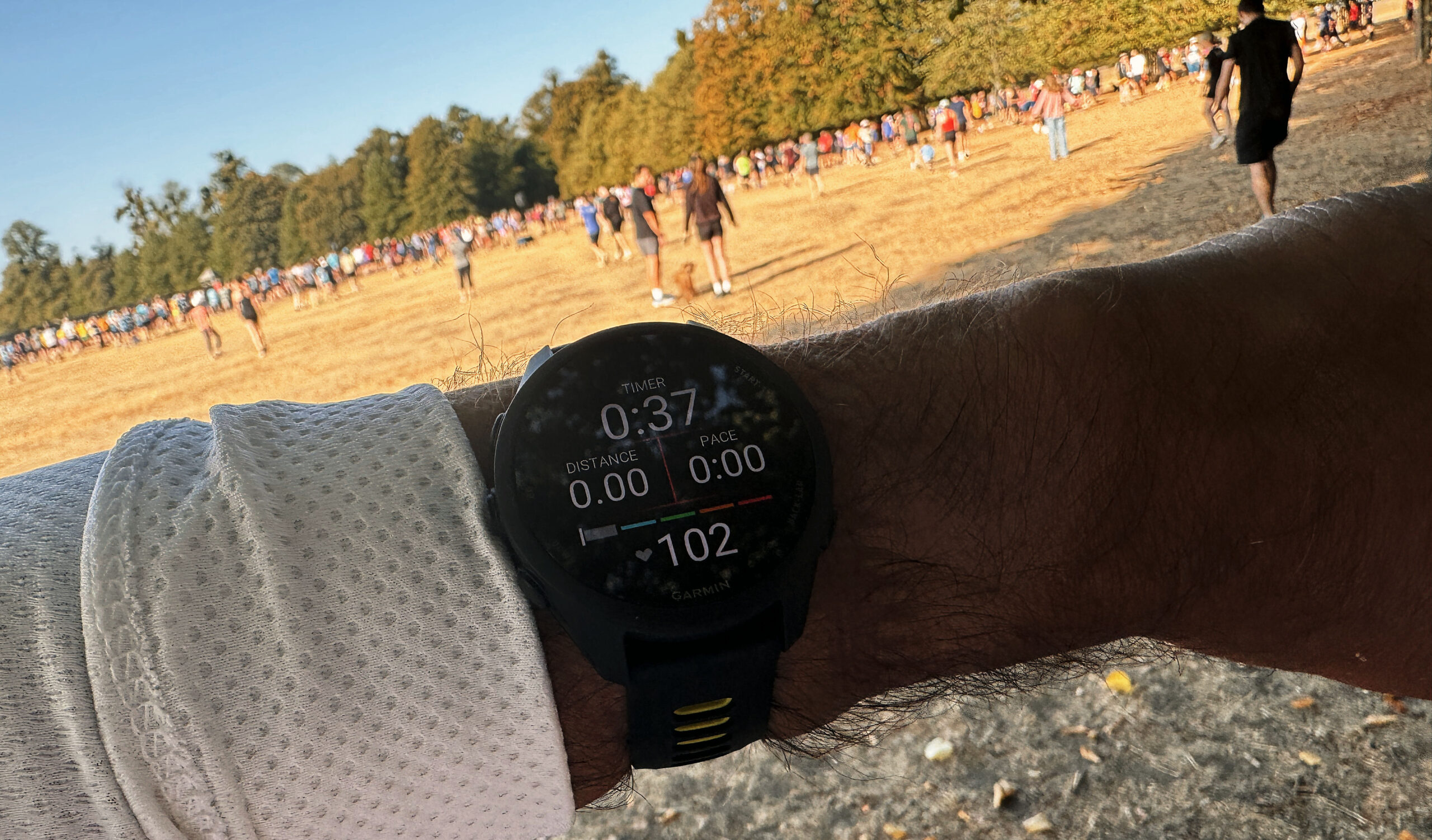 The Forerunner 170 is more watch than most beginners need, but nothing in it gets in the way if you want to grow into it. GPS and heart rate accuracy were excellent across parkrun, a 10-mile run, gym and cycling testing, and it beat its own GPS battery claim in normal use. Training Readiness and Training Status add real day-to-day guidance beyond core running metrics, at the cost of an app that’s still more involved than it needs to be for a first-time buyer.
Pros
- Training Readiness and Training Status, both new at this price point
- HRV and Recovery Status
- VO2max and race predictor
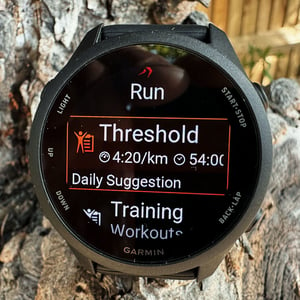
- On-device Garmin Coach adaptive plans, Daily Suggested Workouts and Quick Workout Generator
- Offline Spotify, Amazon Music and Deezer storage (Music edition)
- Garmin Pay contactless payments
- Wrist-based Running Power and Running Dynamics
- Open Water Swim and Floor Climb activity profiles
- Cycling power-meter and smart-trainer support, plus Garmin Cycling Coach
- Elevate Gen 4 heart rate sensor, tested accurate across running, gym, yoga and cycling
- Barometric altimeter, compass and gyroscope, absent on the FR70
Cons
- No premium case materials; glass lens scratches more easily than Gorilla Glass or Sapphire
- Poor default watch faces
- Garmin Connect’s interface remains more involved than it needs to be for a first-time user
- Only a modest hardware step up from the cheaper FR70 for casual use
- No dedicated triathlon mode, though each leg can still be recorded separately
- Body Battery’s underlying methodology isn’t well substantiated
- Previous-gen optical HR and GPS
Who should buy the Forerunner 170, and who shouldn’t
The Forerunner 170 isn’t a beginner’s watch, but a beginner can use it perfectly well.
Who should buy this
- A runner who wants something more than core running features – like recovery and smart payment features
- Someone upgrading from an older generation Garmin with their history already in Garmin Connect
Who should avoid this
- Someone who wants to wear a sports watch only for sports 2-5 hours a week
- Someone who prefers simplicity and ease of use
The Forerunner 170 is capable enough for a beginner to grow into, though the FR70 covers the basics for less if you’d rather start cheaper.
What’s new versus the older Forerunner 165
There’s a $50 price bump in the US compared to the launch price of the Forerunner 165 predecessor (Feb 2024). In the UK, the rise is far smaller: £259.99 against the 165’s £249.99 launch price, a £10 increase. The new features, new interface and inflation make the price rise reasonable in my opinion, and UK buyers get an easier case for that than US buyers do.
Hardware carried over from the 165:
- The 43mm case, sitting somewhere between small and medium.
- The 1.2-inch AMOLED display (390 x 390), a decent size with excellent brightness and colour.
- The Elevate Gen 4 heart rate sensor.
New on the 170: a gyroscope, adding about 2g over the 165’s weight (41g vs 39g). It’s a light watch overall despite the extra sensor.
Software new to this price point:
- Training Readiness
- Training Status with Acute Load
- wrist-based Running Power
- wrist-based Running Dynamics
- Garmin Cycling Coach
- cycling power-meter and smart-trainer support
- the on-device Quick Workout generator
- Garmin Coach adaptive run/walk plans
- Open Water Swim and Floor Climb profiles
- Guided Meditation
- an expanded 80+ sport-profile library
- the modern Garmin UI shared with the Forerunner 570, 970 and Fenix 8
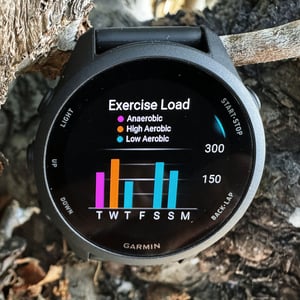
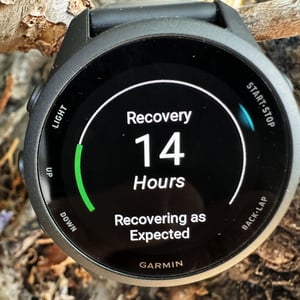
Forerunner 170 logs and labels the activities most people do in a gym (Yoga, HIIT, etc) or even Padel and Pickleball. Pretty much all it won’t do is a dedicated triathlon mode or triathlon-specific plans, but you can still record each leg of a triathlon separately, including open water swimming. The addition of running power is an advanced run training metric, and the cycling power meter support and cycling coach are great additions for those using two wheels from time to time. Training Status shows your progress over recent days and weeks. Training Readiness shows whether you’re fit to train today.
The Goldilocks zone: Forerunner ranges past and present
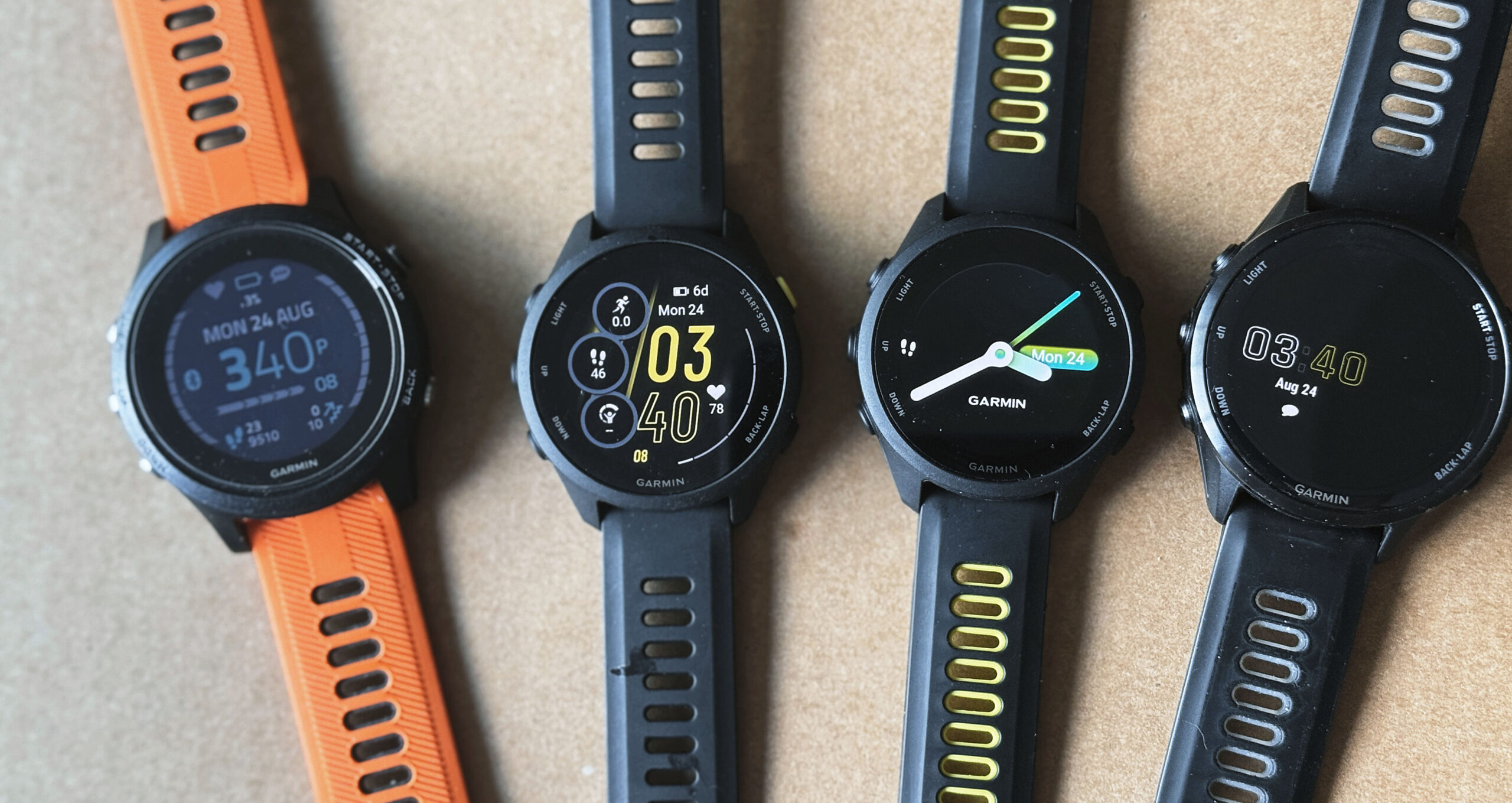
The Forerunner 935 launched almost 10 years ago and looks superficially similar to today’s models. In reality, everything has changed. Displays are now excellent, bright colour AMOLED touchscreens. GPS has significantly improved, although FR170/70 remain on prior-generation tech – still good though. Battery life has improved significantly across the entire current range. Interfaces are improved, training plans are included, physiology metrics are added to assess many aspects of recovery and performance, and there is Spotify support and support for contactless payments among many other features.
Forerunner 170 and 70 are better than the Forerunner 935 and cheaper than the top-of-the-range Forerunner 970. They both sit in the ‘just right’ Goldilocks range with a great combination of features and price. Of course, Garmin’s prices are a bit higher than competing brands as you’re paying for the name and the superior ecosystem, so maybe they should be compared to Goldilocks wearing her evening gown?
Setup and the first week
I’ve set up lots of watches, and Garmin is not the easiest. The Forerunner 170 is no exception. There seem to be too many interactions required, and if things go wrong (like it not wanting to pair to your particular phone), fixing it can be non-trivial. I never have the same kinds of issues with Apple.
Similarly, your first week with the watch and the app might be OK, depending on what you’re trying to do. I’ve used Garmin products for well over a decade and still sometimes get confused about where certain settings or options live. The current interface on the Forerunner 170 is Garmin’s latest and certainly an improvement over the predecessor. However, it is still not well designed, but fine once you eventually get used to it. The smartphone app is very powerful, as is the web interface for the same info…it’s just very involved to use.
Heads Up: If it’s your first time with a Garmin, you will almost inevitably need to search for help on how to use it.
Build, display and comfort
Spec facts: 43mm fibre-reinforced polymer case, 41g, chemically strengthened glass lens, 5 ATM (50m) water rating. Colours: Forerunner 170 in Black with a Black/Amp Yellow band, or Whitestone with a Whitestone/Cloud Blue band. Forerunner 170 Music adds Black, Whitestone, Teal Green with a Teal Green/Citron band, and Red Pink with a Red Pink/Mango band.
The design is that of a solid sport watch. You’re not going to want to wear it to the MET Gala for sure, and some of the colour options might put you off wearing it anytime other than when you are running; similarly, the pre-canned watchfaces are visually poor.
I’ve got a smallish wrist, and this looks and feels fine for me but smaller than I prefer. And it’s very light, so no complaints there. Screen visibility is great even in direct sunlight.
Heads Up: there are no premium materials on offer here, just glorified plastic. That’s fine, but the glass lens is prone to scratching, unlike the Gorilla Glass or Sapphire glass on premium models.
How I tested this
I kept my testing focused on running covering intervals, a 5K UK parkrun, and my 10-mile standard GPS test, plus other tests in built-up areas and at varying intensities. Here is my testing methodology.
GPS and distance accuracy, tested
Test 1 – Bushy Park parkrun
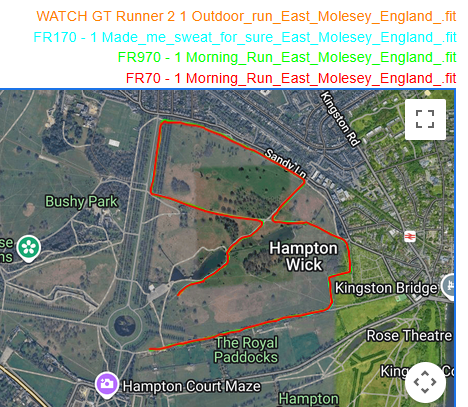
I ran with my dog on a lead from the back of the Bushy Park parkrun course, a measured 5000m course with generally excellent GPS reception. However, I deviated from the shortest route on many occasions to get around people, and I would have expected my actual distance to be recorded as 5020-5030m.
Forerunner 70 and 970 both recorded 5010 m, whereas the Forerunner 170 and Huawei Watch GT Runner 2 both recorded 5.00km.
Each device recorded a visually excellent track as shown below.
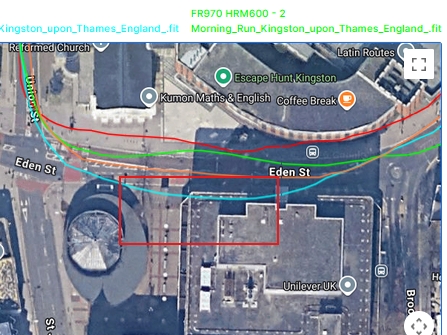
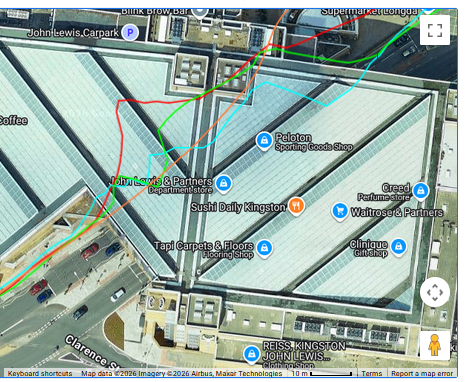
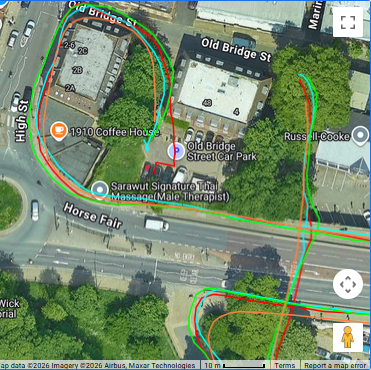
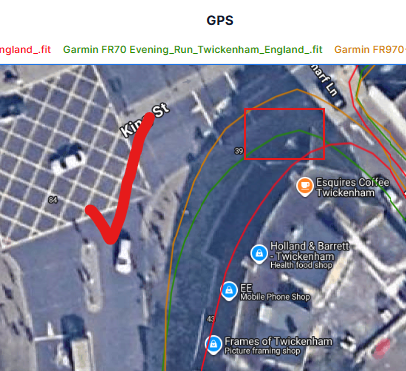
Test 2 – Kingston urban canyon, 50m underpass, close to tall buildings
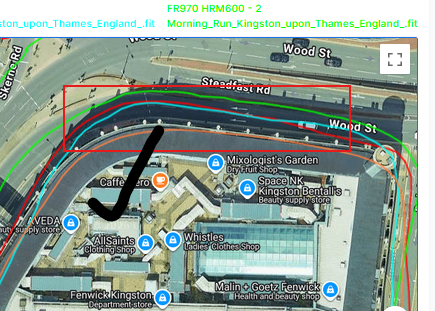
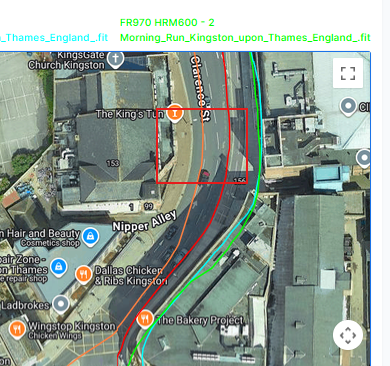
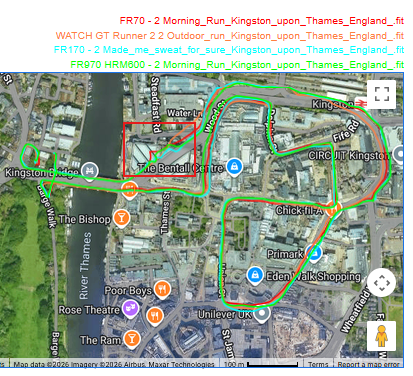
FR170 performed variably against the supposed reference devices, the FR970 and Huawei Watch GT Runner 2 (on the latest v6 firmware). I say ‘supposed’ reference devices as the Huawei is significantly worse here than at launch. All devices struggle in these difficult reception conditions, where the signal is lost for 50 metres, and there are numerous times when they have to deal with reflected (multipath) signals when running very close to buildings. Results are somewhat of a lottery and are generally unreliable in these conditions, with many times when the recorded track is over 5m from the actual route. That said, FR170 did perform well next to some of the buildings, but probably more by luck than anything else. The bottom line is that if you plan to run or race by pace in built-up areas, you must use a footpod like Stryd.
This particular segment of the run recorded distances of Huawei Watch GT Runner 2 (2.97km), FR70 2.94km, FR170 2.98km, and FR970 2.94km (actual Stryd footpod distance). You can’t read anything into the closeness of the other devices to Stryd, as there were periods of over- and under-recording that just so happened to approximate the correct distance in this instance.
From a zoomed-out level, you might be happy with the tracks you recorded for your logs; however, zooming in on any section shows numerous clear deviations between the devices, with the FR970’s GPS track being the most accurate on the day.
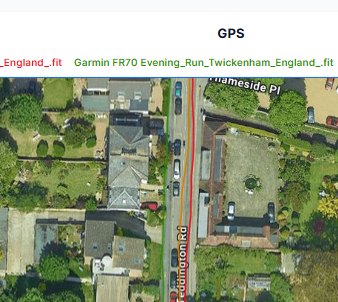
Test 3 – a suburban grid
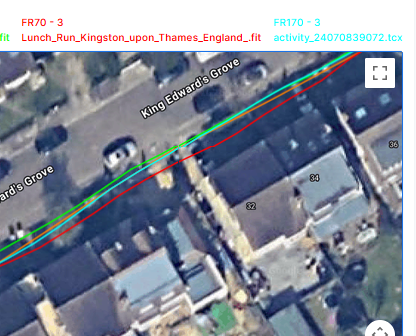
On this particular segment, the three watches recorded almost identical distances. The FR170 and FR70 both showed 3.73km, matching the Stryd footpod exactly, and the FR970 showed 3.75km.
The tracks were mostly excellent, with FR170 deviating slightly from the path but always staying parallel, suggesting a possible timing error in one or more satellites.
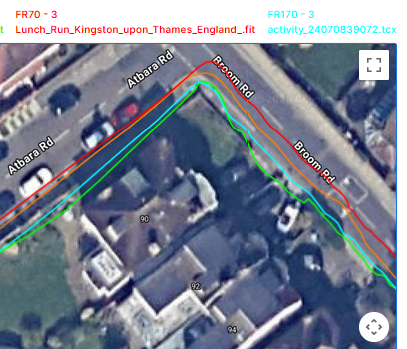
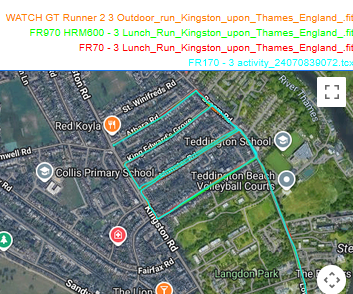
Test 4 – 10-mile test run
FR170 did not record or did not sync, so I lost the recording. Here I use the FR70 as a proxy, as it shares the same GPS chipset and Elevate Gen 4 sensor as the FR170.
The Forerunner 70 had the best performance on my 10-mile test that day compared to any other single-frequency watch before. Performance certainly isn’t perfect, but it is one of the very few single-frequency watches where I would say it’s good enough for my own use. Well done, Garmin. This is a hard test.
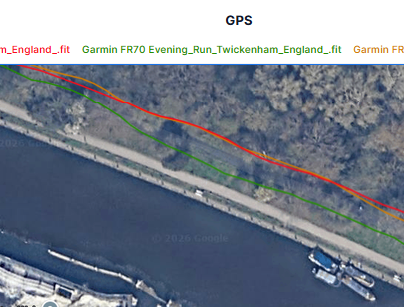
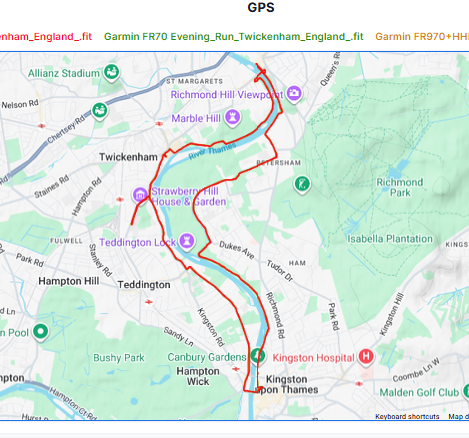
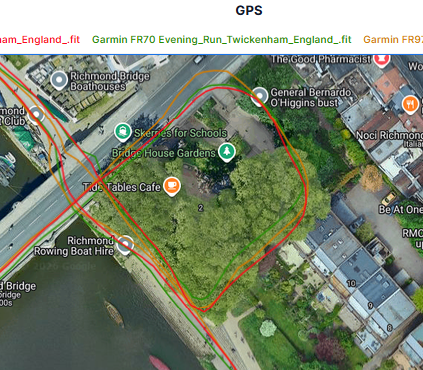
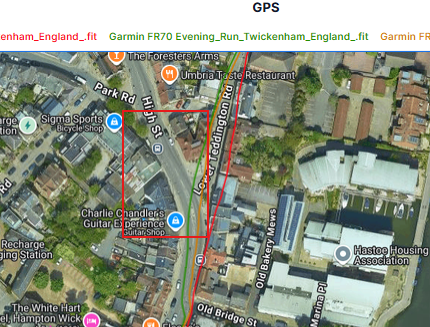
Aggregate scores over easy, medium, and hard sections were 85%, 88%, and 94%, respectively, so it scored better on the harder sections! This implies an element of luck on the day for whatever reason. Perhaps the only cause for concern was on a multi-kilometre stretch in very open conditions towards the end of the run where the FR70, at times, was on the pavement on the wrong side of the road, which is an error of over 5m on an easy section.
Test 5 – a ride to Windsor
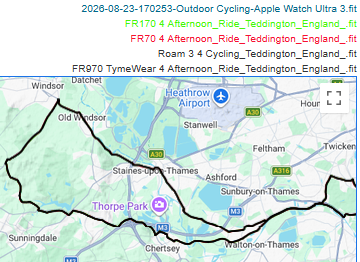
FR70 and FR170 sat nicely in the middle of the distance ranges for this ride, coming in at 62.99 and 62.97km, respectively. Roam 3 was 62.83km, and Apple Watch Ultra 3 was 62.92km. That’s just over 150m spread across all four devices, so they all appear to perform well even without knowing the true distance.
A visual inspection of each GPS trace shows no cause for concern for any device, as expected in most open-road cycling scenarios.
Distance accuracy, summarised
| Test | Recorded | Reference | Deviation |
|---|---|---|---|
| 1: Bushy Park parkrun | 5.00km | Avg. of other 3 devices: 5006.7m | −7m |
| 2: Kingston Urban Canyon | 2.98km | Stryd (actual): 2.94km | +40m |
| 3: Suburban Grid | 3.73km | Stryd: 3.73km | 0m |
| 5: Ride to Windsor | 62.97km | Avg. of other 3 devices: 62.91km | +57m |
Across four completed tests spanning a parkrun, an urban canyon, a suburban grid and a 63km bike ride, the Forerunner 170 matched Stryd’s reference exactly on the suburban grid, came within 7m of the average of the other three devices at parkrun, and deviated by 57m on the Windsor ride. No consistent bias emerged in either direction across the conditions tested.
Heart rate accuracy, tested
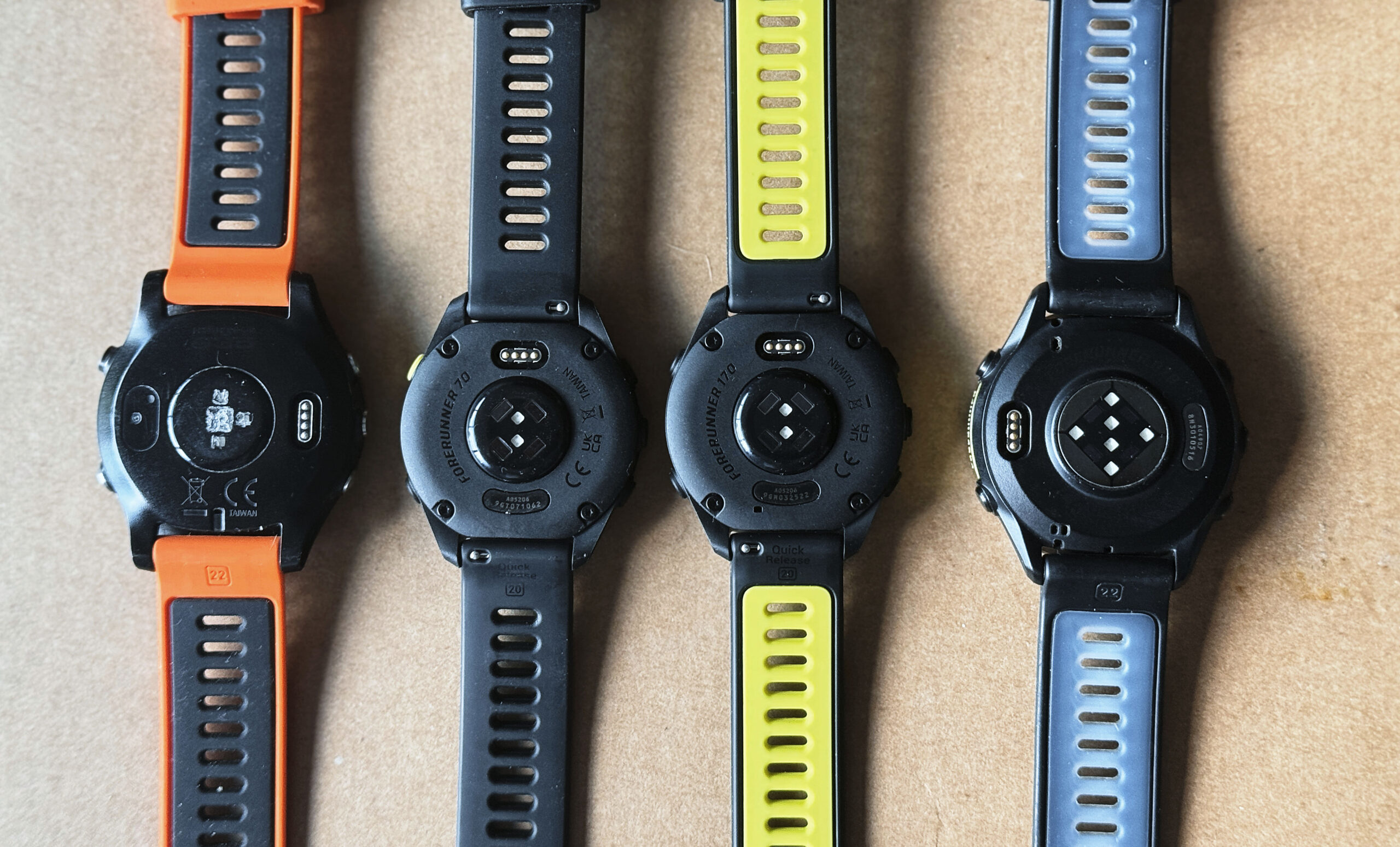
The Forerunner 170 uses the Elevate Gen 4.0 optical HR sensor. Top-end Garmin watches, such as the FR970 below, use the 5.0 version, and there is also an improved 4.1 version used on Garmin CIRQA. The Gen 4 sensor has some known quirks that sometimes show up when performing intervals or riding. Here are my test results to show you if I experienced them again this time around. The test results cover a range of HR intensities while running, plus tests in the gym doing weights and yoga, and finally a long, bumpy bike ride.
Problem: FR170 synced to the same Garmin Connect account as the FR70, and some FR170 results were lost. The FR70 results are included here in places as the watch is essentially identical to the FR170 for accuracy purposes.
Test 1 – parkrun steady, easy zone 1-2
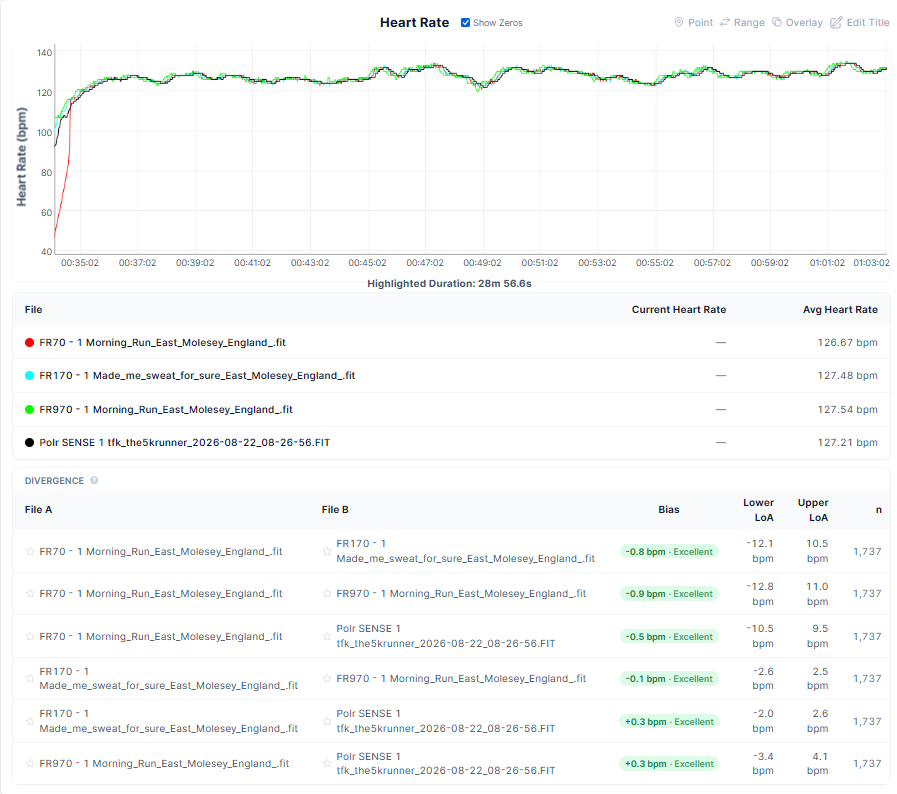
Garmin Forerunner 170 optical HR accuracy is excellent. Against the Forerunner 970 (paired with HRM 600 chest-strap reference), it showed a bias of only −0.1 bpm and 95% limits of agreement of −2.6 to +2.5 bpm (n = 1,737); against the Polar Sense reference, the bias was +0.3 bpm with limits of agreement −2.0 to +2.6 bpm (n = 1,737).
Test 2 – easy rising effort from zone 1 to zone 2
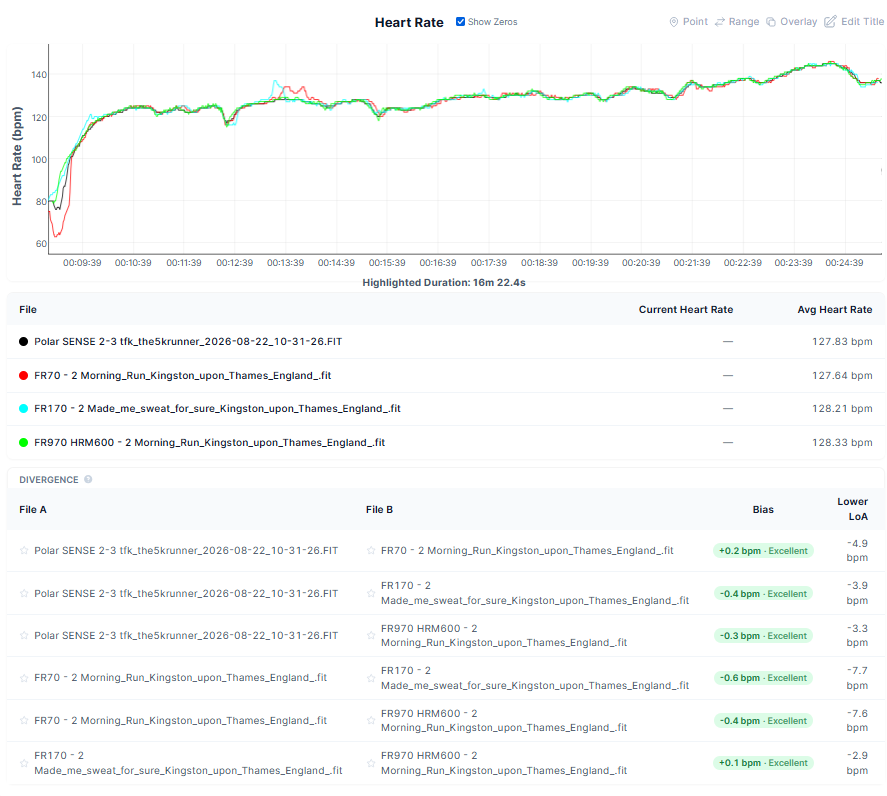
Garmin Forerunner 170 optical HR accuracy remains excellent on this second run. Against the Forerunner 970 (paired with HRM 600 chest-strap reference), it showed a bias of only +0.1 bpm and tight limits of agreement starting at −2.9 bpm (n ≈ 979); against the Polar Sense reference, the bias was −0.4 bpm with 95% limits of agreement of −3.9 to +3.0 bpm (n = 979). Visually, the FR170 matched well except for one unexplainable blip around 13:00.
Test 3 – Short intervals
This time, I ran three short 1 to 2 minute intervals: the first followed by a walk, the second from a standing start, and the third with an immediate stop, to test how the devices respond to rapidly changing effort.
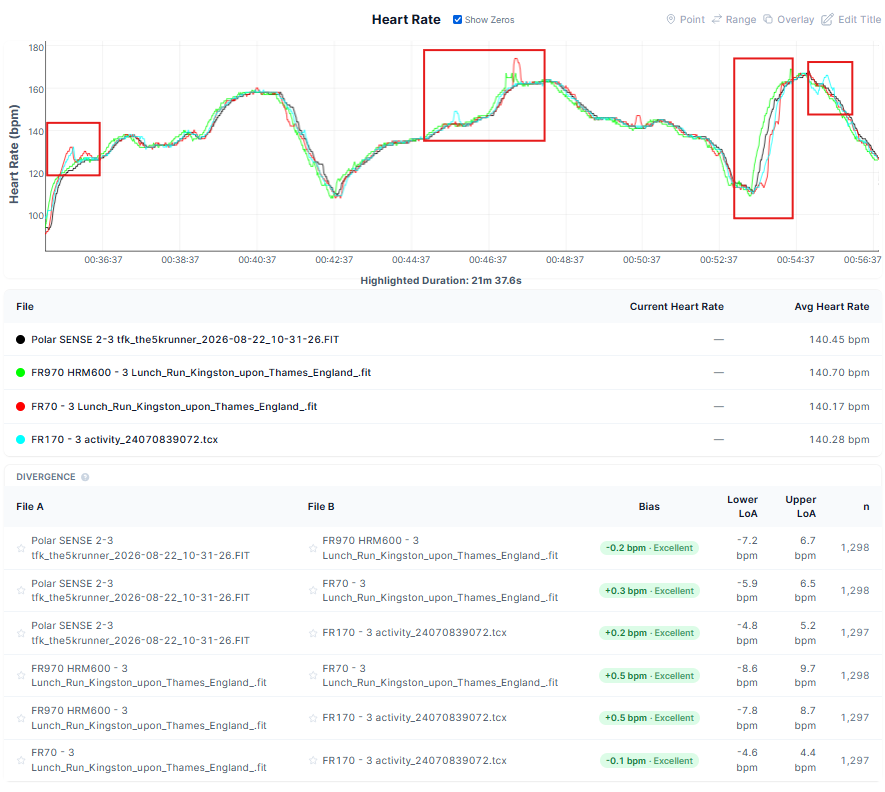
Garmin Forerunner 170 optical HR accuracy was excellent during the short-interval test with rapid intensity changes. Against the Forerunner 970 (paired with HRM 600 chest-strap reference), it showed a bias of +0.5 bpm and 95% limits of agreement of −7.8 to +8.7 bpm (n = 1,297); against the Polar Sense reference, the bias was +0.2 bpm with limits of agreement −4.8 to +5.2 bpm (n = 1,297). Visually, it displayed only a minor false-peak blip and was slightly slow to catch up on the final interval, but overall tracking remained good.
Test 4 – long steady tempo run
This test was a relatively constant-tempo effort for well over an hour. This test is hard to repeat, and I think I forgot to start the FR170 but did start the FR70, which shares the same sensor, so that I will include it here as a proxy; the latter was surprisingly near-perfect.
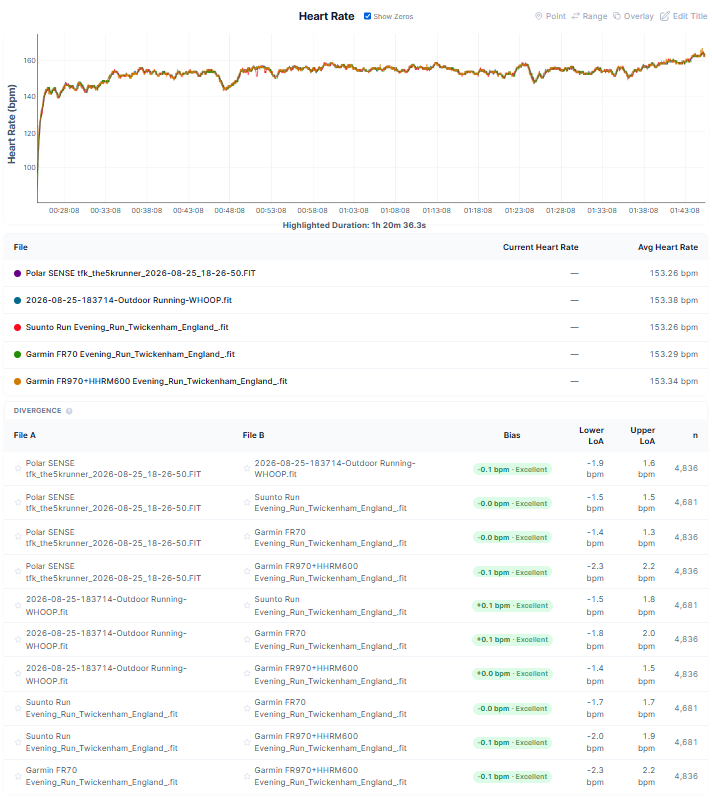
Garmin Forerunner 70 (proxy) optical HR accuracy was excellent on this evening run. Against the Polar Sense reference, it showed essentially zero bias (−0.0 bpm) and extremely tight 95% limits of agreement of −1.4 to +1.3 bpm (n = 4,836); against the Forerunner 970 paired with HRM 600 chest-strap reference, the bias was −0.1 bpm with limits of agreement −2.3 to +2.2 bpm (n = 4,836).
Test 5 – upper body strength workout
Working mostly on gym stations for upper-body, the results were good against a reference chest strap, reference biceps band and against Whoop MG. The Forerunner was the worst on this test.
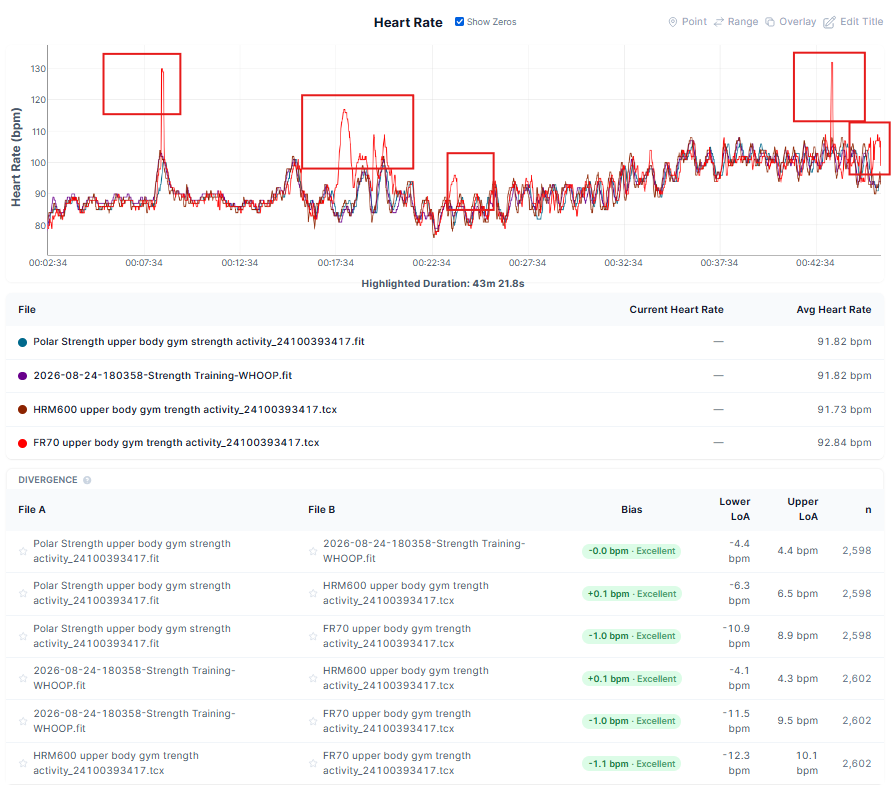
Garmin Forerunner 70 (proxy) optical HR accuracy was good but more variable during this upper-body gym strength session. Against the Polar Strength reference, it showed a bias of −1.0 bpm and 95% limits of agreement of −10.8 to +8.9 bpm (n = 2,660); against the HRM 600 chest-strap reference, the bias was −1.1 bpm with limits of agreement −12.3 to +10.1 bpm (n = 2,652). Visual inspection revealed several short but notable incorrect spikes, likely caused by significant arm and wrist movement affecting the wrist-based optical sensor.
Test 6 – Yoga
In a strength-focused yoga session holding extreme positions for some time, the results were good against a reference chest strap, reference biceps band and against Whoop MG. The Forerunner was the worst on this test.
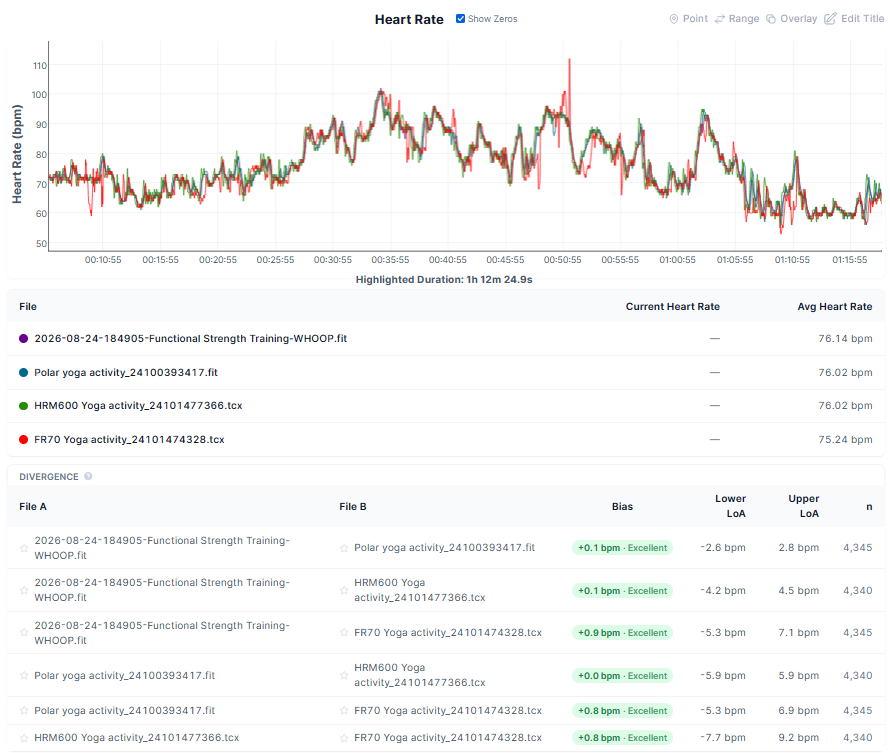
Garmin Forerunner 70 (proxy) optical HR accuracy was good during this ~70-minute yoga session. Against the Polar reference, it showed a bias of +0.8 bpm and 95% limits of agreement of −5.3 to +6.9 bpm (n = 4,345); against the HRM 600 chest-strap reference, the bias was +0.8 bpm with limits of agreement −7.7 to +9.2 bpm (n = 4,340). Visual inspection revealed four notable troughs and one spike over the course of the session.
Test 7 – road cycling, zone 2 to 3, sometimes bumpy surfaces
These were surprisingly good results from the FR170 when road cycling to Windsor. Roads were bumpy in many places, and at times I was riding in a fairly aggressive position with wrist flexion, even with the devices touching the bars.
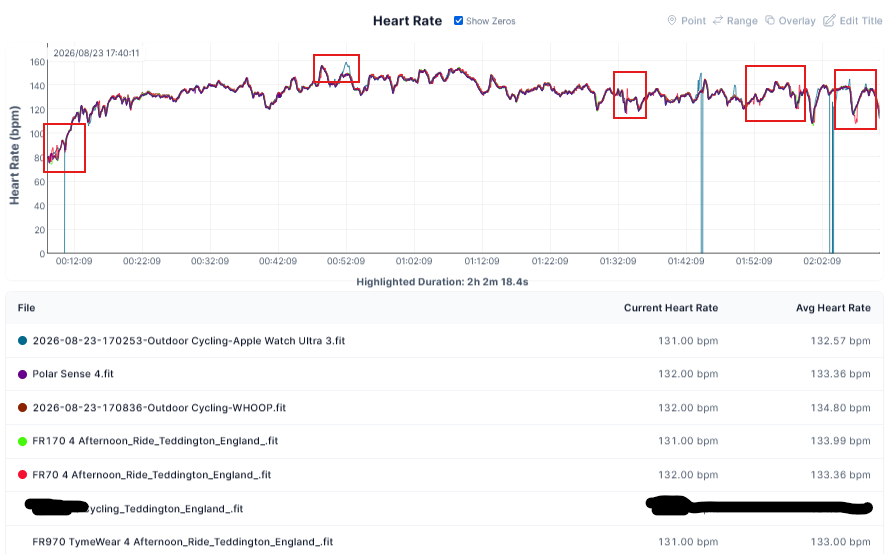
Garmin Forerunner 170 optical HR accuracy was excellent during the outdoor cycling session. Against the Polar Sense reference, it showed essentially zero bias (−0.0 bpm) and very tight 95% limits of agreement of −2.2 to +2.1 bpm (n = 2,025); against the FR970 with TymeWear Vital Pro chest-strap reference, the bias was +0.5 bpm with limits of agreement −2.7 to +3.7 bpm (n = 2,025). Visually, the tracking was excellent.
The FR170’s lower sample count in this test (n = 2,025) isn’t a data error; it’s Test 4’s Smart Recording mode, covered in the battery section below, which logs sensor data less frequently to save power.
Elevation accuracy, tested
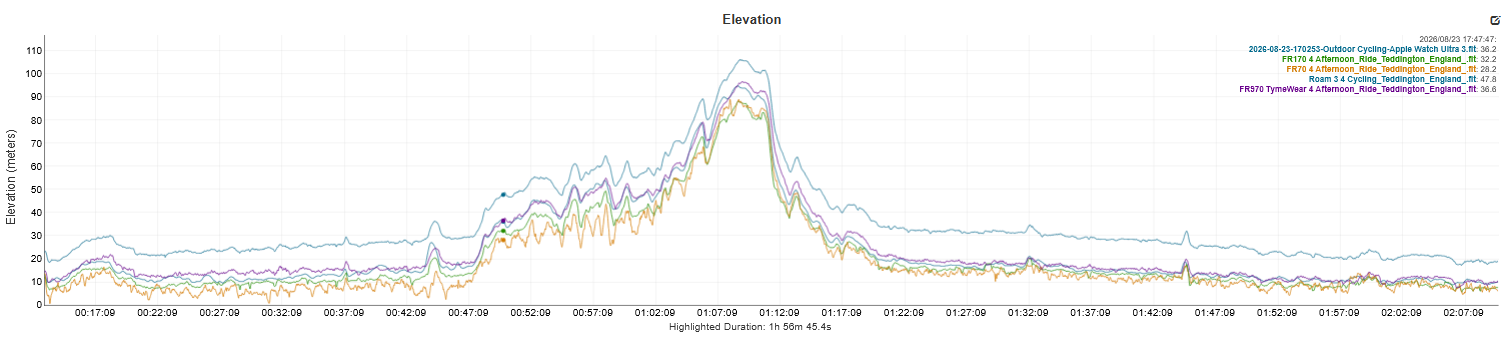
FR170 has a barometric altimeter, whereas the sibling FR70 does not. Both derive elevation from GPS, but the barometric altimeter, which only the FR170 has, allows for more granular, accurate readings. You can see that clearly on this trace from a ride to Windsor, where the only device lacking the barometer is the FR70, which gives a more jagged elevation profile. Either way, it still needs a calibrated or manual fix to start correctly, and both watches get that right here, unlike the Apple Watch, which starts around 10m too high and never corrects.
The FR170 looks good based on this one test. If you’re doing long hikes or ultra runs, that’s where the FR170’s barometric altimeter earns its keep.
Battery life in real use
I used the DCRainmaker Analyzer to track battery charge states through each recorded workout. Results for GPS recording mode varied widely, from around 12 hours to 25 hours, likely skewed by some unusually short test workouts.
Test 4, the ride to Windsor, was recorded on the FR170 using Smart Recording rather than the continuous recording used in every other test; this only became apparent afterwards, from the unusually low point density in that session’s FR170 data. Smart Recording, which was enabled on the FR170 and disabled on the FR70, saves battery by logging position and sensor data less often. That setting difference is why the two watches cannot be compared on this test. The FR70 recorded continuously throughout, including in Test 4, where it landed close to its own 23-hour GPS-only claim.
Excluding the FR170’s Smart Recording result and looking only at genuinely comparable continuous-recording data: the FR170 averages 18.75 hours across Tests 1 and 2. Garmin’s corrected claims for the FR170 are up to 20 hours in GPS-only mode and up to 14 hours in All-Systems GNSS mode; 18.75 hours falls short of the higher figure but comfortably beats the lower one, and it isn’t clear from testing which satellite mode was active, so this comparison should be read with that caveat. The FR70 averages 18.6 hours across all four tests (all continuously recorded) against its 23-hour GPS-only claim, more than 4 hours short, and its worst result (12.5 hours) is barely half the claimed figure.
The pattern this suggests: the FR70’s battery claim looks optimistic under normal continuous use regardless of satellite mode. The FR170’s result is less clear-cut without knowing which satellite setting was active during testing, though Smart Recording clearly extends runtime beyond whatever the underlying continuous figure would be.
- Test 1: FR70 13.89 hours, FR170 20.83 hours
- Test 2: FR70 12.5 hours, FR170 16.67 hours
- Test 3: FR70 25 hours, FR170 not recorded
- Test 4 (FR170 recorded via Smart Recording): FR70 23 hours, FR170 17 hours
Garmin’s claims for the FR170: up to 10 days smartwatch mode (4 days with always-on display), up to 20 hours in GPS-only mode, up to 14 hours in All-Systems GNSS mode, up to 7 hours GPS with music playing (170 Music only).
Training Readiness, Training Status, and Body Battery explained
- Training Readiness. A useful score to indicate when you can next train hard, combining sleep score, HRV status, remaining recovery time, acute training load, sleep history, and stress history into a single morning figure. You’ll need to wear the watch as you sleep for a couple of weeks to establish a baseline, and when you do, you will start to get easy-to-interpret feedback: 95–100 Prime, 75–94 High, 50–74 Moderate, 25–49 Low, 1–24 Poor.
- Training Status. Another useful one-word verdict summarising the impact of your recent training over the last seven days against the three-to-four-week VO2 max trend (Productive, Maintaining, Peaking, Recovery, Unproductive, Overreaching, or Detraining). Needs at least seven days of recorded activity to produce a stable reading. This is not intended for the occasional or beginner runner, but if you are keen and start to run too much, this metric will warn you.
- Body Battery. A 5–100 energy-reserve score; it recovers mainly through sleep and drains through exercise, stress, and illness. Current zones: 76–100 high reserve/ready for intense training, 51–75 medium/moderate activity, 26–50 low/consider lighter activity, 5–25 very low/prioritise rest. Takes one to two weeks to calibrate; scores of 50–70 are normal and not a fault during that window. This metric shows how your body’s energy supposedly recovers during the day, and it’s a metric that looks great and is loved by many; unfortunately, its scientific basis is a little shaky. A good bit of fun, though.
Smart features in brief
The FR170’s smart features are fantastic by the standards of 5 or so years ago. Tech has moved on, but these features remain genuinely useful: Garmin Pay, Smart Notifications, on-wrist texting (Android or Garmin Messenger), LiveTrack, the Connect IQ store, and Google Maps turn-by-turn on Android. Music storage and offline Spotify/Amazon Music/Deezer are 170 Music only. Many of the smart features are wholly new compared to earlier generations like the FR70. I personally find Garmin PAY highly useful, and Garmin’s music streaming capabilities are the best and most flexible out there.
Forerunner 170 versus the Forerunner 70, the Forerunner 165, and the Coros Pace 4
Confirmed differentiators from the specs hub: over the Forerunner 70, the 170 adds a barometric altimeter, compass, gyroscope, thermometer, Garmin Pay, open water swimming, and cycling power-meter support. Its predecessor is the Forerunner 165.
| Model | Price at launch | Decisive differentiator vs the FR170 |
|---|---|---|
| Garmin Forerunner 70 | £219.99 / $249.99 | No need for beginners or casual runners to spend more than this unless they want Garmin Pay or music options. |
| Garmin Forerunner 165 | £249.99 / $249.99 at launch (Feb 2024), often discounted since | Not especially outdated; won’t be updated. Better value (often cheaper than current list price) |
| Coros Pace 4 | £229/$249 | Coros wins on GPS accuracy; Garmin wins on ecosystem depth. |
I always recommend the latest, most-featured model you can afford. It’s hard for me to know exactly what you need, so my recommendation will suit most people. The Forerunner 165 (or 265) would be the standout value-for-money choice. In contrast, the Forerunner 170 offers extra features with broader appeal: Garmin PAY (use CURVE to support your bank) and a streaming music option (Spotify, etc.).
Detailed technical specifications and product features
For detailed questions, see the full Garmin Forerunner 170 specifications.
Garmin Forerunner 170 price: where to buy
Forerunner 170: £259.99 / $299.99. Forerunner 170 Music: £299.99 / $349.99. Released 15 May 2026 (announced 12 May 2026).
Out of the box, you get the watch, a charging cable and lots of paper you’ll never read.
At the launch price level, Forerunner 170 is decent value and recommended.

Verdict
The Garmin Forerunner 170 is best for a committed runner on a budget who needs core training, guidance and recovery feedback. The runner’s other sporting interests will likely be well served, as will beginner runners who want a few more advanced features to grow into as they improve.
Quick answers
Is the Garmin Forerunner 170 good for a first-time runner?
Yes. It’s more capable than a true beginner needs, but nothing is hard to ignore, and it gives you room to grow into features like Training Readiness and Training Status as you improve.
Forerunner 170 vs Forerunner 70: what's the real difference?
The 170 adds a barometric altimeter, compass, gyroscope, thermometer, Garmin Pay, open water swimming and cycling power-meter support. In testing, the 70 fell well short of its own 23-hour GPS battery claim; the 170’s result sat between its two corrected claims (20 hours GPS-only, 14 hours All-Systems).
Does the Forerunner 170 have GPS accuracy problems?
No. It tracked closely with a Stryd footpod and comparable watches across parkrun, a 10-mile run, urban, and cycling tests, with occasional drift in built-up areas and under tree cover that affects every GPS watch tested alongside it.
How long does the Forerunner 170 battery actually last?
Garmin claims up to 20 hours in GPS-only mode, or 14 hours in All-Systems GNSS mode. Testing found it averaging around 18.75 hours in continuous recording, between those two figures; it isn’t certain which satellite mode was active during testing.
Is the Forerunner 170 worth it over the discounted Forerunner 165?
The 165 is the better value pick if you don’t need Training Readiness, Training Status, or the newer interface. The 170 justifies its higher price mainly in the UK, where the price gap over the 165 is small.
Last Updated on 8 October 2026 by tfk the5krunner
Small things I always use
- Garmin 90-degree charging adapter: Charges your Garmin from any USB-C cable. Essential when travelling. I use one.
- Body Glide: The blue anti-chafe stick swimmers and runners carry. I use it.
- Speedo earplugs: Fewer ear infections and no cold-water dizziness. I use them.
- Dryrobe Advance: My winter changing robe for open-water swims. I use one. A cheaper option is the AONYIYI changing robe.
- Maurten: Race fuel that stays easy on the stomach. I use them.
- Garmin charging puck: The quickest way to top up before a session. I use one.
- Injinji: Toe socks that stop rubbing, so you run more. I use them.
- Ultimate toe protectors: Stop black toenails on long runs. They work. I use them.
- Compressport R2 v2 calf sleeves: My calf sleeves of choice. I use them.
- Cellucor C4: My pre-workout before hard sessions.
- TPU tubes: Schwalbe Aerothan, Tubolito and Pirelli SmarTube. Light, tiny spares. I use all three.
- G8 insoles: Adjustable insoles that are good. I use them.
- Cycplus Cube: A 97g electric pump that gets a road tyre rideable in two minutes. I carry one. 5% off with code THE5KRUNNER.
Watches and sensors
- Polar H10: My daily driver for waking HRV.
- Polar Verity Sense: My backup arm-worn HR sensor.
- Nomad bedside charger: Charges my iPhone and Apple Watch overnight. I use it, and many of their bands.
- Train.Red: The best muscle oxygen sensor I’ve used.
- Tymewear: Accurate heart rate and reliable ventilatory zones. I use it to pace endurance rides over an hour.
- Garmin Forerunner 970: A pro-grade triathlon watch. I use this.
- Apple Watch Ultra 4: My daily smartwatch. No phone needed on rides.
- Garmin Fenix 9 Pro: I’ve just bought one.
On the bike
- Continental GP5000 for everyday riding, and Aero 111 on the front for special occasions.
- Helmets: Specialized S-Works Evade 3 for road riding, and Rudy Project Wing for TT-style races. I use both.
- Ravemen FR300: A front light that mounts under your Garmin or Wahoo. I use one.
- Wahoo TRACKR Radar: I use it on one bike and Varia on the other. They perform the same.
- Garmin Varia RTL515: Radar that warns you of cars from behind. I use this model.
- Wahoo ELEMNT Roam 3: The bike computer that’s easy to use. I use mine on most rides.
- Favero Assioma Pro RS2: Accurate power pedals that swap easily between bikes. I use this model.
Home and indoor training
- NPE Runn: Makes my basic treadmill smart, sending more accurate speed and distance to my watch and Zwift. I use it.
- Google Wifi: Keeps Zwift connected in my pain cave. I use it.
- Apple TV 4K: Zwift on the big screen. I use two.
- Google Nest Doorbell (wired, 2nd gen): My video doorbell, running in both Google Home and Apple Home. I use it.
Health, recovery and sleep
- FreeStyle Libre 3 Plus: Shows how my blood sugar responds to diet.
- hDrop: Measures my sweat loss in summer and indoors.
- Fourth Frontier Zone: Checks my heart under load in hard sessions.
- Oura Ring 5: My partner’s recovery tracker of choice.
- Kineon MOVE+: Red light therapy for niggles. It works.
- Eight Sleep: A cooling mattress cover my partner and I use nightly.
Reader-Powered Content

This content is not sponsored. It’s mostly me behind the labour of love, which is this site, and I appreciate everyone who supports it.
Support the site: Follow (free, fewer ads) · Subscribe (paid, ad-free) · Buy Me A Coffee ❤️
Written by real people, with AI assistance. Fact-checked and verified for originality. See the Editorial Policy. FTC: Affiliate Disclosure — some links pay commission. As an Amazon Associate, I earn from qualifying purchases.
tfk is the founder and author of the5krunner, an independent endurance sports technology publication. With 20 years of hands-on testing of GPS watches and wearables, and competing in triathlons at an international age-group level, tfk provides in-depth expert analysis of fitness technology for serious athletes and endurance sport competitors. ID

Yep, checks almost all the boxes and power meter support is certainly a plus ! After upgrading from the 235 to the 935 in (2017 ?) I’ve stayed with the 9xx models (955 and now 965) but I very rarely use maps…
Too bad there’s no support for breadcrumb mapping/gpx loading. I suppose you can use some CIQ apps (Komoot ?) but that’s always going to be a bit of a hassle.
yes i would have thought dwmaps will work