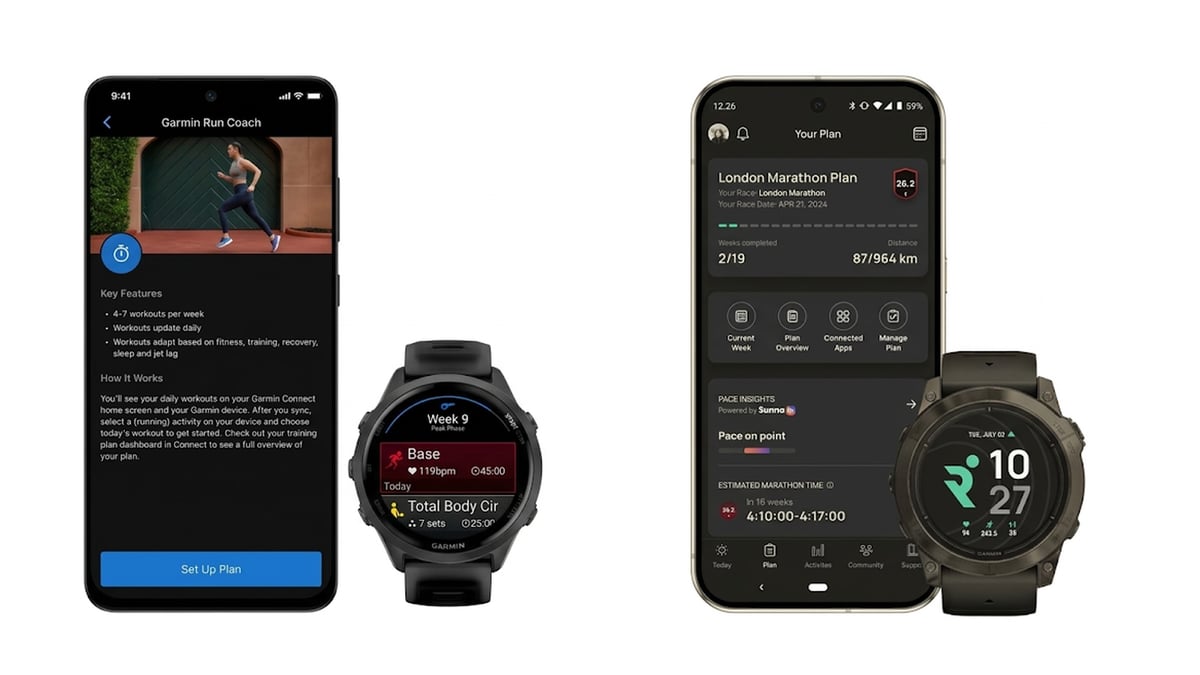
Garmin owners already have free adaptive running plans on their watch, so the question for most runners is whether Runna is worth $119.99 (£109.99) a year on top. The two coach in different ways. Garmin builds and changes the plan based on what the watch measures, including recovery, while Runna starts with a coach-written plan and suggests pace changes based on the runs you record. Runna also runs on Garmin watches, so a Garmin owner can compare the two before paying.
Garmin Coach covers four different things: Run Coach, the Expert Running Plans, Daily Suggested Workouts and self-guided plans. Which one you can use depends on your watch and how fast you run.
The short answer
- Cost: Garmin Coach is free with a compatible Garmin watch. Runna is free for Week 1 of a plan, then $19.99 a month or $119.99 a year (£17.99 or £109.99).
- How Garmin coaches: Run Coach builds the plan from your watch data and adjusts each day’s session based on your training load, recovery, sleep, and HRV.
- How Runna coaches: Coaches write the plans, and the app suggests pace and mileage changes from the runs you record, which you can accept or ignore. It does not use sleep or HRV data.
- Watches: Garmin Coach runs only on Garmin. Runna runs on Garmin, Apple Watch, COROS, Suunto, Amazfit and Fitbit.
- Flexibility: Runna lets you move a session within the same week or one week either side. Garmin’s adaptive plans don’t let you move sessions; they change the plan for you instead.
- Distances: both cover 5K to the marathon and beyond. Runna has dedicated ultra plans, and Garmin Run Coach accepts custom distances. Garmin’s Expert plans stop at the half marathon.
- Targets: Garmin Run Coach lets you train by heart rate, pace, or a mix of the two. Runna trains by pace.
- Faster runners: Garmin’s Expert plans stop at a goal pace of about a 21:45 5K, and its Run Coach, confusingly, accepts significantly faster target times.
- Which to choose: Garmin owners get most of what Runna offers for free. Runna is worth paying for on another brand of watch, or if you want to see the whole plan and move sessions yourself.
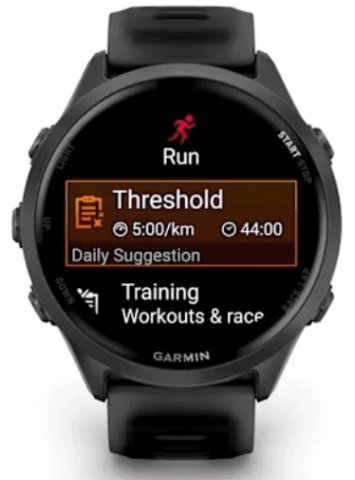
Garmin Forerunner 570
Well-featured GPS triathlon smartwatch.
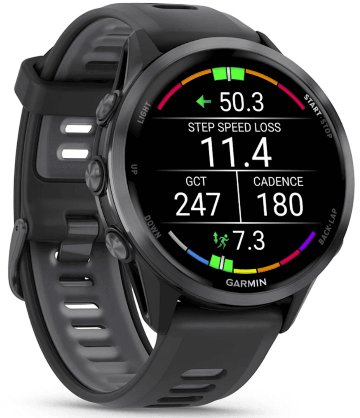
Garmin Forerunner 970
Premium GPS triathlon smartwatch. Features a bright AMOLED touch screen and a built-in LED flashlight.
The fundamental difference
Runna makes following a training programme simple and enjoyable. Garmin bases its training on what the watch knows about your fitness and recovery.
| Why runners like Runna | Why runners like Garmin Coach |
|---|---|
| It tells you exactly what to do in each session. | It uses the physiological data your watch already records. |
| It makes training feel organised, with the whole plan in view. | It responds to how you train and recover. |
| It explains why each workout has the pace it does. | It works with the watch’s other metrics, such as Training Readiness and Race Predictor. |
| It makes your progress easy to see. | Its training plans are free. |
| It gives every plan a race to aim for. | It keeps your plan, runs and recovery data in one app. |
How each coach works
How Runna builds and changes a plan
Runna says its plans are not created by AI. Coaches write them, and an algorithm then adjusts them to each runner’s progress, feedback and performance. Is Runna AI? covers what Runna has and has not published about that algorithm.
A plan starts from what you tell Runna: your current ability, your experience, the days you can run, and your race distance and date. Your running ability, from Beginner to Elite Plus, sets your starting weekly mileage and the length of each run, including the long run. Elite Plus is for runners already doing 80 to 100 km a week. You can change ability, volume, and difficulty later, and Runna will rebuild the plan. Plans run for up to 26 weeks. The key input is your estimated current race time, which is what you can run today and is separate from the time Runna predicts for race day. It sets the pace target for every workout, and one time covers every distance, so a faster 5K time also speeds up your 10K and half marathon paces. If you have not raced recently, Runna suggests a timed effort or a recent 10K time. The paces then get faster as the plan progresses. Runna does not let you enter a goal time. To aim higher, you enter a faster current time, which makes every pace target harder, and Runna recommends changes of only 15 to 30 seconds at a time.
The plan then changes in three ways. The first is Pace Insights, which checks every speed session against its pace targets. When it sees a consistent pattern of beating or missing them, it suggests a faster or slower pace, and nothing changes until you accept it. One fast session is not enough to trigger a suggestion. Pace Insights is not available on the New to Running, Return to Running or Path to parkrun plans.
The second is Mileage Insights, which compares the distance you actually run with the plan. A skipped long run can bring a suggestion to rebuild gradually, and regularly running more than planned can bring a suggestion to raise your weekly volume. You accept or dismiss each one, and it works only on race plans.
The third is the set of changes you ask for. Not Feeling 100% eases the plan when you are unwell, sore, or short on time; Holiday Mode pauses it, and Adapt for Heat slows pace targets based on the weather forecast. You can also add a B-race and choose how hard to run it, and Runna adjusts the taper and recovery around it. Runna reads heart rate from your watch for completed runs, but it doesn’t use sleep, HRV, or recovery data to change a session.
Runna’s predicted race time comes from the ability and schedule you enter, plus data from runners like you. Runna says it aims to be conservative and assumes good weather on a fairly flat road course.
How Garmin builds and changes a plan
Garmin offers four kinds of guidance.
| Option | What it is | Distances and length | Pace limit | Move sessions | Watches |
|---|---|---|---|---|---|
| Run Coach | A plan to a race or goal date that changes day to day with your watch data | 5K, 10K, half, marathon and custom distances up to 1,000 miles 6 to 52 weeks |
Accepts targets significantly faster than the Expert plans | No, the plan adapts instead | Recent models, such as Forerunner 165, 265, 570 and 970, Fenix 7 or later, Venu 4 and Vivoactive 6 |
| Expert Running Plans | Plans from three named coaches, adjusted after benchmark runs | 5K, 10K and half marathon 6 to 26 weeks |
7:00 a mile or slower, about a 21:45 5K | Yes | Almost every Garmin running watch, including Instinct and older Forerunners |
| Daily Suggested Workouts | One session each morning, with no plan or race date | No set distance | None | Not needed | Most current Garmin watches |
| Self-guided plans | Fixed plans on the Garmin Connect website | 5K to marathon 12 to 16 weeks |
Not stated | Yes | Any Garmin, or none |
For most Garmin owners, the choice is between the first two. If your watch supports Run Coach, it is the one to use. If your watch only supports the Expert plans, you are limited to the half marathon and to goals of about a 21:45 5K or slower.
How Run Coach works
You build a Run Coach plan in Garmin Connect by entering your current weekly distance and average pace, the distance you are training for, a goal, the days you can train, your long-run day and whether you want strength sessions, and then a race or an end date. A time goal is only offered if you already run close to the plan’s weekly distance; otherwise, the plan aims to get you to the finish. Garmin says the plan then adjusts to your current fitness, schedule, and race date, and each day’s session changes based on your performance and health metrics.
How the Expert plans work
The Expert plans come from Jeff Galloway, Greg McMillan and Amy Parkerson-Mitchell, and the word Expert refers to these coaches, not to the runner. Galloway uses his run-walk method, McMillan blends performance science with practical coaching, and Parkerson-Mitchell, a physical therapist, focuses on avoiding injury. The plan sets your level based on benchmark runs and makes later workouts harder or easier depending on how you perform. A half marathon plan lasts at least 14 weeks. The plans have always been aimed at slower runners. When Garmin Coach launched in 2018, it offered only a 5K plan for runners slower than 25 minutes.
How Daily Suggested Workouts work
Daily Suggested Workouts give one session each morning without a plan or a race date. Run Coach and Daily Suggested Workouts draw on the same watch data, but Run Coach builds towards a race or goal date, with your chosen training days, a long-run day and optional strength sessions. Garmin says Run Coach factors in VO2 max, lactate threshold and training history. For Daily Suggested Workouts, Garmin states three inputs: training habits, recovery time and VO2 max, and a running VO2 max estimate must exist before any session appears. Garmin publishes nothing more about how a session is chosen. The likely mechanism is that training load and Training Status decide the type of session, recovery time stops hard sessions until you have recovered, and Training Readiness adds sleep and HRV on watches that have it. A poor night or a big load spike therefore turns the day’s intervals into an easy run, which Runna cannot do. The modelling comes from Firstbeat, which Garmin bought in 2020.
The weakness is that Garmin only knows what the watch records. A gym session or bike ride done without the watch is invisible, so the plan thinks you are fresher than you are. Wrist heart rate errors and an inaccurate VO2 max estimate also make the targets less reliable.
Garmin’s Race Predictor uses your VO2 max estimate, training history and, since September 2024, your recent fastest runs. The 5K figure is the most reliable of its four predictions, and the marathon figure is often optimistic.
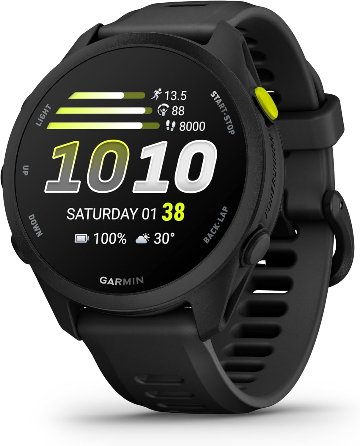
Garmin’s dedicated run-walk Run Coach plan covers the 5K and is available only on Forerunner 70 and Forerunner 170; Expert plans also include a run-walk 5K plan. Garmin’s running plans page lists which plans each watch supports.
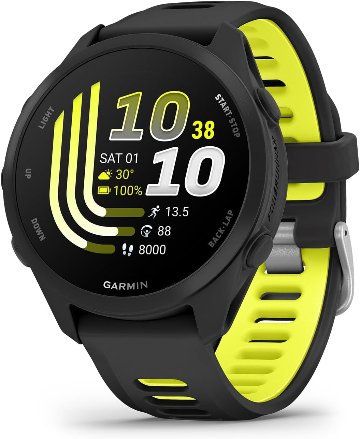
Garmin Forerunner 170
GPS running watch
Garmin Forerunner 70
GPS running watch
What you get without paying
| Runna | Garmin Coach | |
|---|---|---|
| Price | $19.99 a month or $119.99 a year £17.99 or £109.99 in the UK |
Free with a compatible Garmin watch |
| Free use | Week 1 of any plan, plus run recording | Every plan, with no limit |
| Free trial | 7 days, 14 with a referral or when bought in Strava, 30 with the Strava + Runna bundle for new Strava users | Not needed |
| Watches | Garmin, Apple Watch, COROS, Suunto, Amazfit, Fitbit | Garmin only |
Prices were checked on 19 November 2026.
Runna
Without a subscription, Runna gives you Week 1 of any plan, run recording and your completed workouts. Every session after Week 1 needs Runna Premium. Its beginner plans, New to Running, Return to Running and Path to parkrun, were free in full until 5 June 2026, so older articles that call them free are out of date. “Is Runna free?” covers the four ways to get a trial.
Runna Premium costs $19.99 a month or $119.99 a year in the US. In the UK, new subscribers have paid £17.99 a month or £109.99 a year since 10 November 2026, and existing subscribers move to those prices at their first renewal on or after 10 December, according to Runna’s support page.
Strava has owned Runna since April 2025 and sells the two together for $149.99 or £124.99 a year. Strava no longer lets runners create new running plans on its website, so for a Strava subscriber, Runna is now the plan. Runna vs Strava covers which of the two most runners need.
Garmin
Garmin Coach plans and Daily Suggested Workouts are free on compatible Garmin watches, so the cost is the watch. Garmin’s paid tier, Garmin Connect+, costs $6.99 a month or $69.99 a year (£6.99 or £69.99) and adds extra coaching insights and video content to Garmin Coach plans. The plans themselves stay free.
During a run
Both apps put structured workouts on the watch, with each warm-up, rep and recovery shown as a step with its own pace target. On a Garmin, Runna’s next two weeks of runs sync through Garmin Connect every Monday, so a Runna session and a Garmin Coach session look much the same on the wrist. Runna’s strength sessions stay in the phone app. On Apple Watch, Runna has its own watch app, and its spoken pace coaching only plays in that app. A Garmin Coach session starts from a prompt on the watch, or from the Garmin Coach glance.
Audio is the one clear difference. When you run a Runna workout on a Garmin, Garmin controls the audio prompts, so you hear Garmin’s alerts rather than Runna’s coach, and many non-Music Garmin models give only vibrations and on-screen alerts. To hear Runna’s pace cues, you also need the Runna app running on your phone with your headphones connected.
Apple Watch Ultra 4
GPS adventure watch
Apple Watch SE 3
Smart fitness watch
Heart rate or pace targets
Garmin Run Coach lets you choose heart rate or pace as the target for your workouts. On watches that support its strength sessions, an Auto setting uses heart rate for recovery and base runs and pace for tempo, threshold and faster sessions. Anaerobic and sprint sessions use spoken guidance rather than a heart rate target. Runna trains by pace and says pace is the more reliable measure because heart rate zones vary between people. Its beginner plans are effort-based and carry no pace targets. A runner who trains by heart rate zones, or who runs hilly routes where pace means little, is better served by Garmin.
Wahoo KICKR RUN
Best, most innovative treadmill
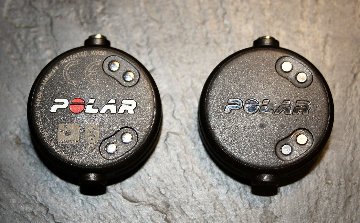
Polar Verity Sense
Optical HR band (biceps, forearm)
Treadmill running
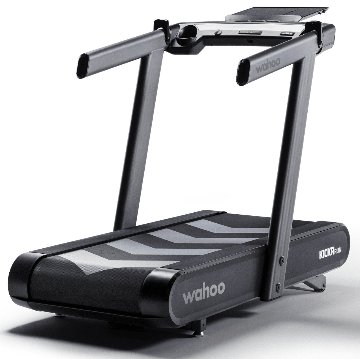
Runna can control a smart treadmill from the phone app. On a treadmill with full Bluetooth FTMS support, it sets the speed and incline for each step of the workout; on others, it shows the target speed for you to set by hand. A Garmin watch runs the same structured workout in its treadmill profile, but it estimates pace from your wrist, so indoor pace targets are only as good as the watch’s calibration. RunBridge is one fix for that.
Pace targets and injury risk
Runna’s pace targets have drawn the most criticism. In February 2026, the Wall Street Journal reported that physical therapists were seeing a wave of Runna-related injuries, with the problem areas being pace progression, intensity distribution, and recovery. Runna’s review with Loughborough University covers the same three areas, and its first changes went live in November 2026, with a more gradual return after Holiday Mode and a cap on one session a week in seven-day plans.
The report does not show that Runna causes more injuries than Garmin Coach, and nobody has compared the two. Because Runna’s paces follow the current race time you enter, an optimistic estimate makes every session too fast from the start. Garmin’s paces follow the watch’s VO2 max estimate, so they depend on accurate heart rate data instead.
Neither approach guarantees fewer injuries. A 2022 review of 36 studies and 23,047 runners found inconsistent evidence linking distance, frequency or intensity to injury, and little support for the popular 10% rule.
Missed sessions and moving your week around
Runna lets you drag a session to another day within the same week, or one week forward or back, as long as that day has no run planned. For longer changes, such as new running days or a different long-run day, go to the plan settings, and Holiday Mode pauses the plan and eases you back in afterwards.
Garmin’s Expert plans let you reschedule a run. Run Coach plans do not, because the plan rebuilds itself when you miss or skip a session. You choose your training days and long-run day when you set the plan up and can change them later, but a Run Coach plan’s end date and distance are fixed.
After a missed week, the two behave differently. Garmin changes the coming sessions without asking. Runna adjusts when you mark a session as skipped, and after several missed runs, it checks in to rebuild the plan. Otherwise, it waits for you to accept a Mileage Insights suggestion or use Not Feeling 100% or Holiday Mode.
Brand and ecosystem
| Runna (Strava) | Garmin Coach (Garmin) | |
|---|---|---|
| Phone app | Runna app, separate from Strava | Garmin Connect, alongside all your health and training data |
| Coaching platform | Runna’s race database also powers Strava’s race discovery | Garmin bought TrainingPeaks in July 2026 |
| Change of watch | Plan carries over to another supported brand | Plan stays with Garmin |
The biggest practical difference is lock-in. A Runna plan survives a move from Garmin to Apple Watch or COROS, while Garmin Coach only exists on Garmin hardware. Against that, Garmin keeps the plan, recovery data, and finished runs in one app, while Runna adds a second app to the routine.
Which one to choose
Choose Garmin Coach if you
- already own a compatible Garmin watch;
- want each day’s session to respond to sleep and recovery;
- train by heart rate rather than pace;
- record all your training on the watch, so it sees your full load;
- would rather not add another subscription.
Choose Runna if you
- run with an Apple Watch, COROS, Suunto, Amazfit or Fitbit watch;
- want to see the whole plan and move sessions yourself;
- are a faster runner and your Garmin only offers the Expert plans;
- have several races in a season and want the plan to taper for each;
- run on a smart treadmill and want the app to control it;
- want strength and mobility sessions in the same app;
- already pay for Strava, where the bundle adds Runna for less.
For an ultra
Runna has dedicated ultra plans, and Garmin Run Coach will build a plan for a custom distance beyond the marathon. An ultra runner with a Garmin should set up both and compare the long-run build before paying.
For a first 5K or parkrun
A newer runner with a Forerunner 70 or 170 has a free run-walk Run Coach plan, and any Garmin that runs the Expert plans has a free run-walk 5K plan. Runna’s beginner plans now need a subscription after Week 1. The 5K pace chart turns a goal time into the pace needed each kilometre.
A Garmin owner can try both at no cost: start Runna’s free Week 1 and compare it with a Run Coach plan set up for the same goal. Runners weighing other options can compare Runna vs Nike Run Club and Coopah vs Runna.
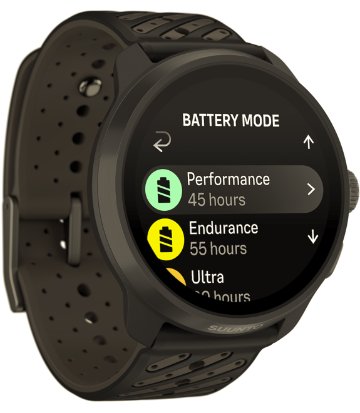
Suunto Race 3S
Titanium bezel, sapphire glass, 1.32" AMOLED (2,000 nits), 38h dual-band GPS.
Quick answers
Is Garmin Coach free?
Yes. Garmin Coach plans and Daily Suggested Workouts are free on compatible Garmin watches, and you do not need a Garmin Connect+ subscription to use them.
Does Runna work with Garmin watches?
Yes. Runna supports every Garmin watch that supports Garmin Coach, and Runna Premium syncs the next two weeks of run workouts to the watch every Monday.
Does Runna use my sleep and HRV data?
No. Runna suggests pace and mileage changes from the runs you record, and you choose whether to accept them. Garmin Coach also takes recovery, sleep and HRV into account on watches that measure them.
Can I move a session in Garmin Coach?
In the Expert Running Plans, yes. Run Coach plans do not allow it, and they adjust the plan automatically when you miss a session.
Is Garmin Run Coach the same as Daily Suggested Workouts?
No. Both use the same watch data, but Run Coach builds a plan towards a race or goal date on the days you choose. Daily Suggested Workouts give one session a day with no plan behind it.
Can Garmin Coach train me for a marathon or an ultra?
Garmin Run Coach covers the marathon and custom distances beyond it. The Expert Running Plans from Jeff Galloway, Greg McMillan and Amy Parkerson-Mitchell stop at the half marathon.
Are Garmin Coach plans suitable for fast runners?
Garmin’s Expert Running Plans support runners aiming for 7:00 a mile (4:21 per km) or slower, about a 21:45 5K. Garmin Run Coach accepts target times significantly faster than that. Runna’s plans go up to Elite Plus, for runners already doing 80 to 100 km a week.
Does Runna use heart rate targets?
No. Runna sets pace targets, and its beginner plans are effort-based. Garmin Run Coach lets you choose heart rate or pace targets.
Is Runna free for beginners?
No. Runna’s beginner and parkrun plans now need a subscription after Week 1, like every other Runna plan.
Can I hear Runna's audio coaching on a Garmin watch?
No. On a Garmin, the watch’s own audio prompts play instead. To hear Runna’s cues, run the Runna app on your phone as well, with headphones connected to the phone.
Do Runna strength sessions sync to my watch?
No. Only run workouts sync to the watch. Strength and mobility sessions stay in the Runna phone app.
Small things I always use
- Garmin 90-degree charging adapter: Charges your Garmin with any USB-C cable. Essential when travelling. I use one.
- Body Glide: The blue anti-chafing stick swimmers and runners carry. I use it.
- Speedo earplugs: Fewer ear infections and no cold-water dizziness. I use them.
- Dryrobe Advance: My winter changing robe for open-water swims. I use one. A cheaper option is the AONYIYI changing robe.
- Maurten: Race fuel that stays easy on the stomach. I use them.
- Beet It Sport nitrate shots: Beetroot shots I take in the days before a race. I use them.
- Garmin charging puck: The quickest way to top up before a session. I use one.
- Injinji: Toe socks that stop rubbing, so you run more. I use them.
- Ultimate toe protectors: Stop black toenails on long runs. They work. I use them.
- Compressport R2 v2 calf sleeves: My calf sleeves of choice. I use them.
- Cellucor C4: My pre-workout before hard sessions.
- TPU tubes: Schwalbe Aerothan, Tubolito and Pirelli SmarTube. Light, tiny spares. I use all three.
- G8 insoles: Adjustable arches, perfect position. I use them.
- Cycplus Cube: A 97g electric pump that gets a road tyre rideable in two minutes. I carry one. 5% off with code THE5KRUNNER.
Health, recovery and sleep
- Kineon MOVE+: Red and infrared light for sore knees, Achilles and other joints after hard training. I use it.
- FreeStyle Libre 3 Plus: Shows how my blood sugar responds to diet. Occasional use.
- hDrop: Measures my sweat loss in summer and indoors. I use it.
- Fourth Frontier Zone: Checks my heart under load in hard sessions.
- Oura Ring 5: My partner’s recovery tracker of choice.
- Eight Sleep: A cooling mattress cover my partner and I use nightly.
Watches and sensors
- Polar H10: My daily driver for waking HRV.
- Polar Verity Sense: My backup arm-worn HR sensor.
- Nomad bedside charger: Charges my iPhone and Apple Watch overnight. I use it, and many of their bands.
- Train.Red: The best muscle oxygen sensor I’ve used. Occasional use.
- Tymewear: Accurate heart rate and reliable ventilatory zones. I use it to pace endurance rides over an hour.
- Garmin Forerunner 970: A pro-grade triathlon watch. I use this.
- Apple Watch Ultra 4: My daily smartwatch. No phone needed on rides.
On the bike
- Continental GP5000 for everyday riding, and Aero 111 on the front for special occasions. I use both.
- Helmets: Specialized S-Works Evade 3 for road riding, and Rudy Project Wing for TT-style races. I use both.
- Ravemen FR300: A front light that mounts under your Garmin or Wahoo. I use one.
- Ravemen FR1000: The light and the computer mount in one unit, so nothing else goes on the bars. Better than mine.
- Ravemen FR1500SE: 1,500 lumens hanging under your Garmin, for proper night rides.
- Ravemen FR1100SE: 1,100 lumens under your Garmin, and up to 46 hours on slow flash.
- Ravemen FR500: A brighter FR300 with the same mount.
- Wahoo TRACKR Radar: I use it on one bike and Varia on the other. They perform the same.
- Garmin Varia RTL515: Radar that warns you of cars from behind. I use this model.
- Wahoo ELEMNT Roam 3: The bike computer that’s easy to use. I use mine on most rides.
- Favero Assioma Pro RS2: Accurate power pedals that swap easily between bikes. I use this model.
Home and indoor training
- NPE Runn: Makes my basic treadmill smart, sending more accurate speed and distance to my watch and Zwift. I use it.
- Google Wifi: Keeps Zwift connected in my pain cave. I use it.
- Apple TV 4K: Zwift on the big screen. I use two.
- Google Nest Doorbell (wired, 2nd gen): My video doorbell, running in both Google Home and Apple Home via Starling. I use it.
Reader-Powered Content
This content is not sponsored. It’s mostly me behind the labour of love, which is this site, and I appreciate everyone who supports it.
Support the site: Follow (free, fewer ads) · Subscribe (paid, ad-free) · Buy Me A Coffee
Written by real people, with AI assistance. Fact-checked and verified for originality. See the Editorial Policy. FTC: Affiliate Disclosure — some links pay commission. As an Amazon Associate, I earn from qualifying purchases.
