Wearable (Watch) MicroLED Display Usage Set to Double Annually
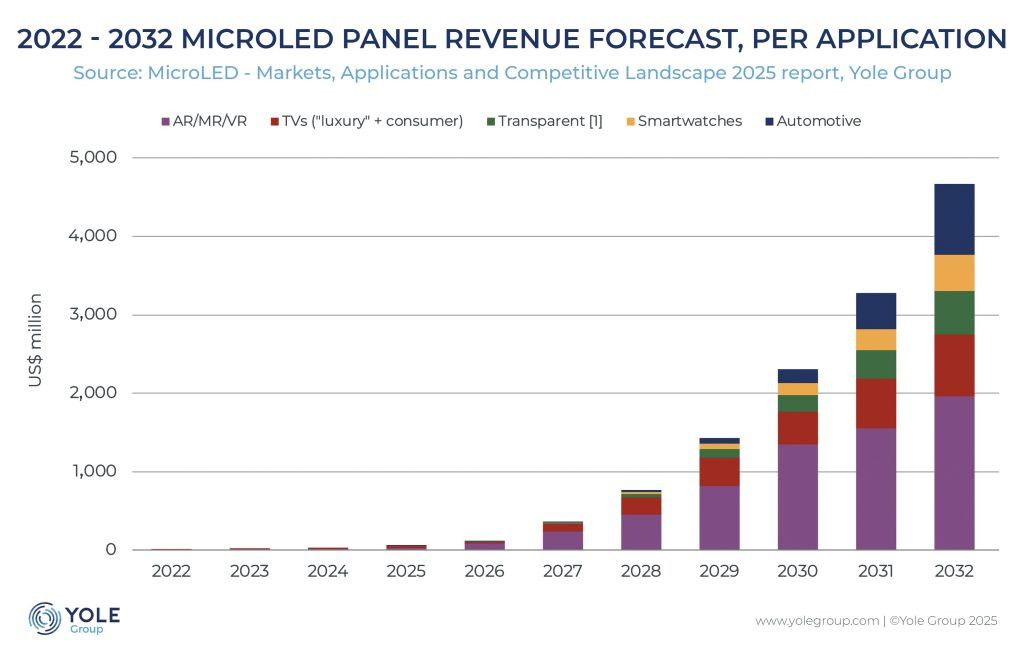
The next five years will see a significant shift in display technology as microLED moves from experimental development into mass-market commercialisation. According to the latest forecasts from the Yole Group, total annual revenue for microLED panels is projected to climb towards $5 billion by 2032.
AR and Wearables Leading the Charge
Initial growth is heavily focused on miniaturised applications where traditional OLED technology faces limitations. Smartwatches and AR/MR/VR microdisplays are the primary drivers, expected to account for well over half of all microLED revenue by 2032, with wearables comprising approximately $500 m.
The demand for these devices stems from several critical advantages offered by microLED:
- Superior brightness, contrast ratios, and shallow viewing angles for outdoor use.
- Enhanced energy efficiency (although not demonstrated by products released to date – Garmin Fenix 8 Pro microLED).
- Lightweight and compact design footprints.
While the market is currently in a pre-volume phase, industry experts like Yole Group predict that meaningful production volumes will begin between 2027 and 2028.
The Road to $5 Billion
The transition to high-volume manufacturing is not straightforward. Major industry players, including Samsung Electronics, Sony, and LG, are currently addressing challenges in yield rates for small-die sizes and the high production costs compared to established OLED panels.
Expansion into Automotive and Luxury Tech
Beyond the wearable market, microLED is set to make a significant impact on the automotive industry. The technology’s high durability and brightness make it ideal for next-generation dashboards and heads-up displays (HUDs). Additionally, the luxury TV market remains a key segment for those seeking the pinnacle of home cinema performance.
As manufacturing processes standardise and costs reduce, the 2030s could see microLED dominate high-end displays.
A Concluding Thought
A Concluding Thought
Analyst Ming-Chi Kuo estimated Apple was quoted $150 per panel in 2024, which contributed to the pause of its microLED Watch project. While $150 sounds high for a single component, early manufacturing yields are notoriously low. However, even if costs fall to the projected $50 mark by 2032, a $500m smartwatch market size implies only 10 million units annually.
Given that Apple already sells roughly 7-10 million Watch Ultra models each year, these forecasts suggest that microLED won’t be an outright OLED-killer just yet. Instead, it may remain a boutique technology reserved for a new tier of absolute top-tier “Pro” and “Ultra” models, rather than becoming the new standard for the entire industry.
This is precisely how Garmin positioned the Fenix 8 Pro microLED in 2025!
For the complete Garmin Fenix series guide, covering all current models, history and buying advice: Garmin Fenix hub.
Last Updated on 3 October 2026 by tfk the5krunner
Small things I always use
- Garmin 90-degree charging adapter: Charges your Garmin from any USB-C cable. Essential when travelling. I use one.
- Body Glide: The blue anti-chafe stick swimmers and runners carry. I use it.
- Speedo earplugs: Fewer ear infections and no cold-water dizziness. I use them.
- Dryrobe Advance: My winter changing robe for open-water swims. I use one. A cheaper option is the AONYIYI changing robe.
- Maurten: Race fuel that stays easy on the stomach. I use them.
- Garmin charging puck: The quickest way to top up before a session. I use one.
- Injinji: Toe socks that stop rubbing, so you run more. I use them.
- Ultimate toe protectors: Stop black toenails on long runs. They work. I use them.
- Compressport R2 v2 calf sleeves: My calf sleeves of choice. I use them.
- Cellucor C4: My pre-workout before hard sessions.
- TPU tubes: Schwalbe Aerothan, Tubolito and Pirelli SmarTube. Light, tiny spares. I use all three.
- G8 insoles: Adjustable insoles that are good. I use them.
- Cycplus Cube: A 97g electric pump that gets a road tyre rideable in two minutes. I carry one. 5% off with code THE5KRUNNER.
Watches and sensors
- Polar H10: My daily driver for waking HRV.
- Polar Verity Sense: My backup arm-worn HR sensor.
- Nomad bedside charger: Charges my iPhone and Apple Watch overnight. I use it, and many of their bands.
- Train.Red: The best muscle oxygen sensor I’ve used.
- Tymewear: Accurate heart rate and reliable ventilatory zones. I use it to pace endurance rides over an hour.
- Garmin Forerunner 970: A pro-grade triathlon watch. I use this.
- Apple Watch Ultra 4: My daily smartwatch. No phone needed on rides.
- Garmin Fenix 9 Pro: I’ve just bought one.
On the bike
- Continental GP5000 for everyday riding, and Aero 111 on the front for special occasions.
- Helmets: Specialized S-Works Evade 3 for road riding, and Rudy Project Wing for TT-style races. I use both.
- Ravemen FR300: A front light that mounts under your Garmin or Wahoo. I use one.
- Wahoo TRACKR Radar: I use it on one bike and Varia on the other. They perform the same.
- Garmin Varia RTL515: Radar that warns you of cars from behind. I use this model.
- Wahoo ELEMNT Roam 3: The bike computer that’s easy to use. I use mine on most rides.
- Favero Assioma Pro RS2: Accurate power pedals that swap easily between bikes. I use this model.
Home and indoor training
- NPE Runn: Makes my basic treadmill smart, sending more accurate speed and distance to my watch and Zwift. I use it.
- Google Wifi: Keeps Zwift connected in my pain cave. I use it.
- Apple TV 4K: Zwift on the big screen. I use two.
- Google Nest Doorbell (wired, 2nd gen): My video doorbell, running in both Google Home and Apple Home. I use it.
Health, recovery and sleep
- FreeStyle Libre 3 Plus: Shows how my blood sugar responds to diet.
- hDrop: Measures my sweat loss in summer and indoors.
- Fourth Frontier Zone: Checks my heart under load in hard sessions.
- Oura Ring 5: My partner’s recovery tracker of choice.
- Kineon MOVE+: Red light therapy for niggles. It works.
- Eight Sleep: A cooling mattress cover my partner and I use nightly.
Reader-Powered Content

This content is not sponsored. It’s mostly me behind the labour of love, which is this site, and I appreciate everyone who supports it.
Support the site: Follow (free, fewer ads) · Subscribe (paid, ad-free) · Buy Me A Coffee ❤️
Written by real people, with AI assistance. Fact-checked and verified for originality. See the Editorial Policy. FTC: Affiliate Disclosure — some links pay commission. As an Amazon Associate, I earn from qualifying purchases.
tfk is the founder and author of the5krunner, an independent endurance sports technology publication. With 20 years of hands-on testing of GPS watches and wearables, and competing in triathlons at an international age-group level, tfk provides in-depth expert analysis of fitness technology for serious athletes and endurance sport competitors. ID
