Amazfit HybridCharge explained: how it works, and why it goes further than Garmin Body Battery and Whoop Recovery.
Amazfit’s new HybridCharge has just launched, and here are my first thoughts based on some initial usage and real training and sleep data.
What HybridCharge is
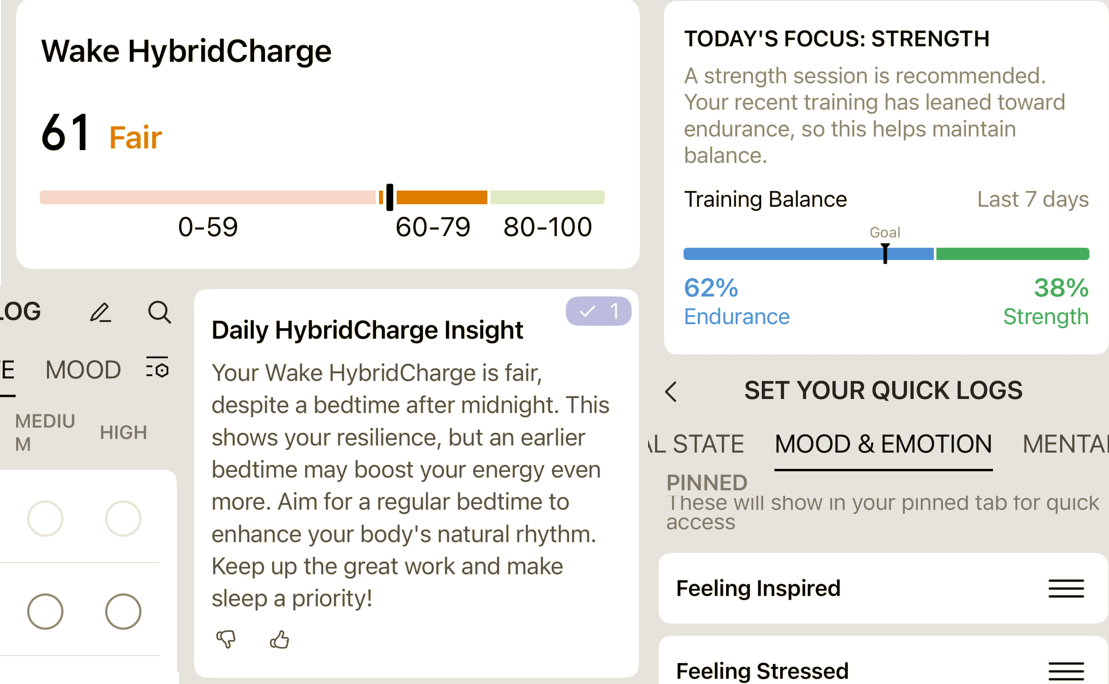
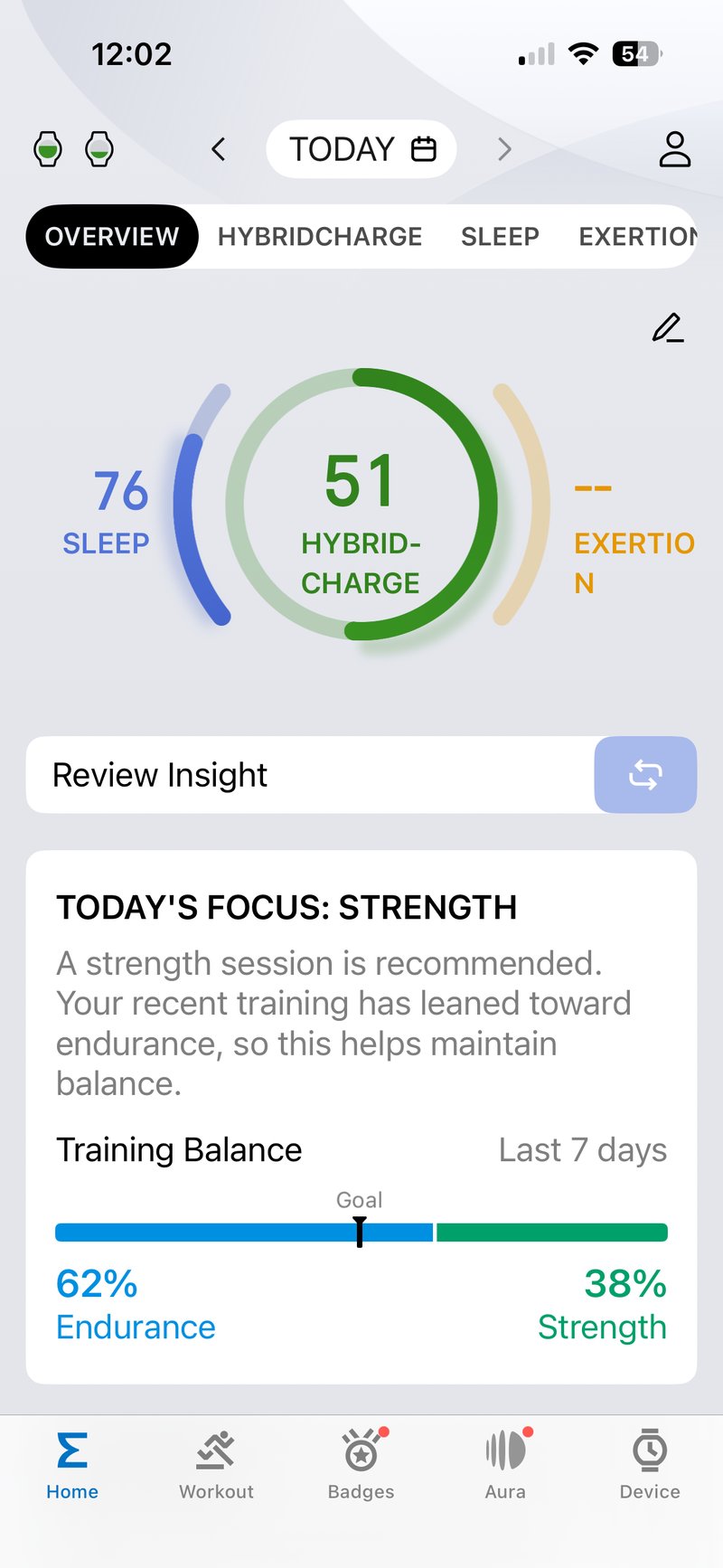
HybridCharge is a 0-100 daily energy score that replaced BioCharge and Readiness in the Zepp app in May 2026. Officially called HybridCharge Energy Intelligence, it launched first on the Balance 3 and Balance Ultra as part of Zepp OS 6, before rolling out via the Zepp app update. The name gives a reasonable idea of the concept and is probably better than BioCharge. Most wearable recovery metrics are built entirely on biometrics: what the device measures from your body. HybridCharge adds a layer of subjective self-reporting on top. That combination is the hybrid. Perhaps a little too literal a name and not as catchy as Garmin’s Body Battery.
The scale runs from 0 to 59 (poor), 60 to 79 (fair), and 80 to 100 (good). Depending on your watch and its latest software, the old BioCharge wording may persist until a firmware update arrives for your model. The Zepp app reflects the updated name and always shows the most current figure after sync. Amazfit has confirmed rollout to ten further models: the Active 3 Premium, Balance 2, Cheetah 2 Pro, Cheetah 2 Ultra, T-Rex 3, T-Rex 3 Pro, and T-Rex Ultra 2 are due in June 2026; the Bip Max in June or July; the Active Max in July or August; and the original Balance in late 2026.
How the score is built
Three values make up the picture across the day:
- Wake HybridCharge: your morning baseline, calculated from overnight sleep quality, HRV, and resting heart rate, then — according to the app — adjusted for residual mental fatigue carried from the previous day. A high score means you are primed for training or focused work. A low score means the body or mind needs recovery, and the app will suggest which type.
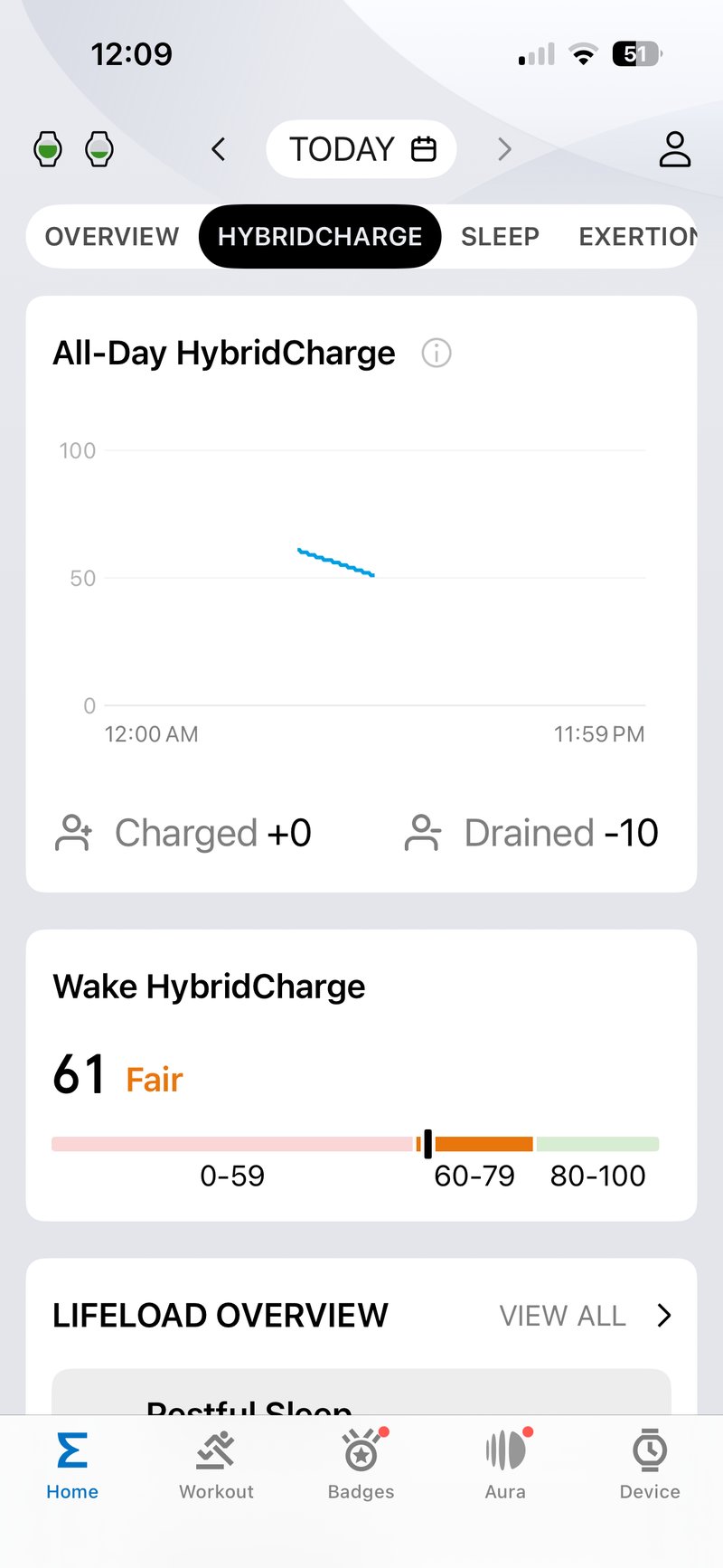
- All-Day HybridCharge: tracks how the score moves as physical and psychological demands accumulate through waking hours. The intraday chart shows the trend, with net Charged and Drained totals displayed below.
- Evening HybridCharge: what remains at the end of the day after the full picture is accounted for. According to the app, a high Evening score indicates capacity for a productive task; a low score signals it is time to wind down and prepare for sleep.
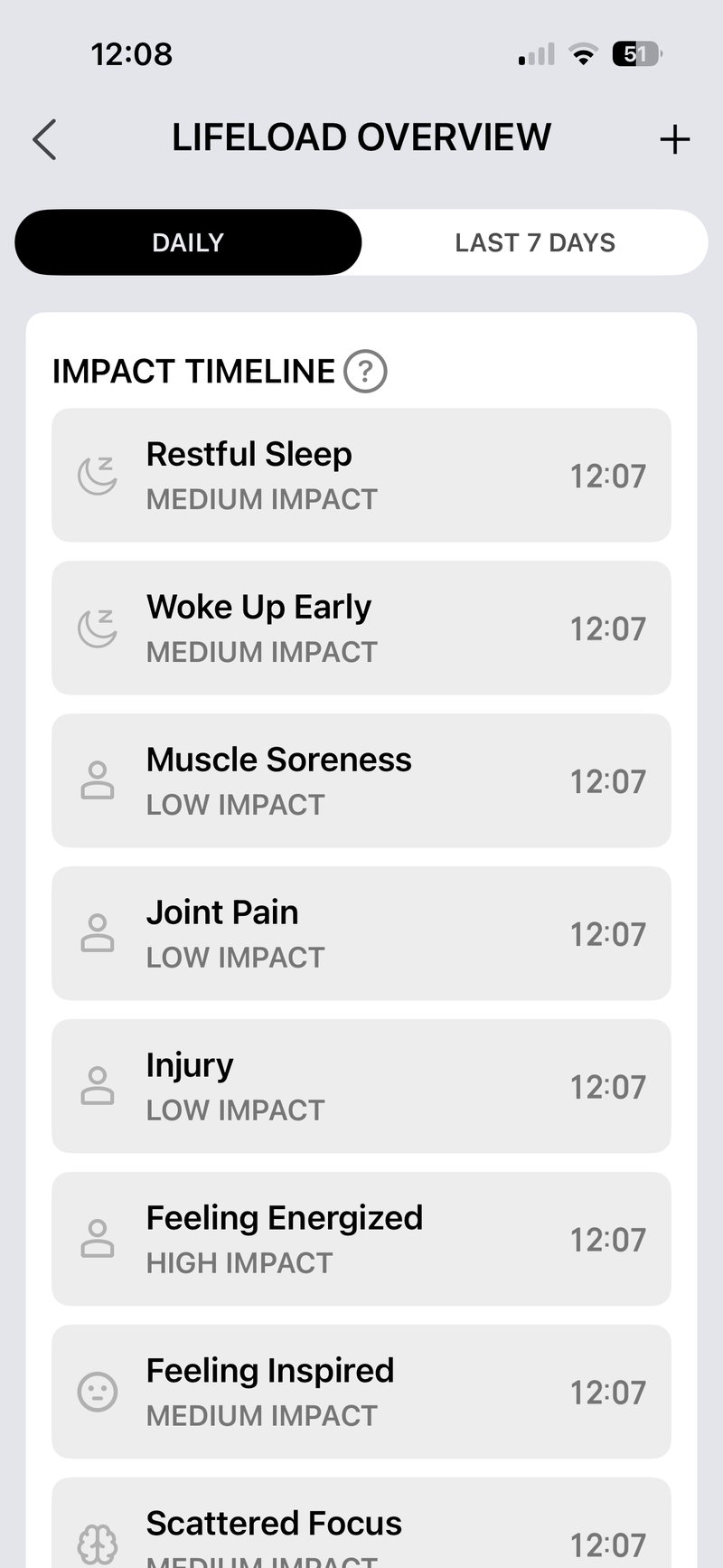
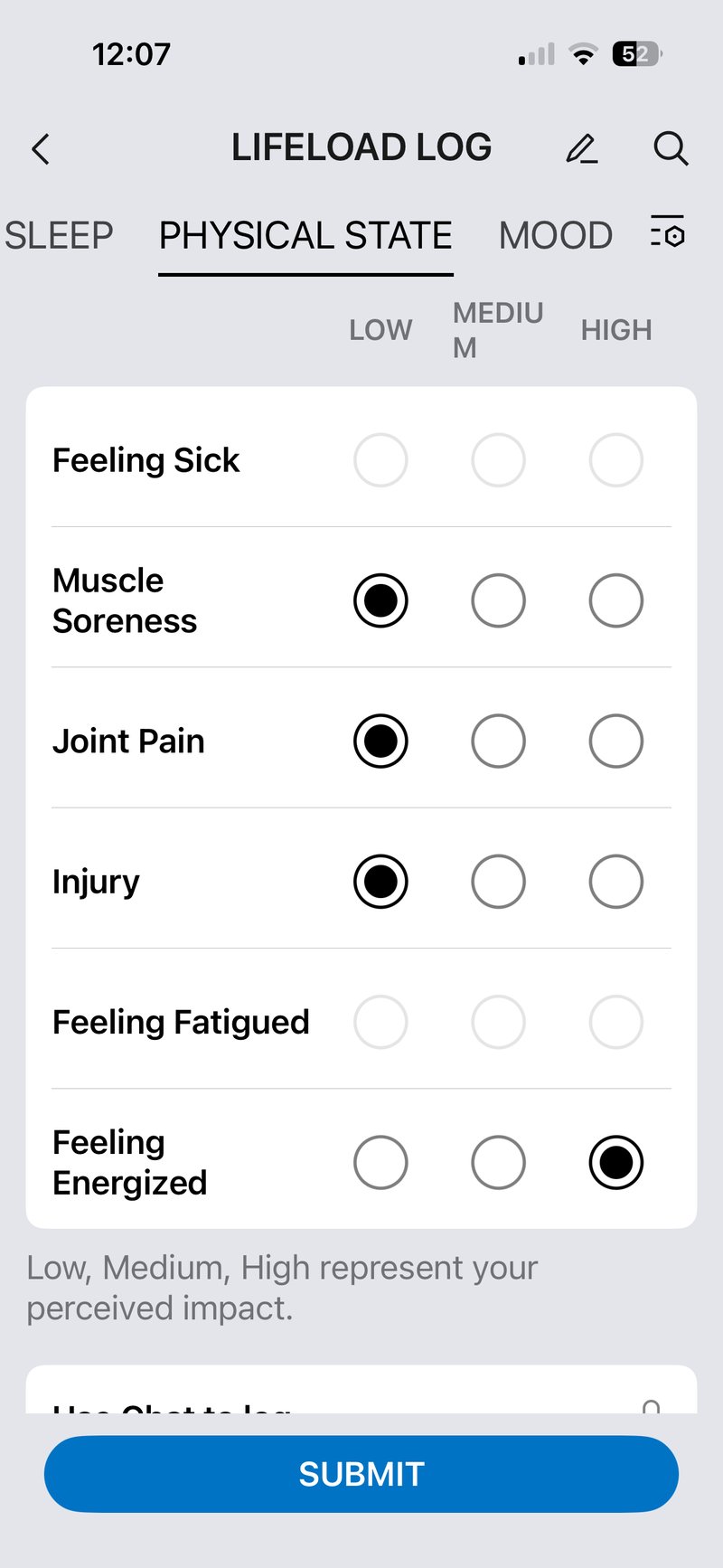
The objective foundation across all three is the sensor data the watch collects: sleep quality, HRV, resting heart rate, and activity. On top of that sits LifeLoad, the self-reporting layer. You log daily factors, rating each Low, Medium, or High for perceived impact, across eight categories:
- Sleep — Restful Sleep, Poor Sleep, Woke Up Early, and others
- Physical State — Muscle Soreness, Joint Pain, Injury, Feeling Energised, and others
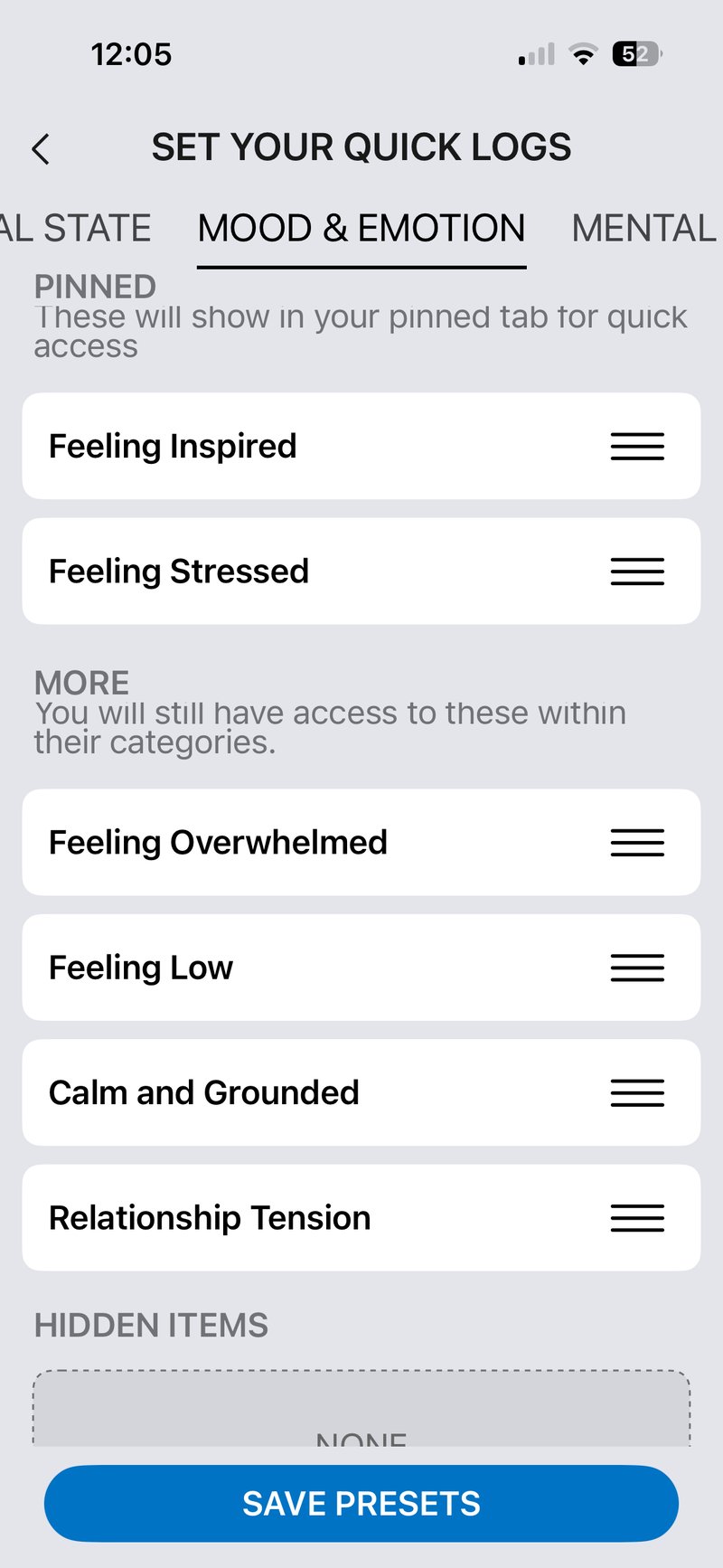
- Mood and Emotion — Feeling Stressed, Feeling Inspired, Calm and Grounded, and others
- Mental Energy — Deep Focus, Scattered Focus, Brain Fog
- Work and Life — Long Work Hours, Busy Meeting Schedule, Caregiving, and others
- Nutrition — Caffeine, Alcohol, Poor Hydration, Clean Eating, and others
- Environment — Sunlight Exposure, Stuck Indoors, Time Zone Shift, and others
- Activity and Recovery — Active Recovery, Rest Day, Sauna/Steam, Cold Exposure, and others
A voice input option is available, the system caps daily entries, and frequently logged items can be pinned for quick access, which I’ve already done. I recommend you only choose four or five that you are not sure about the effects of — do not choose alcohol, as we all know it is bad.
Amazfit is clear on how the two layers relate. Physical data forms what the in-app FAQ calls the unshakeable foundation (sounds a bit serious). LifeLoad inputs then apply a calculated adjustment on top of the biometric base, but do not override it. According to the app, the model also adapts over time to your personal patterns, so a stressor that weighs heavily in week one may carry less impact as it calibrates. Weekly insights are withheld for the first seven days while those personal baselines are established.
The third input is RPE (rate of perceived exertion). When you log how hard a workout felt alongside the heart rate data the watch captures, HybridCharge produces an Internal Load figure for that session, which feeds into the All-Day and Evening scores.
Note: RPE is a valid assessment metric with a scientific foundation in RPE-TRIMP. That said, I tried correlating my feelings against actual waking HRV values for a year and eventually concluded that I had no idea how I felt. You could be different, but it is worth trying for a few months to see whether the algorithms can glean any insights into your physiology.
Where Garmin Body Battery and Whoop Recovery fall short
Garmin Body Battery is a 0-100 score built from HRV-based stress, sleep, rest, and activity data via the Firstbeat Analytics engine. Garmin does offer a logging feature — Lifestyle Logging, introduced with the Venu 4 in September 2025 and now available across compatible Garmin Connect accounts — which allows you to tag daily behaviours such as caffeine, alcohol, and cold exposure. Garmin Connect then correlates those tags with changes in Body Battery and other metrics over time, surfacing insights when statistically meaningful patterns emerge. This is a meaningful addition, but it operates retrospectively: the tags inform you about what is affecting your score after the fact, but they do not modify the Body Battery calculation itself.
Whoop Recovery is a 0-100 percentage, colour-coded green, yellow, or red, calculated from overnight HRV, resting heart rate, respiratory rate, and sleep performance. Whoop does offer a Journal feature for logging lifestyle behaviours, and the platform shows correlations between those entries and recovery scores over time. But Journal entries do not alter the morning Recovery score itself. The score remains biometric-only; the Journal is for retrospective analysis, not real-time adjustment.
Both Garmin and Whoop have therefore reached the same architectural decision: log the behaviour, surface the correlation later, leave the score calculation untouched. The question HybridCharge poses is whether feeding subjective inputs directly into the score — rather than using them to explain it retrospectively — produces something more useful.
Both also share a second limitation. Heart rate alone can underestimate aspects of muscular fatigue during heavy resistance training, in which effort is high but cardiovascular demand remains modest relative to the load on muscle tissue. A score derived primarily from heart rate may indicate less fatigue from a heavy squat session than the body has actually incurred.
Note: My personal view is that metrics like Body Battery are proprietary composite scores without peer-reviewed scientific validation. That said, this whole class of battery-and-charge metrics is widely used and often claimed to be useful and accurate. There is no universally accepted external standard against which these scores can be definitively validated. However, if people find them useful, that is a good thing. Check the comments — some will say Body Battery is a good representation of how they feel. Then why do you need a metric for what you already know?
What HybridCharge does differently
Here is the twist. LifeLoad entries appear to actively modify the score rather than sit alongside it as correlational data, as both Garmin’s Lifestyle Logging and Whoop’s Journal do.
Logging a high-impact Feeling Stressed entry or a medium-impact Long Work Hours entry will move the All-Day score in the same direction as a hard training session. Subjective and objective data are part of the same calculation, not parallel outputs that never meet.
The RPE input aims to address the strength-training problem. Perceived effort, alongside heart rate, provides the system with more information about muscular load and strain than heart rate data alone typically captures.
The Evening score is the clearest expression of what HybridCharge is attempting to do. Rather than resetting overnight, it accounts for the full daily toll: training load, cognitive demands, and emotional state in a single figure.
Early impressions
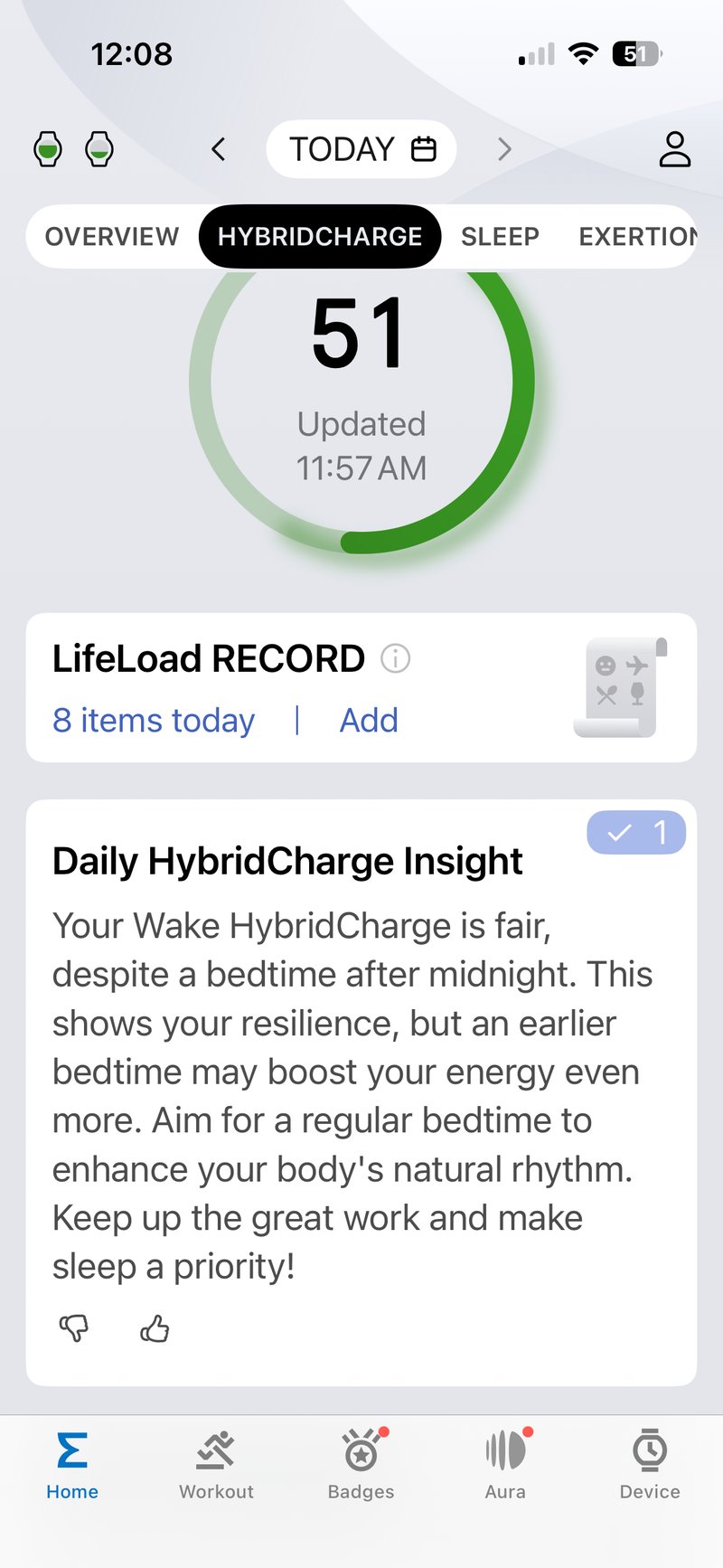
My Wake HybridCharge this morning was 61, rated Fair. I had gone to bed after midnight, and the Daily HybridCharge Insight acknowledged this directly, noting a fair score despite the late bedtime and suggesting that a more regular sleep schedule would improve it. That reading felt accurate to how I was actually functioning.
Beyond that, three things give me pause.
- The first is compliance. LifeLoad requires consistent daily input across multiple categories to work as intended. The score is only as informative as you are willing to log honestly and regularly. In a category where many people already struggle to act on the insights their devices generate, a daily eight-category self-report is a significant ask.
- The second is methodology. Amazfit provides no details on how the subjective-to-objective weighting is calculated or what validation the model has undergone. The in-app FAQ states that the system mathematically calculates exactly how your reported mental state alters physical reality, but that is a positioning statement rather than a methodological disclosure. Without transparency on the model, independent verification is not possible.
- The third is integrity. The score can, in principle, be inflated. Logging Feeling Energised at high impact every day, regardless of actual state, will be reflected in the number.
The bottom line
HybridCharge is the most ambitious readiness score Amazfit has produced, and it has genuinely novel components.
The conceptual case for combining objective and subjective data is sound: exercise scientists have argued for years that RPE belongs in training load calculations, and the acknowledgement that cognitive and emotional demands carry a physiological cost is grounded in evidence.
Whether it proves more useful than Garmin Body Battery or Whoop Recovery in practice will depend on how consistently you engage with it. I will return with a fuller assessment after extended use. Please feel free to add your thoughts or questions below. In the meantime, our Amazfit reviews cover the hardware these features run on, and the HYROX hub has more on the partnership integration.
Quick answers
Is HybridCharge replacing BioCharge?
Yes. HybridCharge replaced BioCharge and Readiness in the Zepp app in May 2026. Depending on your device model and firmware, the watch face may continue to show the BioCharge label; the Zepp app reflects the updated name and holds the current score after sync.
Does HybridCharge require manual input?
HybridCharge appears capable of functioning from biometric data alone, but the LifeLoad layer adds the subjective context that distinguishes it from a conventional readiness metric. Without regular LifeLoad entries, the score behaves closer to a standard biometric figure.
How is HybridCharge different from Garmin Body Battery?
Garmin Body Battery is calculated by the Firstbeat Analytics engine from HRV-based stress, sleep, rest, and activity data. Garmin’s Lifestyle Logging tags do not directly alter the score calculation. HybridCharge’s LifeLoad layer appears to work differently: entries feed into the score directly rather than informing retrospective analysis.
Does Whoop use subjective data in its Recovery score?
Whoop’s Journal feature allows you to log lifestyle behaviours and see correlations with recovery scores over time. However, Journal entries do not directly alter the morning Recovery score, which remains biometric-only: HRV, resting heart rate, respiratory rate, and sleep performance. The Journal works as a retrospective insight tool, not a real-time input.
Can HybridCharge detect strength-training fatigue more accurately than other metrics?
The intent is yes. Biometric-only scores use heart rate as the primary proxy for workout load, which can underestimate the fatigue cost of heavy resistance work where cardiovascular demand is modest relative to actual muscular effort. HybridCharge incorporates RPE to produce an Internal Load figure per session, giving the system more to work with after a gym session than heart rate alone provides.
Why does my watch still say BioCharge?
The label on the watch face depends on your device model and firmware. The Zepp app will display HybridCharge and hold the most current score following sync.
How long before HybridCharge gives personalised weekly insights?
According to the app, the system requires approximately seven days to establish your personal baselines: resting heart rate, HRV, and stress-reporting patterns. Weekly insights are withheld during this calibration period.
For the full Amazfit range, accuracy data and Zepp Health analysis: Amazfit sports watch guide.
Last Updated on 3 October 2026 by tfk the5krunner
Small things I always use
- Garmin 90-degree charging adapter: Charges your Garmin from any USB-C cable. Essential when travelling. I use one.
- Body Glide: The blue anti-chafe stick swimmers and runners carry. I use it.
- Speedo earplugs: Fewer ear infections and no cold-water dizziness. I use them.
- Dryrobe Advance: My winter changing robe for open-water swims. I use one. A cheaper option is the AONYIYI changing robe.
- Maurten: Race fuel that stays easy on the stomach. I use them.
- Garmin charging puck: The quickest way to top up before a session. I use one.
- Injinji: Toe socks that stop rubbing, so you run more. I use them.
- Ultimate toe protectors: Stop black toenails on long runs. They work. I use them.
- Compressport R2 v2 calf sleeves: My calf sleeves of choice. I use them.
- Cellucor C4: My pre-workout before hard sessions.
- TPU tubes: Schwalbe Aerothan, Tubolito and Pirelli SmarTube. Light, tiny spares. I use all three.
- G8 insoles: Adjustable insoles that are good. I use them.
- Cycplus Cube: A 97g electric pump that gets a road tyre rideable in two minutes. I carry one. 5% off with code THE5KRUNNER.
Watches and sensors
- Polar H10: My daily driver for waking HRV.
- Polar Verity Sense: My backup arm-worn HR sensor.
- Nomad bedside charger: Charges my iPhone and Apple Watch overnight. I use it, and many of their bands.
- Train.Red: The best muscle oxygen sensor I’ve used.
- Tymewear: Accurate heart rate and reliable ventilatory zones. I use it to pace endurance rides over an hour.
- Garmin Forerunner 970: A pro-grade triathlon watch. I use this.
- Apple Watch Ultra 4: My daily smartwatch. No phone needed on rides.
- Garmin Fenix 9 Pro: I’ve just bought one.
On the bike
- Continental GP5000 for everyday riding, and Aero 111 on the front for special occasions.
- Helmets: Specialized S-Works Evade 3 for road riding, and Rudy Project Wing for TT-style races. I use both.
- Ravemen FR300: A front light that mounts under your Garmin or Wahoo. I use one.
- Wahoo TRACKR Radar: I use it on one bike and Varia on the other. They perform the same.
- Garmin Varia RTL515: Radar that warns you of cars from behind. I use this model.
- Wahoo ELEMNT Roam 3: The bike computer that’s easy to use. I use mine on most rides.
- Favero Assioma Pro RS2: Accurate power pedals that swap easily between bikes. I use this model.
Home and indoor training
- NPE Runn: Makes my basic treadmill smart, sending more accurate speed and distance to my watch and Zwift. I use it.
- Google Wifi: Keeps Zwift connected in my pain cave. I use it.
- Apple TV 4K: Zwift on the big screen. I use two.
- Google Nest Doorbell (wired, 2nd gen): My video doorbell, running in both Google Home and Apple Home. I use it.
Health, recovery and sleep
- FreeStyle Libre 3 Plus: Shows how my blood sugar responds to diet.
- hDrop: Measures my sweat loss in summer and indoors.
- Fourth Frontier Zone: Checks my heart under load in hard sessions.
- Oura Ring 5: My partner’s recovery tracker of choice.
- Kineon MOVE+: Red light therapy for niggles. It works.
- Eight Sleep: A cooling mattress cover my partner and I use nightly.
Reader-Powered Content

This content is not sponsored. It’s mostly me behind the labour of love, which is this site, and I appreciate everyone who supports it.
Support the site: Follow (free, fewer ads) · Subscribe (paid, ad-free) · Buy Me A Coffee ❤️
Written by real people, with AI assistance. Fact-checked and verified for originality. See the Editorial Policy. FTC: Affiliate Disclosure — some links pay commission. As an Amazon Associate, I earn from qualifying purchases.

tfk is the founder and author of the5krunner, an independent endurance sports technology publication. With 20 years of hands-on testing of GPS watches and wearables, and competing in triathlons at an international age-group level, tfk provides in-depth expert analysis of fitness technology for serious athletes and endurance sport competitors. ID
