Has Strava Just Signed Its Own Death Warrant?
A: No. AI signed it months ago.
This morning, Strava announced that you can now ask Claude AI questions about your own training history in plain English. Connect your Strava account to get answers to things like: how has my running improved this year, are my easy runs actually easy, or how does my cycling affect my running fitness? It draws the answers directly from your Strava data. The link that makes this possible is called an MCP — think of it as the glue between a chat app and your personal data — it takes less than one minute to turn on (I just did it).
What it means is that Strava has formalised a breach that was already open.
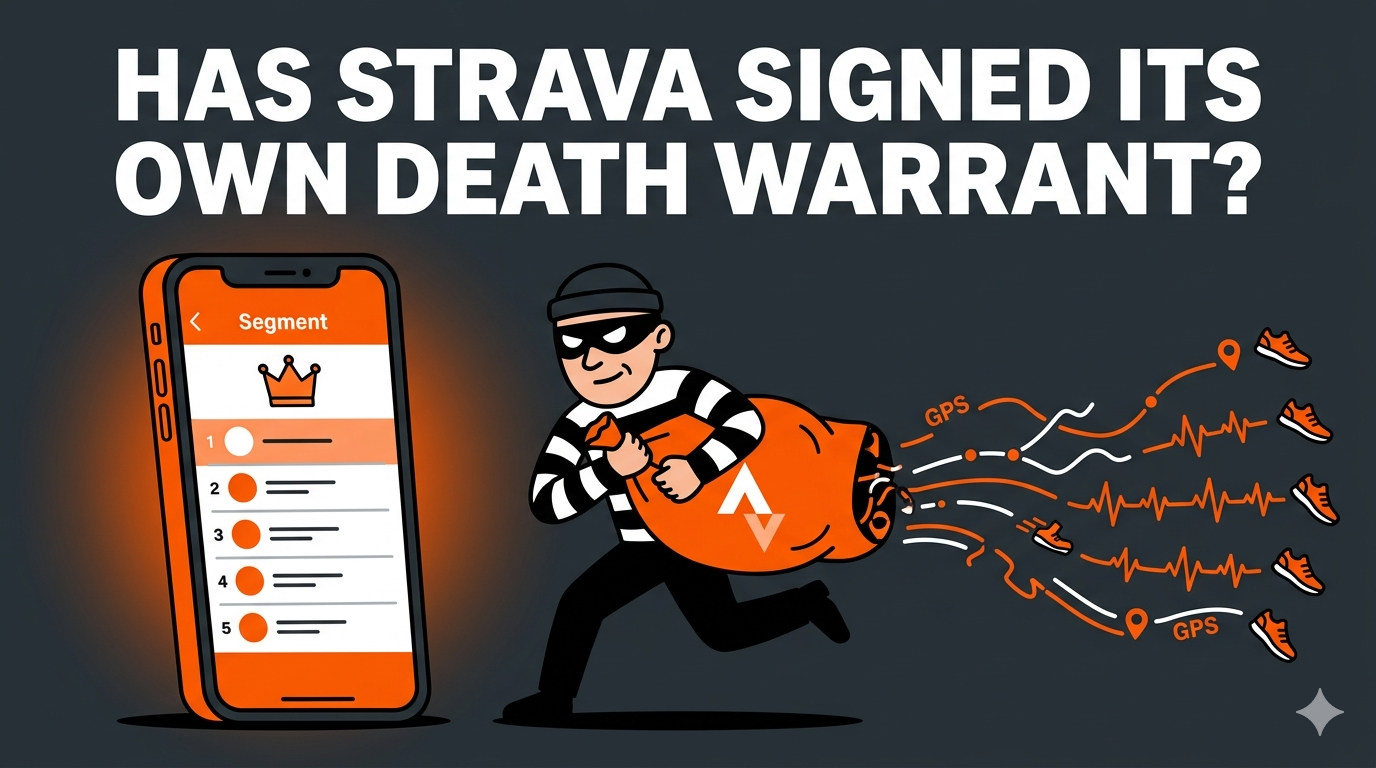
AI already had a way in
In January 2026, Claude gained the ability to read from the health app on your phone if you connect it. Every time you finish a run or ride on a Garmin, a COROS, a Suunto, a Polar, or an Apple Watch, that device writes workout data to your phone. For the Apple Watch, that data is comprehensive. For other brands, it varies. You may have disabled it, but the pipeline exists, and millions of others won’t.
Claude can read all of that. Without Strava being involved at all.
Your training data already reaches AI through your watch and phone, bypassing Strava entirely. Strava had no say in it. Strava cannot close it. It was opened by Apple and Google, not by Strava, months before today’s announcement.
What Strava launched today is an attempt to curb unauthorised scraping by multiple AIs. It creates an exit for this data that it did not create by turning it into a feature for existing subscribers.
What Strava’s defensive moat actually was
Strava built a genuinely valuable position over fifteen years. Understanding what remains of it requires looking at each element honestly.
| Strava moat | Broken by today’s connection to Claude | Broken already by the health app on your phone |
|---|---|---|
| Personal training analysis and trends | Yes, full history queryable in chat | Yes, workouts, heart rate and trends readable since January 2026 |
| Per-second heart rate and pace | Yes, included in the data Strava shares | Partial, depends on what your watch writes to your phone |
| GPS route data | Yes, Strava describes geographic analysis as part of the connection | Not confirmed live yet, but your route data already sits in your phone’s health app; making it readable by AI is a settings decision, not a technical barrier |
| Your personal bests on routes you repeat | Yes, Claude benchmarks you against your own history | Partial, reconstructable from accumulated GPS data over time |
| Your personal heatmap | Yes, built from your activity history | Yes, already possible from any GPS watch to write to your phone |
| Global heatmap | No, individual data only | No – but never Strava-exclusive: Garmin, Ride with GPS, and Komoot all hold versions of it |
| Segment leaderboards | No, requires everyone else’s data | No, the health app on your phone has no segment concept |
| Social layer: kudos, clubs, events, feed | Partial – clubs and events are exposed, but the people, the notifications, and the habits are not replicated. | No, the health app on your phone doesn’t have a social layer. |
Look at the pattern in the table. Everything that is a data or analysis feature was already reachable by AI through the health app on your phone, regardless of today’s announcement. Everything that survives is a people function: the leaderboard that ranks you against others, the clubs, the activity feed, and the kudos. Those require other people. A health app has no social layer.
Strava’s real moat was always the community. Not the data. Not segments.
Who loses first
The first casualties of sports software won’t include Strava.
The losers are the subscription coaching apps that charge between fifteen and twenty-five pounds a month to sit between your Strava data and a training plan. Platforms like TrainingPeaks, which serious cyclists and triathletes use to analyse their training load, and a handful of smaller AI coaching services that launched in the last two years, assume that access to your data and their skills are the competitive advantages.
Those advantages are gone.
Claude now holds comparable data at comparable depth, for the cost of a Strava subscription you already hold. Those platforms now need to argue their case on different grounds: the quality of their training plans, the depth of their coaching logic, and the structured workout libraries they have built over the years. Those are harder things to defend as each month passes and the AI improves.
The scraping background
Today’s announcement came from a position of strategic weakness. Strava’s chief executive, Michael Martin, confirmed this morning that AI companies had been systematically harvesting (read: stealing) Strava’s public data at a scale that, on multiple occasions, impaired the platform’s performance. Strava had banned this practice in late 2024. The ban was ignored.
In response, Strava has put public profiles and club pages behind a login, introduced a monthly fee for developers who build apps on top of Strava, and removed access to certain data it considers sensitive. On the same day it announced those defensive measures, it launched its official connection to Claude.
Strava spent months losing a fight to keep AI out of its data, then opened a controlled door and attached a subscription to it. Whether the data that was scraped before those defences went up has already been used to train AI models is not publicly known.
The IPO problem
Strava filed to list on the US stock market in January 2026, with Goldman Sachs advising, after recording 50 per cent revenue growth in a year and claiming to be profitable. Its last known valuation was $ 2.2 billion. The vast majority of its revenue comes from subscriptions.
A stock market listing at that valuation is priced on the future. Investors are buying what they believe the business will look like in five years. And what a listing eventually pushes every subscription platform toward is a second revenue stream. The obvious one, the one almost every social platform has reached for, is advertising.
Advertising requires people to open the app. It requires time, attention, and a daily habit. A platform that directs its subscribers to conduct their training reviews in Claude rather than Strava is undermining the prospect of building an advertising business.
What survives
The all-time segment leaderboard, the ranking that tells you where you stand against everyone who has ever ridden the same climb, requires every other athlete’s data to have meaning. Claude cannot reconstruct it from your account alone. Strava’s famous “social graph”, the people you follow, the activity feed, the clubs, the kudos on a Sunday long run, is a people layer that data access does not replicate. Those things require real human interaction, and they are not going away quickly.
Strava’s ability to hold subscribers depends on people opening the app every day. The connection to Claude does not delete the social layer. It moves the analytical reasons to open the app somewhere else. Among subscribers who are most analytically engaged, engagement declines over time.
A leaderboard and an activity feed can sustain a community. Whether they sustain a subscription at stock market prices is the question Strava’s bankers now need to answer.
Was there a correct move Strava could have made?
A: Probably not.
The data was leaving via three routes at once: AI companies scraping at an industrial scale, the Health-apps bypass that Strava cannot close, and developers repurposing legitimate access in ways that broke the rules. Strava chose to formalise the most controllable of those routes, attach a subscription to it, and present it as a product launch.
The death warrant was not signed today. It was signed in January, when Claude connected to the health app on your phone, and every Garmin, every COROS, every Suunto feeding that app became part of AI’s accumulating picture of where athletes train and how. Today, Strava countersigned it.
Quick answers
Does this mean Strava can see my Claude conversations?
No. The connection is one-way and read-only. Claude reads your Strava data. Strava does not receive anything from your Claude sessions.
Do I need to pay for this?
Yes. The connection to Claude requires an active Strava subscription. It is not available on the free tier.
Will this work with ChatGPT?
Not at launch. The current connection routes through Claude only. Strava has not confirmed a ChatGPT equivalent.
Correction, 2 June 2026: An earlier version overstated Claude’s automatic access to health app data. Updated.
Last Updated on 3 October 2026 by tfk the5krunner
Small things I always use
- Garmin 90-degree charging adapter: Charges your Garmin from any USB-C cable. Essential when travelling. I use one.
- Body Glide: The blue anti-chafe stick swimmers and runners carry. I use it.
- Speedo earplugs: Fewer ear infections and no cold-water dizziness. I use them.
- Dryrobe Advance: My winter changing robe for open-water swims. I use one. A cheaper option is the AONYIYI changing robe.
- Maurten: Race fuel that stays easy on the stomach. I use them.
- Garmin charging puck: The quickest way to top up before a session. I use one.
- Injinji: Toe socks that stop rubbing, so you run more. I use them.
- Ultimate toe protectors: Stop black toenails on long runs. They work. I use them.
- Compressport R2 v2 calf sleeves: My calf sleeves of choice. I use them.
- Cellucor C4: My pre-workout before hard sessions.
- TPU tubes: Schwalbe Aerothan, Tubolito and Pirelli SmarTube. Light, tiny spares. I use all three.
- G8 insoles: Adjustable insoles that are good. I use them.
- Cycplus Cube: A 97g electric pump that gets a road tyre rideable in two minutes. I carry one. 5% off with code THE5KRUNNER.
Watches and sensors
- Polar H10: My daily driver for waking HRV.
- Polar Verity Sense: My backup arm-worn HR sensor.
- Nomad bedside charger: Charges my iPhone and Apple Watch overnight. I use it, and many of their bands.
- Train.Red: The best muscle oxygen sensor I’ve used.
- Tymewear: Accurate heart rate and reliable ventilatory zones. I use it to pace endurance rides over an hour.
- Garmin Forerunner 970: A pro-grade triathlon watch. I use this.
- Apple Watch Ultra 4: My daily smartwatch. No phone needed on rides.
- Garmin Fenix 9 Pro: I’ve just bought one.
On the bike
- Continental GP5000 for everyday riding, and Aero 111 on the front for special occasions.
- Helmets: Specialized S-Works Evade 3 for road riding, and Rudy Project Wing for TT-style races. I use both.
- Ravemen FR300: A front light that mounts under your Garmin or Wahoo. I use one.
- Wahoo TRACKR Radar: I use it on one bike and Varia on the other. They perform the same.
- Garmin Varia RTL515: Radar that warns you of cars from behind. I use this model.
- Wahoo ELEMNT Roam 3: The bike computer that’s easy to use. I use mine on most rides.
- Favero Assioma Pro RS2: Accurate power pedals that swap easily between bikes. I use this model.
Home and indoor training
- NPE Runn: Makes my basic treadmill smart, sending more accurate speed and distance to my watch and Zwift. I use it.
- Google Wifi: Keeps Zwift connected in my pain cave. I use it.
- Apple TV 4K: Zwift on the big screen. I use two.
- Google Nest Doorbell (wired, 2nd gen): My video doorbell, running in both Google Home and Apple Home. I use it.
Health, recovery and sleep
- FreeStyle Libre 3 Plus: Shows how my blood sugar responds to diet.
- hDrop: Measures my sweat loss in summer and indoors.
- Fourth Frontier Zone: Checks my heart under load in hard sessions.
- Oura Ring 5: My partner’s recovery tracker of choice.
- Kineon MOVE+: Red light therapy for niggles. It works.
- Eight Sleep: A cooling mattress cover my partner and I use nightly.
Reader-Powered Content

This content is not sponsored. It’s mostly me behind the labour of love, which is this site, and I appreciate everyone who supports it.
Support the site: Follow (free, fewer ads) · Subscribe (paid, ad-free) · Buy Me A Coffee ❤️
Written by real people, with AI assistance. Fact-checked and verified for originality. See the Editorial Policy. FTC: Affiliate Disclosure — some links pay commission. As an Amazon Associate, I earn from qualifying purchases.
tfk is the founder and author of the5krunner, an independent endurance sports technology publication. With 20 years of hands-on testing of GPS watches and wearables, and competing in triathlons at an international age-group level, tfk provides in-depth expert analysis of fitness technology for serious athletes and endurance sport competitors. ID

Is this Health app access an Android thing? The Claude app does not have an entitlement to connect to Apple Health. It doesn’t even have the option to try to connect let alone read the Health database by default.
I discovered you can do this for free without a Strava subscription. Claude told me I can connect an MCP to Garmin directly. But the difference is that Strava hosts it for you so that you don’t need to have Claude Code or Desktop to host the MCP.
https://mcpmarket.com/server/garmin
i think that’s one of the things strava is trying to close down and get everyone to do it via being a subscriber (with claude as the chatter)
The data available through the Garmin MCP is significantly more. It includes the health stuff: body battery, HRV, resting (basal) HR etc. Strava is at a disadvantage relative to first parties by only having activity data.
you comment a lot (thank you). you should register as a follower (free) and get fewer ads.
I take it you have to have the AI app installed on your phone for this to happen, right?
Strava already lets you download all of your data as a CSV file. I loaded mine into chatGPT to get an analysis.
yes but opening up data to AI creates population level copies. AI can then easily build its own features on top of that, effectively recreating strava,
eg you could only ecreate your personal heatmap but not the global one. strava could do both and soon will be able to