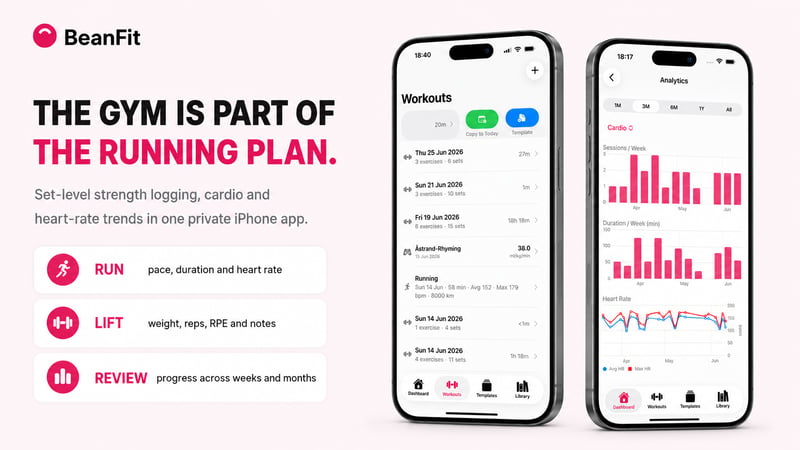
Most runners can say how far they ran last week, what pace they held, and how their heart rate behaved. A watch records every split. The strength sessions that support those miles are often reduced to “trained legs”, scattered across a notes app, or left in memory. That creates a blind spot: runners can see the endurance work clearly but struggle to judge whether the gym work is progressing, consistent, and still matching the demands of the running programme.
BeanFit is an independent iPhone app developed by Anthony Grisoni to close this gap. Its uncommon combination is the way set-level strength data is tracked alongside cardio, heart-rate, bodyweight and muscle-load analytics, making all your training work visible to review. Completing a session is not the same as understanding how it was completed.
The missing half of the training log
A useful strength record needs more than an exercise name and a session total. A back squat completed for three sets of five at 130 kg can mean something very different when the sets feel like RPE 6.5, 7, and 7.5 than when they feel like 8.5, 9 and 9.5. The tonnage is identical, but the training exposure is not. Set-level load, repetitions, RPE, and notes preserve the context that helps explain whether a runner is adapting, accumulating fatigue, or simply repeating the same work without progress.
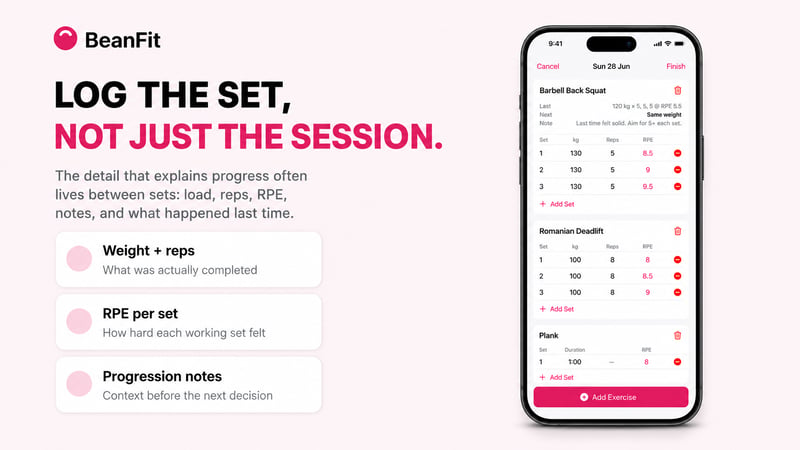
This is especially valuable for mixed training. Your periodisation might dictate running volume rising while gym volume needs to fall. A given strength exercise may stay at the same load while perceived effort drops. A note may explain why a session looked flat despite the numbers appearing normal. Recording these details turns the gym from a separate obligation into information that can shape the next decision.
Why strength training matters for short- and long-distance runners
For middle- and long-distance runners, the strongest evidence centres on running economy: the oxygen cost of maintaining a given pace. Recent systematic reviews and meta-analyses indicate that high-load resistance training, plyometric training, or a planned combination can improve running economy, particularly when added to normal endurance training rather than replacing it.1-3
The benefits are not confined to one physiological variable. Reviews of distance-running studies have reported improvements in time-trial performance, maximal sprint speed and other performance indicators after appropriately programmed strength work. These qualities matter at both ends of the running spectrum: shorter events demand high rates of force and power, while longer events still depend on economical force production, finishing speed and the ability to maintain running mechanics as fatigue accumulates.2,4
Strength and endurance training can also coexist without automatically cancelling each other out. An updated meta-analysis found that concurrent aerobic and strength training overall remains compatible for maximal strength and muscle development. However, explosive-strength adaptations may be more sensitive to how sessions are scheduled. In practice, programming, recovery and exercise selection still matter.5
Current physical activity guidance recommends both aerobic and muscle-strengthening activity, and recent meta-analyses associate muscle-strengthening activity with lower all-cause and cardiovascular mortality. The greatest health value appears to come from combining aerobic and resistance activity rather than relying on either as sufficient on its own.6-8
Runners who maintain strength, muscle function and training consistency may find it easier to keep participating, adapt their programme as life changes, and continue enjoying the sport for longer.
How BeanFit works
TL;DR: BeanFit logs every working set and stores it alongside cardio, heart rate, body weight, and longer-term analytics in one iPhone app.
- Resistance sessions can be logged with weight, repetitions, RPE, rest time and notes.
- Progression information appears during a live session as it is being recorded.
- Estimated one-repetition maximums, personal records and exercise history can be reviewed over time.
- Cardio sessions can track duration, distance, pace, average heart rate, maximum heart rate and personal notes.
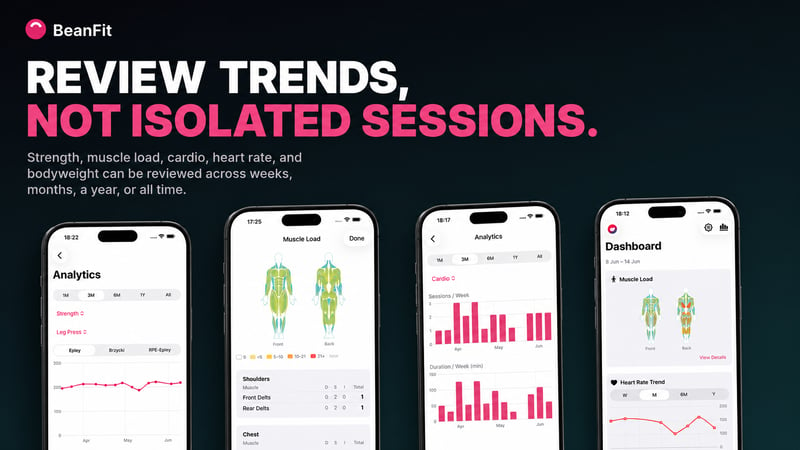
- The dashboard and analytics views bring together resistance, cardio, heart rate, body weight, and muscle load across one week, one month, three months, six months, one year, or all time.
- Previous periods can be revisited to compare training blocks rather than relying on the most recent week.
- The weekly muscle-load map translates logged resistance work into front-and-back anatomical diagrams across more than 27 muscle groups. This can quickly visualise which muscles have received repeated work and what may have been neglected.
- BeanFit also includes 39 built-in templates, more than 200 resistance and cardio exercises, custom exercises, shareable templates and backup export and restore.
Worked example: a half-marathon runner who lifts
Consider an endurance runner building towards an autumn half-marathon. The objective is to increase running volume, retain sufficient strength work to support performance and robustness, and flag when the two parts of the programme no longer fit together.
| Day | Session | Recorded detail |
|---|---|---|
| Monday | Easy run + drills | 8 km easy in 48 minutes; average HR 146 bpm; maximum HR 161 bpm; plus 6 × 20 s strides and running drills. |
| Tuesday | Strength | Back squat: 3 × 5 at 130 kg, RPE 8.5 / 9 / 9.5. Romanian deadlift: 3 × 8 at 100 kg, RPE 8 / 8.5 / 9. |
| Wednesday | Tempo / HM-pace run | 2 km warm-up + 3 × 10 min at tempo with 2 min jog; total 12 km in 64 minutes; average HR 164 bpm; maximum HR 178 bpm. |
| Friday | Strength | Lower-volume top-up session using similar movements at a lower overall dose. |
| Saturday | Long run | 18 km easy-steady in 1 hour 42 minutes; average HR 150 bpm; maximum HR 166 bpm. |
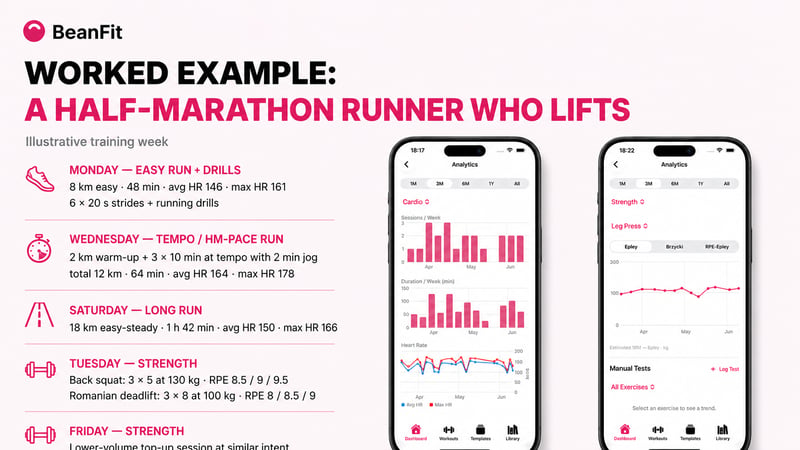
In a conventional running app, Monday’s run is recorded in detail while Tuesday’s lifting may be almost invisible. In BeanFit, both sessions sit in the same training history. Four weeks later, the runner can ask more useful questions: Is the same squat load moving at a lower RPE? Has cardio duration fallen while gym volume has risen? Are calves, hamstrings, or upper-body support work repeatedly under-dosed?
Suppose the same 130 kg squat is later completed at RPE 7.5, 8 and 8.5. That is a clearer sign of improved tolerance than total tonnage alone. If easy-run heart rate is also lower at a similar pace, that may be encouraging. However, heart rate should still be interpreted alongside heat, sleep, terrain and fatigue rather than treated as a diagnosis.
The example is illustrative rather than prescriptive. Its value lies in the review process: the athlete can see the support work clearly enough to decide whether to progress, maintain, or reduce it.
Why progression over time matters
Most useful training decisions are not made based on a single workout. They emerge from trends. The same load may feel easier. An extra repetition may be achieved at the same RPE. Cardio frequency may drift down while gym volume climbs. Bodyweight may remain stable while estimated strength rises. None of these signals is decisive alone, but together they illuminate your training picture.
This is where integrated analytics can directly improve decision-making. They allow runners to review support work in the same rhythm as their mileage: week to week, block to block and across an entire season. That makes it easier to distinguish a planned reduction from inconsistency, a genuine progression from a one-off good day, and a balanced programme from one that repeatedly ignores the same tissues or movement patterns.
BeanFit does not predict injury, prescribe rehabilitation or replace coaching. Its role is specific: it preserves your context for you (and your coach) to make a better-informed judgement. Better records do not guarantee better outcomes, but poor records make it much harder to know what should change.
Compatibility, privacy and price
BeanFit is designed for iPhone and requires iOS 17.2 or later. Apple’s listing also permits installation on Apple-silicon Macs running macOS 14.2 or later, although it is not verified for macOS. The app is currently available in English and supports Family Sharing for up to six family members.
It is intentionally self-contained rather than via an integration hub. BeanFit is not positioned as a replacement for a GPS watch, route platform or cloud coaching service. Its job is to let users record resistance and cardio sessions, review the data locally, share template files when they choose, and export or restore backup files.
The privacy model is straightforward. No account is required, no training history is sent to a BeanFit server, the developer collects no data, and there is no cloud sync, advertising or social feed. Data remains on the device unless the user chooses to export or share it.
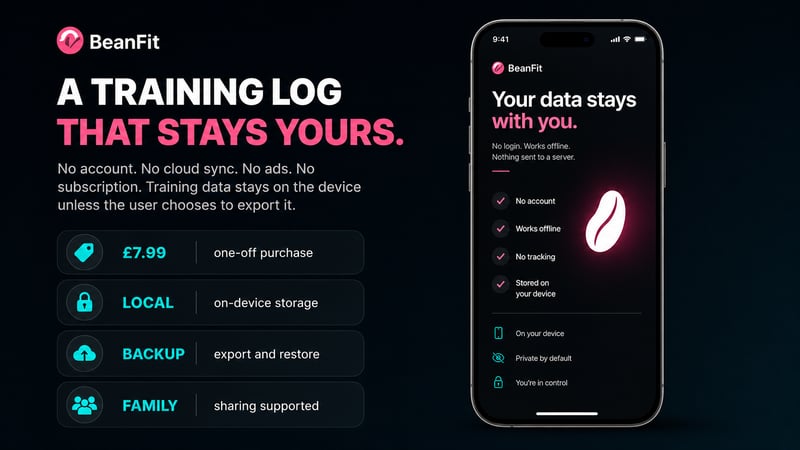
BeanFit costs £7.99 as a one-off purchase. There is no free tier, subscription, premium plan or upsell. For runners who are already paying for watches, race entries, and other platforms, the value proposition is deliberately simple: buy the training log once, keep the data, and receive future app updates without an additional monthly charge.
Summary
BeanFit will appeal most to runners who have identified that resistance training supports their performance but do not, or have not yet, track it with the same level of detail as their mileage. Its distinctive value is the combination of set-level strength logging, cardio and heart-rate records, muscle-load mapping and long-term analytics in one private iPhone app.
The app does not promise that more data automatically produces better training. It claims that when all your training (strength and endurance work) can be reviewed together, progression becomes clearer to achieve, imbalances become visible, and support work is less likely to disappear into a separate log that nobody revisits. BeanFit: a clearer path to chase your goals.
Quick answers
Is BeanFit only for lifters?
No. It is useful for runners, triathletes, strength-based, hybrid, and mixed-sport athletes who want strength, cardio, and heart rate information in the same training record.
Does BeanFit replace Garmin, Strava or a running watch?
No. BeanFit is a local training log and analytics app rather than a GPS route platform or automatic wearable-sync service. It complements a running watch by preserving the strength and cardio detail that often sits outside the main endurance record. Smart tech integrations are in the design phase.
Does strength training prevent running injuries?
Strength work can improve capacity and performance, but evidence for runner-specific prevention is mixed. Programme design, supervision, adherence, recovery, and the nature of the individual problem are all factors to be considered.
BeanFit is a fitness-tracking tool and does not provide medical advice. Exercise within your own abilities, and consult a healthcare professional if you have an injury, medical condition, or concerns about exercising. Stop immediately and seek appropriate medical advice if you experience pain or other concerning symptoms.
More: BeanFit on the App Store.
Related reading on the5krunner
- RiversideArt: Eighteen Garmin Apps Built Against the Subscription Tide: another indie shop shipping one-time-purchase apps against the subscription direction.
- Vitara: Apple Health Tells You What Happened, Vitara Shows What Changed: another privacy-first iPhone training app with on-device computation and no server.
- Negative Split: Free Local Running Analytics for Strava, No API to Lose: a local-first analytics tool that computes everything in the browser with no login or account.
References
- Llanos-Lagos C, Ramirez-Campillo R, Moran J, Saez de Villarreal E. Effect of strength training programs in middle- and long-distance runners’ economy at different running speeds: a systematic review with meta-analysis. Sports Med. 2024;54:895-932. doi:10.1007/s40279-023-01978-y.
- Blagrove RC, Howatson G, Hayes PR. Effects of strength training on the physiological determinants of middle- and long-distance running performance: a systematic review. Sports Med. 2018;48:1117-1149. doi:10.1007/s40279-017-0835-7.
- Eihara Y, Takao K, Sugiyama T, Maeo S, Terada M, Kanehisa H, et al. Heavy resistance training versus plyometric training for improving running economy and running time-trial performance: a systematic review and meta-analysis. Sports Med Open. 2022;8:138. doi:10.1186/s40798-022-00511-1.
- Beattie K, Carson BP, Lyons M, Rossiter A, Kenny IC. The effect of strength training on performance indicators in distance runners. J Strength Cond Res. 2017;31(1):9-23. doi:10.1519/JSC.0000000000001464.
- Schumann M, Feuerbacher JF, Sünkeler M, Freitag N, Rønnestad BR, Doma K, et al. Compatibility of concurrent aerobic and strength training for skeletal muscle size and function: an updated systematic review and meta-analysis. Sports Med. 2022;52(3):601-612. doi:10.1007/s40279-021-01587-7.
- Bull FC, Al-Ansari SS, Biddle S, et al. World Health Organisation 2020 guidelines on physical activity and sedentary behaviour. Br J Sports Med. 2020;54(24):1451-1462. doi:10.1136/bjsports-2020-102955.
- Momma H, Kawakami R, Honda T, Sawada SS. Muscle-strengthening activities are associated with lower risk and mortality in major non-communicable diseases: a systematic review and meta-analysis of cohort studies. Br J Sports Med. 2022;56(13):755-763. doi:10.1136/bjsports-2021-105061.
- Saeidifard F, Medina-Inojosa JR, West CP, et al. The association of resistance training with mortality: a systematic review and meta-analysis. Eur J Prev Cardiol. 2019;26(15):1647-1665. doi:10.1177/2047487319850718.
Author: Anthony Grisoni, developer of BeanFit, edited by the5krunner.
If you enjoyed reading this, here is another in the Indie Spotlight series: RiversideArt: Eighteen Garmin Apps Built Against the Subscription Tide.
Last Updated on 12 October 2026 by tfk the5krunner
Small things I always use
- Garmin 90-degree charging adapter: Charges your Garmin from any USB-C cable. Essential when travelling. I use one.
- Body Glide: The blue anti-chafe stick swimmers and runners carry. I use it.
- Speedo earplugs: Fewer ear infections and no cold-water dizziness. I use them.
- Dryrobe Advance: My winter changing robe for open-water swims. I use one. A cheaper option is the AONYIYI changing robe.
- Maurten: Race fuel that stays easy on the stomach. I use them.
- Beet It Sport nitrate shots: Beetroot shots I take in the days before a race. I use them.
- Garmin charging puck: The quickest way to top up before a session. I use one.
- Injinji: Toe socks that stop rubbing, so you run more. I use them.
- Ultimate toe protectors: Stop black toenails on long runs. They work. I use them.
- Compressport R2 v2 calf sleeves: My calf sleeves of choice. I use them.
- Cellucor C4: My pre-workout before hard sessions.
- TPU tubes: Schwalbe Aerothan, Tubolito and Pirelli SmarTube. Light, tiny spares. I use all three.
- G8 insoles: Adjustable insoles that are good. I use them.
- Cycplus Cube: A 97g electric pump that gets a road tyre rideable in two minutes. I carry one. 5% off with code THE5KRUNNER.
Watches and sensors
- Polar H10: My daily driver for waking HRV.
- Polar Verity Sense: My backup arm-worn HR sensor.
- Nomad bedside charger: Charges my iPhone and Apple Watch overnight. I use it, and many of their bands.
- Train.Red: The best muscle oxygen sensor I’ve used.
- Tymewear: Accurate heart rate and reliable ventilatory zones. I use it to pace endurance rides over an hour.
- Garmin Forerunner 970: A pro-grade triathlon watch. I use this.
- Apple Watch Ultra 4: My daily smartwatch. No phone needed on rides.
- Garmin Fenix 9 Pro: I’ve just bought one.
On the bike
- Continental GP5000 for everyday riding, and Aero 111 on the front for special occasions.
- Helmets: Specialized S-Works Evade 3 for road riding, and Rudy Project Wing for TT-style races. I use both.
- Ravemen FR300: A front light that mounts under your Garmin or Wahoo. I use one.
- Wahoo TRACKR Radar: I use it on one bike and Varia on the other. They perform the same.
- Garmin Varia RTL515: Radar that warns you of cars from behind. I use this model.
- Wahoo ELEMNT Roam 3: The bike computer that’s easy to use. I use mine on most rides.
- Favero Assioma Pro RS2: Accurate power pedals that swap easily between bikes. I use this model.
Home and indoor training
- NPE Runn: Makes my basic treadmill smart, sending more accurate speed and distance to my watch and Zwift. I use it.
- Google Wifi: Keeps Zwift connected in my pain cave. I use it.
- Apple TV 4K: Zwift on the big screen. I use two.
- Google Nest Doorbell (wired, 2nd gen): My video doorbell, running in both Google Home and Apple Home. I use it.
Health, recovery and sleep
- FreeStyle Libre 3 Plus: Shows how my blood sugar responds to diet.
- hDrop: Measures my sweat loss in summer and indoors.
- Fourth Frontier Zone: Checks my heart under load in hard sessions.
- Oura Ring 5: My partner’s recovery tracker of choice.
- Eight Sleep: A cooling mattress cover my partner and I use nightly.
Reader-Powered Content

This content is not sponsored. It’s mostly me behind the labour of love, which is this site, and I appreciate everyone who supports it.
Support the site: Follow (free, fewer ads) · Subscribe (paid, ad-free) · Buy Me A Coffee
Written by real people, with AI assistance. Fact-checked and verified for originality. See the Editorial Policy. FTC: Affiliate Disclosure — some links pay commission. As an Amazon Associate, I earn from qualifying purchases.
tfk is the founder and author of the5krunner, an independent endurance sports technology publication. With 20 years of hands-on testing of GPS watches and wearables, and competing in triathlons at an international age-group level, tfk provides in-depth expert analysis of fitness technology for serious athletes and endurance sport competitors. See the gear tfk uses. ID
