When Garmin launched its Connect+ subscription in March 2025, the reaction from owners was loud and mostly unprintable. People who had paid several hundred pounds for a watch did not enjoy being asked for a monthly fee to get more from it, and a year on, the mood is similar. Meanwhile, a quieter frustration has been building beneath the surface: useful features keep landing only on the newest and most expensive watches, while perfectly good Forerunners and Fenixes from two or three years ago are left as they are.
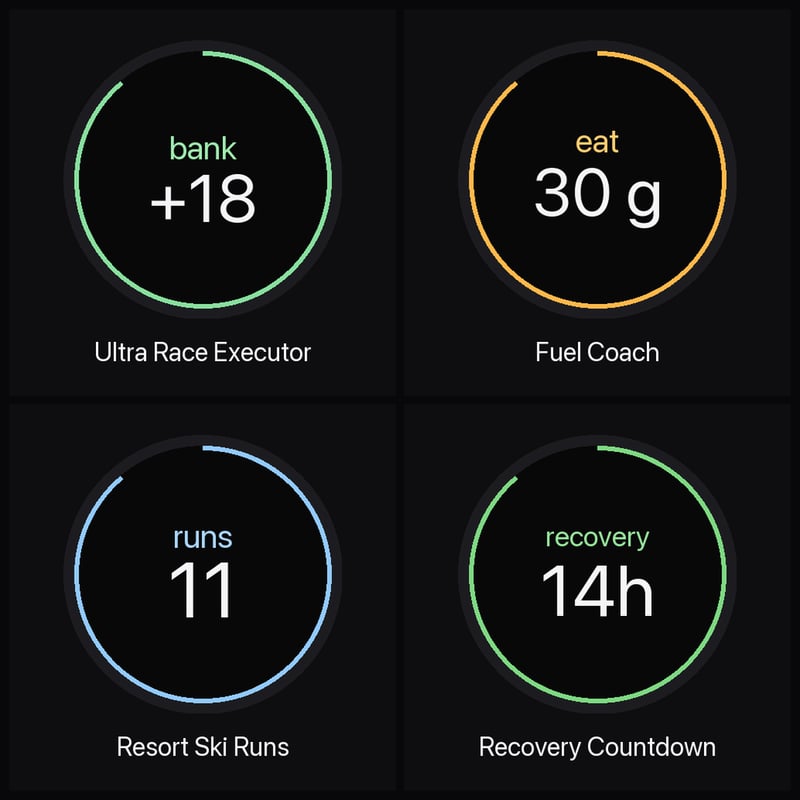
RiversideArt is a small Connect IQ shop that has planted its flag on exactly that ground. Since June 2026, it has shipped eighteen apps to the Connect IQ store. Each one is either free or a one-time purchase; every paid app now carries a free 7-day trial, and nothing needs an account, a phone connection mid-activity, or a server. This article looks at what the shop is doing and at four apps that each fill a specific gap Garmin has left open.
The Problem With Renting Features on a Watch You Own
Subscriptions make sense for services with running costs. A data field that does arithmetic on your watch has zero running cost to support, and owners know it.
The consequence for Connect IQ is that readers increasingly check the payment model before the feature list. At the same time, Garmin focuses on new native features on current premium hardware, so the large installed base of older watches becomes fertile ground for small developers willing to solve one problem well and charge for it once.
How RiversideArt Works
TL;DR: Eighteen Connect IQ apps, all free or one-time purchases between $1.99 and $4.99, free 7-day trials on everything paid, no subscriptions, no accounts, no servers.
The catalogue is mostly data fields, plus two watch faces, two small watch apps, and a glance widget. Nearly every product traces back to a specific request or complaint on Garmin’s own forums, some of them years old, and the shop’s habit is to reply in those threads once the app exists. Support requests get answered by the developer, and twice already, a user request has shipped as an update within a day:
- a configurable label for the free Countdown Timer field, and
- weigh-in calibration for the Sweat Loss Estimate field after a Forerunner 970 owner asked to tune the model against real before-and-after weights. (for live sweat and sodium loss, see the hDrop review)
Ultra Race Executor: Cutoff Pacing for the Watches Garmin Left Behind
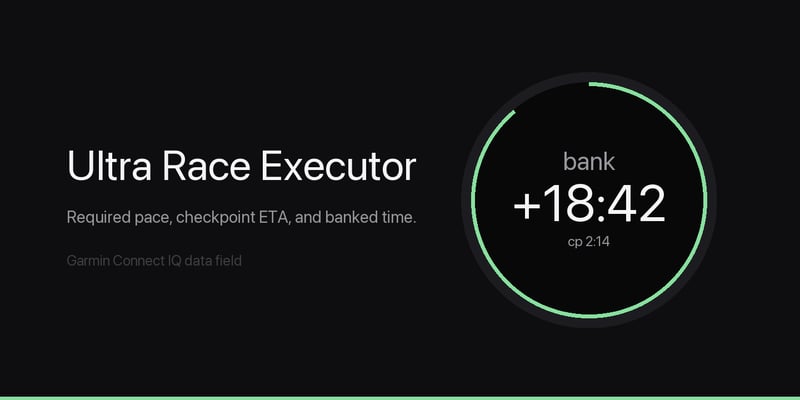
Garmin’s early 2026 update added checkpoint and cutoff tools to its course planner, but only on the newest premium watches. If you run ultras on a Forerunner 255, 265, 945, 955 or 965, or a Fenix 6 or 7, you’ve got nothing, and plenty of ultra runners still carry a paper pace card for exactly this.
Ultra Race Executor is that card, live. Set race distance, goal time, an optional cutoff time and an optional checkpoint distance, and mid-race, the field answers the questions that actually matter: the pace you need, the time you have banked, the pressure of the cutoff, and when you will hit the next checkpoint. It is $4.99 once, and it runs on the older watches that the native feature skipped.
Fuel Coach: Alerts That Survive Structured Workouts
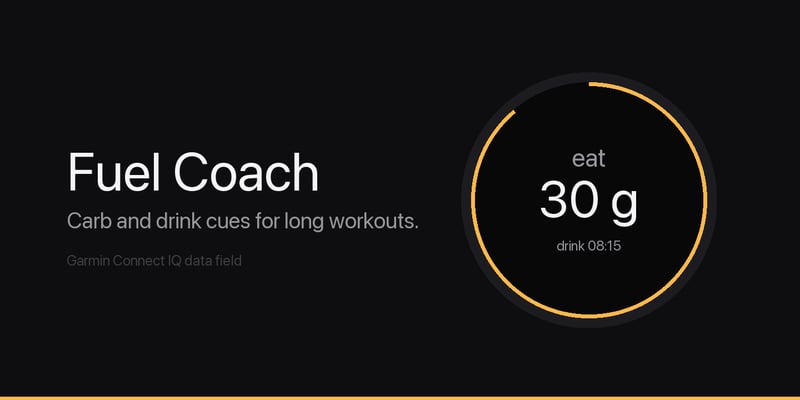
Garmin’s native eat and drink alerts have a known dead zone: they stop firing during structured workouts, which, for long interval sessions, is precisely when fuelling discipline collapses. Fuel Coach runs off the activity timer instead, so the cues keep coming.
Here is a worked example. Set a target of 90 grams of carbs per hour with 22-gram gels and the field cues a gel about every 15 minutes, which works out at 88 grams per hour, over a 3-hour ride that is 12 gels and roughly 264 grams of carbs, within a few per cent of target, with separate drink cues on their own interval. Run a 6-by-8-minute threshold session in the middle of that ride, and the cues carry straight through, where the native alerts would have gone silent. It is $3.99 with the 7-day trial to test it on a real workout first.
Resort Ski Runs: Counting Descents, Not Chairlifts
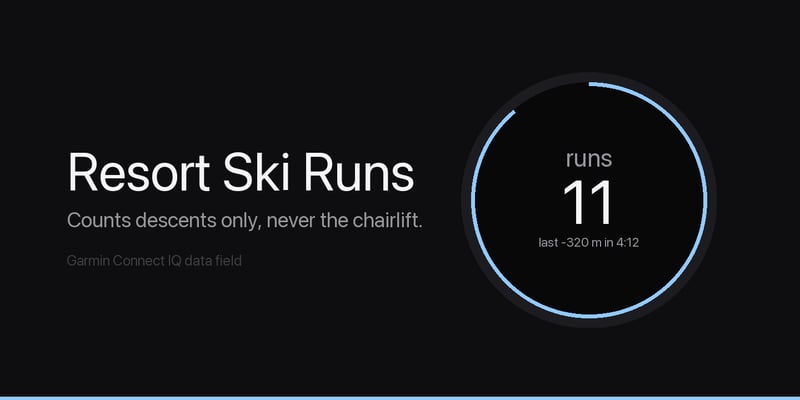
There are forum threads several years old about the alpine ski profile counting chairlift ascents into run counts and distance on watches like the Forerunner 955 and Forerunner 265S. Garmin has acknowledged it, but no fix so far.
Resort Ski Runs sidesteps the whole issue. The field watches barometric vertical speed and ground speed, decides whether you are descending, riding a lift, or standing around, and counts descents only: count, last run drop and time, descent-only vertical, and ski time against lift time. A minimum drop setting stops bunny slopes from inflating the count. Southern hemisphere skiers can use it right now; everyone else has it ready for winter. It is $3.99.
Recovery Countdown: When You Will Actually Be Recovered
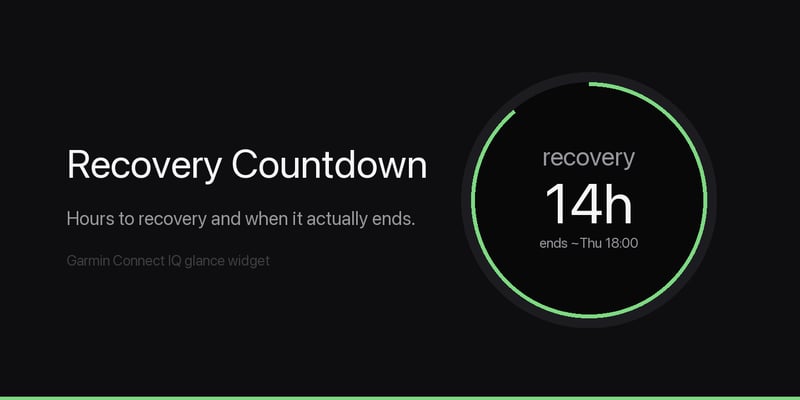
Garmin gives you recovery as a bare number of hours, which means clock arithmetic every time you glance at it. Recovery Countdown is a glance and widget that shows the hours remaining and the day and hour the countdown actually ends, so “38 hours” becomes “Thursday around 6 pm”.
One honest caveat the app states itself: outside a watch face, Garmin exposes recovery in whole hours only, so the end time is approximate by design. It is $2.99. On the Venu series watches, note that it lives in the glance list, which Garmin makes you add to by hand.
Compatibility
The portfolio targets the broad Connect IQ range rather than only current flagships:
- Forerunner: 165, 255, 265, 570, 945, 955, 965 and 970 series
- Fenix and Epix: Fenix 8 families, Fenix 6 and 7 families, Epix Gen 2 and Epix Pro, Enduro 2, Tactix 7 and 8
- Venu and vivoactive: Venu 2, 3, 4 and X1, vivoactive 5 and 6
- Instinct: Instinct 3 AMOLED models
- Edge: the fuelling and countdown fields also run on current Edge cycling computers
Exact device lists are on each store page. The review prompt and trial mechanics need Connect IQ 4.2 or newer, but the apps themselves run well below that.
Background
RiversideArt is a one-person shop, registered as a small LLC, that entered the Connect IQ store in June 2026 with three free utilities and, within weeks, followed with the paid catalogue. The build list comes from reading what Garmin owners keep asking for: the indoor rowing field, for example, implements a feature list posted almost verbatim in a forum idea thread. The bet is simple: in a market annoyed by subscriptions, being the shop that visibly does not do them is a position worth holding.
Summary
Eighteen apps, one price each, trials on everything paid, and a build list drawn from what Garmin owners actually ask for. If one of the four gaps above matches your watch and your sport, the trial costs nothing to check. Search RiversideArt on the Connect IQ store.
Quick answers
Are these really one-time purchases?
Yes. Every paid app is a single purchase between $1.99 and $4.99 with a free 7-day trial. There are no subscriptions, no accounts, and no in-app purchases.
Which watches are supported?
Most Connect IQ-capable Garmin watches from the Fenix 6 and Forerunner 945 era onward, including Forerunner 165 through 970, Venu 2 through X1, Instinct 3, and current Edge units for the cycling-relevant fields. Check the store page for the exact model.
What happens when the trial ends?
The watch blocks the app after 7 days and offers the unlock. Buying it through the Connect IQ store unlocks it permanently on the user’s account.
Related reading on the5krunner
- Garmin Connect IQ 9: Do You Miss Out On The New Capabilities?: six new CIQ 9 capabilities, which devices qualify, and which do not.
- Awesome Maps: Ordnance Survey and Satellite Maps for Garmin CIQ: another indie Connect IQ shop shipping premium map tiles to older watches, one-time purchase model.
- Beatpace: Structured Running Music That Plays Native on Garmin: an indie Connect IQ music provider that plays a workout structure rather than a catalogue.
- Fix Files: the ongoing coverage of specific Garmin bugs, gaps and workarounds. RiversideArt’s whole catalogue is that same fix-a-thing approach, delivered as apps rather than articles.
Author: RiversideArt, edited by the5krunner.
If you enjoyed reading this, here is another in the Indie Spotlight series: Structured Swim Training for Runners Who End Up in the Pool.
Last Updated on 12 October 2026 by tfk the5krunner
Small things I always use
- Garmin 90-degree charging adapter: Charges your Garmin from any USB-C cable. Essential when travelling. I use one.
- Body Glide: The blue anti-chafe stick swimmers and runners carry. I use it.
- Speedo earplugs: Fewer ear infections and no cold-water dizziness. I use them.
- Dryrobe Advance: My winter changing robe for open-water swims. I use one. A cheaper option is the AONYIYI changing robe.
- Maurten: Race fuel that stays easy on the stomach. I use them.
- Garmin charging puck: The quickest way to top up before a session. I use one.
- Injinji: Toe socks that stop rubbing, so you run more. I use them.
- Ultimate toe protectors: Stop black toenails on long runs. They work. I use them.
- Compressport R2 v2 calf sleeves: My calf sleeves of choice. I use them.
- Cellucor C4: My pre-workout before hard sessions.
- TPU tubes: Schwalbe Aerothan, Tubolito and Pirelli SmarTube. Light, tiny spares. I use all three.
- G8 insoles: Adjustable insoles that are good. I use them.
- Cycplus Cube: A 97g electric pump that gets a road tyre rideable in two minutes. I carry one. 5% off with code THE5KRUNNER.
Watches and sensors
- Polar H10: My daily driver for waking HRV.
- Polar Verity Sense: My backup arm-worn HR sensor.
- Nomad bedside charger: Charges my iPhone and Apple Watch overnight. I use it, and many of their bands.
- Train.Red: The best muscle oxygen sensor I’ve used.
- Tymewear: Accurate heart rate and reliable ventilatory zones. I use it to pace endurance rides over an hour.
- Garmin Forerunner 970: A pro-grade triathlon watch. I use this.
- Apple Watch Ultra 4: My daily smartwatch. No phone needed on rides.
- Garmin Fenix 9 Pro: I’ve just bought one.
On the bike
- Continental GP5000 for everyday riding, and Aero 111 on the front for special occasions.
- Helmets: Specialized S-Works Evade 3 for road riding, and Rudy Project Wing for TT-style races. I use both.
- Ravemen FR300: A front light that mounts under your Garmin or Wahoo. I use one.
- Wahoo TRACKR Radar: I use it on one bike and Varia on the other. They perform the same.
- Garmin Varia RTL515: Radar that warns you of cars from behind. I use this model.
- Wahoo ELEMNT Roam 3: The bike computer that’s easy to use. I use mine on most rides.
- Favero Assioma Pro RS2: Accurate power pedals that swap easily between bikes. I use this model.
Home and indoor training
- NPE Runn: Makes my basic treadmill smart, sending more accurate speed and distance to my watch and Zwift. I use it.
- Google Wifi: Keeps Zwift connected in my pain cave. I use it.
- Apple TV 4K: Zwift on the big screen. I use two.
- Google Nest Doorbell (wired, 2nd gen): My video doorbell, running in both Google Home and Apple Home. I use it.
Health, recovery and sleep
- FreeStyle Libre 3 Plus: Shows how my blood sugar responds to diet.
- hDrop: Measures my sweat loss in summer and indoors.
- Fourth Frontier Zone: Checks my heart under load in hard sessions.
- Oura Ring 5: My partner’s recovery tracker of choice.
- Kineon MOVE+: Red light therapy for niggles. It works.
- Eight Sleep: A cooling mattress cover my partner and I use nightly.
Reader-Powered Content

This content is not sponsored. It’s mostly me behind the labour of love, which is this site, and I appreciate everyone who supports it.
Support the site: Follow (free, fewer ads) · Subscribe (paid, ad-free) · Buy Me A Coffee ❤️
Written by real people, with AI assistance. Fact-checked and verified for originality. See the Editorial Policy. FTC: Affiliate Disclosure — some links pay commission. As an Amazon Associate, I earn from qualifying purchases.
tfk is the founder and author of the5krunner, an independent endurance sports technology publication. With 20 years of hands-on testing of GPS watches and wearables, and competing in triathlons at an international age-group level, tfk provides in-depth expert analysis of fitness technology for serious athletes and endurance sport competitors. ID

Speaking of extra fees for using Garmin watches: I own a Polar Vantage V3 and am very happy with it. Unfortunately, Polar doesn’t make a cycling computer, so after trying out various options, I bought an Edge 1040. The Edge provides accurate training analysis—but only if you also wear a Garmin watch all day.
I had the chance to test the Fenix 8 Pro for a few days. I was shocked to find that, despite it having LTE capabilities, I couldn’t use that feature or make calls without my phone unless I paid for a subscription! 😳🤬
My carrier provided a second SIM card, allowing me to connect via eSIM on devices like my iPad. Why isn’t that an option with the Fenix 8 Pro?!? It normally costs €1,200—or €900 at the current price! To put it emotionally: it’s a total rip-off that completely crosses the product off my list; I’ll just use the Edge as a display while continuing to use my Vantage.
Speaking of extra fees for using Garmin watches: I own a Polar Vantage V3 and am very happy with it. Unfortunately, Polar doesn’t make a cycling computer, so after trying out various options, I bought an Edge 1040. The Edge provides accurate training analysis—but only if you also wear a Garmin watch all day.
I had the chance to test the Fenix 8 Pro for a few days. I was shocked to find that, despite it having LTE capabilities, I couldn’t use that feature or make calls without my phone unless I paid for a subscription!
My carrier provided a second SIM card, allowing me to connect via eSIM on devices like my iPad. Why isn’t that an option with the Fenix 8 Pro?!? It normally costs €1,200—or €900 at the current price! To put it emotionally: it’s a total rip-off that completely crosses the product off my list; I’ll just use the Edge as a display while continuing to use my Vantage.