The pro cycling organisation (UCI) thinks there is a problem with distraction in the peloton and has decided that the size of bike computers is the issue. On the face of it, they appear to have a point, but a few seconds of thought make it all sound ridiculous.
Background
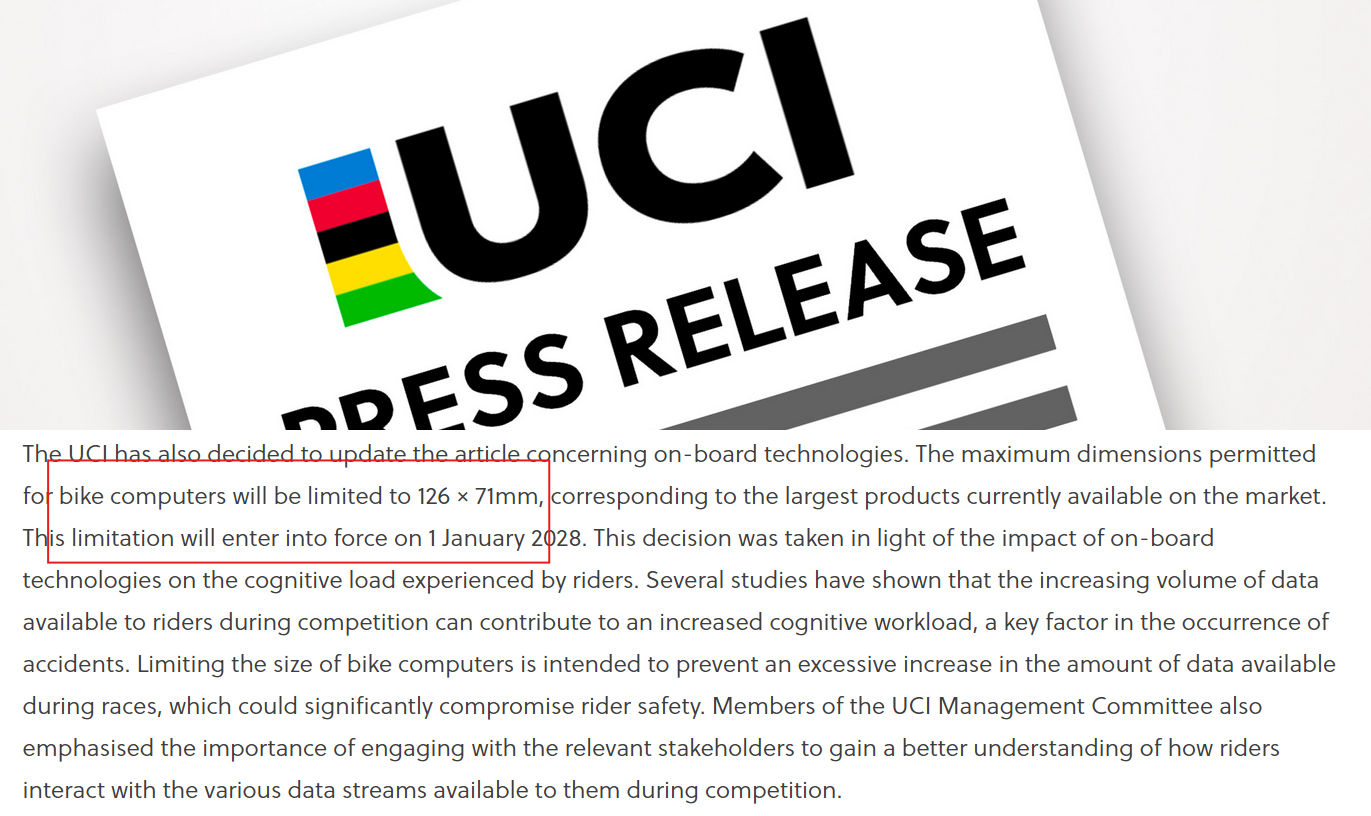
At its Management Committee meeting in Desenzano del Garda this week, the governing body approved a maximum footprint of 126 x 71mm for cycling computers used in UCI-sanctioned competition, with effect from 1 January 2028.
That number is the exact footprint of the Wahoo ELEMNT ACE, currently the largest head unit on the market. Thus, no device available today is banned. The rule targets where the industry goes next.
The cognitive load argument
Studies cited by the Management Committee link increasing volumes of on-screen data to higher cognitive workload, and higher cognitive workload to accidents. The governing body wants to prevent future screen-size inflation from making it worse.
The flaw is that screen size and data volume are not the same thing. A manufacturer can show the same number of fields, or more, on a device that fits within the 126 x 71mm limit as on a larger device. Alerts, notifications, sensor feeds, and turn-by-turn prompts: things that both inform and distract are not affected.
Smaller numbers on a smaller screen are also harder to read at speed, which is a distraction in itself. During fast descents, detailed full-screen mapping is a safety asset I always use. The UCI’s own safety rationale can, in some circumstances, increase danger.
The problem is in the software. The rule addresses hardware.
The data is going one way.
Wahoo’s recent sensor integration update for the ELEMNT ACE, ROAM 3 and BOLT 3 added native support for four new physiological data streams: CORE body temperature and Heat Strain Index, Tymewear VitalPro breathing thresholds, FLOWBIO sweat and sodium loss, and hDrop electrolyte analysis. Core temperature, hydration status, and ventilatory thresholds now sit alongside power, heart rate, and navigation as live fields. The screen dimensions play no part in the cognitive load required to manage these streams.
Garmin’s Connect IQ ecosystem and Hammerhead’s developer tools mean that third-party sensors can freely add novel, multi-coloured data fields to any modern Edge computer. A size cap does nothing to limit that. Younger riders entering the peloton will engage with these tools more readily than their predecessors. As the peloton ages and tech adoption spreads, the risk of distraction widens.
Who rides with large computers anyway?
Professional riders choose smaller, lighter units. Weight and aerodynamics settle that question before any regulation is needed. A 208g Wahoo ELEMNT ACE won’t be seen anywhere in the upcoming Tour de France. The riders running large displays either have poor eyesight or are navigating the backroads of Provence rather than tearing up the Tourmalet.
What actually gets banned
Integrated cockpit displays.
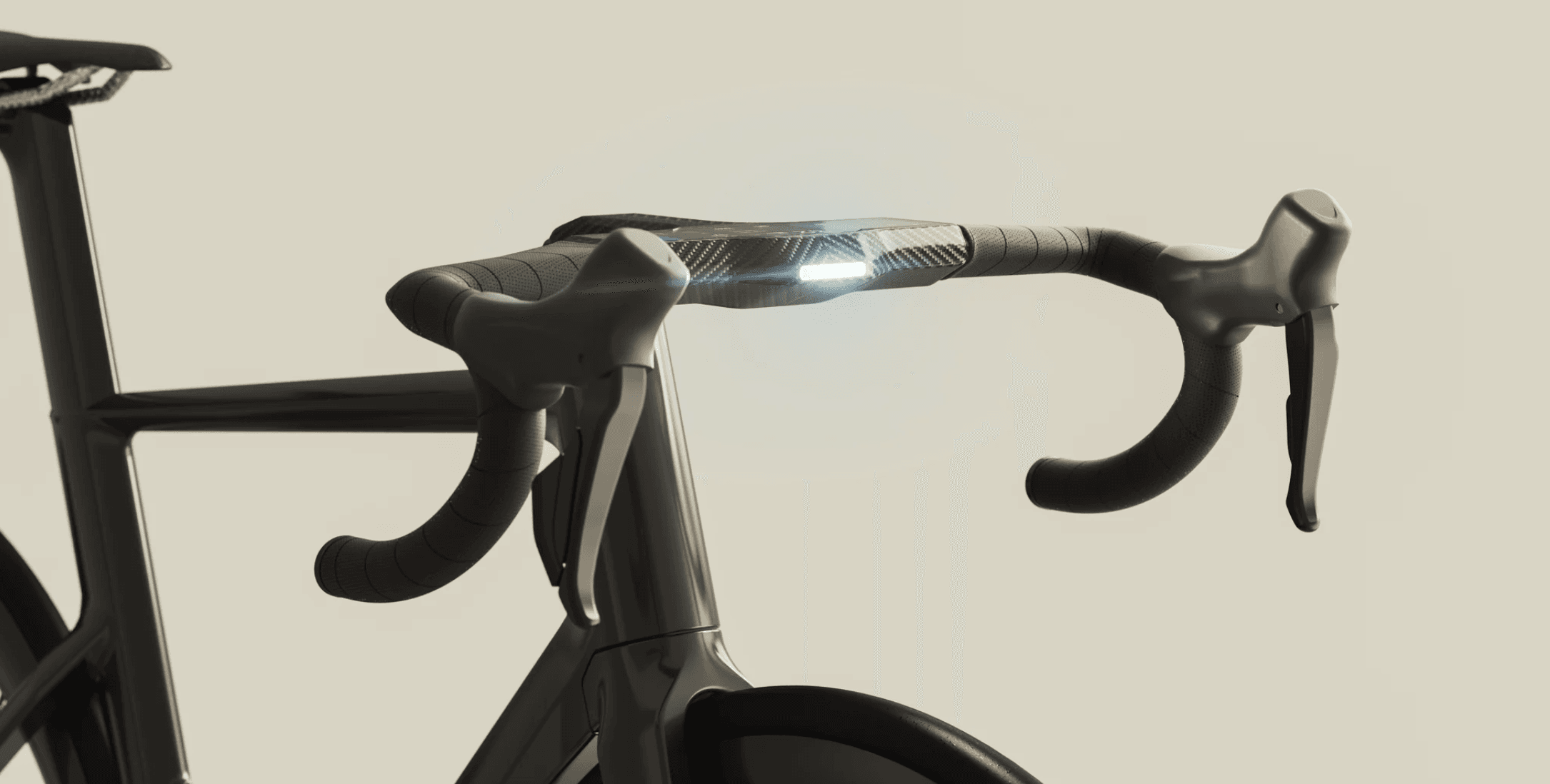
This site covered the Flitedeck last year: a handlebar with a 180 x 70mm screen built directly into the bar. That form factor will soon be UCI-illegal for competition. Any successor product is ruled out before it launches. That is the concrete consequence of this rule, not the notional ban on a device nobody in the pro peloton was using.
Front pockets, too. Yes, really.
Oh, and front jersey pockets are banned from 1 July 2026. Riders were filling the fronts of their jerseys with nutrition products they could not actually access during races, purely for the aerodynamic shaping the bulge provided. The UCI noticed. One exception: a single front pocket for a radio communication device. Fair enough.
Where this ends up
A size cap is a first move. Regulating data and functionality is the logical next step, but it is a harder problem. Banning specific data types does not work: new sensor categories arrive faster than any rulebook can keep up with, as the Wahoo update above demonstrates. The only enforceable endpoint is a list of permitted data fields; nothing else is allowed in competition.
That is also precisely where GPLama lands in his analysis, which goes one step further. Having looked at the same evidence, I agree with him. A purpose-built, UCI-approved race computer may be the only solution that is actually enforceable. Watch his full take below.
https://youtu.be/9nFBr-ARdP4
Last Updated on 3 October 2026 by tfk the5krunner
Small things I always use
- Garmin 90-degree charging adapter: Charges your Garmin from any USB-C cable. Essential when travelling. I use one.
- Body Glide: The blue anti-chafe stick swimmers and runners carry. I use it.
- Speedo earplugs: Fewer ear infections and no cold-water dizziness. I use them.
- Dryrobe Advance: My winter changing robe for open-water swims. I use one. A cheaper option is the AONYIYI changing robe.
- Maurten: Race fuel that stays easy on the stomach. I use them.
- Beet It Sport nitrate shots: Beetroot shots I take in the days before a race. I use them.
- Garmin charging puck: The quickest way to top up before a session. I use one.
- Injinji: Toe socks that stop rubbing, so you run more. I use them.
- Ultimate toe protectors: Stop black toenails on long runs. They work. I use them.
- Compressport R2 v2 calf sleeves: My calf sleeves of choice. I use them.
- Cellucor C4: My pre-workout before hard sessions.
- TPU tubes: Schwalbe Aerothan, Tubolito and Pirelli SmarTube. Light, tiny spares. I use all three.
- G8 insoles: Adjustable insoles that are good. I use them.
- Cycplus Cube: A 97g electric pump that gets a road tyre rideable in two minutes. I carry one. 5% off with code THE5KRUNNER.
Watches and sensors
- Polar H10: My daily driver for waking HRV.
- Polar Verity Sense: My backup arm-worn HR sensor.
- Nomad bedside charger: Charges my iPhone and Apple Watch overnight. I use it, and many of their bands.
- Train.Red: The best muscle oxygen sensor I’ve used.
- Tymewear: Accurate heart rate and reliable ventilatory zones. I use it to pace endurance rides over an hour.
- Garmin Forerunner 970: A pro-grade triathlon watch. I use this.
- Apple Watch Ultra 4: My daily smartwatch. No phone needed on rides.
- Garmin Fenix 9 Pro: I’ve just bought one.
On the bike
- Continental GP5000 for everyday riding, and Aero 111 on the front for special occasions.
- Helmets: Specialized S-Works Evade 3 for road riding, and Rudy Project Wing for TT-style races. I use both.
- Ravemen FR300: A front light that mounts under your Garmin or Wahoo. I use one.
- Wahoo TRACKR Radar: I use it on one bike and Varia on the other. They perform the same.
- Garmin Varia RTL515: Radar that warns you of cars from behind. I use this model.
- Wahoo ELEMNT Roam 3: The bike computer that’s easy to use. I use mine on most rides.
- Favero Assioma Pro RS2: Accurate power pedals that swap easily between bikes. I use this model.
Home and indoor training
- NPE Runn: Makes my basic treadmill smart, sending more accurate speed and distance to my watch and Zwift. I use it.
- Google Wifi: Keeps Zwift connected in my pain cave. I use it.
- Apple TV 4K: Zwift on the big screen. I use two.
- Google Nest Doorbell (wired, 2nd gen): My video doorbell, running in both Google Home and Apple Home. I use it.
Health, recovery and sleep
- FreeStyle Libre 3 Plus: Shows how my blood sugar responds to diet.
- hDrop: Measures my sweat loss in summer and indoors.
- Fourth Frontier Zone: Checks my heart under load in hard sessions.
- Oura Ring 5: My partner’s recovery tracker of choice.
- Eight Sleep: A cooling mattress cover my partner and I use nightly.
Reader-Powered Content

This content is not sponsored. It’s mostly me behind the labour of love, which is this site, and I appreciate everyone who supports it.
Support the site: Follow (free, fewer ads) · Subscribe (paid, ad-free) · Buy Me A Coffee
Written by real people, with AI assistance. Fact-checked and verified for originality. See the Editorial Policy. FTC: Affiliate Disclosure — some links pay commission. As an Amazon Associate, I earn from qualifying purchases.
tfk is the founder and author of the5krunner, an independent endurance sports technology publication. With 20 years of hands-on testing of GPS watches and wearables, and competing in triathlons at an international age-group level, tfk provides in-depth expert analysis of fitness technology for serious athletes and endurance sport competitors. See the gear tfk uses. ID

That’s what you get when (barely competent) bureaucrats, who probably don’t bike and who are overwhelmed by the information from their iPhone when they rent an E-Scooter, are allowed to make rules and decide over equipment bans. But I am sure they are able to present plenty of evidence that smaller screens with a much smaller font have reduced the number of incidents and will do so in the future. And if anyone from the UCI is reading this blog, I would like to join the board and my pitch would be to ban all bicycles, since they seem to cause a lot of incidents and are constantly blocking all the team cars and motorbikes with camera men.