I don’t drink much alcohol, but tonight was going to be one of those nights. The plan? 2 hours in the gym doing something pretty hard, then hoping that the much higher excess post-exercise oxygen consumption (EPOC) will burn off the alcohol. It doesn’t. The liver clears alcohol at a fixed rate regardless of what you just did in the gym. All I did was arrive at the pub tired. Very tired.
I was very tired because I ran to and from the gym, and whilst there, did a Hyrox simulation with 5 minutes per station, plus some faffing around and chatting. Two hours from start to finish.
Other than having a few beers, the plan was to test out Fitbit Air, Amazfit Cheetah 2 Ultra, the Frontier Zone ECG chest strap, Whoop MG (biceps) and my trusty Polar SENSE (biceps).
What I did
Hyrox intersperses 8 functional exercises with 1km runs. I did my best to match the real-world arena events with the functional exercises. I had no sled to push or pull this time, so I improvised, and I might have to admit that the wall-ball target I chose was lower than it should have been, explaining why it felt much easier than normal.
What I found
Fitbit AIR was the worst of the devices on test, but I’d say it was mostly good. You’ll see why once we get past the stats and onto the charts. Here are the summary accuracy stats for each device
- Fitbit Air – Accurate average HR (within ~1 bpm of others) but widest error range (up to ±22 bpm); least consistent device tested.
- Amazfit Cheetah 2 Ultra (Zepp) – Excellent accuracy; −0.1 bpm bias vs WHOOP, +1.1 bpm vs Polar SENSE; slightly more consistent than WHOOP.
- Polar SENSE – Best optical sensor; 5,501 samples; ~+1 bpm bias vs Zepp/WHOOP; tightest agreement among wearables.
- Frontier Zone (chest strap) – Reference device; best overall agreement, but only 275 matched samples.
- WHOOP MG – Excellent accuracy; ~+1.2 bpm bias vs Polar SENSE; essentially tied with Zepp.
And here is a timeseries chart and Levels of Agreement between each pair of devices.
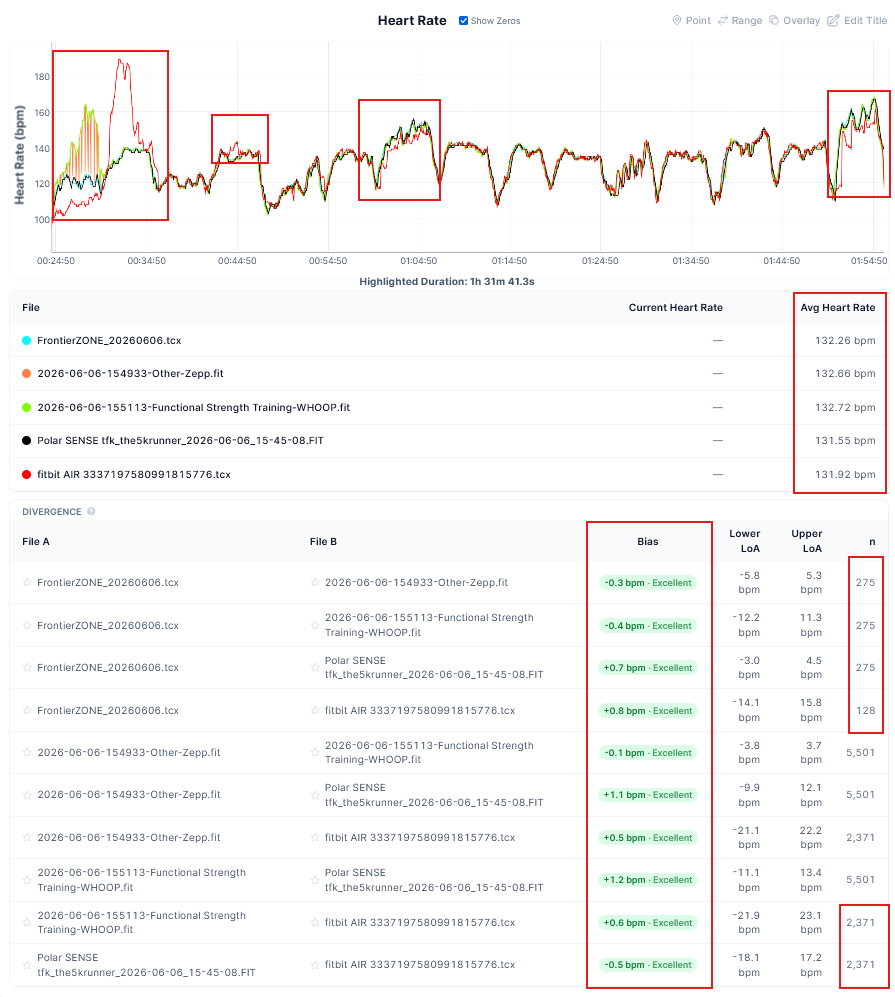
The highlighted part of the workout skips the run to and from the gym, so it goes straight into the ski erg and the treadmill. Clearly, several devices struggle a bit to get up to speed, even after 20 minutes of easy running. Whoop and Zepp/Amazfit both over-read during the ski erg, but the interesting observation is that Zepp toggles between the correct reading and the incorrect Whoop reading. Oddly, two incorrect values match, no? My explanation is that both have the same motion-artefact detection bug.
After that, all the devices pretty much agree, except Air, which has a slight blip on the sled pull but then undercooks things slightly on the burpees and wall balls.
I’ll keep coming back to Whoop’s accuracy. It is more than accurate enough on the biceps. I’ve found that in my review of the Whoop MG version immediately after launch and consistently since. People who say ‘Whoop is inaccurate’ mean ‘inaccurate on the wrist’ (I agree, it can be), and every device has a significantly higher chance of being inaccurate on the wrist, depending on many factors, including motion artefacts. I find Garmin to be inaccurate on the wrist – I simply rely on a chest strap instead, as I want accurate data in Garmin Connect.
The final data issue to nail is the number of data points, the ‘n’ value. For some reason, this particular non-GPS recording prevented Frontier Zone from exporting its usual FIT file, instead, the TCX (CSV) file I got and converted had only one data point every 40 seconds or so. Very odd. Very annoying. The Fitbit Air’s earlier paucity of test data points was mostly rectified here, with it now recording half as many as before, up from the 20% found in previous tests. The 50% is correct behaviour as Air is specified as up to one recording per 2 seconds (0.5Hz)
Sleep Quality – Post Exercise+Alcohol
Alcohol negatively affects sleep quality.
This particular post-beer night, I was blessed with good sleep, and even my HRV4Training HRV readings were above my normal range.
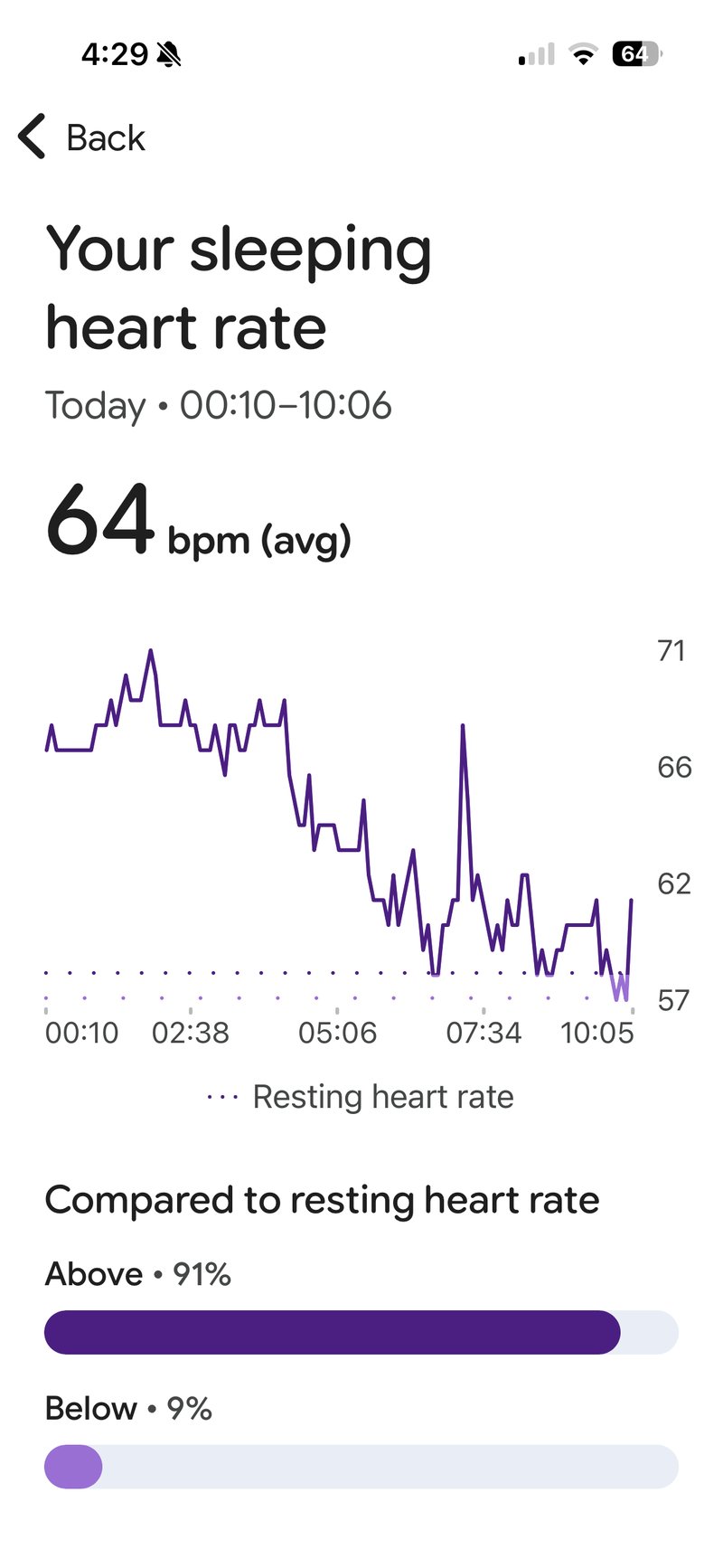
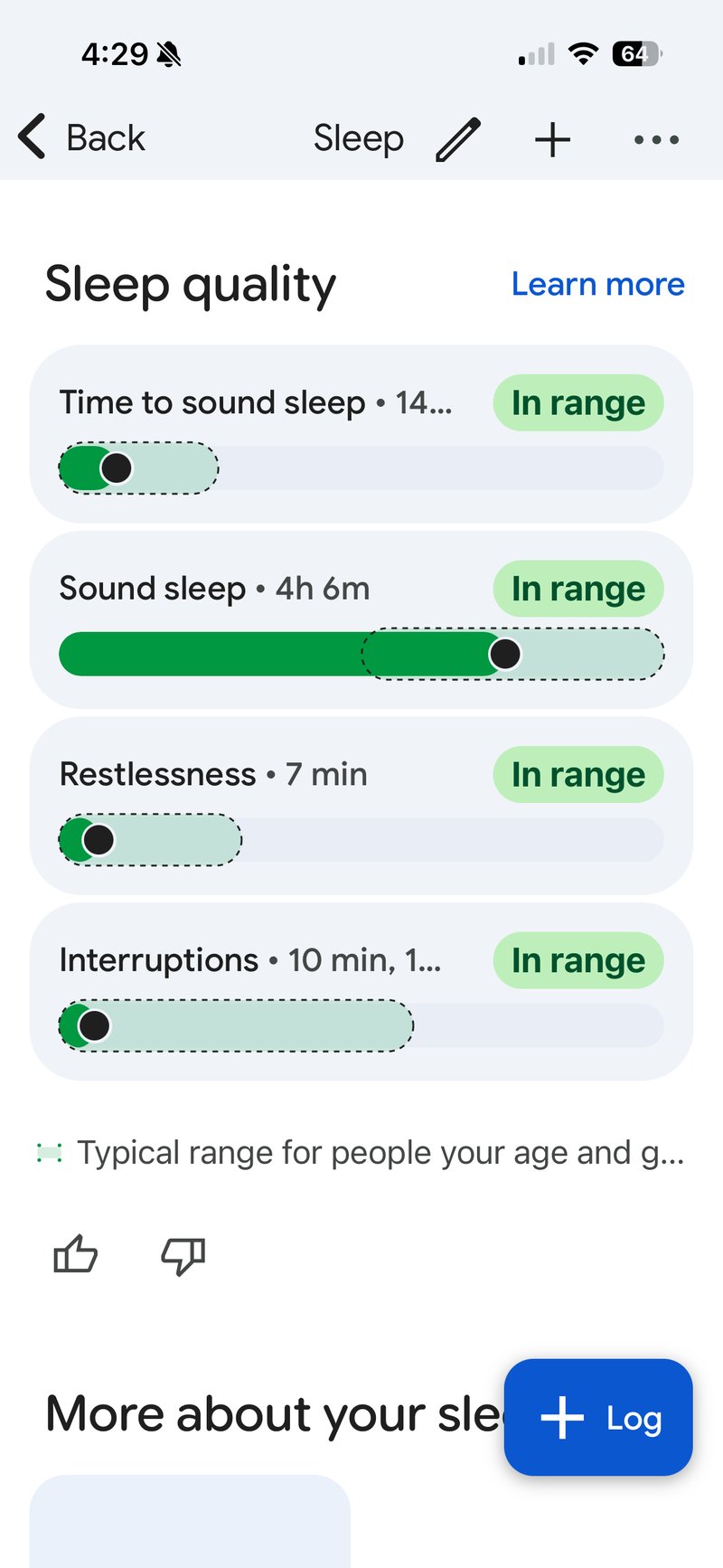
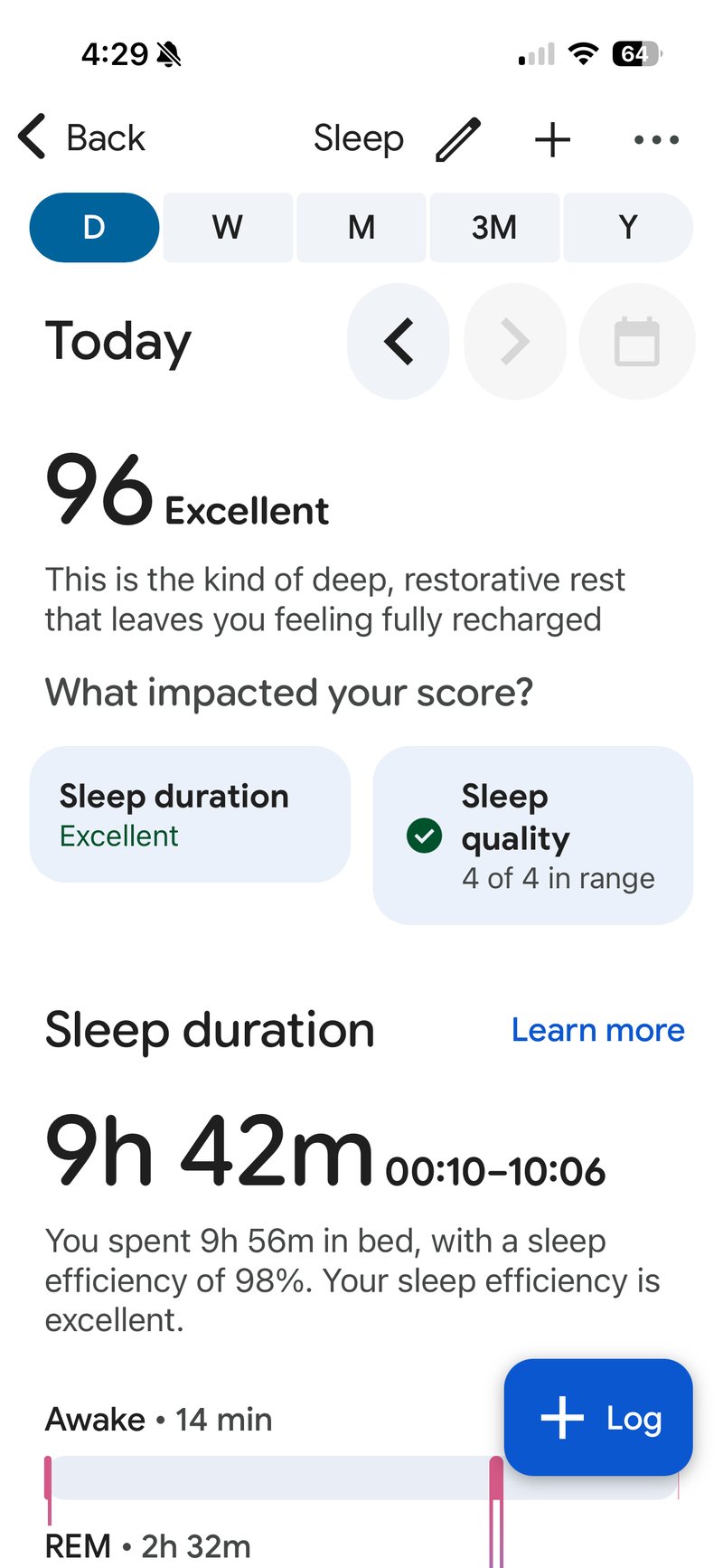
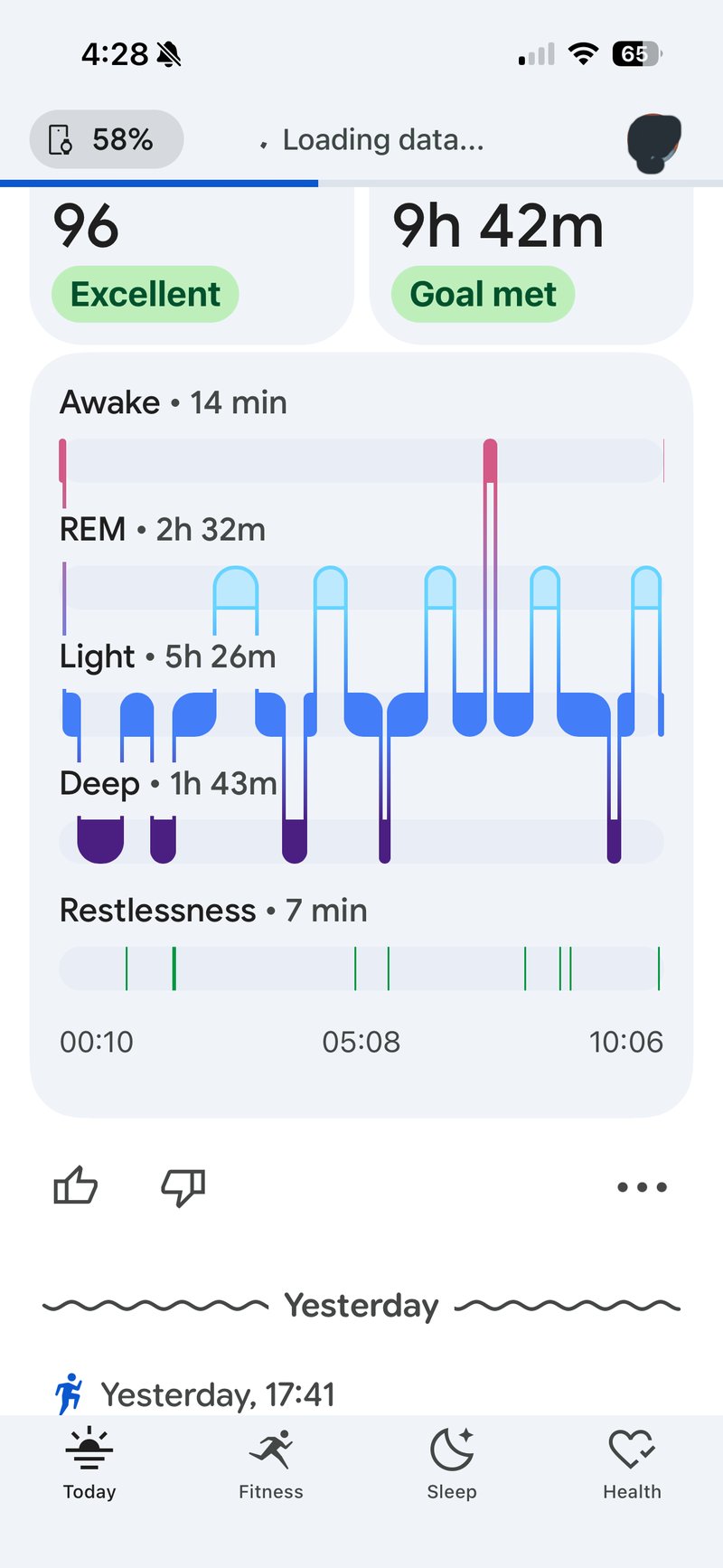
Fitbit Air did a good job of recording my sleep parameters, even catching the 6 am toilet visit. However, it rated my sleep as 96, whereas Eight Sleep came in slightly more conservatively at 86. These scores are meaningless scientifically, but considering alcohol was involved and my HR at rest throughout the night declined to a still high level by morning, I think Fitbit’s 96 is probably over-egging reality.
Take Out
The main takeaway is not to waste your time doing workouts when there is alcohol involved before or after. That aside, let’s get back to the tech on test.
Amazfit Cheetah is positioning itself as the HYROX watch. So the HR performance here is good but not perfect. Hopefully, the brand has some more tweaks for us that I will get to experience firsthand when I get hold of the new Balance (next week).
Fitbit Air keeps proving itself generally good when it actually records data, but annoying when it just forgets to – its performance seems unnecessarily overhyped by almost the entirety of the internet. Either way, it’s not an athletic-grade product. Fitness grade? Sure. Recovery grade? Sure. General tracker? Sure. Just not for athletes doing athletic stuff. Every test and the verdict are in the Fitbit Air review.
For the full Amazfit range, accuracy data and Zepp Health analysis: Amazfit sports watch guide. For full context on the Fitbit Air within the Google ecosystem: Google Fitbit and Wear OS hub.
Last Updated on 16 October 2026 by tfk the5krunner
Small things I always use
- Garmin 90-degree charging adapter: Charges your Garmin from any USB-C cable. Essential when travelling. I use one.
- Body Glide: The blue anti-chafe stick swimmers and runners carry. I use it.
- Speedo earplugs: Fewer ear infections and no cold-water dizziness. I use them.
- Dryrobe Advance: My winter changing robe for open-water swims. I use one. A cheaper option is the AONYIYI changing robe.
- Maurten: Race fuel that stays easy on the stomach. I use them.
- Beet It Sport nitrate shots: Beetroot shots I take in the days before a race. I use them.
- Garmin charging puck: The quickest way to top up before a session. I use one.
- Injinji: Toe socks that stop rubbing, so you run more. I use them.
- Ultimate toe protectors: Stop black toenails on long runs. They work. I use them.
- Compressport R2 v2 calf sleeves: My calf sleeves of choice. I use them.
- Cellucor C4: My pre-workout before hard sessions.
- TPU tubes: Schwalbe Aerothan, Tubolito and Pirelli SmarTube. Light, tiny spares. I use all three.
- G8 insoles: Adjustable insoles that are good. I use them.
- Cycplus Cube: A 97g electric pump that gets a road tyre rideable in two minutes. I carry one. 5% off with code THE5KRUNNER.
Watches and sensors
- Polar H10: My daily driver for waking HRV.
- Polar Verity Sense: My backup arm-worn HR sensor.
- Nomad bedside charger: Charges my iPhone and Apple Watch overnight. I use it, and many of their bands.
- Train.Red: The best muscle oxygen sensor I’ve used.
- Tymewear: Accurate heart rate and reliable ventilatory zones. I use it to pace endurance rides over an hour.
- Garmin Forerunner 970: A pro-grade triathlon watch. I use this.
- Apple Watch Ultra 4: My daily smartwatch. No phone needed on rides.
- Garmin Fenix 9 Pro: I’ve just bought one.
On the bike
- Continental GP5000 for everyday riding, and Aero 111 on the front for special occasions.
- Helmets: Specialized S-Works Evade 3 for road riding, and Rudy Project Wing for TT-style races. I use both.
- Ravemen FR300: A front light that mounts under your Garmin or Wahoo. I use one.
- Wahoo TRACKR Radar: I use it on one bike and Varia on the other. They perform the same.
- Garmin Varia RTL515: Radar that warns you of cars from behind. I use this model.
- Wahoo ELEMNT Roam 3: The bike computer that’s easy to use. I use mine on most rides.
- Favero Assioma Pro RS2: Accurate power pedals that swap easily between bikes. I use this model.
Home and indoor training
- NPE Runn: Makes my basic treadmill smart, sending more accurate speed and distance to my watch and Zwift. I use it.
- Google Wifi: Keeps Zwift connected in my pain cave. I use it.
- Apple TV 4K: Zwift on the big screen. I use two.
- Google Nest Doorbell (wired, 2nd gen): My video doorbell, running in both Google Home and Apple Home. I use it.
Health, recovery and sleep
- FreeStyle Libre 3 Plus: Shows how my blood sugar responds to diet.
- hDrop: Measures my sweat loss in summer and indoors.
- Fourth Frontier Zone: Checks my heart under load in hard sessions.
- Oura Ring 5: My partner’s recovery tracker of choice.
- Eight Sleep: A cooling mattress cover my partner and I use nightly.
Reader-Powered Content

This content is not sponsored. It’s mostly me behind the labour of love, which is this site, and I appreciate everyone who supports it.
Support the site: Follow (free, fewer ads) · Subscribe (paid, ad-free) · Buy Me A Coffee
Written by real people, with AI assistance. Fact-checked and verified for originality. See the Editorial Policy. FTC: Affiliate Disclosure — some links pay commission. As an Amazon Associate, I earn from qualifying purchases.
tfk is the founder and author of the5krunner, an independent endurance sports technology publication. With 20 years of hands-on testing of GPS watches and wearables, and competing in triathlons at an international age-group level, tfk provides in-depth expert analysis of fitness technology for serious athletes and endurance sport competitors. See the gear tfk uses. ID

on my end it has recorded everything and when it takes time to upload it i just chat with the AI and let i know i did a run or wtv the case may be and it works as intended. to me so far the hype has been real. no bugs no issues just working as it should.
Hey!
We are developing a specific wearable for functional fitness.
Maybe you would like to check it out.
Let me know if you have any questions.
https://wodmotions.com/