Amazfit price rises: are they getting too expensive?
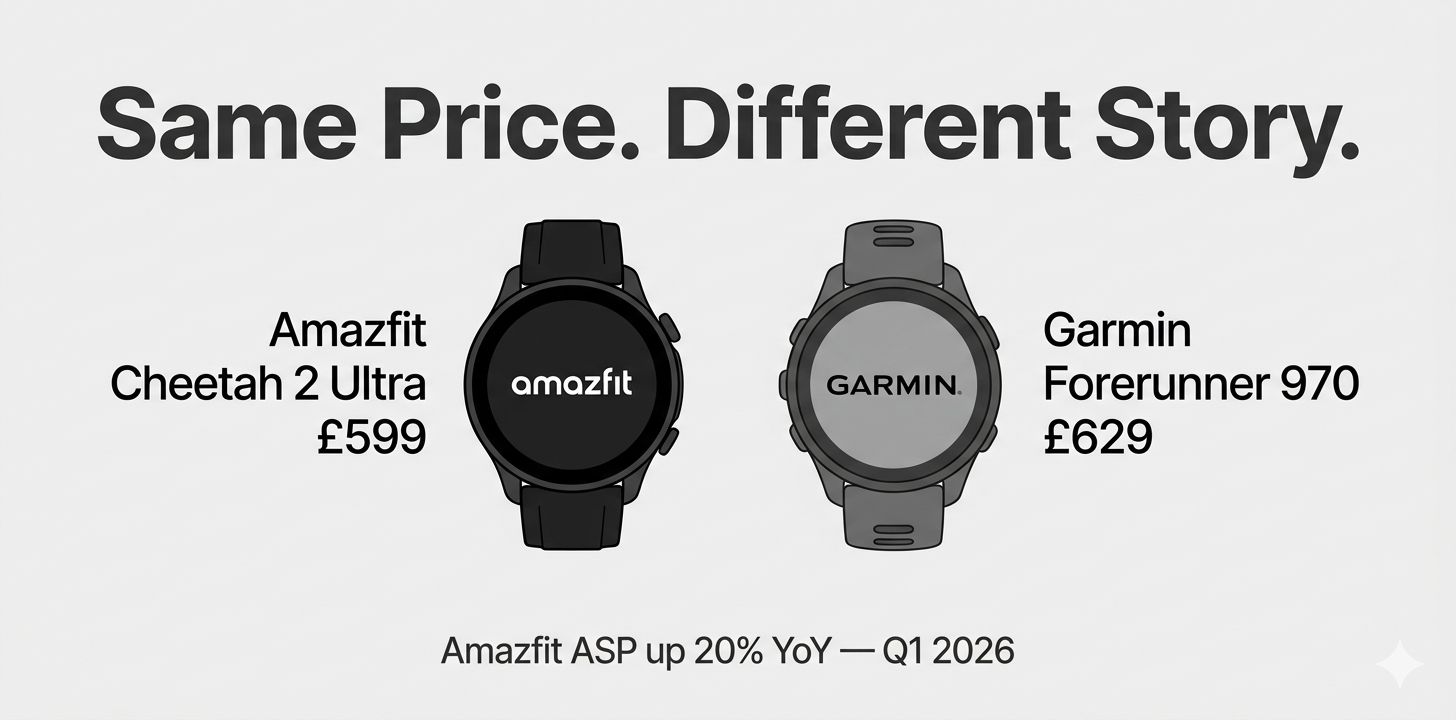
Zepp Health has confirmed that average selling prices across the Amazfit portfolio rose more than 20 per cent year-over-year in Q1 2026. Consumers are paying the higher prices. For now, at least, the market appears willing to follow Amazfit upmarket.
I assumed the usual Amazfit pattern would reassert itself: launch high, discount quickly. So far, it has not, as all seven products launched in 2026 are holding at MSRP. Clearly, this is the new strategy:
| Product | Launch | Price (unchanged) |
|---|---|---|
| Active Max | January 2026 | $169.99 |
| Active 3 Premium | February 2026 | $169.99 |
| T-Rex Ultra 2 | February 2026 | $549.99 / £549.90 |
| Cheetah 2 Pro | April 2026 | $449.99 |
| Cheetah 2 Ultra | May 2026 | $599.99 / £599.90 |
| Bip Max | May 2026 | $99.99 |
| Balance 3 / Balance Ultra | June 2026 | $369.99-$599.99 |
Q: Could discounts be widespread in third-party channels?
A: No. Price comparison sites show only Amazfit’s own channels, including its Amazon Store, so there is no meaningful independent retail channel in the UK applying competitive pricing pressure. The periodic coupon codes and Prime Day bundles are shallow.
The Cheetah 2 Ultra, recently launched at £599.90, now sits alongside the Garmin Forerunner 970, which launched at £629.99 and is currently available at slightly lower retail levels (around £592 to £599). Garmin remains ahead in software, ecosystem depth, and training functionality. Battery life still goes the other way in Amazfit’s favour, but price no longer does. The brand is no longer asking buyers to take a chance on a cheaper alternative. It is asking them to choose Amazfit.
The Polar and Coros trap
Amazfit is falling into the same trap that Polar fell into a decade ago, and that Coros is currently walking into with its eyes open. The difficulty is that premium watch buyers rarely make a purchase based on a specification sheet. The Cheetah 2 Ultra’s titanium and sapphire are real and valuable product characteristics. But Garmin’s advantage is its brand. At one end, that means genuine trust and perceived quality. At the other, it simply means the watch a friend mentions when asked.
The strategic problem
The pincer movement on Garmin that this site has argued for requires Chinese brands to compress from below, while Apple compresses from above. Amazfit moving upmarket and away from the discounted zone blunts the lower jaw of that pincer, leaving the entry levels open for the next challenger.
As Michael Porter wrote in Competitive Strategy (1980, p.41): “The firm stuck in the middle is almost guaranteed low profitability.” He restated it on the same page: “A firm stuck in the middle is in an extremely poor strategic situation.” Porter’s generic strategies framework makes the survival logic plain: defensible positions are either high volume and low cost, or low volume and high margin. Garmin does not occupy the low-cost end. Amazfit is vacating it.
Huawei is the wildcard. Smartphone-scale distribution in China and a device that shares truly smart features give it a platform neither Garmin nor Amazfit can match, though its reach outside China remains limited. The full picture of Amazfit 2026 product launches is covered separately.
Quick answers
Has Amazfit discounted any of its 2026 watches?
Not as of June 2026. All seven products launched this year are holding at MSRP. Periodic coupon codes exist but are shallow and short-lived.
Why are Amazfit's prices rising?
Zepp Health confirmed that average selling prices rose more than 20 per cent year-over-year in Q1 2026, driven by a deliberate shift toward premium materials, including titanium and sapphire glass, across the range.
Is Amazfit a good value compared to Garmin at the same price?
On materials, yes. On features, software depth, and ecosystem maturity, no.
What is Porter's 'stuck in the middle' theory?
Michael Porter argued in Competitive Strategy (1980) that firms which fail to commit to either cost leadership or differentiation end up in an indefensible middle ground. He called this being stuck in the middle and described it as almost guaranteeing low profitability.
For the full Amazfit range, accuracy data and Zepp Health analysis: Amazfit sports watch guide.
Last Updated on 3 October 2026 by tfk the5krunner
Small things I always use
- Garmin 90-degree charging adapter: Charges your Garmin from any USB-C cable. Essential when travelling. I use one.
- Body Glide: The blue anti-chafe stick swimmers and runners carry. I use it.
- Speedo earplugs: Fewer ear infections and no cold-water dizziness. I use them.
- Dryrobe Advance: My winter changing robe for open-water swims. I use one. A cheaper option is the AONYIYI changing robe.
- Maurten: Race fuel that stays easy on the stomach. I use them.
- Beet It Sport nitrate shots: Beetroot shots I take in the days before a race. I use them.
- Garmin charging puck: The quickest way to top up before a session. I use one.
- Injinji: Toe socks that stop rubbing, so you run more. I use them.
- Ultimate toe protectors: Stop black toenails on long runs. They work. I use them.
- Compressport R2 v2 calf sleeves: My calf sleeves of choice. I use them.
- Cellucor C4: My pre-workout before hard sessions.
- TPU tubes: Schwalbe Aerothan, Tubolito and Pirelli SmarTube. Light, tiny spares. I use all three.
- G8 insoles: Adjustable insoles that are good. I use them.
- Cycplus Cube: A 97g electric pump that gets a road tyre rideable in two minutes. I carry one. 5% off with code THE5KRUNNER.
Watches and sensors
- Polar H10: My daily driver for waking HRV.
- Polar Verity Sense: My backup arm-worn HR sensor.
- Nomad bedside charger: Charges my iPhone and Apple Watch overnight. I use it, and many of their bands.
- Train.Red: The best muscle oxygen sensor I’ve used.
- Tymewear: Accurate heart rate and reliable ventilatory zones. I use it to pace endurance rides over an hour.
- Garmin Forerunner 970: A pro-grade triathlon watch. I use this.
- Apple Watch Ultra 4: My daily smartwatch. No phone needed on rides.
- Garmin Fenix 9 Pro: I’ve just bought one.
On the bike
- Continental GP5000 for everyday riding, and Aero 111 on the front for special occasions.
- Helmets: Specialized S-Works Evade 3 for road riding, and Rudy Project Wing for TT-style races. I use both.
- Ravemen FR300: A front light that mounts under your Garmin or Wahoo. I use one.
- Wahoo TRACKR Radar: I use it on one bike and Varia on the other. They perform the same.
- Garmin Varia RTL515: Radar that warns you of cars from behind. I use this model.
- Wahoo ELEMNT Roam 3: The bike computer that’s easy to use. I use mine on most rides.
- Favero Assioma Pro RS2: Accurate power pedals that swap easily between bikes. I use this model.
Home and indoor training
- NPE Runn: Makes my basic treadmill smart, sending more accurate speed and distance to my watch and Zwift. I use it.
- Google Wifi: Keeps Zwift connected in my pain cave. I use it.
- Apple TV 4K: Zwift on the big screen. I use two.
- Google Nest Doorbell (wired, 2nd gen): My video doorbell, running in both Google Home and Apple Home. I use it.
Health, recovery and sleep
- FreeStyle Libre 3 Plus: Shows how my blood sugar responds to diet.
- hDrop: Measures my sweat loss in summer and indoors.
- Fourth Frontier Zone: Checks my heart under load in hard sessions.
- Oura Ring 5: My partner’s recovery tracker of choice.
- Eight Sleep: A cooling mattress cover my partner and I use nightly.
Reader-Powered Content

This content is not sponsored. It’s mostly me behind the labour of love, which is this site, and I appreciate everyone who supports it.
Support the site: Follow (free, fewer ads) · Subscribe (paid, ad-free) · Buy Me A Coffee
Written by real people, with AI assistance. Fact-checked and verified for originality. See the Editorial Policy. FTC: Affiliate Disclosure — some links pay commission. As an Amazon Associate, I earn from qualifying purchases.
tfk is the founder and author of the5krunner, an independent endurance sports technology publication. With 20 years of hands-on testing of GPS watches and wearables, and competing in triathlons at an international age-group level, tfk provides in-depth expert analysis of fitness technology for serious athletes and endurance sport competitors. See the gear tfk uses. ID

The price difference in GBP is very small. Here in Czechia we have something about 40 EUR when Forerunner 970 is on sale. The official price is about 780 EUR compared to about 620 EUR price of Cheetah 2 Ultra (and Balance Ultra as well probably). Which is quite interesting given official price of Forerunner 970 on german site is 670 EUR and of Balance Ultra/Cheetah 2 Ultra also on german site is 600 EUR.
Because Cheetah 2 Ultra and Balance Ultra are using a lot of titanium, I think the price is ok. They have delivered high-quality watches from a material standpoint. If they would have released a Cheetah 2 Ultra stainless steel version, it would be probably match the Balance 3 stainless steel pricing of $/€ 369- which is a very good price for the delivered hardware. I have no problems with the Amazfit pricing. The Bip Max has a really good pricing for the offered hw and sw, so is the Active Max and…. But others may see this different…
TI – agreed, that’s part of the argument. for those who notice and value materials it is important. you are the minority!
They shouldn’t grumble or whine; they should just buy a cheaper model instead. No one is forced to buy a specific model. Yet, many people always want the latest thing. Higher quality comes at a price, after all—and that’s not just the case with Amazfit.