Polar and Suunto’s 2025 accounts: two different roads through the same year
Polar and Suunto are both Finnish endurance sports companies that filed their 2025 accounts within weeks of each other, and both are under real financial pressure. Here are the highlights alongside Zepp-Amazfit for the same period, with the full breakdown in Polar’s 2025 results and Suunto’s 2025 results.
| Metric | Polar 2025 | Suunto 2025 | Amazfit (Zepp Health) 2025 |
|---|---|---|---|
| Revenue | €112.2m, down 2.75% | €106.5m, up 26.95% | $258.9m, up 41.8% |
| Operating result | -€11.0m, widened 42.8% | €2.9m, from a €7.4m loss | not disclosed separately |
| Net result | -€14.8m, widened 20% | €4.9m, from a €9.1m loss | -$40.1m, narrowed from -$75.8m |
| R&D spending | €20.2m, 17.9% of revenue, held flat | €7.4m, down 30.8% | not disclosed separately |
| Headcount | 937, down 3.6% | 214, down 22.5% | not disclosed |
| Net worth | €13.4m, down 54.3% | -€3.6m, still negative but improving | $214.5m, down from $252.7m |
| Cash | €12.5m, up 12.6% | €9.6m, down 10.4% | $57.0m, down from $91.1m |
| Operating cash flow | +€0.77m | -€0.4m | -$25.7m |
| Ownership | Finnish, family-owned | Chinese-owned (Liesheng, since 2022) | US-listed (NYSE: ZEPP), Cayman holding company |
The fourth major competitor in the space, Coros, is legally domiciled in the US but privately held and majority-owned by a Chinese firm; as a private US company with no stock listing, it has no disclosure requirements, so no public figures exist.
Two Finnish companies, opposite trajectories
Polar’s revenue held roughly flat while its losses kept widening, whereas Suunto’s revenue jumped sharply, and it swung to profit. On the surface, Suunto looks like the winner, but a deeper look reveals a different picture.
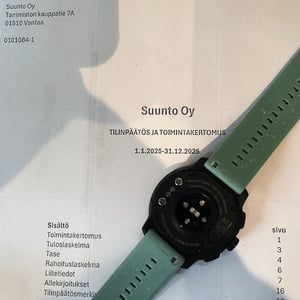
A meaningful share of Suunto’s net profit came from an unrealised currency gain, and its operating cash flow actually went negative in the same year the profit and loss account improved; rising receivables and inventory ate the cash a genuinely strong trading year should have generated.
What each company chose to protect
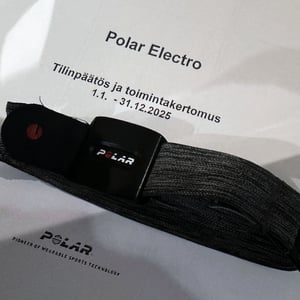
Polar protected its R&D budget in full while cutting other operating costs by a fifth. Suunto cut R&D by nearly a third alongside a 22.5% headcount reduction, a far larger cut than anything in Polar’s own accounts.
That’s a real strategic divergence: Polar is betting its technology itself is worth defending even as sales struggle, licensing Smart Coaching and sensor tech to Sennheiser and Motorola along the way. Suunto cut deeper into the thing that builds future products, yet so far is managing to deliver them.
Net worth tells two different stories
Polar’s net worth is large and shrinking fast, down 54% in a single year.
Polar still owns more than it owes, but the pace of decline could become a problem, and it’s exactly what the auditor flagged.
Suunto’s net worth is small and was still negative at year-end. But the gap had already narrowed sharply during 2025, and it closed entirely afterwards, when Suunto’s Chinese parent converted a $13.9 million loan into equity. KPMG raised no going-concern doubts about Suunto.
Where Amazfit fits, and where it doesn’t
Amazfit‘s parent, Zepp Health, posted $258.9 million in revenue for 2025, larger than Polar and Suunto combined. Its turnaround story rhymes with Suunto’s: a sharp reversal from -$75.8 million to -$40.1 million in net loss, driven by Amazfit-branded growth (the Xiaomi business isn’t significant anymore, I believe).
The comparison only goes so far. Zepp operates a Cayman Islands shell company, a genuinely different risk profile from either Finnish company, with disclosed risks around Chinese regulatory oversight and US audit-inspection rules that don’t apply to Polar or Suunto. Its accounts also don’t separate operating results, R&D spending, or headcount the way Polar’s and Suunto’s Finnish filings do, so several rows in the table above simply aren’t available for Zepp.
What is clear: unlike Polar and Suunto, Zepp’s 2025 was a story of returning to growth after genuine decline, not managing a slow bleed or a currency-flattered recovery.
Where it all sits from our perspective
As customers, what we see is the new product release cadence and unanswered support calls.
I won’t comment on support as I probably get special treatment whenever I log something.
But the new products are plain to see, and Amazfit has released a lot of them. That isn’t a sign of a company managing decline. Maybe, like its HYROX investment, it’s a Hail Mary move – IDK, but they’re spending money rather than trying to save it.
Suunto’s release cadence is OK, with more to come. Polar’s hasn’t been OK, but I expect more to come soon. What is different with Polar is its stated focus on things like licensing IP, which is a smart move and likely very profitable if pulled off.
On Coros: the company has clearly sold lots of low-end products, probably less so on its higher-value items. It’s also investing and growing, but on a business likely based on relatively low margins compared to, say, Garmin (with literally billions of dollars of cash in the bank). Coros is trying to move its lower-end product up the value chain, and I suspect it is the one path to success and stability. That path is blocked by Garmin, though, a company better by most measures.
As mentioned on this site many times over the years, this game is all about market share (which Garmin has) and who can ultimately make the perfect smart sports watch. My bet has always been that Apple, Google, and Samsung will eventually expand their smartness to cover the sportiness most people need. If or when that happens, the true sports watch market becomes very small and very crowded. I’ll leave you to draw your own conclusions.
Quick answers
Did Polar or Suunto perform better in 2025?
They performed differently, not directly comparably. Suunto returned to profit and grew revenue 26.95%, while Polar’s losses widened on flat revenue. But Suunto’s profit included an unrealised currency gain and negative operating cash flow, while Polar’s weaker numbers carried no such qualifications.
Which company cut research and development spending more?
Suunto. It cut R&D by 30.8%, from 10.7 million euros to 7.4 million euros. Polar held its R&D budget flat at 20.2 million euros despite cutting other operating costs by a fifth.
Is Polar or Suunto financially stronger?
Neither is clearly stronger. Polar’s net worth is larger but fell 54% in a year. Suunto’s net worth was still negative at year-end but had narrowed sharply and was resolved entirely after year-end when its parent converted a loan into equity.
How does Amazfit's 2025 revenue compare to Polar and Suunto?
Amazfit’s parent, Zepp Health, reported 258.9 million US dollars in revenue for 2025, more than Polar and Suunto combined, though the figures aren’t directly comparable because of different currencies and disclosure requirements.
Why isn't Coros included in this comparison?
Coros is privately held and does not publish audited financial accounts, unlike Polar, Suunto and Zepp Health, which are all subject to public filing requirements.
Last Updated on 13 September 2026 by the5krunner
My favourite kit and nutrition
- Garmin Fenix 9 Pro — I’ve just bought one.
- Injinji – Runners protect your toes. Avoid discomfort and minor injury. Run more. Run faster. I use them.
- Garmin 90-degree charging adapter — A small keyring adapter you can use anywhere. Essential when away. I use one.
- Garmin charging puck — the fastest and most reliable way to top up your Garmin before a session. I use one.
- Ravemen FR300 — Front light that mounts directly under your Garmin or Wahoo head unit. Keeps your bars clean and your beam pointed where it matters. I use one.
- Body Glide – The blue anti-chafe stick that all swimmers and many runners use. I use it.
- Maurten — The race nutrition trusted by elite athletes. Gels and drink mixes engineered to be easy on the stomach. I use them.
- Garmin Varia RTL515 — A radar rear light that alerts you to vehicles approaching from behind. Pairs with your Edge or Wahoo. I use this model.
- Favero Assioma Pro RS2 — The power-meter pedals most serious cyclists choose. Accurate, easy to move between bikes. I use this model.
- Garmin Forerunner 970 — A serious choice for a pro-grade triathlon watch. I use this.
- Polar H10 — My daily driver for accurate, waking HRV readings.
- Wahoo ELEMNT Roam 3 — The bike computer that has the feature Garmin lacks: usability. I use mine on most rides.
Reader-Powered Content

This content is not sponsored. It’s mostly me behind the labour of love, which is this site, and I appreciate everyone who supports it.
Support the site: Follow (free, fewer ads) · Subscribe (paid, ad-free) · Buy Me A Coffee ❤️
All articles are written by real people, fact-checked, and verified for originality. See the Editorial Policy. FTC: Affiliate Disclosure — some links pay commission. As an Amazon Associate, I earn from qualifying purchases.

tfk is the founder and author of the5krunner, an independent endurance sports technology publication. With 20 years of hands-on testing of GPS watches and wearables, and competing in triathlons at an international age-group level, tfk provides in-depth expert analysis of fitness technology for serious athletes and endurance sport competitors. ID
