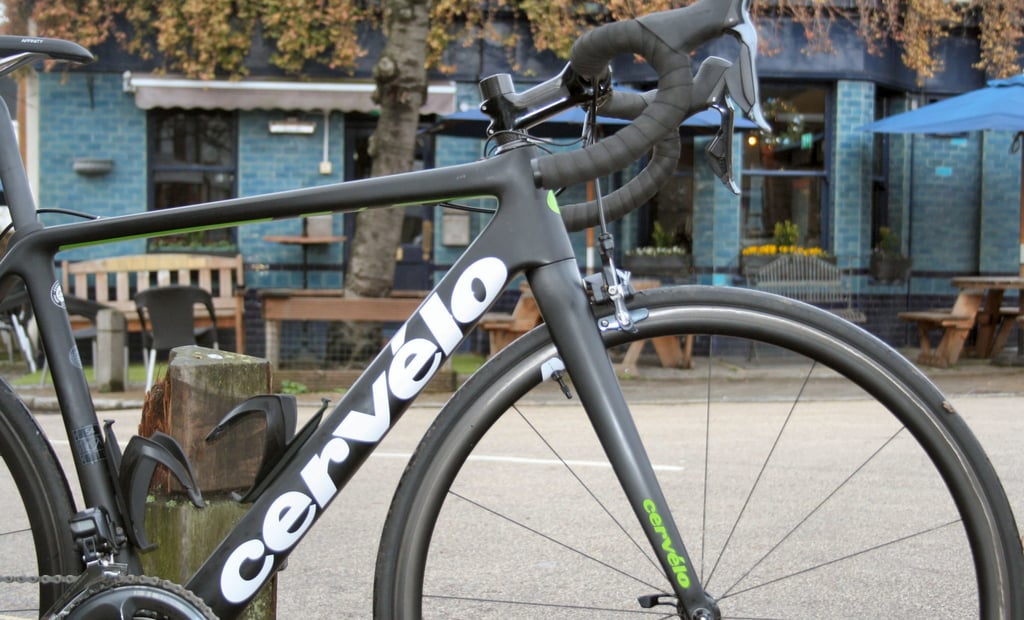
Finding the best place to hide an Apple AirTag in your bike is harder than it looks.
The hiding spot needs to avoid rattle, allow battery changes every twelve months or so, stay out of obvious sight, and let the Bluetooth signal escape. Metal frames attenuate the signal, so deep concealment inside a tube is a trade-off rather than an unambiguous win. There is also a paradox at work: once a single hiding spot becomes the consensus best, it also becomes the first place a thief will check.
Apple’s AirTag is a strong tool for locating misplaced items, including luggage lost in transit. It is also, regrettably, used to stalk people. As a live tracker for a bike ride, it falls short. The tag relies on nearby iPhones to relay location, so updates arrive in bursts rather than a continuous stream. For loved ones at home tracking your Sunday morning loop, an AirTag is a reasonable compromise, particularly when riding with friends carrying iPhones. Even on solo rides, the halfway cafe stop is usually enough to register a position.
Where to Put an AirTag on a Bike: Inside the Frame
My first plan failed quickly.
I had intended to wrap the AirTag in something breathable, add a layer of bubble wrap to silence the rattle, and push it through the cable access port on the underside of the bottom bracket. The AirTag was simply too large.
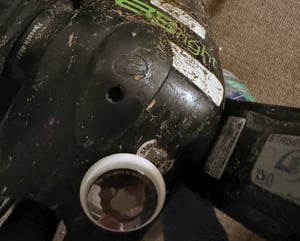
You may have more luck if your frame has a larger access point in the down tube, such as a Di2 charging port. The frame is the best hiding spot if you can reach it again in a year to swap the battery.
Hiding an AirTag Under the Bottle Cage
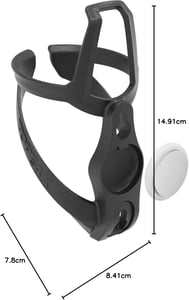
One of the most popular locations is under a water bottle cage. Using the standard two-bolt mount found on most frames, you can secure an AirTag against the frame with a custom cage designed for the purpose. The tag sits hidden in plain sight, and the signal escapes cleanly.
- Example 1: Topeak (cheaper) £12
- Example 2: Lezyne
Hiding an AirTag Inside the Stem Cap
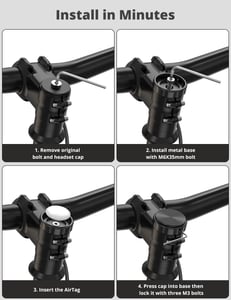
This solution requires you to remove the bolt from the stem cap, an easy job for any home mechanic. The result hides the AirTag in plain sight and works well on cheaper bikes. On a more expensive bike, a generic-looking stem cap may stand out as a non-original part and signal exactly what it conceals.
Hiding an AirTag Inside the Saddle or Saddle Bag
Some Specialized saddles include a discreet compartment designed to take an AirTag, which makes the saddle a clean hiding spot. Without a dedicated compartment, you can fashion a holder from insulation tape and fix the tag to the saddle rails. Avoid taping the AirTag to the underside of the saddle, since it will work loose and fall off.
The saddle and saddle bag are also the first places a competent thief will check. Treat them as low-security options.
A 3D-printed saddle with a built-in AirTag compartment would be a neat product. None has reached the market yet.
Hiding an AirTag In the Steerer Tube
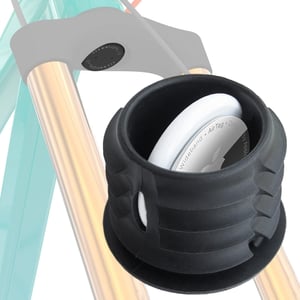
If your bike has a suspension fork, the steerer tube offers excellent concealment. An AirTag pushed inside the tube is almost invisible and well protected from tampering. Installation and retrieval take more effort than other options, but the level of concealment justifies it. This is the best location for a mountain bike. Watch the risk of the plug working loose. On the bright side, an AirTag in a steerer tube will not stay lost for long, since you can locate it with the Find My app.
Hiding an AirTag In a Reflector or Bell
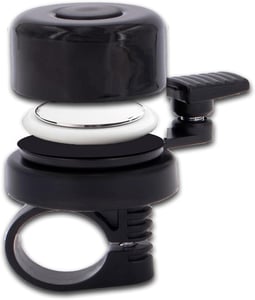
A seatpost-mounted reflector or a handlebar bell can both hide an AirTag effectively. Thieves usually ignore these accessories, and both have enough internal space to take the tag. Each is easy to open for battery changes.
The downside is durability and aesthetics. Cheap bells fail quickly and look out of place on higher-end builds.
Recommended Picks
For the simplest setup, drop the AirTag into your saddle bag. With a measure of luck, a less attentive thief will leave the bag alone, and the tag will keep reporting until the bike is recovered.
For a mountain bike, the fork plug in the steerer tube is the strongest option.
The best overall choice is a custom bottle cage. The location works on almost any frame, the AirTag is easy to reach for battery swaps, and the assembly looks like a normal cage to a casual observer.
Frequently Asked Questions
Where is the best place to put an AirTag on a bike?
Mount it under a custom bottle cage that conceals the tracker against the frame. The location is easy to access for battery changes and rarely draws attention. For mountain bikes, the steerer tube fork plug offers stronger concealment.
Does an AirTag work inside a metal or carbon bike frame?
Yes, though the signal weakens. Carbon attenuates the Bluetooth signal modestly. Aluminium and steel attenuate it more. Position the AirTag close to an opening, a plastic component, or a non-metallic accessory such as a saddle bag to preserve range.
How long does the AirTag battery last on a bike?
Apple rates the CR2032 battery at roughly one year of normal use. Cold weather, frequent location pings, and vibration shorten this in practice. Plan to replace the battery every twelve months and choose a hiding spot you can reach without specialist tools.
Can a thief detect an AirTag?
Yes. iPhones alert their owners to unknown AirTags travelling with them, and Android phones can scan for unknown trackers using Apple’s Tracker Detect app or Google’s built-in detection. A determined thief will find an obvious AirTag within minutes. Concealment is the only meaningful defence, which is why placement matters.
Is an AirTag a real-time GPS tracker?
No. AirTags rely on Apple’s Find My network. Any nearby iPhone reports the tag’s location anonymously to its owner. Updates are intermittent rather than continuous. In rural areas or at night, expect gaps of several hours between location reports.
Will an AirTag survive rain and bike washing?
AirTags carry an IP67 rating, meaning they tolerate dust and brief immersion in shallow water. Road spray, rain, and a normal bucket-and-sponge wash are fine. Avoid aiming a pressure washer directly at the tag.
What should I do if my bike is stolen and I have an AirTag?
Report the theft to the police immediately and share the AirTag’s location history with the investigating officer. Do not approach the location yourself. Police forces in the UK, US, and several EU countries have recovered bikes using AirTag data, but only where the owner reported promptly and let officers act.
Is it legal to put an AirTag on my own bicycle?
Yes. Tracking your own property is lawful in the UK, US, and EU. Tracking another person or their property without consent is not. Use the AirTag only on items you own.
Should I use more than one AirTag on a bike?
Two AirTags is a sensible setup for a higher-value bike. Place one in a relatively obvious spot, such as a saddle bag, as a decoy. Conceal the second in a harder location such as the steerer tube or under a bottle cage. The decoy increases the chance that the hidden tag survives a thief’s initial sweep.
See also: Fashion Forward: How to Check for the Latest Trends.
Last Updated on 4 October 2026 by tfk the5krunner
Small things I always use
- Garmin 90-degree charging adapter: Charges your Garmin from any USB-C cable. Essential when travelling. I use one.
- Body Glide: The blue anti-chafe stick swimmers and runners carry. I use it.
- Speedo earplugs: Fewer ear infections and no cold-water dizziness. I use them.
- Dryrobe Advance: My winter changing robe for open-water swims. I use one. A cheaper option is the AONYIYI changing robe.
- Maurten: Race fuel that stays easy on the stomach. I use them.
- Garmin charging puck: The quickest way to top up before a session. I use one.
- Injinji: Toe socks that stop rubbing, so you run more. I use them.
- Ultimate toe protectors: Stop black toenails on long runs. They work. I use them.
- Compressport R2 v2 calf sleeves: My calf sleeves of choice. I use them.
- Cellucor C4: My pre-workout before hard sessions.
- TPU tubes: Schwalbe Aerothan, Tubolito and Pirelli SmarTube. Light, tiny spares. I use all three.
- G8 insoles: Adjustable insoles that are good. I use them.
- Cycplus Cube: A 97g electric pump that gets a road tyre rideable in two minutes. I carry one. 5% off with code THE5KRUNNER.
Watches and sensors
- Polar H10: My daily driver for waking HRV.
- Polar Verity Sense: My backup arm-worn HR sensor.
- Nomad bedside charger: Charges my iPhone and Apple Watch overnight. I use it, and many of their bands.
- Train.Red: The best muscle oxygen sensor I’ve used.
- Tymewear: Accurate heart rate and reliable ventilatory zones. I use it to pace endurance rides over an hour.
- Garmin Forerunner 970: A pro-grade triathlon watch. I use this.
- Apple Watch Ultra 4: My daily smartwatch. No phone needed on rides.
- Garmin Fenix 9 Pro: I’ve just bought one.
On the bike
- Continental GP5000 for everyday riding, and Aero 111 on the front for special occasions.
- Helmets: Specialized S-Works Evade 3 for road riding, and Rudy Project Wing for TT-style races. I use both.
- Ravemen FR300: A front light that mounts under your Garmin or Wahoo. I use one.
- Wahoo TRACKR Radar: I use it on one bike and Varia on the other. They perform the same.
- Garmin Varia RTL515: Radar that warns you of cars from behind. I use this model.
- Wahoo ELEMNT Roam 3: The bike computer that’s easy to use. I use mine on most rides.
- Favero Assioma Pro RS2: Accurate power pedals that swap easily between bikes. I use this model.
Home and indoor training
- NPE Runn: Makes my basic treadmill smart, sending more accurate speed and distance to my watch and Zwift. I use it.
- Google Wifi: Keeps Zwift connected in my pain cave. I use it.
- Apple TV 4K: Zwift on the big screen. I use two.
- Google Nest Doorbell (wired, 2nd gen): My video doorbell, running in both Google Home and Apple Home. I use it.
Health, recovery and sleep
- FreeStyle Libre 3 Plus: Shows how my blood sugar responds to diet.
- hDrop: Measures my sweat loss in summer and indoors.
- Fourth Frontier Zone: Checks my heart under load in hard sessions.
- Oura Ring 5: My partner’s recovery tracker of choice.
- Kineon MOVE+: Red light therapy for niggles. It works.
- Eight Sleep: A cooling mattress cover my partner and I use nightly.
Reader-Powered Content

This content is not sponsored. It’s mostly me behind the labour of love, which is this site, and I appreciate everyone who supports it.
Support the site: Follow (free, fewer ads) · Subscribe (paid, ad-free) · Buy Me A Coffee ❤️
Written by real people, with AI assistance. Fact-checked and verified for originality. See the Editorial Policy. FTC: Affiliate Disclosure — some links pay commission. As an Amazon Associate, I earn from qualifying purchases.
tfk is the founder and author of the5krunner, an independent endurance sports technology publication. With 20 years of hands-on testing of GPS watches and wearables, and competing in triathlons at an international age-group level, tfk provides in-depth expert analysis of fitness technology for serious athletes and endurance sport competitors. ID
