
Triathlon, Duathlon, and Multisport Distances: A Complete Guide From Sprint to Iron
Multisport extends well beyond the familiar swim, bike, and run of the triathlon. World Triathlon, the international governing body formerly known as the ITU, recognises seven core multisport disciplines: triathlon, duathlon, aquathlon, aquabike, cross triathlon, winter triathlon, and mixed relay. Alongside these sit the Ironman and Ironman 70.3 race series, the Powerman duathlon series, the Challenge Family, swimrun (born of Ötillö in the Stockholm archipelago), quadrathlon, and a small number of ultra-distance flagships such as Norseman and Ultraman.
For the broader triathlon technology context, see the triathlon and multisport technology hub.
Distances are standardised at championship level. Commercial races introduce small variations to suit local geography, but the headline numbers below are the reference points used across the sport. Both metric and imperial figures are given throughout.
Ironman is a registered trademark of the World Triathlon Corporation, not a generic race distance. Other organisers running races over the same length must use neutral terms such as Iron Distance, Long Distance, or 140.6 to describe their events. The same applies to 70.3, which other operators describe as Half Iron or Middle Distance.
Triathlon Distances
A triathlon follows a swim, bike, run sequence. Two transitions, known as T1 and T2, link the three legs and form part of the official race time. The standard distances are:
- Super Sprint: 400m swim / 10km bike / 2.5km run. In imperial: 0.25 miles / 6.2 miles / 1.55 miles. The shortest standardised format and the recommended entry point for newcomers.
- Sprint: 750m swim / 20km bike / 5km run, or 0.47 miles / 12.4 miles / 3.1 miles. Pool-based sprint races usually shorten the swim to 400m or 500m. Most age-group competitors finish in 75 to 90 minutes.
- Standard, also called Olympic: 1500m swim / 40km bike / 10km run, or 0.93 miles / 24.9 miles / 6.2 miles. The Olympic Games distance and the World Triathlon Championship Series benchmark.
- Half Iron, also marketed as 70.3: 1.9km swim / 90km bike / 21.1km run, or 1.2 miles / 56 miles / 13.1 miles. The total of 70.3 miles gives the brand its name. The run is a half marathon.
- Long Distance (World Triathlon): approximately 3km swim / 120km bike / 30km run, or 1.86 miles / 74.6 miles / 18.6 miles. The format used at the World Triathlon Long Distance Championships. Some events extend the swim to 4km.
- Iron Distance, also marketed as 140.6: 3.8km swim / 180km bike / 42.2km run, or 2.4 miles / 112 miles / 26.2 miles. The bike leg is roughly the length of a Tour de France stage. The run is a full marathon. Cut-off times for Ironman-branded events are 17 hours.
Duathlon Distances
A duathlon replaces the swim with a second run, producing a run, bike, run sequence. The format suits athletes without ready access to open water, and is also used by triathlon series when a swim leg is cancelled for safety reasons. The standard distances are:
- Super Sprint: 2.5km run / 10km bike / 2.5km run, or 1.55 miles / 6.2 miles / 1.55 miles.
- Sprint: 5km run / 20km bike / 2.5km run, or 3.1 miles / 12.4 miles / 1.55 miles. The format used at World Triathlon Sprint Duathlon Championships. Time-trial bikes are not permitted at draft-legal championship events.
- Powerman Sprint: 5km run / 30km bike / 5km run, or 3.1 miles / 18.6 miles / 3.1 miles. A European staple from the Powerman series.
- Standard, also called Olympic: 10km run / 40km bike / 5km run, or 6.2 miles / 24.9 miles / 3.1 miles. The World Triathlon Standard Duathlon Championship distance.
- Powerman Classic, or Middle Distance: 10km run / 60km bike / 10km run, or 6.2 miles / 37.3 miles / 6.2 miles.
- Long Distance, the Powerman Zofingen format: 10km run / 150km bike / 30km run, or 6.2 miles / 93.2 miles / 18.6 miles. Total run distance of 40km combined with a near-century bike leg makes Zofingen one of the toughest one-day events in multisport.
Aquathlon Distances
An aquathlon combines swimming and running. World Triathlon’s standard format is run, swim, run, with the open-water swim sandwiched between two run legs. When water temperature falls below 22°C, the order changes to swim, run, so athletes do not have to put on a wetsuit mid-race.
- Standard, warm water: 2.5km run / 1km swim / 2.5km run, or 1.55 miles / 0.62 miles / 1.55 miles. The World Aquathlon Championship distance when water is 22°C or warmer.
- Standard, cold water: 1km swim / 5km run, or 0.62 miles / 3.1 miles. Used when water temperature requires wetsuits.
- Long course: typically 2km swim / 10km run, or 1.24 miles / 6.2 miles. Common at regional events and triathlon-club race series.
Pool-based aquathlons run throughout the winter at many UK and European clubs and use shorter swim distances, typically 400m to 750m, paired with a 5km run.
Aquabike Distances
An aquabike strips the run from a triathlon, leaving a swim followed by a bike leg. The format suits athletes managing run injuries and those approaching multisport from a swimming or cycling background. World Triathlon recognises two championship distances:
- Standard Aquabike: 1.5km swim / 40km bike, or 0.93 miles / 24.9 miles. Same swim and bike distances as the Olympic triathlon, without the run.
- Long Distance Aquabike: 3km swim / 120km bike, or 1.86 miles / 74.6 miles. Often raced alongside Long Distance Triathlon at the same venue.
Cross Triathlon and Cross Duathlon
Cross triathlon is the off-road version of the swim, bike, run format, with a mountain bike replacing the road bike and trail running replacing the road run. The XTERRA series is the best-known commercial circuit. World Triathlon recognises a cross duathlon as the off-road equivalent of the duathlon. Approximate championship distances are:
- Cross Triathlon Sprint: 500m swim / 10 to 12km MTB / 3 to 4km trail run, or 0.31 miles / 6.2 to 7.5 miles / 1.86 to 2.49 miles.
- Cross Triathlon Standard: 1 to 1.5km swim / 20 to 30km MTB / 6 to 10km trail run, or 0.62 to 0.93 miles / 12.4 to 18.6 miles / 3.7 to 6.2 miles. The XTERRA World Championship and World Triathlon Cross Triathlon Championship distance.
- Cross Duathlon: 6 to 8km trail run / 20 to 30km MTB / 3 to 4km trail run, or roughly 3.7 to 5 miles / 12.4 to 18.6 miles / 1.9 to 2.5 miles.
- XTERRA Full: 1.5km swim / 35 to 45km MTB / 11km trail run, or 0.93 miles / 21.7 to 28 miles / 6.8 miles. The flagship XTERRA distance.
Swimrun and Ötillö Distances
Swimrun originated in the Stockholm archipelago in 2002, when four friends raced from the island of Sandhamn to Utö. The sport pairs alternating run and swim sections, raced in teams of two. Athletes carry all their kit throughout, swimming in their shoes and running in their wetsuits. The Ötillö Swimrun World Championship remains the sport’s signature event.
- Ötillö World Championship: approximately 75km total, made up of 65km of trail running and 10km of open-water swimming, or roughly 47 miles total (40 miles run, 6 miles swim). The course covers 24 islands, with 23 swim sections and 24 run sections.
- Ötillö Sprint: typically 7 to 12km total, with run and swim sections proportionally shortened.
- Ötillö Experience: typically 25 to 35km total, the most common middle-distance format.
- Ötillö Merit and World Series races: roughly 35 to 50km total, used as qualifiers for the World Championship.
Independent swimrun events outside the Ötillö series, including Breca in the UK and the global Survival Race circuit, broadly follow the same sprint, middle, and long-distance shape.
Winter Triathlon and Winter Duathlon
Winter triathlon is run, mountain bike, cross-country ski, all on snow. Winter duathlon drops the bike leg, leaving run and ski. Both are World Triathlon disciplines and have annual world championships. Course lengths shift slightly with snow conditions, but the championship targets are:
- Winter Triathlon, elite Standard: 8km run / 12 to 14km MTB on snow / 12km cross-country ski, or 5 miles / 7.5 to 8.7 miles / 7.5 miles. The format includes multiple transitions and laps.
- Winter Triathlon, age-group: roughly half the elite distances. A common format is 6km run / 10km MTB / 10km ski, or 3.7 miles / 6.2 miles / 6.2 miles.
- Winter Triathlon Sprint: 3km run / 5km MTB / 5km ski, or 1.86 miles / 3.1 miles / 3.1 miles.
- Winter Duathlon: approximately 4km run / 8km cross-country ski, raced in two run-ski-run-ski loops with three transitions. In imperial: roughly 2.49 miles / 5 miles.
A separate format known as Winter Triathlon S3, comprising snowshoeing, ice skating, and cross-country skiing, was introduced in 2013 but remains rare in international competition.
Quadrathlon Distances
Quadrathlon adds a kayak leg to swim, bike, and run. The first event ran in Ibiza in 1987. The World Quadrathlon Federation now governs the sport, with strongholds in the Czech Republic, Germany, and the United Kingdom. The standard distances are:
- Sprint: 0.75km swim / 20km bike / 4km kayak / 5km run, or 0.47 miles / 12.4 miles / 2.49 miles / 3.1 miles. The World Quadrathlon Federation championship sprint distance.
- Middle Distance: 1.5km swim / 40km bike / 8km kayak / 10km run, or 0.93 miles / 24.9 miles / 5 miles / 6.2 miles.
- Long Distance: 4km swim / 90km bike / 20km kayak / 21km run, or 2.49 miles / 55.9 miles / 12.4 miles / 13.1 miles. The classic championship long-course format.
- Original Diamond Man, Ibiza 1987: 5km swim / 100km bike / 20km kayak / 21.1km run, or 3.1 miles / 62.1 miles / 12.4 miles / 13.1 miles. Now run only as the middle distance event in Ibiza.
Ultra-Distance Multisport
A small number of events sit beyond the standard Iron Distance and represent the upper bound of multisport racing.
- Norseman Xtreme Triathlon, Norway: 3.8km swim from a fjord boat / 180km bike with 3,500m of climbing / 42.2km run finishing on Gaustatoppen mountain. Iron Distance numbers, but on terrain that turns the race into a different event entirely.
- Ultraman, three-day stage race: Day 1 — 10km swim and 145km bike. Day 2 — 276km bike. Day 3 — 84.4km double marathon run. Total roughly 515km, or 320 miles.
- Deca and Double Deca Iron events: 10 or 20 consecutive Iron Distances, raced over consecutive days or as continuous events. Niche but established in the ultra-triathlon community.
What About Bikeathons?
The term bikeathon usually describes a charity cycling event, not a multisport discipline. Bikeathons are single-sport rides, typically 25 to 100 miles in length, organised to raise money for a chosen cause. They sit outside the World Triathlon framework and have no standardised championship format.
Choosing A Watch For It
You don’t need a watch to enjoy a triathlon. Over longer distances, sports tech in general and watches in particular can significantly improve your trainign and racing; here’s a look at the best triathlon watch.
Choosing a Distance
The Super Sprint and Sprint formats, in either triathlon or duathlon, are the right starting points for first-time competitors. Both are achievable on three to four months of structured training for an athlete coming in with a basic fitness foundation. The Standard, or Olympic, distance is the next major step, with race times typically running from 2 hours 15 minutes to 3 hours.
The Half Iron and Iron Distance formats are committing endurance events. Avoid them as a first multisport race. Build through Standard distance first, then take twelve months of training before a debut Half Iron, and another full season of long-course racing before attempting an Iron Distance.
For athletes without confident open-water swimming, the duathlon, aquabike, or pool-based aquathlon offer a route into the sport with a lower technical barrier.
Quick answers
What are the official triathlon distances?
World Triathlon recognises Super Sprint (400m / 10km / 2.5km), Sprint (750m / 20km / 5km), Standard or Olympic (1.5km / 40km / 10km), and Long Distance (3km / 120km / 30km, with some variation). The Ironman series adds Half Iron at 70.3 miles and Iron Distance at 140.6 miles, both of which are commercial brand distances rather than World Triathlon championship distances.
Why is it called 70.3 and 140.6?
The numbers are the total race distance in miles. A 70.3 covers 1.2 miles of swimming, 56 miles of cycling, and 13.1 miles of running, totalling 70.3 miles. A 140.6 doubles all three legs: 2.4 miles, 112 miles, and 26.2 miles, totalling 140.6 miles.
What is the difference between an Ironman and an Iron Distance race?
The course lengths are identical. Ironman is a registered trademark, owned by the World Triathlon Corporation, and only events licensed by that organisation can use the name. Other operators running the same 3.8km / 180km / 42.2km format must use generic terms such as Iron Distance, Long Course, or 140.6. Challenge Roth, the largest non-Ironman event over the distance, is a notable example.
What is the Olympic distance triathlon?
The Olympic distance is 1500m swim, 40km bike, 10km run, also known as the Standard distance. It is the format used at the Summer Olympic Games and at the World Triathlon Championship Series. Strong age-group athletes finish in 2 hours to 2 hours 30 minutes. Elite men finish in roughly 1 hour 45 minutes.
How long does each triathlon distance take?
Typical age-group finishing times: Super Sprint 45 to 75 minutes; Sprint 75 minutes to 2 hours; Standard 2 hours 15 minutes to 3 hours 30 minutes; Half Iron 5 to 7 hours; Iron Distance 11 to 16 hours. Course profile, water temperature, and conditions can shift these by 30 minutes or more.
What is the cut-off time for an Iron Distance race?
Ironman-branded races set a 17-hour cut-off, with intermediate cut-offs at the swim exit (2 hours 20 minutes) and the bike finish (10 hours 30 minutes from race start). Independent Iron Distance events set their own limits. Challenge Roth allows 15 hours, for example.
Are pool sprint triathlons the same distance as open-water sprints?
The bike and run legs are the same. The swim is shorter. Pool sprint triathlons typically use 400m or 500m swims rather than the standard 750m, because pool lane congestion and timed start waves make a longer pool swim impractical.
What is the difference between a triathlon and an aquathlon?
An aquathlon has no bike leg. The standard format is run, swim, run, with a 2.5km run, 1km swim, and 2.5km run. The format is cheaper to enter than a triathlon, since no bike or transition kit is required, and is widely used by triathlon clubs as a summer evening race series.
What is an aquabike?
An aquabike is a triathlon without the run: a swim followed by a bike leg. Standard distance is 1.5km swim and 40km bike. Long distance is 3km swim and 120km bike. The format is recognised by World Triathlon and is included at the annual Multisport World Championships festival.
What is a long-course triathlon?
Long course is the catch-all term for any triathlon longer than the Standard distance. It covers Half Iron, World Triathlon Long Distance, Iron Distance, and ultra-triathlons. The term is often used interchangeably with Iron Distance in casual conversation, though the two are not strictly the same.
What is the Powerman Zofingen?
The Powerman Zofingen is the long-distance world championship of duathlon, held annually in Zofingen, Switzerland. The course is 10km run, 150km bike, 30km run, with significant climbing on both bike and run legs. Total run distance is a marathon. The event has run since 1989 and is widely regarded as one of the toughest single-day endurance races in the sport.
What is swimrun?
Swimrun is a multisport format combining alternating open-water swim and trail run sections, raced in teams of two without transitions. Athletes wear wetsuits throughout and swim in their running shoes. The flagship event is Ötillö, held annually in the Stockholm archipelago, covering roughly 75km across 24 islands.
What is a quadrathlon?
A quadrathlon is a four-discipline event: swim, bike, kayak, run. Sprint distance is 0.75km swim, 20km bike, 4km kayak, 5km run. Long distance is 4km swim, 90km bike, 20km kayak, 21km run. The sport is governed by the World Quadrathlon Federation and has its strongest communities in the UK, Czech Republic, and Germany.
What is the difference between cross triathlon and XTERRA?
Cross triathlon is the off-road version of the swim, bike, run format, using a mountain bike and trail running. XTERRA is the largest commercial cross triathlon series and operates a world championship at standard distance. World Triathlon also runs a separate Cross Triathlon World Championship under the same general format.
How does winter triathlon work?
Winter triathlon is run, mountain bike, cross-country ski, all on snow. Standard elite distance is 8km run, 12 to 14km MTB, 12km ski, with multiple transitions and laps. Studded shoes, wide low-pressure mountain-bike tyres, and skating-style cross-country skis are the standard kit.
Are children's triathlon distances standardised?
Yes. National federations set tristart, tristar, and youth distances by age band. As a guide: ages 8 to 9 swim 100m, bike 4km, run 1.3km. Ages 10 to 11 swim 200m, bike 6km, run 2km. Ages 12 to 13 swim 300m, bike 10km, run 3km. Ages 14 to 15 race the Super Sprint or a slightly trimmed Sprint. Distances vary by federation, so check with British Triathlon, USA Triathlon, or the relevant national body.
Which distance should a beginner choose?
Choose a Super Sprint or pool-based Sprint triathlon as a first race. Both are achievable on three to four months of structured training for someone with basic fitness. If swimming is the limiting factor, start with a Sprint duathlon or pool aquathlon. Avoid setting a Half Iron or Iron Distance as a first multisport goal.
Key Tech
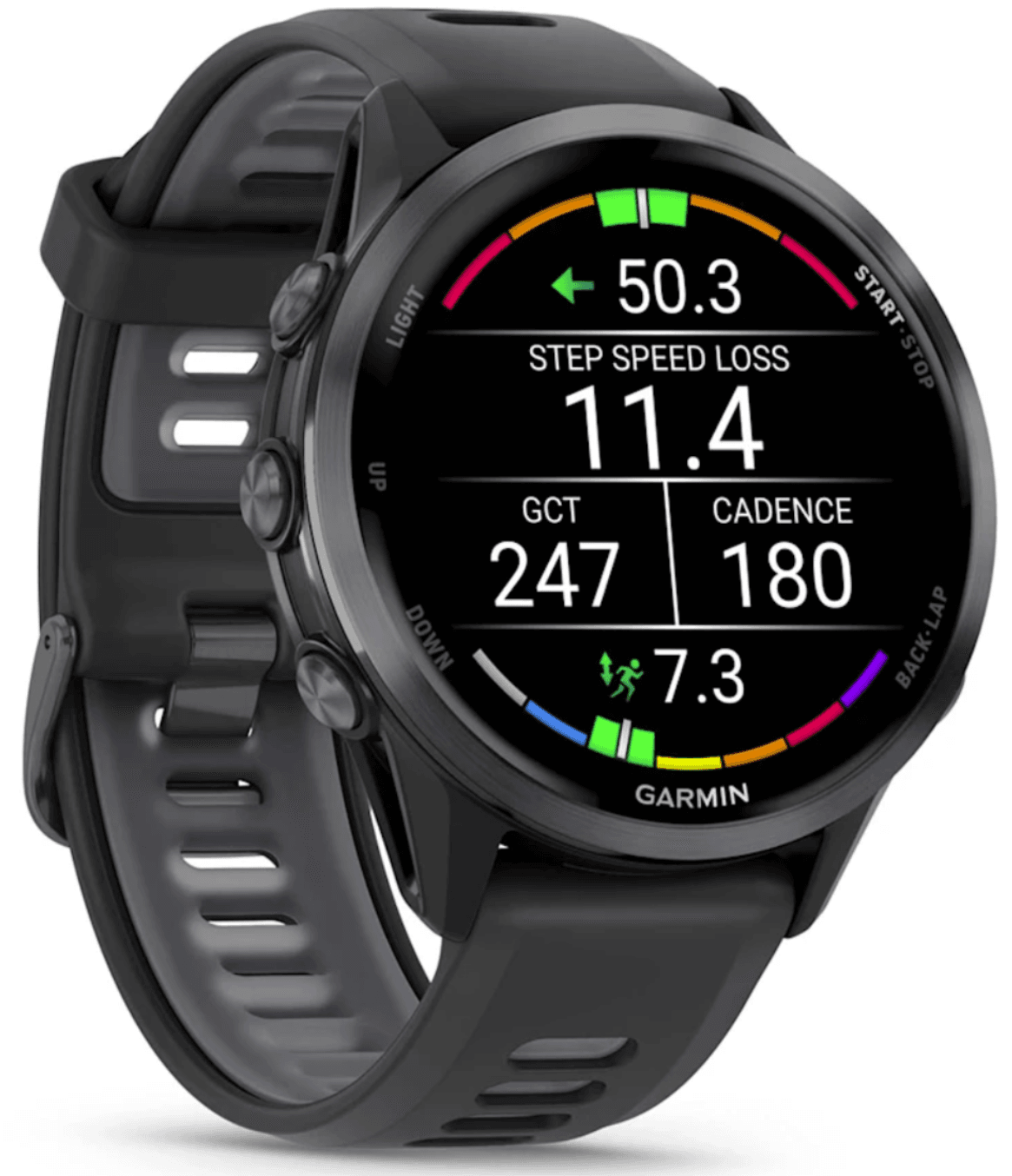
Garmin Forerunner 970
Premium GPS triathlon smartwatch. Features a bright AMOLED touch screen and a built-in LED flashlight.

Last Updated on 3 October 2026 by tfk the5krunner
Small things I always use
- Garmin 90-degree charging adapter: Charges your Garmin from any USB-C cable. Essential when travelling. I use one.
- Body Glide: The blue anti-chafe stick swimmers and runners carry. I use it.
- Speedo earplugs: Fewer ear infections and no cold-water dizziness. I use them.
- Dryrobe Advance: My winter changing robe for open-water swims. I use one. A cheaper option is the AONYIYI changing robe.
- Maurten: Race fuel that stays easy on the stomach. I use them.
- Garmin charging puck: The quickest way to top up before a session. I use one.
- Injinji: Toe socks that stop rubbing, so you run more. I use them.
- Ultimate toe protectors: Stop black toenails on long runs. They work. I use them.
- Compressport R2 v2 calf sleeves: My calf sleeves of choice. I use them.
- Cellucor C4: My pre-workout before hard sessions.
- TPU tubes: Schwalbe Aerothan, Tubolito and Pirelli SmarTube. Light, tiny spares. I use all three.
- G8 insoles: Adjustable insoles that are good. I use them.
- Cycplus Cube: A 97g electric pump that gets a road tyre rideable in two minutes. I carry one. 5% off with code THE5KRUNNER.
Watches and sensors
- Polar H10: My daily driver for waking HRV.
- Polar Verity Sense: My backup arm-worn HR sensor.
- Nomad bedside charger: Charges my iPhone and Apple Watch overnight. I use it, and many of their bands.
- Train.Red: The best muscle oxygen sensor I’ve used.
- Tymewear: Accurate heart rate and reliable ventilatory zones. I use it to pace endurance rides over an hour.
- Garmin Forerunner 970: A pro-grade triathlon watch. I use this.
- Apple Watch Ultra 4: My daily smartwatch. No phone needed on rides.
- Garmin Fenix 9 Pro: I’ve just bought one.
On the bike
- Continental GP5000 for everyday riding, and Aero 111 on the front for special occasions.
- Helmets: Specialized S-Works Evade 3 for road riding, and Rudy Project Wing for TT-style races. I use both.
- Ravemen FR300: A front light that mounts under your Garmin or Wahoo. I use one.
- Wahoo TRACKR Radar: I use it on one bike and Varia on the other. They perform the same.
- Garmin Varia RTL515: Radar that warns you of cars from behind. I use this model.
- Wahoo ELEMNT Roam 3: The bike computer that’s easy to use. I use mine on most rides.
- Favero Assioma Pro RS2: Accurate power pedals that swap easily between bikes. I use this model.
Home and indoor training
- NPE Runn: Makes my basic treadmill smart, sending more accurate speed and distance to my watch and Zwift. I use it.
- Google Wifi: Keeps Zwift connected in my pain cave. I use it.
- Apple TV 4K: Zwift on the big screen. I use two.
- Google Nest Doorbell (wired, 2nd gen): My video doorbell, running in both Google Home and Apple Home. I use it.
Health, recovery and sleep
- FreeStyle Libre 3 Plus: Shows how my blood sugar responds to diet.
- hDrop: Measures my sweat loss in summer and indoors.
- Fourth Frontier Zone: Checks my heart under load in hard sessions.
- Oura Ring 5: My partner’s recovery tracker of choice.
- Kineon MOVE+: Red light therapy for niggles. It works.
- Eight Sleep: A cooling mattress cover my partner and I use nightly.
Reader-Powered Content

This content is not sponsored. It’s mostly me behind the labour of love, which is this site, and I appreciate everyone who supports it.
Support the site: Follow (free, fewer ads) · Subscribe (paid, ad-free) · Buy Me A Coffee ❤️
Written by real people, with AI assistance. Fact-checked and verified for originality. See the Editorial Policy. FTC: Affiliate Disclosure — some links pay commission. As an Amazon Associate, I earn from qualifying purchases.
tfk is the founder and author of the5krunner, an independent endurance sports technology publication. With 20 years of hands-on testing of GPS watches and wearables, and competing in triathlons at an international age-group level, tfk provides in-depth expert analysis of fitness technology for serious athletes and endurance sport competitors. ID
