Well, this was a bit of a surprise – the Amazfit Cheetah 2 Ultra excelled itself.
I had dreaded performing this test because I expected the same mediocre result as the Cheetah 2 Pro produced a couple of weeks ago. I’d much rather report good news. It’s just nicer. I assumed that the Ultra model was identical to the Pro but a bit bigger. That’s pretty much true, but the important takeaway is that all the innards are likely identical except for the bigger battery. However, there were a few peripheral expectations for good results – the larger Ultra model will have a subtly different antenna construction (and just a physically bigger one), the weather might be more conducive for upper atmospheric conditions affecting multipath – turns out I had a lightning storm during the test...oops.
The long and the short of it is that today’s result was better than the 2 Pro but not quite as good on the day as the Garmin Forerunner 970.
Test Conditions
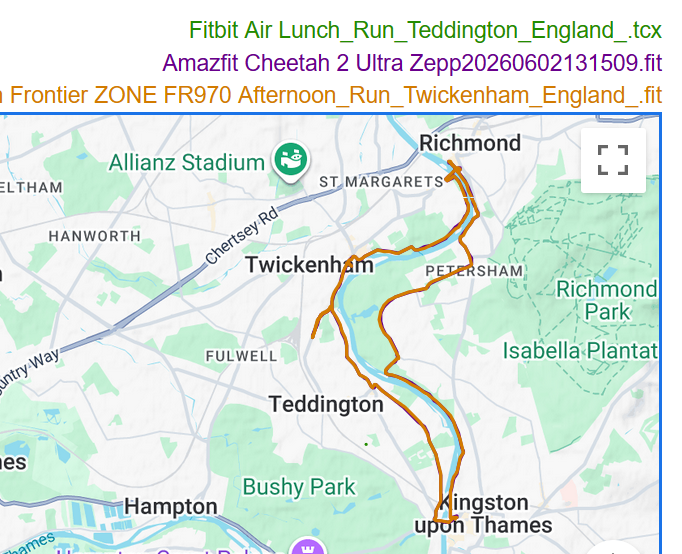
This test is one of the key ones in my standard methodology. It follows a predetermined 10-mile route that includes many GPS difficulty points. Results are almost always indicative of general GPS performance in all but extreme conditions. I perform many other tests as well.
The Cheetah 2 Ultra was on test alongside the Forerunner 970. No other comparators are required as this is a longitudinal test covering many devices over many years. Several heart rate monitors were being tested: Fourth Frontier Zone, Fitbit Air, and Polar SENSE, but this article focuses on the GPS. The main review of the Cheetah 2 Ultra will cover HR accuracy in detail.
Test Results
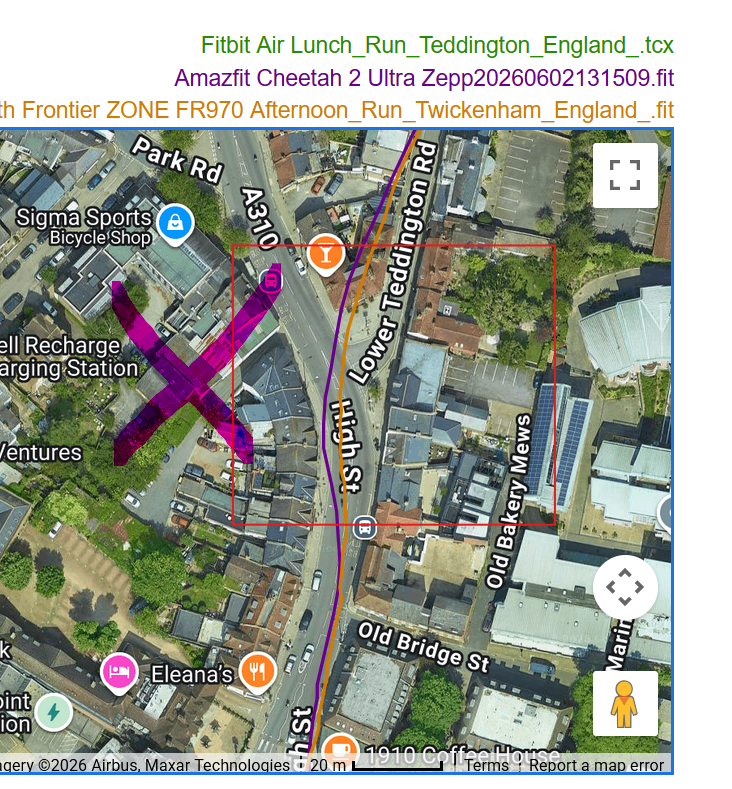
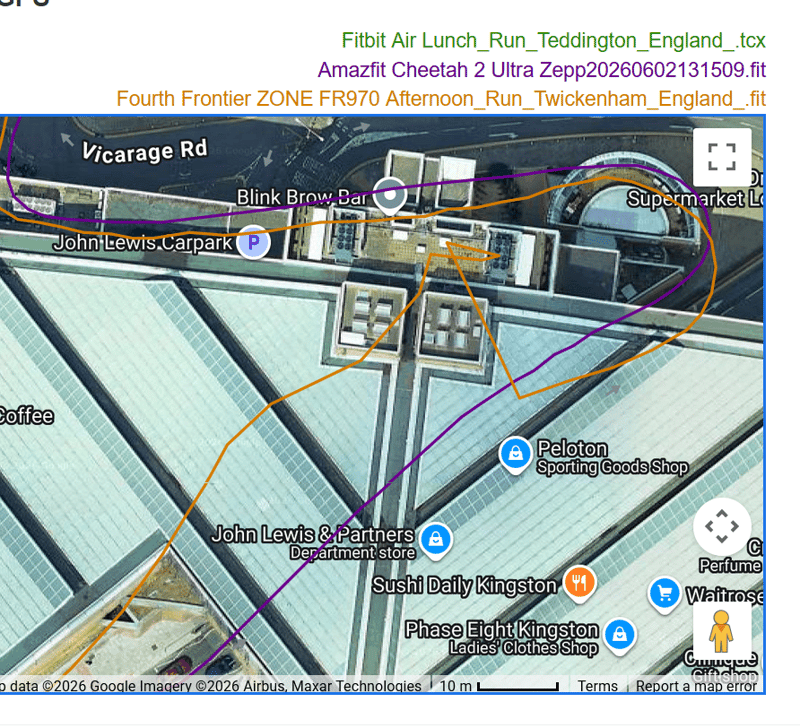
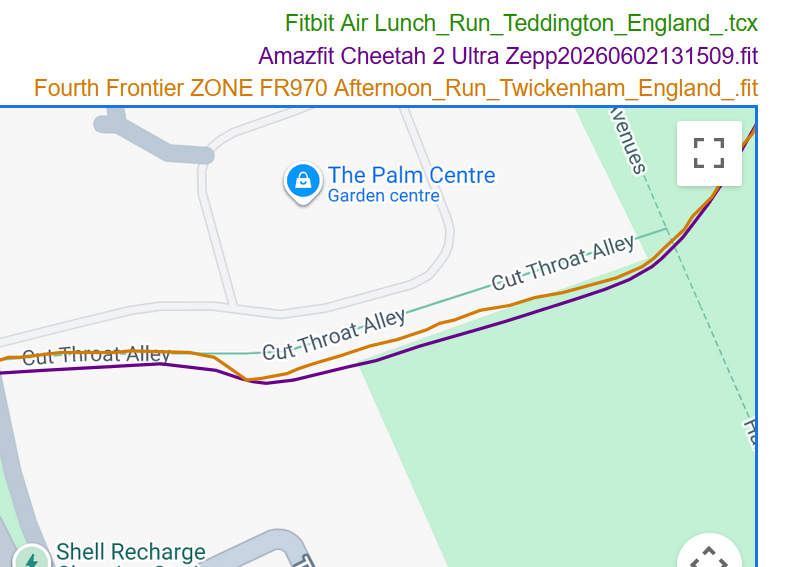
Here are the visual results first, which show the overall route and a couple of points of interest. Cheetah is the purple line.
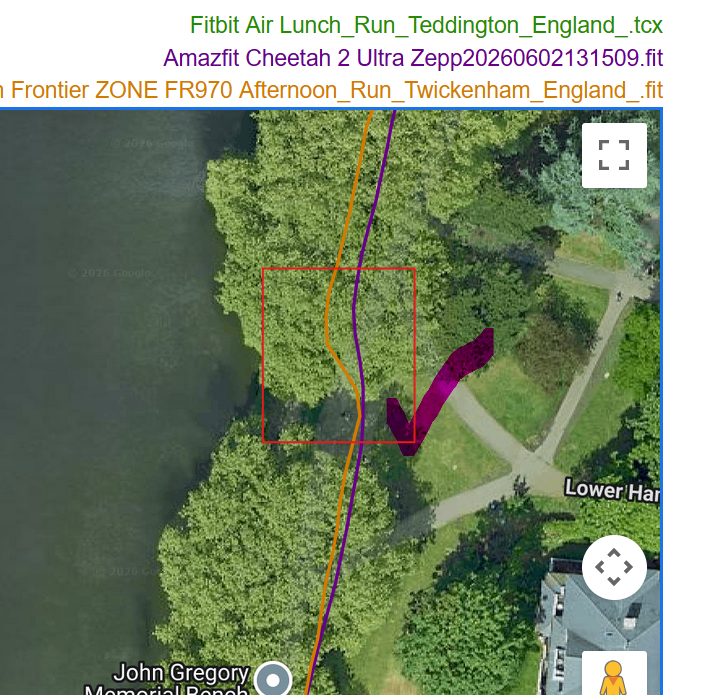
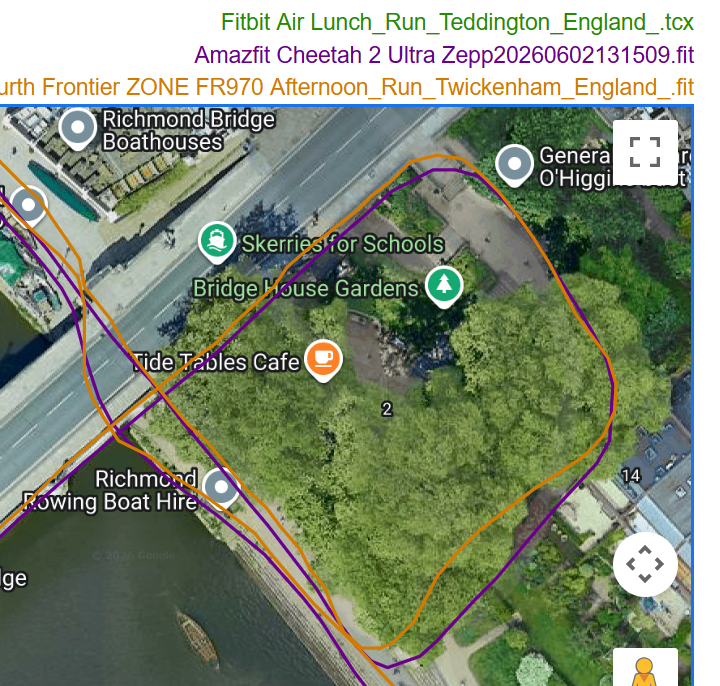
edit: Error corrected from original draft score is 85% not 81%
Cheetah 2 Ultra scored 85% overall, which is good and certainly better than the average for the current range of sports watches overall. For a dual-frequency GNSS chip (which this has), the score is a tad lower than I would hope for, but any difference there is explainable by the vagaries of the day. Meaning it could quite easily score 88% if I retested tomorrow in the absence of a lightning storm, but it would certainly not get a top score of 92%.
Contrast that to Amazfit Cheetah 2 Pro (73%), Amazfit T-Rex 3 (85%), Amazfit Balance 2 (85%), Coros Pace 4 (88%), and Garmin Forerunner 970 (92% – joint top score).
The score is broken down into differently graded and aggregated sections: Easy (90%), Medium (81%), and Hard (81%). Unsurprisingly, the watch found the harder sections, err, harder. That said, the Garmin Fenix 8 and Garmin FR970 counterintuitively performed best on the hardest sections, at least they did on the day of the test.
The lower difficulty score is due to running VERY close to tall buildings, through a long tunnel, and in a narrow alley with high brick walls. Essentially, situations where GPS can’t perform accurately. Amazfit claim to have dead reckoning (another term for GPS Sensor Fusion) but that didn’t work in the tunnel today. The Cut Throat Alley segment was pretty good, and the proximity to a very tall building wasn’t too bad. One medium difficulty area is next to less tall buildings and Cheetah 2 Pro exhibits the tracks being thrown away from the building – this is clear evidence that reflected signals (multipath) are used to determine position rather than discarded, as should be the case with a dual frequency chipset. That sounds bad but EVERY other dual frequency watch does the same. I think the answer is that the point of reflection must be 30 ish metres away. So when I am right next to a wall, the point of reflection is 3m away. If you are running through Manhattan, the point of reflection could be halfway up the Empire State. Those signals would be reflected, detected as such and rejected. Perversely my tests in Kingston are harder than downtown New York. Maybe. At least that’s my theory! – See the GPS accuracy resource on this site, where there are some interesting things I’ve written and deep dives linked from other experts on GPS device testing (eg MikeG a speed sail racer)
In the context of other bike-and-run tests, this result is representative. The 2 Ultra does have small deviations here and there, but it is actually pretty good overall. Essentially, the 85% score from this one test is warranted and validated by other tests.
Can Amazfit Improve?
A: Tricky
To improve performance in difficult conditions, the definition must be harder than getting the basics right. Which is what Amazfit has done here, it’s got the basics right.
We suspect the chipset is the Airoha AG3353. Coros use Airohas and get excellent results. Airoha was used by Garmin, which got pretty good results with it, but now uses Synaptics chipsets to get excellent results. The point being that there might be scope for improving accuracy beyond the standard sometimes achieved by Coros.
The bottom line for normal use in easy to normal conditions, Cheetah 2 Ultra is sufficiently accurate.
For the full Amazfit range, accuracy data and Zepp Health analysis: Amazfit sports watch guide.
Last Updated on 3 October 2026 by tfk the5krunner
Small things I always use
- Garmin 90-degree charging adapter: Charges your Garmin from any USB-C cable. Essential when travelling. I use one.
- Body Glide: The blue anti-chafe stick swimmers and runners carry. I use it.
- Speedo earplugs: Fewer ear infections and no cold-water dizziness. I use them.
- Dryrobe Advance: My winter changing robe for open-water swims. I use one. A cheaper option is the AONYIYI changing robe.
- Maurten: Race fuel that stays easy on the stomach. I use them.
- Beet It Sport nitrate shots: Beetroot shots I take in the days before a race. I use them.
- Garmin charging puck: The quickest way to top up before a session. I use one.
- Injinji: Toe socks that stop rubbing, so you run more. I use them.
- Ultimate toe protectors: Stop black toenails on long runs. They work. I use them.
- Compressport R2 v2 calf sleeves: My calf sleeves of choice. I use them.
- Cellucor C4: My pre-workout before hard sessions.
- TPU tubes: Schwalbe Aerothan, Tubolito and Pirelli SmarTube. Light, tiny spares. I use all three.
- G8 insoles: Adjustable insoles that are good. I use them.
- Cycplus Cube: A 97g electric pump that gets a road tyre rideable in two minutes. I carry one. 5% off with code THE5KRUNNER.
Watches and sensors
- Polar H10: My daily driver for waking HRV.
- Polar Verity Sense: My backup arm-worn HR sensor.
- Nomad bedside charger: Charges my iPhone and Apple Watch overnight. I use it, and many of their bands.
- Train.Red: The best muscle oxygen sensor I’ve used.
- Tymewear: Accurate heart rate and reliable ventilatory zones. I use it to pace endurance rides over an hour.
- Garmin Forerunner 970: A pro-grade triathlon watch. I use this.
- Apple Watch Ultra 4: My daily smartwatch. No phone needed on rides.
- Garmin Fenix 9 Pro: I’ve just bought one.
On the bike
- Continental GP5000 for everyday riding, and Aero 111 on the front for special occasions.
- Helmets: Specialized S-Works Evade 3 for road riding, and Rudy Project Wing for TT-style races. I use both.
- Ravemen FR300: A front light that mounts under your Garmin or Wahoo. I use one.
- Wahoo TRACKR Radar: I use it on one bike and Varia on the other. They perform the same.
- Garmin Varia RTL515: Radar that warns you of cars from behind. I use this model.
- Wahoo ELEMNT Roam 3: The bike computer that’s easy to use. I use mine on most rides.
- Favero Assioma Pro RS2: Accurate power pedals that swap easily between bikes. I use this model.
Home and indoor training
- NPE Runn: Makes my basic treadmill smart, sending more accurate speed and distance to my watch and Zwift. I use it.
- Google Wifi: Keeps Zwift connected in my pain cave. I use it.
- Apple TV 4K: Zwift on the big screen. I use two.
- Google Nest Doorbell (wired, 2nd gen): My video doorbell, running in both Google Home and Apple Home. I use it.
Health, recovery and sleep
- FreeStyle Libre 3 Plus: Shows how my blood sugar responds to diet.
- hDrop: Measures my sweat loss in summer and indoors.
- Fourth Frontier Zone: Checks my heart under load in hard sessions.
- Oura Ring 5: My partner’s recovery tracker of choice.
- Eight Sleep: A cooling mattress cover my partner and I use nightly.
Reader-Powered Content

This content is not sponsored. It’s mostly me behind the labour of love, which is this site, and I appreciate everyone who supports it.
Support the site: Follow (free, fewer ads) · Subscribe (paid, ad-free) · Buy Me A Coffee
Written by real people, with AI assistance. Fact-checked and verified for originality. See the Editorial Policy. FTC: Affiliate Disclosure — some links pay commission. As an Amazon Associate, I earn from qualifying purchases.
tfk is the founder and author of the5krunner, an independent endurance sports technology publication. With 20 years of hands-on testing of GPS watches and wearables, and competing in triathlons at an international age-group level, tfk provides in-depth expert analysis of fitness technology for serious athletes and endurance sport competitors. See the gear tfk uses. ID

Great test! Yes, gps performance is not bad, but also not great. I assume your test was done with the new C2U software 3.3.2.1?
The change log especially mentioned “ With this update, we have improved GPS track accuracy and real-time pace performance in shaded environments, helping the watch deliver more stable and reliable workout data when satellite signals may be partially blocked.”
no, v3.0.4.1 I think.
I got home, it synced and said do you want to update the firmware!?!
i record firmware version on spreadsheet results if i remember. i used to record the hdop/vdop of satellites but i suspect its not that relevant any more.
Hm 600 Euros is too much. Forerunner 970 or fenix 8 just cost 20 to 40 Euros more, the Vertical 2 is 50 Euros cheaper. The Cheetah 2 Ultra still has no ECG and no coating on the Display. The Titanium build is good tho…. i am excited for your review, but i think for 499 it would be a much better deal….
have you seen a draft of what i wrote? 😉
Just a random comment to suggest watching the latest video from Veritasium about GPS. 😃
A great channel.
Not sure I like the new guys doing it (probably unfairly because the og guy was awesome) but I will have a look. Was this the one where they foudn the Russian GPS blocking satellite? that appeared in my feed but i never clicked.
I always meant to writ about that subject but never did. (Or maybe I did but forgot!!)