Finding Fitbit – A tale of an open water swimmer’s epic journey to find a lost heart rate recording.
This is ridiculous. When you press stop on your Garmin Fenix, it’s annoying that you have to wait 10 seconds or so to see the summary. Really annoying when you might have a $500 or $1,000 watch running at glacial speed. But you do eventually get the summary, and Garmin does a pretty good job showing you lots of post-workout summaries on your watch.
Fitbit Air is obviously far cheaper than any Garmin; however, I’ve been waiting 10 to 30 minutes for it to sync my workout to the Google Health app. For me, that is completely unacceptable.
After a swim test today, I was pretty furious that no swim data appeared. The swim was under half an hour, but the whole test took me over three hours, including travel. Every other device worked. But Fitbit decided not to show me anything.
So, like on previous occasions, I tried to assign a workout to a specific time period. ‘Swim’ would seem a reasonable choice considering I’d just swum. I waited a while, but unlike before, nothing surfaced after an hour. I then went back to the built-in Gemini AI tool. I’ve been using this more for troubleshooting than getting insights. It’s great and helpful for troubleshooting, but I would rather there were no troubles to deal with in the first place. This is becoming ridiculous.
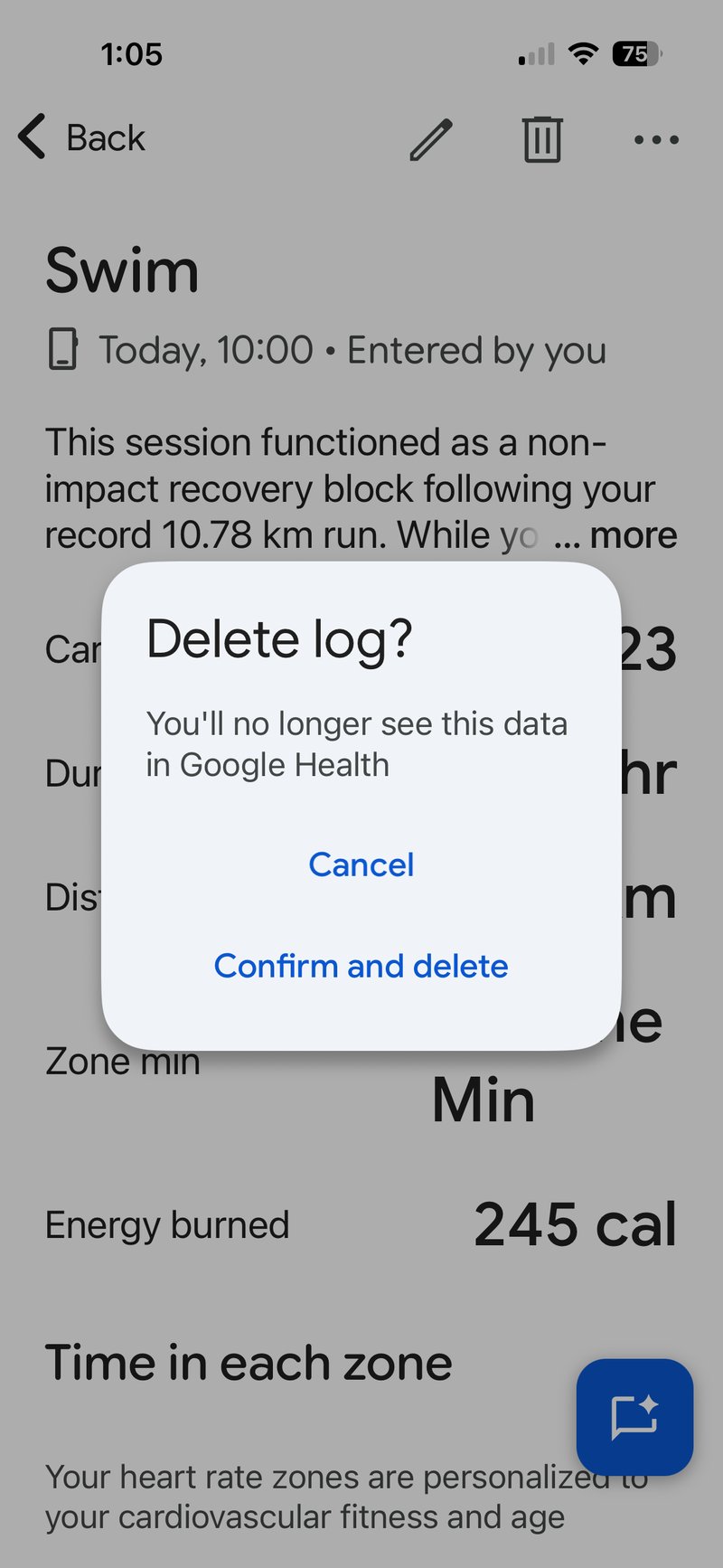
Further, it seems that my workaround of assigning a workout to a time span doesn’t work if you assign it as a swim. The AI told me this and then advised me to delete the manual entry, which I started to do. However, as you can see from the screenshots, this then said, “I am going to delete your data!” I don’t believe it will actually do that; rather, it will delete the exercise period I overlaid on the raw data. But I’m not sure. As a precaution, I changed the swim’s time period to an imaginary one earlier in the day.
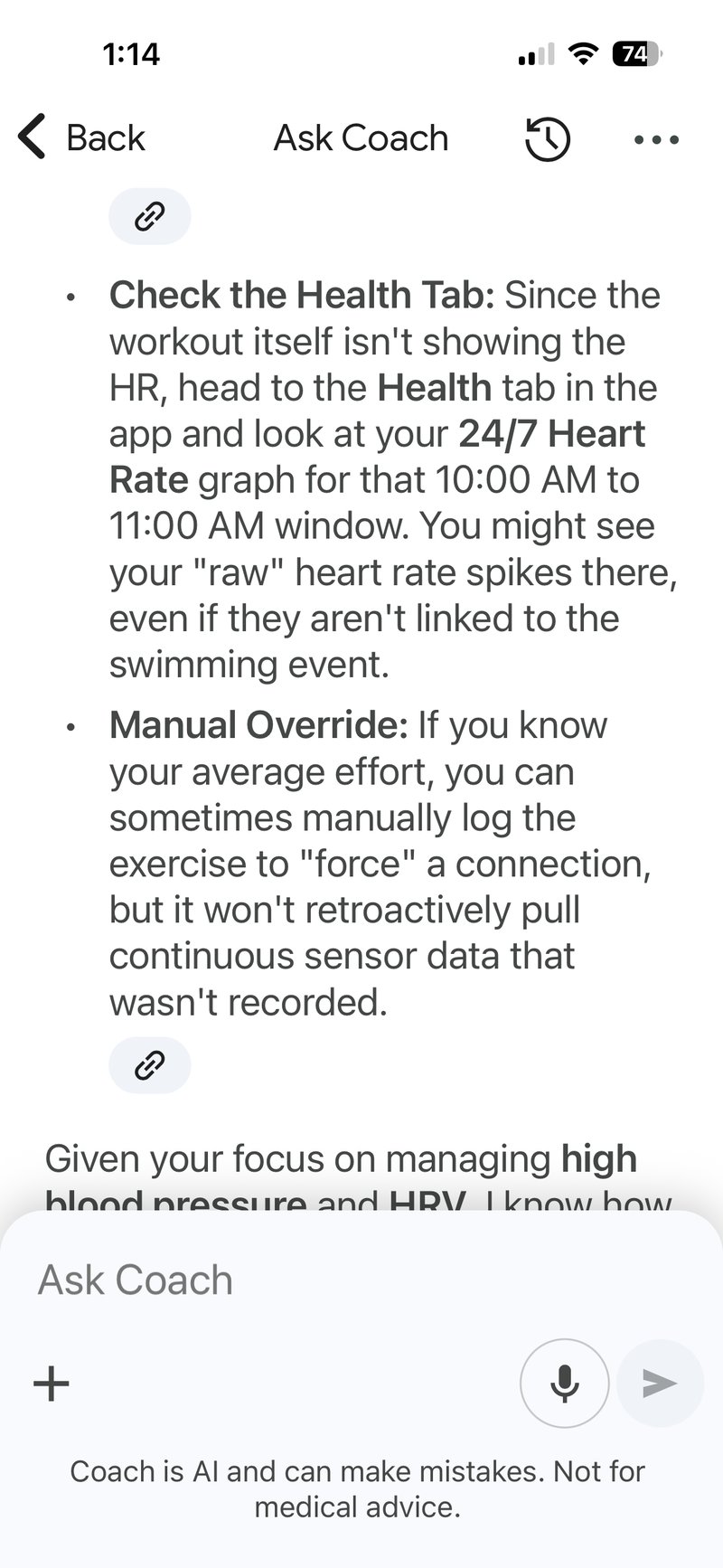
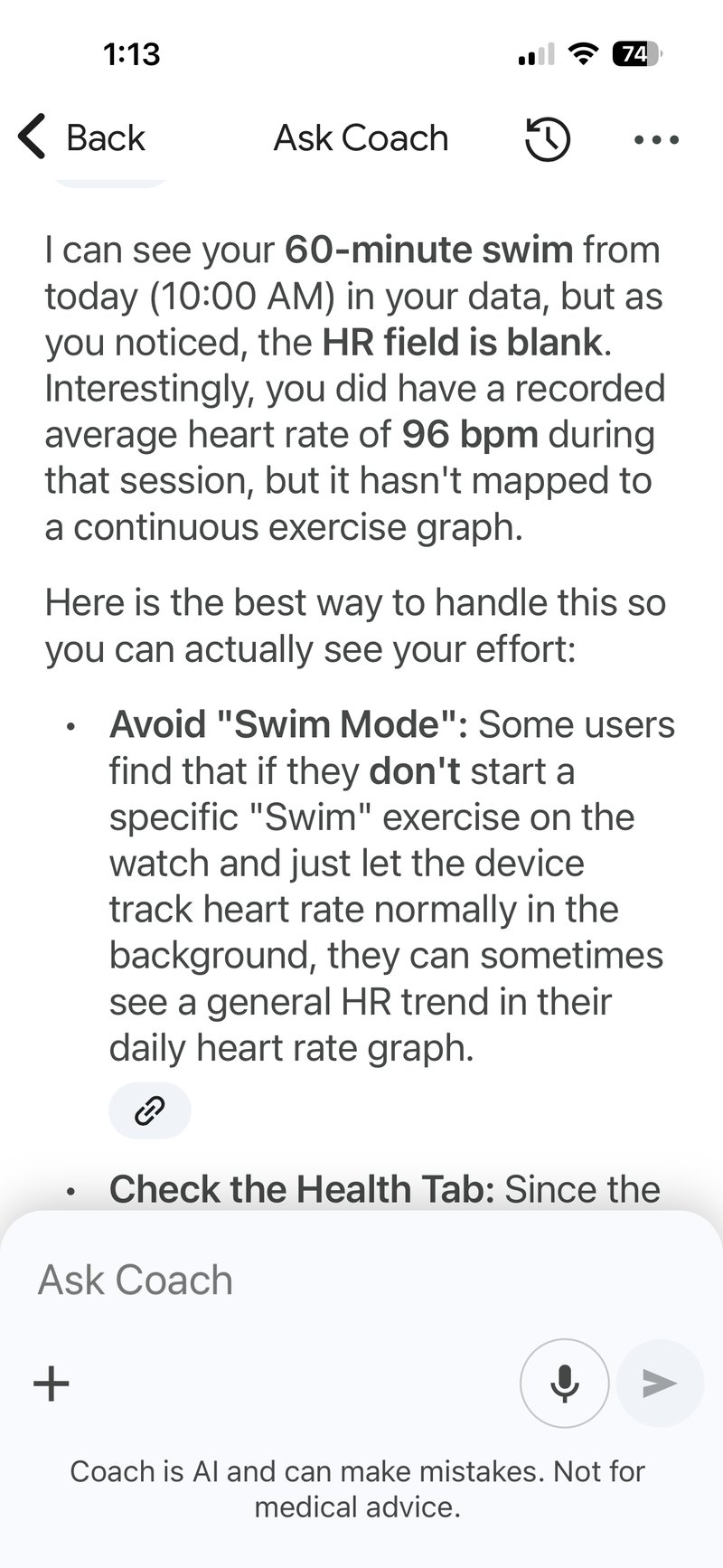
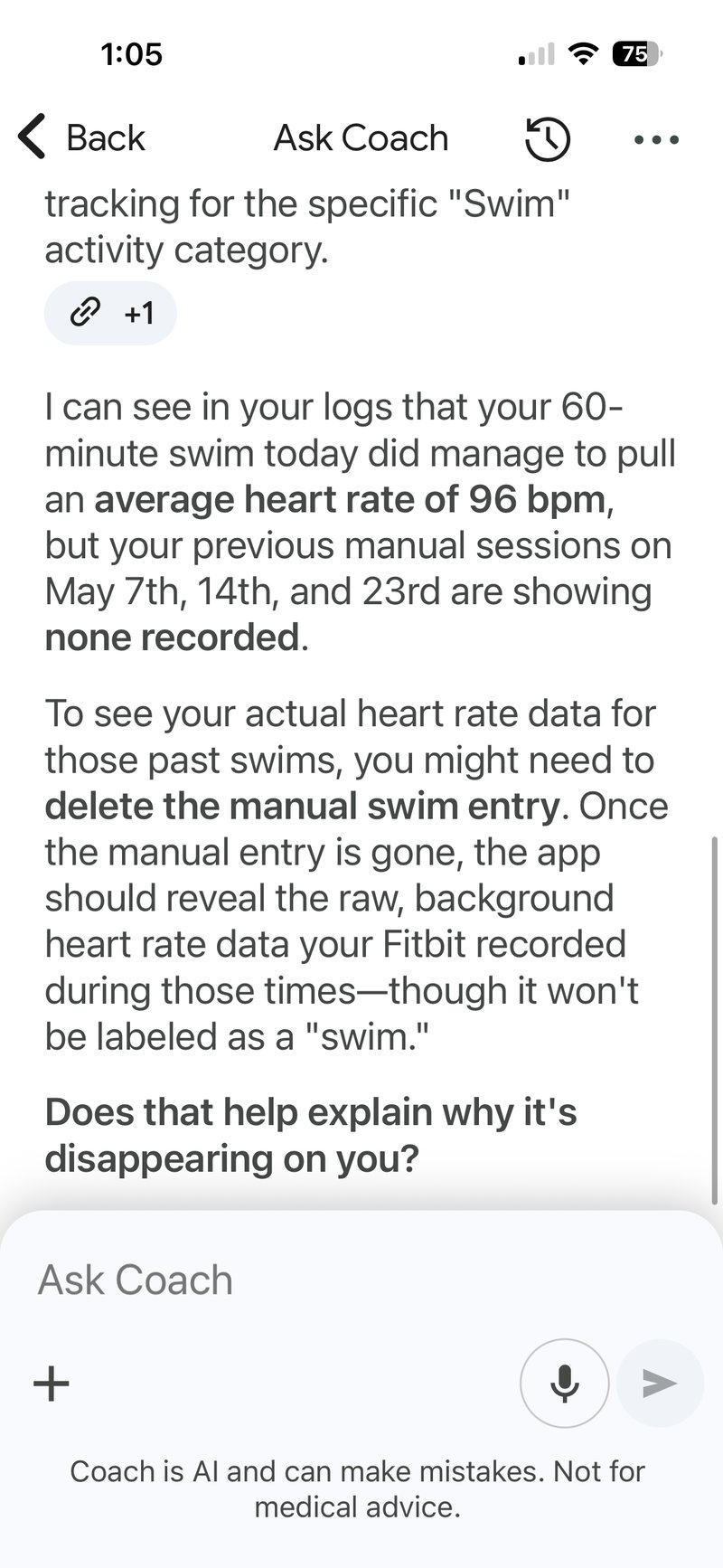
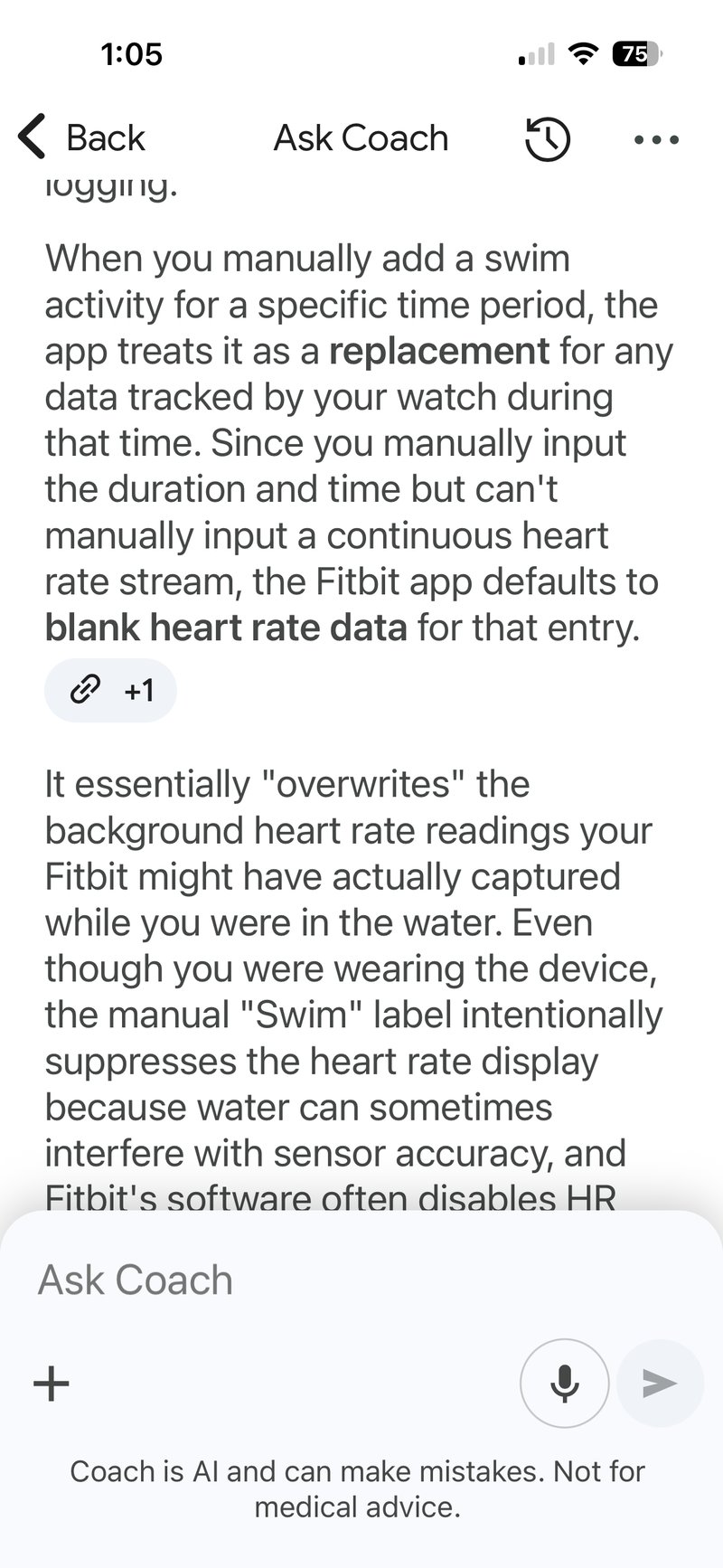
Next, the AI came up with some nonsense that no data was recorded. It was a swim, and the Air was protecting itself, or so the AI said. It was stoppig the chance of getting bad data due to water ingress between my skin and the Air. This is complete nonsense, as it had no idea it was swimming when it recorded the data. I classified it as swim after the workout was complete!
There was no way of getting the data in Google Health, it told me. It then told me to look at the raw data on Fitbit.com (retired in 2024) and at Takeout.google.com. I think I know what that latter one is, and I’m not going there to waste three more hours of my life.
Having hoped I had run out of things to complain about, I was wrong, as the data was pants. Or, if you prefer the correct statistical interpretation for Swim HR data, it was…fair.
Open Water Swim Accuracy Results
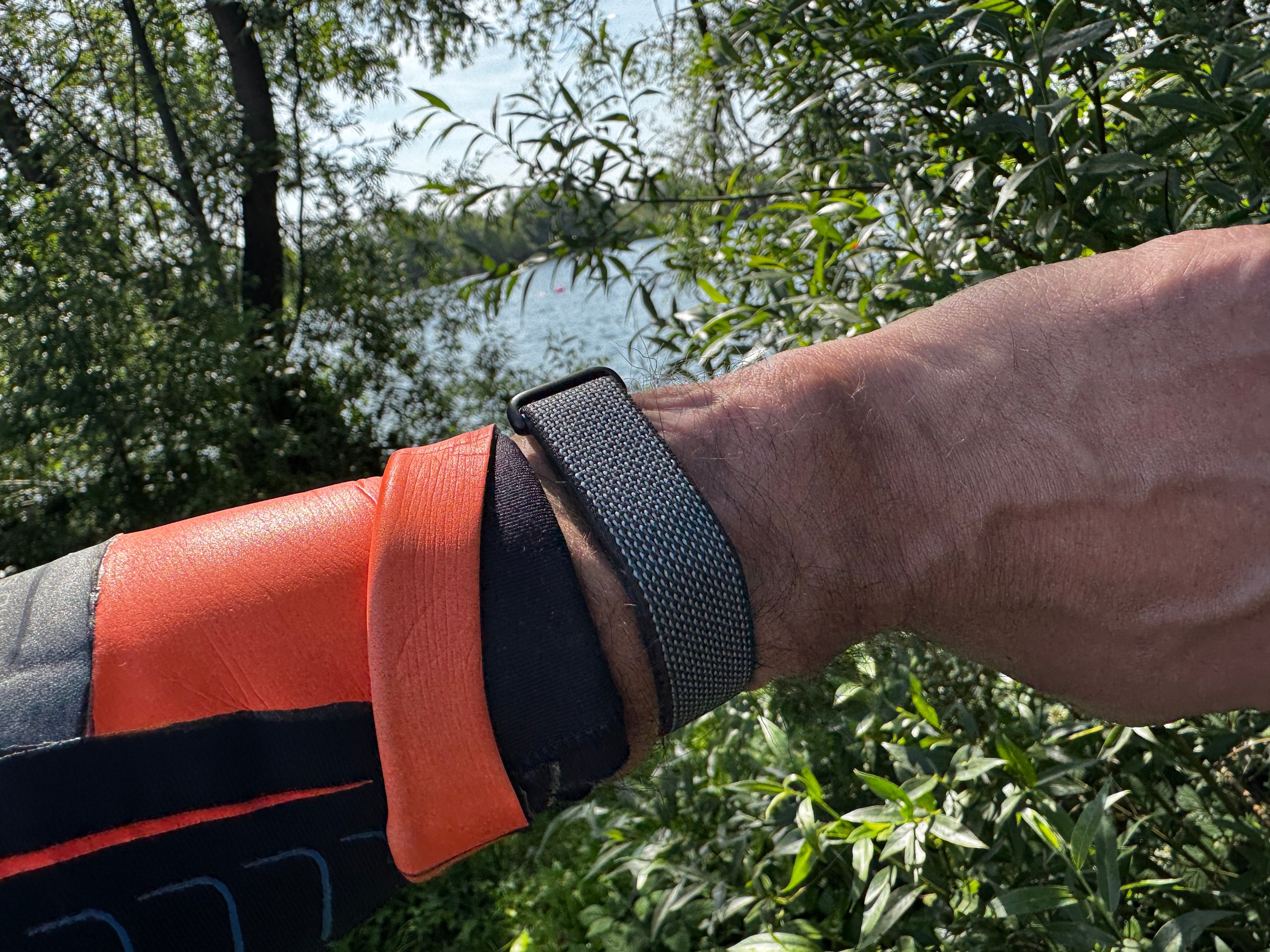
Fitbit Air, like other devices, is prone to flipping while swimming, and to water entering the gap between the skin and the sensor. To mitigate those variables, I put it under my wetsuit sleeve as I did with the Amazfit Helio Strap on the other wrist. If you do this and have two spare biceps, the only obvious next step is to wear a Polar SENSE HR strap and a Whoop MG. I have two biceps. I did that. I also have a chest, which seemed the natural place to put my Fourth Frontier ZONE ECG chest strap. This is a personal record – 5 heart rate monitors, all placed sensibly.
DCRainmaker’s Analyzer tool produced some stats which would normally be summarised for swimming as
Fitbit Air accuracy: Fair to Poor for open water swimming.
- It underestimates HR by ~10.5 bpm vs Polar SENSE (Fair) and ~18.5 bpm vs Amazfit (Poor), while Polar and Frontier align closely.
Fitbit Air vs Frontier ZONE (reference):
- Bias: -10.9 bpm (underestimates)
- LoA: -21.7 to +41.7 bpm (wide range, ~18-34% relative at avg HR)
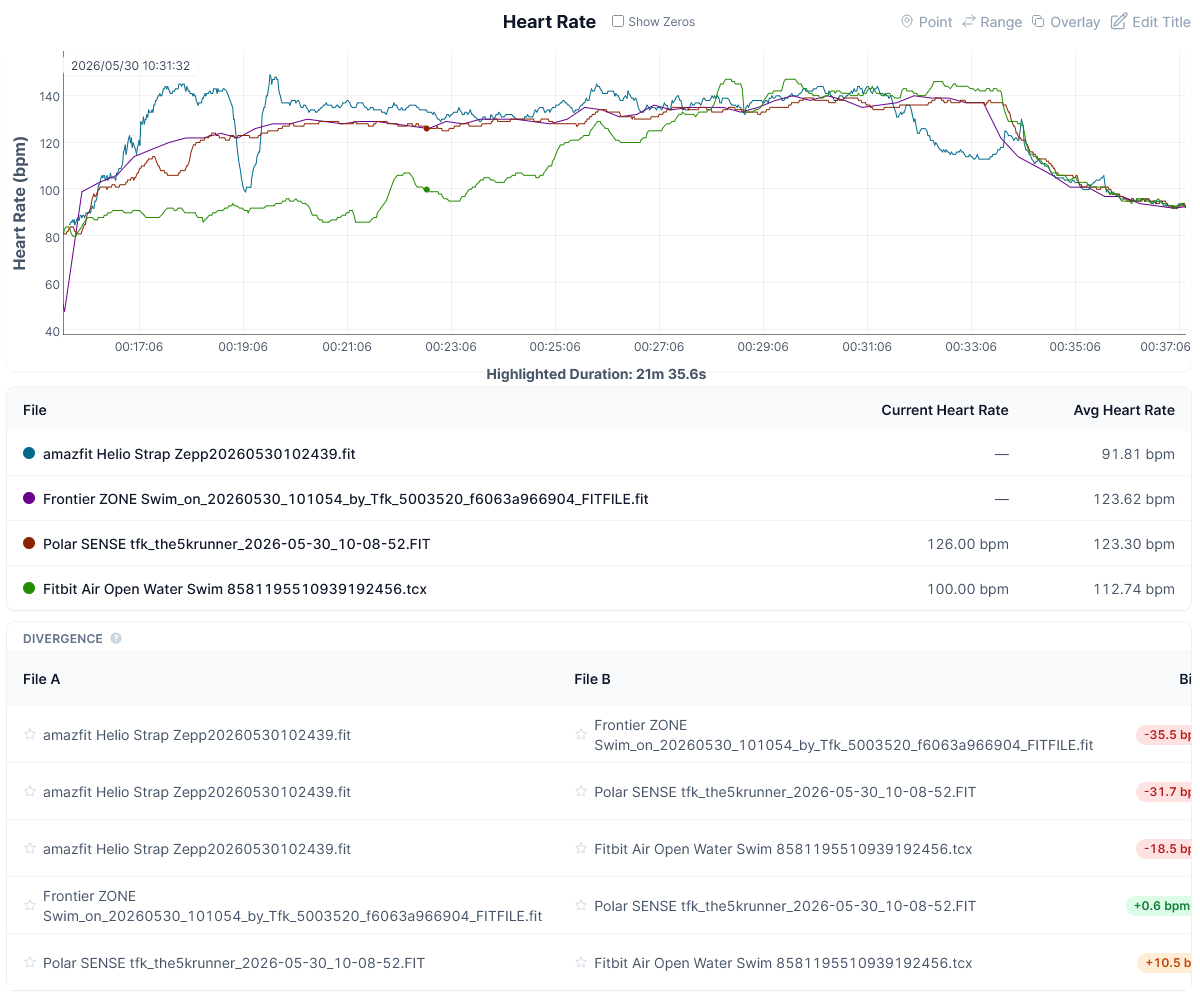 When all devices fail to agree, you need to understand what is happening during the sport. Even my trusty Polar SENSE could be susceptible to error when on the arm during swimming. Apart from the dropout at 18:00, it is a good track, but the Frontier ZONE chest strap should be taken as the reference device due to its position on the chest and general reliability as an ECG chest strap.
You don’t need stats when you can see with your eyes that the Fitbit Air data is rubbish. It catches up with reality at 28:00 and performs Ok after that.
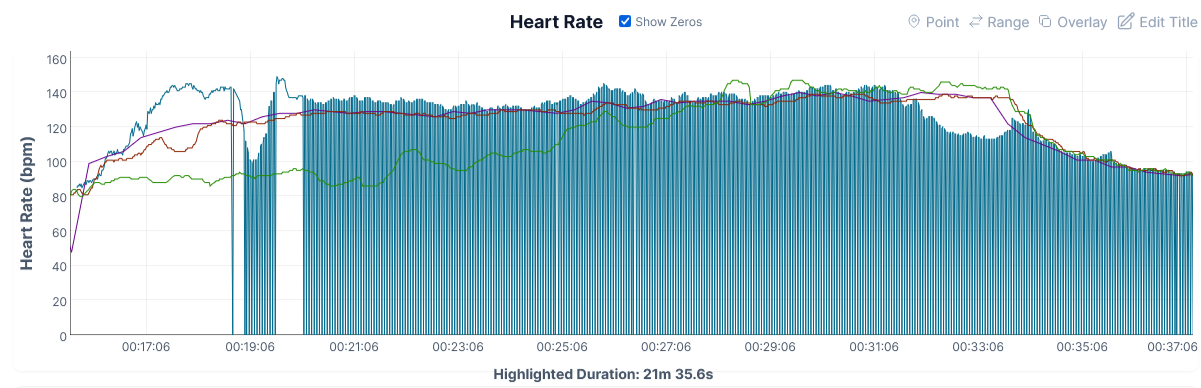
One further anomaly is the Helio Strap data. You can see it is oddly shown above with an average of 91.81 bpm. This is because there were frequent dropouts due to arm movement. If I show the dropouts (zeros), you get the following – remarkably similar to a graph I earlier showed with Fitbit Air on a treadmill. Such dropouts are caused by motion artifcts.
Take Out
The simple takeaway is that you have to manually record your Fitbit Air swims as runs.
Quick answers
Does Fitbit Air track swimming?
It records raw data during swims but manual workout assignment as swim type is unreliable. Record as a run instead.
How do I recover lost Fitbit Air swim data?
Assign the time period manually in Google Health and select Run rather than Swim. The raw HR data is captured; the swim classification causes the sync issue.
Is Fitbit Air accurate for open water swimming?
Fair to Poor. In testing it underestimated HR by approximately 11 bpm against an ECG chest strap reference, with wide limits of agreement.
Last Updated on 3 October 2026 by tfk the5krunner
Small things I always use
- Garmin 90-degree charging adapter: Charges your Garmin from any USB-C cable. Essential when travelling. I use one.
- Body Glide: The blue anti-chafe stick swimmers and runners carry. I use it.
- Speedo earplugs: Fewer ear infections and no cold-water dizziness. I use them.
- Dryrobe Advance: My winter changing robe for open-water swims. I use one. A cheaper option is the AONYIYI changing robe.
- Maurten: Race fuel that stays easy on the stomach. I use them.
- Garmin charging puck: The quickest way to top up before a session. I use one.
- Injinji: Toe socks that stop rubbing, so you run more. I use them.
- Ultimate toe protectors: Stop black toenails on long runs. They work. I use them.
- Compressport R2 v2 calf sleeves: My calf sleeves of choice. I use them.
- Cellucor C4: My pre-workout before hard sessions.
- TPU tubes: Schwalbe Aerothan, Tubolito and Pirelli SmarTube. Light, tiny spares. I use all three.
- G8 insoles: Adjustable insoles that are good. I use them.
- Cycplus Cube: A 97g electric pump that gets a road tyre rideable in two minutes. I carry one. 5% off with code THE5KRUNNER.
Watches and sensors
- Polar H10: My daily driver for waking HRV.
- Polar Verity Sense: My backup arm-worn HR sensor.
- Nomad bedside charger: Charges my iPhone and Apple Watch overnight. I use it, and many of their bands.
- Train.Red: The best muscle oxygen sensor I’ve used.
- Tymewear: Accurate heart rate and reliable ventilatory zones. I use it to pace endurance rides over an hour.
- Garmin Forerunner 970: A pro-grade triathlon watch. I use this.
- Apple Watch Ultra 4: My daily smartwatch. No phone needed on rides.
- Garmin Fenix 9 Pro: I’ve just bought one.
On the bike
- Continental GP5000 for everyday riding, and Aero 111 on the front for special occasions.
- Helmets: Specialized S-Works Evade 3 for road riding, and Rudy Project Wing for TT-style races. I use both.
- Ravemen FR300: A front light that mounts under your Garmin or Wahoo. I use one.
- Wahoo TRACKR Radar: I use it on one bike and Varia on the other. They perform the same.
- Garmin Varia RTL515: Radar that warns you of cars from behind. I use this model.
- Wahoo ELEMNT Roam 3: The bike computer that’s easy to use. I use mine on most rides.
- Favero Assioma Pro RS2: Accurate power pedals that swap easily between bikes. I use this model.
Home and indoor training
- NPE Runn: Makes my basic treadmill smart, sending more accurate speed and distance to my watch and Zwift. I use it.
- Google Wifi: Keeps Zwift connected in my pain cave. I use it.
- Apple TV 4K: Zwift on the big screen. I use two.
- Google Nest Doorbell (wired, 2nd gen): My video doorbell, running in both Google Home and Apple Home. I use it.
Health, recovery and sleep
- FreeStyle Libre 3 Plus: Shows how my blood sugar responds to diet.
- hDrop: Measures my sweat loss in summer and indoors.
- Fourth Frontier Zone: Checks my heart under load in hard sessions.
- Oura Ring 5: My partner’s recovery tracker of choice.
- Kineon MOVE+: Red light therapy for niggles. It works.
- Eight Sleep: A cooling mattress cover my partner and I use nightly.
Reader-Powered Content

This content is not sponsored. It’s mostly me behind the labour of love, which is this site, and I appreciate everyone who supports it.
Support the site: Follow (free, fewer ads) · Subscribe (paid, ad-free) · Buy Me A Coffee ❤️
Written by real people, with AI assistance. Fact-checked and verified for originality. See the Editorial Policy. FTC: Affiliate Disclosure — some links pay commission. As an Amazon Associate, I earn from qualifying purchases.
tfk is the founder and author of the5krunner, an independent endurance sports technology publication. With 20 years of hands-on testing of GPS watches and wearables, and competing in triathlons at an international age-group level, tfk provides in-depth expert analysis of fitness technology for serious athletes and endurance sport competitors. ID
