Garmin Cirqa Smart Band Filing: New Whoop-Beating Feature Listed
Garmin has filed trademark applications for Cirqa in Canada and the UK within four days of each other: Canada on June 19, the UK on June 23. Both filings are routine in form, but one phrase in the goods description is not.
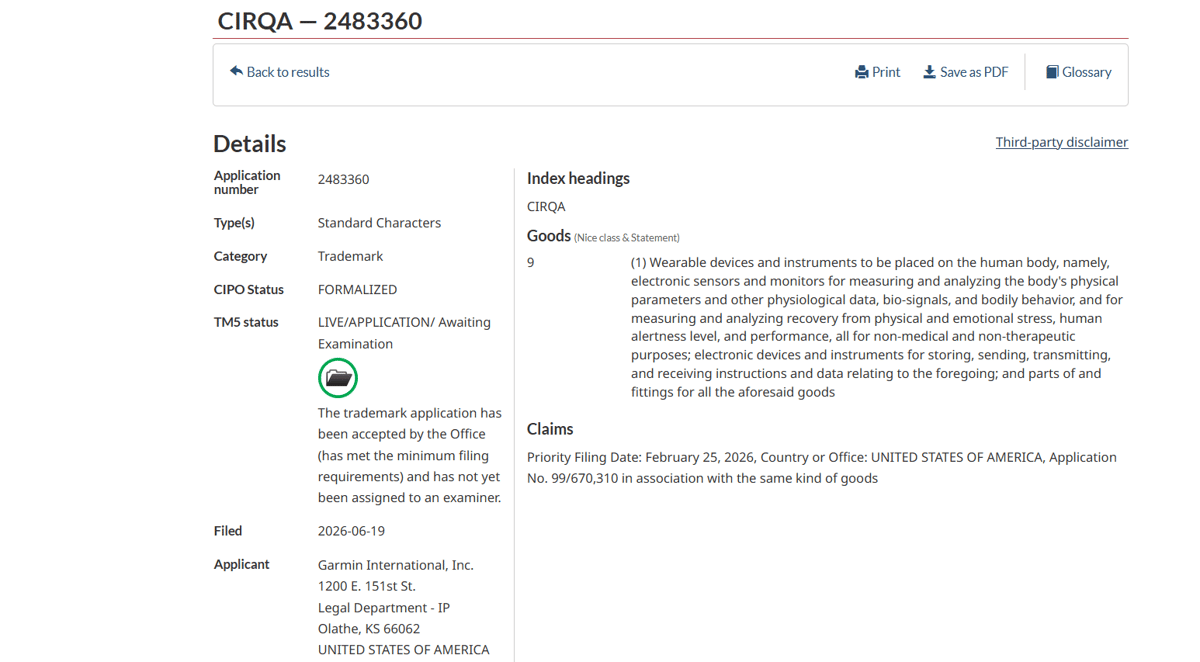
One phrase in the listed goods separates this filing from standard commercial protection: “measuring and analyzing recovery from physical and emotional stress, human alertness level, and performance”. Garmin’s existing stress metric is HRV-derived and does not distinguish between physical and emotional arousal. The Canadian filing deliberately separates the two, thus strongly suggesting new capabilities.
For the full picture of what Cirqa is expected to do and how it compares to Whoop and Fitbit Air, see the detailed Garmin Cirqa analysis.
Why is “emotional stress” the interesting part
The sensor used to measure emotional and cognitive stress is EDA (electrodermal activity, also known as the galvanic skin response, GSR). It works by detecting changes in skin electrical conductance driven by eccrine sweat glands activated by the sympathetic nervous system. Unlike optical heart rate sensing, which infers stress indirectly from HRV, EDA reads arousal state directly from the skin. FEDA/GSR sensors are not new to the market, and Fitbit did indeed build EDA into the Sense, Sense 2 and Pixel Watch 4, but neither Whoop nor Garmin have ever implemented it.
If Cirqa incorporates EDA sensing, it would add a stress-monitoring dimension that no current-generation wearable from any brand offers.
What this might mean for the sensor stack
EDA is bioelectrical rather than optical, which means it requires direct contact with skin electrodes. It cannot sit inside an Elevate optical HR sensor. Three possibilities follow. Either
- Cirqa carries Elevate 5 alongside a discrete EDA sensor module,
- a next-generation Elevate 6 incorporates additional bioelectrical sensing with EDA as one capability among several, or
- ECG/EDA could be combined into one inner-surface electrode. Published research has demonstrated this.
An initial FCC filing analysis published here in February confirmed the presence of WiFi, BLE, and a skin-worn band format. It did not have any new insights into the sensor stack, so the Canadian filing is the first documentary signal of potentially new capabilities.
What the filing actually says
Canadian trademark application 2483360 was filed on June 19, 2026, by Garmin International Inc., with a priority date of February 25, 2026. USPTO application 99/670,310 was already in place before the March launch speculation. The status is formalised and awaiting examination, which is a normal state for a pre-release filing. Cirqa is listed under Nice class 9: wearable sensors for measuring and analysing physical and emotional stress, human alertness levels, and performance, also adding standard non-medical, non-therapeutic wording.
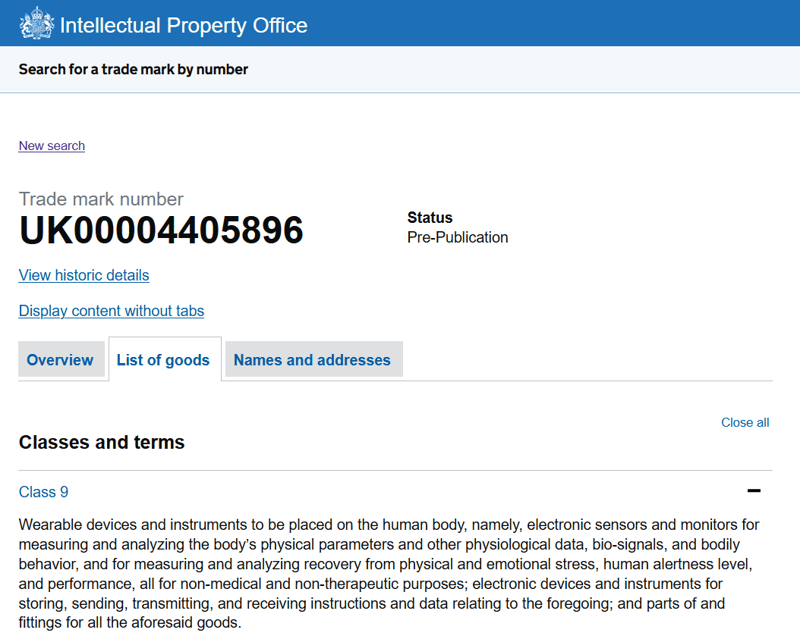
Four days later, on June 23, 2026, Garmin filed UK trademark application UK00004405896 with the UK Intellectual Property Office. The status is Pre-Publication, meaning the application has been received but not yet published for third-party opposition. The goods description is word-for-word identical to the Canadian filing, and the same priority date of February 25, 2026 applies. Canada on June 19, UK on June 23: that is a coordinated multi-jurisdiction filing wave.
The bigger picture
The dates confirm Cirqa was a defined product by late February 2026, consistent with the Garmin Connect app code analysis and the regulatory filings across Singapore and the UAE that were covered earlier this year. The Canadian trademark signals Garmin is treating Cirqa as a near-live product being actively extended and protected across jurisdictions.
The filing does not confirm a launch date, a price, or a final sensor specification, but all three were resolved when Garmin announced the CIRQA on 21 July 2026. What it does confirm is that Garmin’s stated ambition for Cirqa goes beyond replicating Whoop’s existing feature set. Whether that ambition is in the hardware or reflects Garmin’s broader platform positioning around stress and readiness, the competitive picture has just become more interesting.
For the full technical specifications, see the Garmin CIRQA specs. A full review will follow separately.
Initial discovery reported on Gadgets & Wearables and Reddit
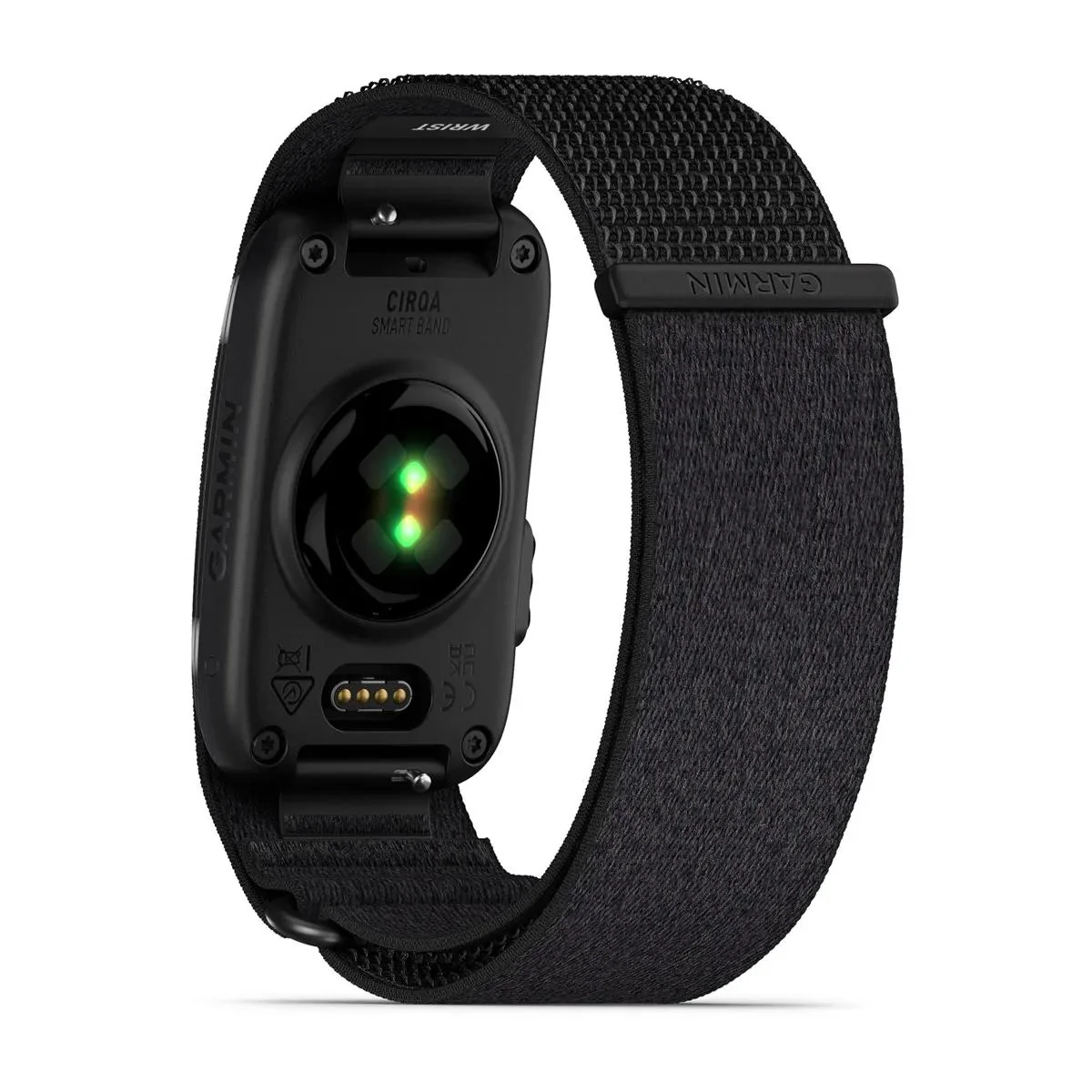
Garmin CIRQA Smart Band
Screenless health and fitness band (no subscription required)
 +other retailers
Quick answers
What is EDA sensing?
EDA stands for electrodermal activity, also known as the galvanic skin response. It measures changes in skin electrical conductance caused by eccrine sweat glands activated by the sympathetic nervous system, making it a direct marker of emotional and cognitive arousal rather than physical exertion.
Does Whoop have EDA sensing?
No. Whoop does not currently include an EDA sensor. Google/Fitbit is the only major wearable brand to have implemented EDA at consumer scale, in the Sense, Sense 2 and Pixel Watch 4.
Could EDA and ECG share the same sensor on Cirqa?
Possibly. Both EDA and ECG require direct electrical contact with the skin, and published research has confirmed that the same electrodes can serve both functions in a single wearable. Garmin already uses skin-contact electrodes for ECG on the Fenix 8. A band format with inner-surface contacts could plausibly handle both modalities. This is inference, not a confirmed specification.
What do the trademark filings confirm about Cirqa?
They confirm Garmin is actively extending trademark protection across multiple jurisdictions: US (February 2026), Canada (June 19, 2026), and the UK (June 23, 2026). All three carry identical goods descriptions. The filings confirm the product was commercially defined by at least February 25, 2026. They do not confirm a launch date or final hardware specification.
Is EDA confirmed for Garmin Cirqa?
No. The inference comes from the goods description in the trademark filing, which distinguishes between physical and emotional stress sensing in a way that Garmin’s existing HRV-based metrics do not support. It is a reasonable inference from the language, not a confirmed specification.
Last Updated on 14 August 2026 by the5krunner
My favourite kit and nutrition
- Injinji – Runners protect your toes. Avoid discomfort and minor injury. Run more. Run faster. I use them.
- Garmin 90-degree charging adapter — A small keyring adapter you can use anywhere. Essential when away. I use one.
- Garmin charging puck — the fastest and most reliable way to top up your Garmin before a session. I use one.
- Ravemen FR300 — Front light that mounts directly under your Garmin or Wahoo head unit. Keeps your bars clean and your beam pointed where it matters. I use one.
- Body Glide – The blue anti-chafe stick that all swimmers and many runners use. I use it.
- Maurten — The race nutrition trusted by elite athletes. Gels and drink mixes engineered to be easy on the stomach. I use them.
- Garmin Varia RTL515 — A radar rear light that alerts you to vehicles approaching from behind. Pairs with your Edge or Wahoo. I use this model.
- Favero Assioma Pro RS2 — The power-meter pedals most serious cyclists choose. Accurate, easy to move between bikes. I use this model.
- Garmin Forerunner 970 — A serious choice for a pro-grade triathlon watch. I use this.
- Polar H10 — My daily driver for accurate, waking HRV readings.
- Wahoo ELEMNT Roam 3 — The bike computer that has the feature Garmin lacks: usability. I use mine on most rides.
Reader-Powered Content

This content is not sponsored. It’s mostly me behind the labour of love, which is this site, and I appreciate everyone who supports it.
Support the site: Follow (free, fewer ads) · Subscribe (paid, ad-free) · Buy Me A Coffee ❤️
All articles are written by real people, fact-checked, and verified for originality. See the Editorial Policy. FTC: Affiliate Disclosure — some links pay commission. As an Amazon Associate, I earn from qualifying purchases.
tfk is the founder and author of the5krunner, an independent endurance sports technology publication. With 20 years of hands-on testing of GPS watches and wearables, and competing in triathlons at an international age-group level, tfk provides in-depth expert analysis of fitness technology for serious athletes and endurance sport competitors. ID

Interesting tidbit. Does the EDA sensing require setting a baseline for a few days, or it starts working right away?
EDA sensor is also on the pixel Watch’s
ty, yes i forgot to add that originally but have since doen that.
Nice info – thanks
Just waiting for the launch date…
On July 19th, the confidentiality of the FCC Filing # IPH-04378 for the User Manual, Internal and External Photos expires and we should be able to see those documents… so hopefully the wait might be over soon
yes, that would imply a launch next tuesday or wednesday