Most runners don’t choose swimming. They get sent there.
A calf strain, a stress reaction, a niggling Achilles, or just an off-season week too many, and suddenly the pool is the only place a runner can maintain aerobic fitness. The engine is there (a runner who can hold threshold for 40 minutes has plenty of cardiovascular fitness to spend), but on entering the water, none of it transfers cleanly. Breathing dies past 50 metres, the legs sink, and the lane clock is the only feedback available. There is no plan, no structure, and no idea whether this counts as training or just splashing.
Max Klackl built AquaPlan for exactly that gap. It is a swim-training app that gives runners a real, periodised plan and lets them send structured sessions to their Garmin, without needing a coach on deck to tell them what to do. What follows is a short, factual walkthrough of what it does and where it fits for the running and triathlon crowd who dip into the water.
How AquaPlan works
TL;DR: The user sets a goal, AquaPlan builds a multi-week swim block with coach-style guidance and per-session structure, and each workout can be pushed straight to a Garmin watch.
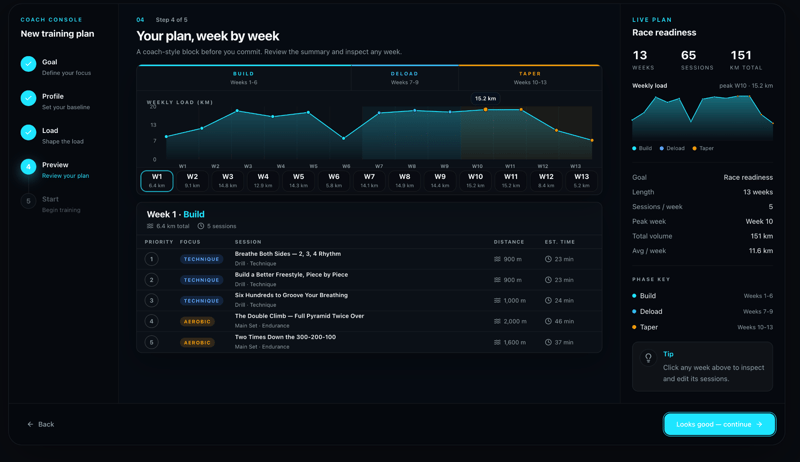
Setup asks four things: the goal (endurance, pace control, technique, or race readiness), how many weeks are available, how many sessions a week the user can commit to, and the target peak session distance. From that, AquaPlan generates a periodised block: a build phase that ramps up volume, followed by a taper if there is a race date on the calendar.
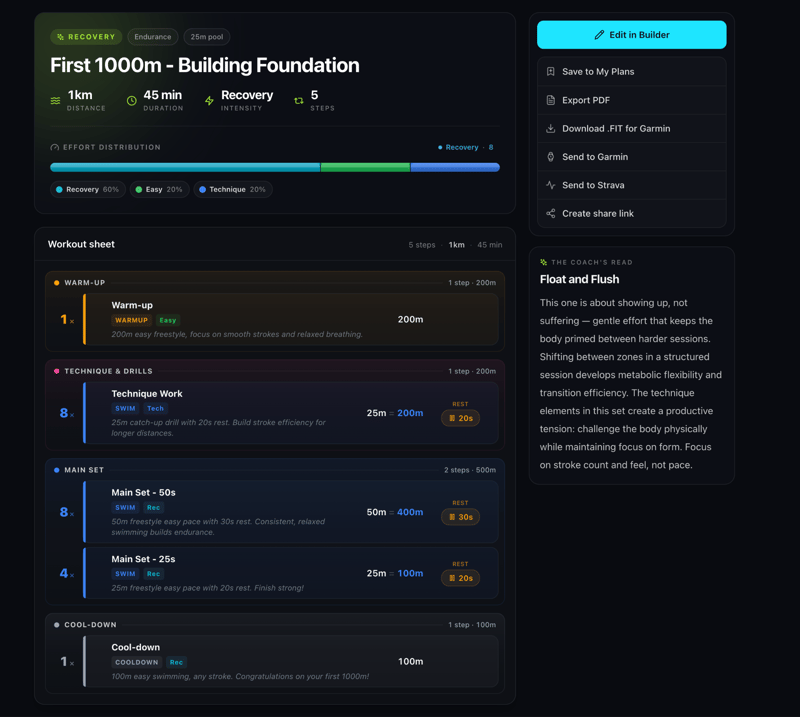
Every session comes broken into blocks: warm-up, drills, a main set, and rest intervals, each tagged with a training zone. Alongside the numbers come plain-language coaching notes: why this session exists, what the phase is doing, and whether progress is on track. The result is structure and rationale, not just a wall of distances.
Max is straight about one thing that matters to a technical audience: the plan generator is rule-based periodisation, not a machine-learning “adaptive” engine. It applies proven build-and-taper templates to user inputs and race date. It does not silently rewrite next week off logged swims. The user stays in control, and any individual session can be re-rolled. Max prefers to describe it honestly rather than oversell it as an AI coach it isn’t.
A worked example: the sidelined 10k runner
Take a runner who can comfortably run 10k, and a calf strain that has just cost three weeks of running. The goal is to hold fitness and, ideally, come back a more complete athlete. Here is what an 8-week AquaPlan endurance block actually looks like for that runner:
- Plan: 8-week endurance block, 3 sessions per week, 2,000 m peak session distance, 25 m pool.
- Week 1, session 1: 400 m warm-up in GA1 (easy aerobic), 4×50 m technique drills, a 6×100 m main set in GA1 to GA2 with rest intervals, and a 200 m cool-down. Total around 1,400 m.
- Progression: volume ramps from roughly 0.6 to 1.0 across the build weeks, so by week 6, that same session structure carries the runner near the 2,000 m peak.
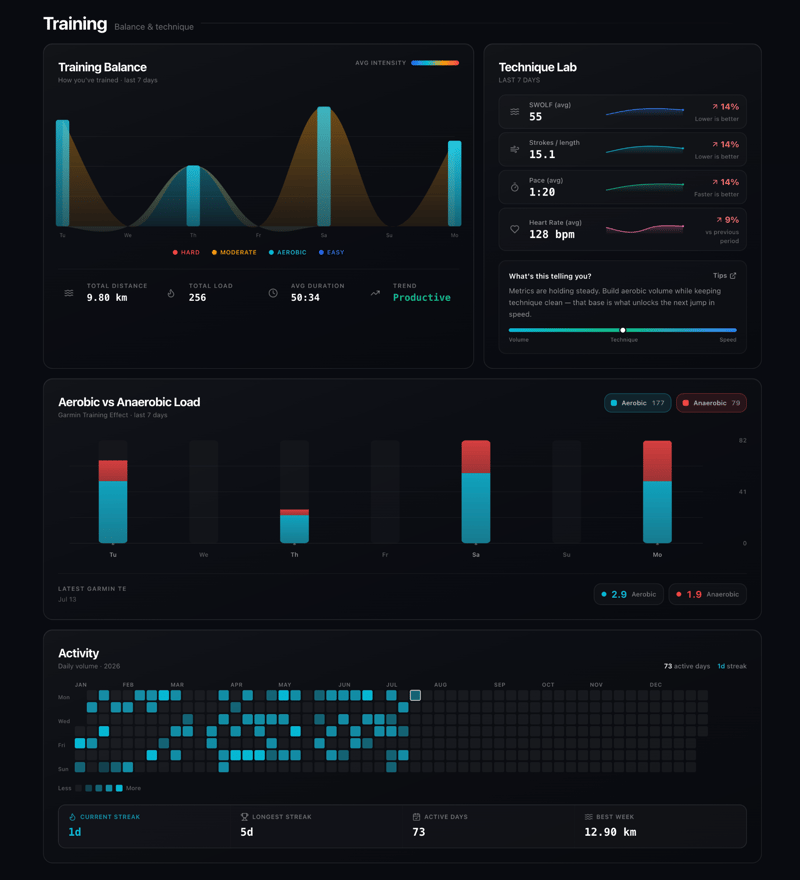
- What to watch: AquaPlan tracks pace per 100 m, distance, SWOLF, and a training-load estimate for every swim that syncs back. For a runner, SWOLF is the number to befriend. It is strokes plus time per length, so it rewards going faster and more efficiently, which is exactly the technique gap most runners have.
The value is walking on deck knowing precisely what to swim, in which zone, and why, instead of grinding 40 aimless lengths and calling it cross-training.
Free, Premium and Coach
Three tiers:
- Free: build and save swim workouts (3 saves a week, up to 5 saved plans), 30 days of history, the full builder, and free access to the SWOLF, pace and interval calculators. Sharing a workout by link is free on purpose.
- Premium (€9/mo or €90/yr): unlimited plans and builder use, full training history, PDF export, and the export features below (FIT-file export and sending structured workouts to Garmin).
- Coach (€19/mo or €190/yr): everything in Premium plus workout import (paste, photograph or upload a PDF of a session and have it parsed into editable builder blocks) and a Garmin activity editor for correcting miscounted lengths on a synced swim.
Integrations and compatibility
AquaPlan is Garmin-compatible workout-planning software, not an official Garmin product. Here is what actually connects:
- Garmin: import swim activities from Garmin Connect, and send workouts the other way, either as a Garmin-compatible FIT file imported into Connect, or pushed as a structured, scheduled workout onto the calendar day.
- Strava: two-way. Import activities and upload a completed AquaPlan workout back to Strava.
Things to note
- The plan engine is deterministic periodisation, as covered above. It is great for structure, but it will not automatically adjust load based on your performance.
- The only feature that uses an AI model is Coach-tier workout import (parsing free-text or photo/PDF sessions). Everything else is computed, not generated.
- AquaPlan is live on iOS (App Store), Google Play Store, and on the web at aquaplan.fit.
- It is built around pool swimming with training zones and structured sets. For swimmers who only ever open-water swim by feel, a structured plan is less relevant.
Summary
For runners and triathletes who end up in the pool, whether by injury, off-season, or building toward a first triathlon swim, AquaPlan turns “I have to swim now” into an actual plan. It provides a periodised block, session-by-session structure with coaching rationale, the metrics that show whether the technique is improving (pace and SWOLF), and the ability to send the workout to the watch already in use. It does not pretend to replace a swim coach’s eyes on the stroke. It replaces the far more common problem: showing up to the pool with fitness to spend and no idea how to spend it.
Max writes more about the runner-to-pool crossover here: Swimming vs Running: what actually transfers, and where cross-training helps.
Quick answers
Do I need a Garmin to use AquaPlan?
No. Plans, structured sessions and the calculators all work without any watch. A Garmin (or Strava) just lets swims sync in, and workouts push to the watch, and those export features are on the paid tiers.
Is it useful for a runner who can barely swim?
Yes, that is a core case. The technique and endurance goals start at beginner-friendly volumes, and SWOLF tracking is specifically the metric that tells a fitness-rich, technique-poor swimmer whether they are actually getting more efficient.
How is this different from a generic training-plan PDF?
The plan is generated from the user’s own goal, weeks, sessions and race date, with zone-tagged sets and coaching notes, and it is not static. Any session can be re-rolled, blocks edited, and the workout sent to the watch instead of reading a PDF on the pool deck.
Related reading on the5krunner
- FORM Smart Swim 2 LT Review: live swim metrics in the goggles’ field of view, at the lowest price the platform has carried.
- Amazfit Balance 3 Swimming Accuracy: HR, Laps, and FORM. Smart Swim Goggles Coaching: pool swim testing on the Balance 3, with the FORM goggles as the coaching layer.
- IntervalCoach: AI Training That Adapts to Your Recovery Each Day: another indie training app that treats swimming as one of the sports in a multi-sport plan.
Author: Max Klackl, developer of AquaPlan, edited by the5krunner.
If you enjoyed reading this, here is another in the Indie Spotlight series: Negative Split: Free Local Strava Running Analytics.
Last Updated on 12 October 2026 by tfk the5krunner
Small things I always use
- Garmin 90-degree charging adapter: Charges your Garmin from any USB-C cable. Essential when travelling. I use one.
- Body Glide: The blue anti-chafe stick swimmers and runners carry. I use it.
- Speedo earplugs: Fewer ear infections and no cold-water dizziness. I use them.
- Dryrobe Advance: My winter changing robe for open-water swims. I use one. A cheaper option is the AONYIYI changing robe.
- Maurten: Race fuel that stays easy on the stomach. I use them.
- Garmin charging puck: The quickest way to top up before a session. I use one.
- Injinji: Toe socks that stop rubbing, so you run more. I use them.
- Ultimate toe protectors: Stop black toenails on long runs. They work. I use them.
- Compressport R2 v2 calf sleeves: My calf sleeves of choice. I use them.
- Cellucor C4: My pre-workout before hard sessions.
- TPU tubes: Schwalbe Aerothan, Tubolito and Pirelli SmarTube. Light, tiny spares. I use all three.
- G8 insoles: Adjustable insoles that are good. I use them.
- Cycplus Cube: A 97g electric pump that gets a road tyre rideable in two minutes. I carry one. 5% off with code THE5KRUNNER.
Watches and sensors
- Polar H10: My daily driver for waking HRV.
- Polar Verity Sense: My backup arm-worn HR sensor.
- Nomad bedside charger: Charges my iPhone and Apple Watch overnight. I use it, and many of their bands.
- Train.Red: The best muscle oxygen sensor I’ve used.
- Tymewear: Accurate heart rate and reliable ventilatory zones. I use it to pace endurance rides over an hour.
- Garmin Forerunner 970: A pro-grade triathlon watch. I use this.
- Apple Watch Ultra 4: My daily smartwatch. No phone needed on rides.
- Garmin Fenix 9 Pro: I’ve just bought one.
On the bike
- Continental GP5000 for everyday riding, and Aero 111 on the front for special occasions.
- Helmets: Specialized S-Works Evade 3 for road riding, and Rudy Project Wing for TT-style races. I use both.
- Ravemen FR300: A front light that mounts under your Garmin or Wahoo. I use one.
- Wahoo TRACKR Radar: I use it on one bike and Varia on the other. They perform the same.
- Garmin Varia RTL515: Radar that warns you of cars from behind. I use this model.
- Wahoo ELEMNT Roam 3: The bike computer that’s easy to use. I use mine on most rides.
- Favero Assioma Pro RS2: Accurate power pedals that swap easily between bikes. I use this model.
Home and indoor training
- NPE Runn: Makes my basic treadmill smart, sending more accurate speed and distance to my watch and Zwift. I use it.
- Google Wifi: Keeps Zwift connected in my pain cave. I use it.
- Apple TV 4K: Zwift on the big screen. I use two.
- Google Nest Doorbell (wired, 2nd gen): My video doorbell, running in both Google Home and Apple Home. I use it.
Health, recovery and sleep
- FreeStyle Libre 3 Plus: Shows how my blood sugar responds to diet.
- hDrop: Measures my sweat loss in summer and indoors.
- Fourth Frontier Zone: Checks my heart under load in hard sessions.
- Oura Ring 5: My partner’s recovery tracker of choice.
- Kineon MOVE+: Red light therapy for niggles. It works.
- Eight Sleep: A cooling mattress cover my partner and I use nightly.
Reader-Powered Content

This content is not sponsored. It’s mostly me behind the labour of love, which is this site, and I appreciate everyone who supports it.
Support the site: Follow (free, fewer ads) · Subscribe (paid, ad-free) · Buy Me A Coffee ❤️
Written by real people, with AI assistance. Fact-checked and verified for originality. See the Editorial Policy. FTC: Affiliate Disclosure — some links pay commission. As an Amazon Associate, I earn from qualifying purchases.
tfk is the founder and author of the5krunner, an independent endurance sports technology publication. With 20 years of hands-on testing of GPS watches and wearables, and competing in triathlons at an international age-group level, tfk provides in-depth expert analysis of fitness technology for serious athletes and endurance sport competitors. ID
