Garmin Forerunner 970 problems & delights – a negative review
This is probably the review of the Forerunner 970 that Garmin dreads.
This review highlights the negative bits so you can make an informed decision rather than relying on every other review, which only tells you how wonderful the watch is (which it is).
Heads up: I have zero links to Garmin and bought this watch with my own money. No media freebies here. People almost always only buy from positive reviews, so if you want to support truly independent content, then please buy the FR970 from this link or Buy Me A Coffee.
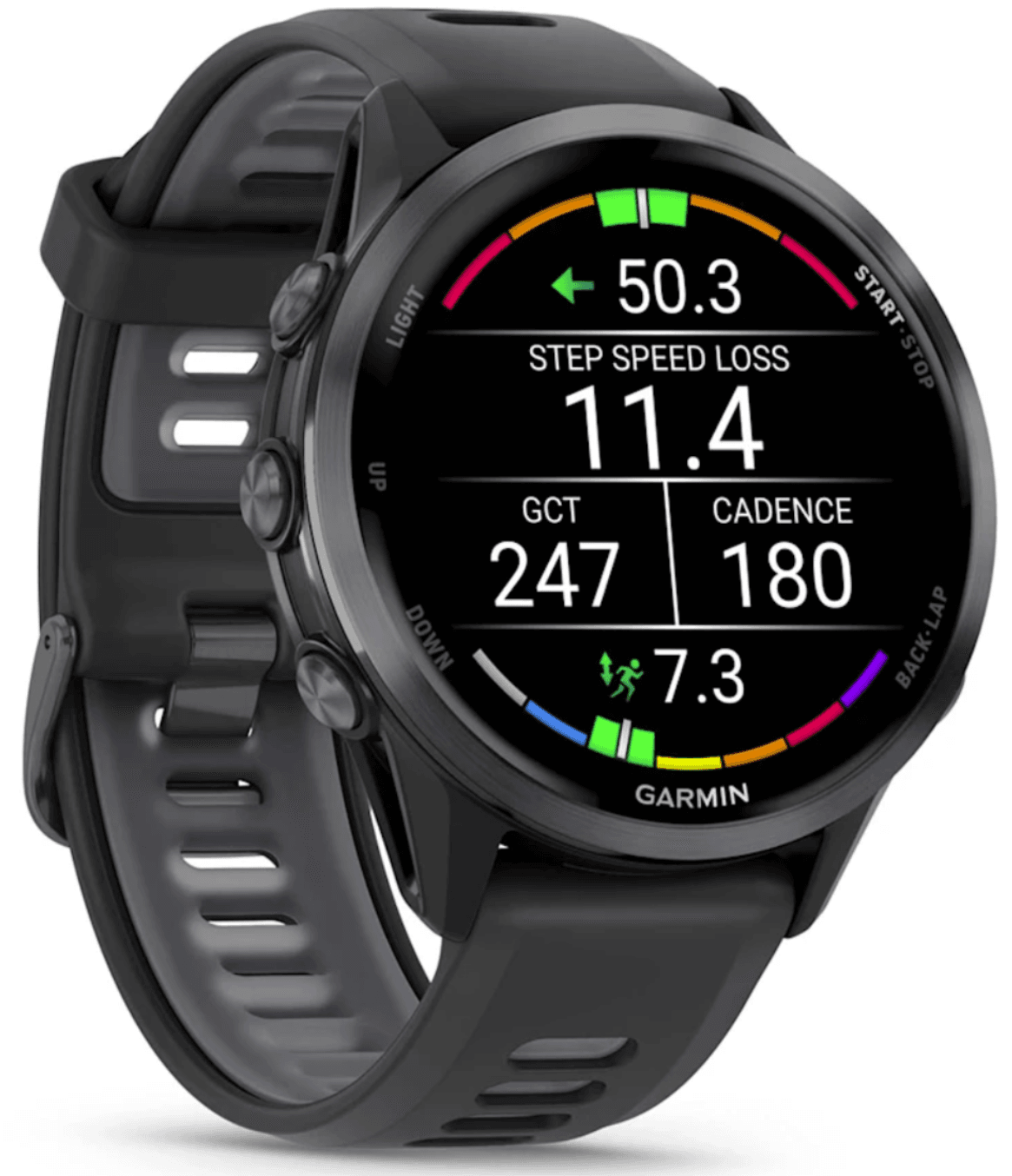
Garmin Forerunner 970
Premium GPS triathlon smartwatch. Features a bright AMOLED touch screen and a built-in LED flashlight.

This product has been awarded the the5krunner Editor’s Choice 2026. The award is given to products that achieve an exceptional standard in independent testing. See all Editor’s Choice awards.
As you already know, Garmin’s best-ever triathlon watch is the Forerunner 970. It has every tri-related feature and is even better than the Forerunner 965. I rarely would say upgrade from the previous generation model of Garmin, but if you are a tri gadget lover (me), then the upgrade is worth considering.
The Forerunner 970 sits at the top of the current Forerunner range; for a full breakdown of all five active models and how Garmin differentiates them in hardware and software, see the Garmin Forerunner guide.
There’s always a but.
Usually, the ‘but’ is that Garmin is the butt of jokes about reliability and bugs. Once again, that is the case. Once again, you are expected to pay an awful lot of money for a sports watch with quite a few bugs. Admittedly, the situation with the FR970 is better than it was last time, when the bugs on the FR965 were more frequent.
This year’s crop of FR970 bugs is mildly annoying. If you contrast the current situation with well over 5 years ago, you would often hear cries of anguish from fellow athletes, “The £%^$%& Garmin has lost the workout.” Those kinds of catastrophic errors are rare nowadays, although you may encounter the odd unexpected mid-workout reboot from which Garmin should recover your data.
My Experience with the Forerunner 970
I’ve had the 970 from day 1 and have used it extensively as my daily driver for triathlon and HYROX training. It is a really good, well-featured watch, but…
Initial Setup
Garmin has a great system to transfer previous settings to a new watch. But. It often doesn’t work. At least it didn’t for me on the 970, nor its FR965 predecessor, nor my last Edge 540.
Garmin Connect just couldn’t find any backup. This is pathetic.
I also have multiple Apple Watches and iPhones. Transferring phones and watches between family members takes a bit of time, but Apple usually requires only a handful of taps at the start before it goes off and does its thing, and it always works reliably, provided the same software version is used.
With Garmin, I had to start setup from scratch, not a backup, and when you have as many sensors as I do, some disabled and some not, then manual setup is a complete nightmare.
- Set up did not find a backup. They should just ‘be there’ and automatically be found on every device, as Apple does.
- I had to go through the setup twice as there was an error at the end of the first attempt.
- The setup process took over 2 hours.
- During the slow setup, I sometimes had no idea whether the process was just slow or had hung. It needs an improved way to indicate progress.
- After setup, it found an old backup it hadn’t found earlier. #sigh
- Garmin PAY credit card details had to be re-entered twice to make it work.
- Garmin Connect IQ app settings were, of course, not passed over either; some of the settings are very specific, and it was a PITA to research, rediscover and reenter them.
- Multiple account logins were required to get Garmin Express (PC) working correctly
- The default setup language for me was French; others on the net found it to be Latvian. This causes lots of problems later if inadvertently tapped. Luckily, I can get by in French. Latvian…less so. You would have thought that the default language would be linked in some way to the customer’s shipping destination. Silly you, this is Garmin. You don’t become a multi-billion-dollar company by knowing which language your customers speak. How ridiculous.
- Multiple Connect IQ apps failed to work at launch or were unavailable. This is a design issue. Although there is a concept of device families/types, it’s broadly true that Connect IQ requires that 3rd party developers compile their apps and data fields to work on each new watch model. For smaller developers or forgetful ones, this can mean you have to wait weeks or months or never, until your favourite app/data field starts to work on Garmin’s latest watch. Certain developers are very good at getting their data fields to work within days of launch, eg Core and Stryd.
- The new secure accessory pairing is very peculiar. Garmin seems to enjoy finding new ways to add more options, clicks, and checks to any process to annoy you and make things take longer. After annoying you once, it repeated the annoyance again for most new sensors. Why am I continually asked if I want secure connections? I don’t. I’ve told you. Don’t ask me again.
- In my gym, the FR970 occasionally automatically detects a new accessory to add, presumably it’s a gym station. It tells me that only a non-secure pairing option is available but i can’t leave the screen. Mid-workout, I’m stuck on that pairing screen to a device I don’t want to pair to. There is no way to get back to the running workout. Ridiculous, the pairing feature clearly hasn’t been anywhere near properly tested.
- Why does Garmin seem to pair to BLE by default? I don’t want that. I want ANT+. I just want to pair stuff and get on with my life. The whole process is way too complex. But set against that, there are very specific things I want control over and Garmin is the only company that can do that properly – for example, I might want to have an accessory paired, specially named, but inactive. With Wahoo, I have to unpair such a sensor.
Hardware
- Garmin cables/ports work fine for a couple of months and then stop working. The connection is poor. It usually makes a charging connection, but the data transfer/synchronisation connection to a PC and/or Garmin Express is appallingly bad and unreliable. I have to wiggle or hold the cable to get the connection – why isn’t the cable exactly the right size? This has been the case for years with these stupid cables/ports. It’s a pathetic situation for such an expensive/premium product.
- The new speakers sound odd to me. The audio quality is not great. The speakers just can’t handle mid- or high-volume without distortion. If I didn’t know any better, I would say mine were simply broken or damaged.
- Thank you, lawmakers, everywhere – Garmin’s new USB-C ended cable doesn’t fit anywhere, at least not for a few more years in my household. Sigh. I guess it saves people from buying new cables, but I had to go out and buy some adapters instead. #Eco
- The buttons and screen are super nice. Gone is the nonsense from a few years ago when watches leaving Garmin’s factories weren’t quality-controlled to ensure buttons worked. Now the buttons work. And the screen, too. Although why I even have to mention that for a multi-hundred-dollar watch is a bit odd. That said, there were reports of ‘Ghost Touches’ which were later addressed through firmware updates.
- There are a couple of Reddit reports (Aug 2025) about manufacturing defects, including excess glue on some case joints.
- Then there is the yellow bit on the right side – the sensor guard. I wanted a black bit. There is no ‘black bit’ option. What idiot designer thought of this bright idea? It is the most aesthetically stupid call Garmin has ever made. Some people obviously like yellow on watches. Good for them. I would strongly suspect that most people do not want yellow bits on their watches. If it were for a $50 watch I only used for 3 runs a week, I wouldn’t mind, but I want to wear my watch all the time. I don’t want a stupid yellow bit, FFS! There are even stories on some forums (with the Fenix equivalent) about people buying hard, enamel paint to paint over the sensor guard. I’ll probably end up doing that. If it were a user-changeable part (it might now be Dec 2025), that would be a different story and present a nice customisation option.
- One of the key, recurring themes with Garmin hardware is that it is underpowered. You’re paying a premium price for a beautifully rich veneer of features that overlay a Sinclair ZX81. To be fair to Garmin, they are masters at designing around the tech; thus, during use, you don’t really notice the slowness too much. In the past, you might have had issues with the slow rendering as you page between screens. Not so now. The only remnants that are badly impacted by the old tech are:
- Saving a workout – this can very easily take 10-20 seconds as the workout saves and you wait to see your summary data.
- Panning and zooming on the maps screen is not great. It can take 5-10 seconds to fully render some zoom levels. If you add a heatmap layer, it can take over 15 seconds to render. You can easily buy a $100 Amazfit watch that performs better with map rendering. Still, that doesn’t matter much as Garmin isn’t really a map company. Oh. Wait a minute. That’s precisely what it is!
- Zooming in to see street names can add 2 seconds to show the street names
- Zooming out to a previously viewed tile can take 2-3 seconds. Why isn’t it cached?
- Another recurring theme is the constant stream of bugs. Garmin is good at fixing many bugs, better than almost all the competitors. But as soon as two are fixed, another is introduced. For example, the 970 no longer crashes when used to answer calls on my iPhone, but the map orientation is too sensitive to my arm movements, so it sometimes shows the wrong direction of travel.
- Battery Life as a 24×7 watch feels less than the older FR965 in real-world usage. I have a 15-second timeout on the AOD with minimum brightness (Normal Power Mode) and SatIQ. I use a 3rd-party watchface, but it has a proper power-saving mode. Calculated GPS battery life with these settings over multiple workouts is around 24 hours, which I am happy with.
- ECG. I enabled ECG, and this requires 2FA password authentication and is irreversible. I now have to wait for Garmin to email a PASS code before I can use Garmin Connect on a PC. Note that the ECG feature only permits active, manual readings, so you will only find an unusual beat pattern if you just happen to catch it in the 30 seconds of the reading or if your heart issue is constant. ie this headline ECG feature is mostly useless, never enable it as it could mess up the ease of access to Connect!
Garmin Connect – Data and widget Data
Years ago, Garmin Connect was a bit rubbish, disorganised and lagging behind its competitors in many respects. Garmin definitely improved it with a concerted effort, and it reached a stage about 6-12 months ago when I thought it was poised to leap further ahead in usability, even though its latest dashboard looked a bit odd in the app. However, over the last 6 months, some very odd things have happened. Despite wearing a Garmin almost 24×7, vast chunks of my data have gone AWOL. This manifests itself on Connect and on the watch itself via the widgets. My problem might be linked to having duplicate data from HRM 600. I can’t think of any other cause, as I’ve had duplicate data before.
Garmin Connect
Don’t forget: Garmin has started adding a subscription paywall to its features.
Not only do you stop getting new features on your FR970 2 years after you buy the most premium-priced sports watch out there, but the $100 paywall subscription has, for now, about one feature and is really worth about 50c a month. But the enshittification of Garmin Connect is only going to end one way. And it’s a very expensive way…for you.
Other than token gestures, where are the influencers? Influencers influence brands, right? Whose interests are they working for? Yours or the brands?
The last thing that annoyed me about Connect was when I was on holiday in mid-2025. I only had access to Garmin Connect mobile. When creating a route, I was stuck with following it on my FR970. It’s not easily possible to export the route GPX to use in non-Garmin hardware or to send to friends – all you can send is a link, which the friend needs a Garmin Connect desktop account to open and then export the GPX file and use on their non-Garmin device.
Watch software
At least Garmin now has an improved process for quality checking software before launching a product. Even better, the company has an improved process for sharing beta releases with customers to iron out bugs ahead of a launch.
It’s all brilliant, right?
A further issue is that Garmin builds in feature obsolescence. Let’s see how Garmin does that compared to apple.
With an Apple Watch, its owner might decide to upgrade rather than replace the battery after 4 years; they last 3-5 years because they go through more charge cycles than a Garmin. That natural degradation of the battery prompts an upgrade decision.
Garmin does not face the same issue (opportunity!) because it has far fewer charge cycles, thanks to battery life that is market-leading, in fact. Your Garmin battery will last a long time, provided you don’t leave it on the charger for excessively long periods.
Instead, and perhaps more annoyingly, Garmin effectively stops adding significant new features about 2 years after launch. It uses features to prompt you to make an upgrade decision.
So, if you wait for a year to buy a FR970 to save a bit of money in a sale, you will soon be horrified to learn that you only get meaningful new features added for another 12 months. That’s it. Of course, Garmin will still keep the bug fixes and other trivial stuff coming.
You might want to consider how happy you will be having spent multiple hundreds of dollars.
Limiting new feature availability is Garmin’s strategy – it almost wants to annoy you into upgrading, whereas Apple, to a degree, can shrug and say, “Ahh, batteries. What can we do? It’s just the tech.” Garmin deliberately chooses to restrict the features available to you.
My latest bug was using round-trip routing (Aug 2025). After about 15km of road cycling, the routing and directions just stopped. End of.
The next day, the following bug was that at the end of the ride, the watch totally hung on the screen before it said ‘save’. I had to reboot the watch to let me actually choose save. Luckily, the rebooted watch recovered the workout and offered the save option, as I hoped. I was ‘worried’ I’d lose the workout, though, and this sort of thing just shouldn’t happen 3 months after launch.
I use the Apple Watch beta software, which generally works but has some issues. I would rank Garmin’s launch software as about at the same standard as Apple’s Developer Beta level ie at the stage before it goes through a public beta process. I kinda don’t mind ‘playing’ with my sports gadgets and quite enjoy it. However, if you just spent hundreds of dollars and want a proper sports tool, you may be considerably less forgiving than me.
An improved Interface
The watch interface has been improved. The biggest improvement is how you start your sports and sort sport profiles using favourites or a favourites folder, easily accessible at the top of the screen.
It takes me 3 or 4 button presses to start a run or ride, depending on how my last activity changes the default favourite. That’s good, and it’s the same or better than most other watches, though the Apple Watch takes 2 or 3 taps to start a workout in the way I have it set up. That one tap or button press makes no difference to me either way; both are fine. Similarly, to zoom in or out on the map screen during a workout is also a similar number of presses – three, or so.
However, you encounter Garmin’s complexity when you go looking for a setting or a feature. Menu structures are not intuitive when you are new to the watch, and menu structures that require you to navigate through nested screens (and sub-screens to find an option) continue to exist where there is no real need for them. The good news is that with use and familiarity, you find what you need quickly, but until you do, Garmin doesn’t help you with their overly complex menus.
Watchfaces
The watchfaces remain a weak point. Garmin’s built-in faces are improving, but many still look dated compared to Apple Watch or Samsung Galaxy Watch. The good news is that the Connect IQ store has a large selection of third-party watchfaces, and several are genuinely excellent. If you find the right one, you can make the FR970 look as good as an Apple Watch. The 454x454px AMOLED screen has the resolution to support it.
Garmin Forerunner 970 Review: Accuracy Tests & Results
I must have easily cycled over 1,000 miles with the FR970 as my data source. GPS and heart rate accuracy tests were performed across running and cycling. The GPS performance is genuinely excellent. The dual-frequency Airoha chip delivers consistent accuracy that rivals the best in class. Heart rate from the Elevate 5 sensor is improved over the FR965 for sport use, particularly during tempo and interval sessions, but a chest strap remains the gold standard for intensity-based training.
GPS accuracy details: Garmin has had years of relatively poor GPS accuracy overhyped by multiple reviewers. Garmin’s recent crop of dual-frequency GNSS chipsets has put an end to that. The dual-frequency, multi-band chips from Airoha and Synaptics deliver a positive step change in accuracy.
Notifications and other Smart Features
The FR970 has a built-in speaker and microphone. This hardware supports phone calls and voice assistant support, and is a major upgrade for smart feature support. Phone calling works well paired to an iPhone, though the audio quality is functional rather than impressive. The smart notification delay feature (added in firmware 16.28) is genuinely useful – you can defer non-urgent notifications until an activity is complete.
Garmin Pay works well on the FR970 wherever contactless is accepted. The watch supports NFC payments and the setup process, though fiddly at first, is straightforward once established.
Hardware and Design Differences: 970 vs 965
Lens Material: The Forerunner 970 features Sapphire Crystal lens material, while the Forerunner 965 uses Corning Gorilla Glass 3 DX. Physical Size: The Forerunner 970 measures 47 x 47 x 12.9 mm, making it slightly thinner than the Forerunner 965 at 47.2 x 47.2 x 13.2 mm. Weight: The Forerunner 970 weighs 56 g, slightly heavier than the Forerunner 965 at 53 g. Built-in Speaker/Microphone: The Forerunner 970 features a built-in speaker and microphone. This hardware supports features like phone calls and voice assistant support, and is a major upgrade for smart feature support in the future (and now). Display Size: While both are listed as 1.4″ diameter, the measurements are slightly different: 35.3 mm for the Forerunner 970 and 35.4 mm for the Forerunner 965.
Battery Life Differences: 970 vs 965
Smartwatch mode: Up to 15 days for the Forerunner 970 vs. Up to 23 days for the Forerunner 965. The 965 has a longer estimated battery life in standard smartwatch mode. GPS-Only GNSS mode: Up to 26 hours for the Forerunner 970 vs. Up to 31 hours for the Forerunner 965. The 965 has a longer estimated battery life in GPS-only mode without music. Satiq (AutoSelect) GNSS mode: Up to 23 hours for the Forerunner 970 vs. Up to 22 hours for the Forerunner 965. The 970 has a slightly longer estimated battery life in SatIQ mode without music.
Smart Features Differences: 970 vs 965
The FR970 adds speaker and microphone (phone calls, voice commands), Garmin Pay, ECG, LED flashlight, and skin temperature tracking (Elevate 5). The FR965 has none of these. The 970’s smart features bring it meaningfully closer to the Apple Watch proposition, though it still can’t match iPhone integration depth.
Health & Wellness Differences: 970 vs 965
Elevate 5 optical HR sensor on the 970 adds ECG capability, skin temperature tracking, and improved accuracy during sport. Elevate 4 on the 965 has no ECG and no skin temperature. Both models track HRV, Body Battery, sleep stages, VO2max, and the full Training Readiness suite.
Workout and Training Plans Differences
The FR970 adds the Garmin Triathlon Coach adaptive plan, which was not available on the 965. Both models support structured workouts, Garmin Coach free plans, and third-party TrainingPeaks integration. The 970 also adds the adaptive Garmin Cycling Coach.
Activity Profile Differences (Exclusive to 970): 970 vs 965
The FR970 adds triathlon-specific profiles including Pool Triathlon and Swimrun, as well as expanded multisport profiles (Duathlon, Brick) and obstacle racing. Mountaineering, Horseback Riding, and several additional sport profiles are exclusive to the 970. Road Biking, Gravel Biking, Bike Commuting, and Cyclocross are present on both. The 970 uniquely supports disc golf and hunting.
Running Features Differences: 970 vs 965
Running Power (wrist-based), PacePro, Grade-Adjusted Pace, and the Race Predictor are present on both models. The 970 adds Garmin’s full adaptive running coaching and heat and altitude acclimation features, which were not present on the 965 at launch. Both support Stryd and other running footpods.
Other New Features: 970 vs 965
Load Ratio, the Suggested Finish Line trim feature, Auto Lap by Timing Gates, and projected waypoints are additions in the 970. The complete golf feature set including CT10 sensor compatibility and Garmin Golf app integration comes to the 970. Varia radar voice alerts were added via firmware 16.28.
4G LTE / 5G RedCap Features
There is no real autonomy with the FR970. Whilst you can upload workouts over Wifi and also download maps, music and firmware updates over Wifi, true connectivity to web services is only via a connected smartphone. Thus, the phone, text, and live tracking features only work if your phone is present. The FR970 can make and take connected calls in this way and is certainly OK to use. I find the audio quality on calls to be satisfactory, but not as good as an Apple Watch.
Triathlon Features and other multi-sport like Hyrox and CrossFit
The triathlon features in the Garmin ecosystem are significantly superior to those of any competitor. Competitors might appear to offer the same broad competencies, but the sheer breadth and depth of Garmin’s capabilities are unmatched.
The multisport mode supports automatic transitions between swim, bike, and run, with discipline-specific data screens. The FR970 supports the full Garmin Triathlon Coach adaptive plan, which automatically adjusts workouts around your available training time and upcoming race schedule. Hyrox is supported via the expanded multisport mode in firmware 16.28, with the Roxfit Connect IQ app providing dedicated Hyrox functionality.
Garmin Forerunner 970 Review – Take Out
This is the best Garmin watch ever made, and I have tested most of them. The FR970 improves on the FR965 in every meaningful hardware dimension: better sensor, sapphire lens, speaker/microphone, ECG, LED flashlight, and a more refined interface. The software remains a work in progress, as Garmin’s software always is at launch.
The bugs are real but manageable. The setup process is genuinely poor. The yellow sensor guard is an aesthetic blunder. The charging cable situation is Garmin being Garmin. None of these things should put you off buying the watch if you are a serious triathlete or runner who wants the deepest training ecosystem available.
The case for the FR970 over the FR965 is straightforward if you want any of: ECG, skin temperature, maps, speaker/microphone for connected calls, LED flashlight, or the full Garmin Triathlon Coach. If you have a FR965 in good condition and none of those features matter to you, the upgrade is optional.
Garmin Forerunner 970
Premium GPS triathlon smartwatch. Features a bright AMOLED touch screen and a built-in LED flashlight.
Quick answers
Is the Garmin Forerunner 970 worth buying?
Yes, for serious triathletes and runners who want Garmin’s deepest training ecosystem, the FR970 is the best available. The price is high, but every triathlon feature is included without additional hardware. The software bugs are real but manageable for athletes who understand that Garmin launch software is always a work in progress.
How does the Forerunner 970 compare to the Fenix 8?
The FR970 and Fenix 8 share most software features. The Fenix 8 adds a more rugged military-spec case, dive capability, and solar charging options. The FR970 is lighter and more running-focused. For a pure triathlete who trains and races in normal conditions, the FR970 is the better choice. For outdoor adventurers who also do triathlon, the Fenix 8 makes sense.
Does the Forerunner 970 have maps?
Yes. The FR970 includes full topographic maps. It is the only current Forerunner with onboard maps. The FR570 uses breadcrumb-only navigation without underlying map tiles.
What is the battery life of the Forerunner 970?
Up to 15 days in smartwatch mode, up to 26 hours in GPS-only mode, and up to 21 hours in all-systems multi-band mode. Real-world battery life with Always-On Display, SatIQ, and background heart rate typically runs 20-24 hours GPS recording. The full specification is on the Garmin Forerunner 970 specifications page.
Related Garmin Features Explained
For a cross-brand view of where the FR970 sits in the running watch market, see the running watches hub.
Last Updated on 29 June 2026 by the5krunner
My favourite kit and nutrition
- Injinji – Runners protect your toes. Avoid discomfort and minor injury. Run more. run faster. I use them.
- Garmin 90-degree charging adapter — the small adapter that keeps your charging cables tidy. Essential for race day. I use one.
- Garmin charging puck — the fastest and most reliable way to top up your Garmin before a session. I use one.
- Ravemen FR300 — front light that mounts directly under your Garmin or Wahoo head unit. Keeps your bars clean and your beam pointed where it matters. I use one.
- Body Glide – The Blue anti-chafe stick that all swimmers and many runners use. I use it.
- Maurten — the race nutrition trusted by elite athletes. Gels and drink mix engineered to be easy on the stomach. I use them.
- Garmin Varia RTL515 — radar rear light that alerts you to vehicles approaching from behind. Pairs with your Edge or Garmin watch. I use this model.
- Favero Assioma Pro RS2 — the power meter pedals most serious cyclists end up choosing. Accurate, easy to move between bikes. I use this model.
Reader-Powered Content

This content is not sponsored. It’s mostly me behind the labour of love, which is this site, and I appreciate everyone who supports it.
Support the site: Follow (free, fewer ads) · Subscribe (paid, ad-free) · Buy Me A Coffee ❤️
All articles are written by real people, fact-checked, and verified for originality. See the Editorial Policy. FTC: Affiliate Disclosure — some links pay commission. As an Amazon Associate, I earn from qualifying purchases.
tfk is the founder and author of the5krunner, an independent endurance sports technology publication. With 20 years of hands-on testing of GPS watches and wearables, and competing in triathlons at an international age-group level, tfk provides in-depth expert analysis of fitness technology for serious athletes and endurance sport competitors. ID

I’m glad that someone finally described problems which are known, but pushed away from Garmin fanboys. As user Enduro3 I mostly agree especially when we talks about Garmin Connect simplicity (sarcasm) and paywall for useless things. Totally destroyed challenges and the final thing is expensive watchfaces, with paid bloatware
HYROX! I didn’t know you did this sport tfk! Have I missed a post on this before?
Those .62m runs are sure intriguing, but I’m curious how do you warm up for these competitions?
i haven’t written too much about it.
i’m quite enjoying the distraction and difficulty of it. for a triathle/runner who maybe should have been to the gym more in the past the hyrox training brings you down to Earth with a bump and exposes your inadequacies. the cross training effect also improves swim bike run
How do you execute those short/fast runs though? Do you warm up separately and prior to the competition?
yes but you can run them as 1km reps.
they’ll be 10mile/10k pace or so in the actual race,
Epix 2 was my first garmin watch and after struggling with bugs and updating the watch all the time just to get new different bugs or battery drains I decided it will be my fisrt and last Garmin watch. My revenge was posting on reddit my thoughts on garmin but I was always downvoted by Garmin lovers who were always commenting smth like: garmin watches are amazing, look how good DCRainmaker is talking about them. But to this day as a Polar strap user I can easily after just 10 minutes of run say when it happend that I have forgotten to change battery in my strap and my hr is recorded by the watch. Like no idea how those influencers get those nice 1:1 100% coverage strap vs watch graphs ;/
I fully agree with. probably 99% of your thoughts on garmin and for me it is shocking that I bought my Epix 3 years ago and nothing have changed. At the beginning I was posting all the bugs on their beta forums but eventually saw that noone is responding to them, you really need something huge like a topic of 300 epix users angry at battery drains (keep in mind it is a low key Garmin beta forum where very small percent is looking and posting even less so the problem was probably common for millions of users) it took a month to eventually fix the bug but the support from Garmin was jsut horrendous.
number of menus and submenus I will not even comment on, bc I could test it quickly by giving my watch to any random person and ask for switching like 3 random things, let’s say hr zones, voice notification (to this day I have no idea why when running it gives me voice turn notification but only on trails and on roads not and why oh why it uses diffrent language depends on the connection of my headphones 😀 like really if i connect them to my phone the language is different then if they are connected to the watch, btw phone and watch are both set as english, but I’m native polish)
So yeah, I think 99% of reviewers on yt and internet are just so called “inflencers” but more strictly more of a paid actors playing in well orchestrated ads….oh here you have my review of the newest watch…ofc my thoughs are 100% honest and you can trust me, I tested this product for last 3 months (ofc only those “Selected” influencers got that product before the launch…ofc the review looks amazing bc is recorded in some random beautiful scenery were those influencers were taken for free to spend weeks and play with devices (flights, hotels, everything included) but again ofc they are honest and tehy think about us and not brands! 😀
sry for this rant but just wanted to say that I’ve found your blog a year ago or so ago (your hrv comparision was a great read) weeks ago decided to make a bookmark of your page bc I had hard time remembering the name (was checking your page here and there), and now I moved it to my most favorites and will be a daily reader (actually I’m already one since the wahoo roam 3 review, great review too!)
PLEASE never become an influencer! be yourself, you are doing amazing job!!! like AMAZING!!!
I defnitely need to become an influencer in order to eat! 😉
i think i am already in any case, its a better word than blogger.
“bc I could test it quickly by giving my watch to any random person and ask for switching like 3 random things, let’s say hr ….” i have meant for years to do a video on that. I’m pretty certain that a non-garmin user would be totally unable to do anytihng with a garmin watch the first time they used it – and that would be after explaining what menus and suchlike the buttons accessed.
If you use tri or dual mode, is it possible in running part to load workout libratry/training/DSW, I cant figure how, middle button is reserved for settings?
I understand that Garmin uses their low power $10 processor to keep high battery. But then it seems quite ridiculous to charge $700-1000 with extreme profit margins for watches that have mapping performance of 2010. Even on Fenix 8 the mapping, a flagship feature for Garmin is so unbelievably slow, and if I push it to hard I am always afraid of getting a reboot.
yup!
maybe it’s a $20 cpu, idk exactly. but the point stands, it’s a cheap one
garmin’s account show 50% margins.
I’ve been using Garmin since fenix 3HR (I used FR945, Fenix 3Hr, 5x+, enduro 1, 7xPro, FR245), switched mostly due to significant updates or watches simply got too tired. Important – i’m not a pro athlete by any means, just an average amateur almost weekend warrior, but trying to keep up with 5-6 training sessions per week. I also love all high-tech a lot.
I never ever had any issues with watches as described on forums, always have latest firmware installed automatically. I understand that my study has a very small sample size :). Not everything is so pinkish with my marriage with Garmin – i had to replace 3 watches for the same reason of barometer failed (enduro 1 twice and 7xpro), so something is wrong either with the sensor or with water it is being exposed to, but I cant complain about Garmin customer service – all was replaced very quickly.
I’m also not a huge fan of Garmin design solutions – fenix are too bulky, earlier FR were too small to my eyes, recent FR970 has a strange colored plug I dont like. I havent been convinced by amoled screens yet and i dont want to spend 700 quids just to give a try. I also dont like their strategy of having gazillion of versions of the same watches.
Reading the post and comments – we have really a piece of tech art on our wrist (regardless of a brand), capable of many things and we at some point got spoiled with technology getting better and better.
We are complaining about reliability of automatic VO2 calculations from the wrist (done in background at no extra cost for you – I mean an extra time&money cost of visiting to a specialized lab) – having a difference of 2 points on the watch versus specialize lab values makes me laughing, it tells how accurate watches are. If you(someone) are(is) a pro athlete, i’m wondering why you care about actual VO2 on your Garmin? It only make sense to track long term VO2 changes. For coach potatos like me, having 54 or 52 gives massages my ego, but i only care about the trend of the change – if it goes up or down.
Same for HR – optical/onwrist measures are never as accurate as on-chest. Do i care about if its not 100% spot on? no, as it doesnt change anything for me (I understand it may be important to someone else if the workout is based on HR).
its great we have a choice, you can go to iWatch with better sleeping and HR/HRV accuracy (but have to charge them once a day and use iPhone), or you can go to other brands (might be cheaper or doing something else better).
its good to continue nagging Garmin to improve what the actual users dont like.
yes
i suppose 90% of people only really need that basic sports watch for $200
but we buy them for all the nice extras
but the point is that we pay a lot more than $200 for the extra features. put simply: they should just work properly. if not, fair enough bugs happen, take a little while and fix them.
maybe you wnat a fancy sports watch case and lens…ok lets have a $300 version that does the same thing.
thats why I loved previous mojo of Forerunner 9xx series – you get almost the same features as top fenix, with a bit of delay (thats OK), at lower price and slimmer/simpler design
Seeing 970 at 630 quids makes me hiccupping… Maybe I will consider them next year if my 7xPRO dies by that time (i hope not).
Thanks for sharing this moment of real life as a Garmin customer
—
I’m not sure i already share with you the fact that Venux X1, VivoActive 6 and Frx70 seems to be aligned on the same System version/branch now.
It is an interesting move and should help to achieve better software quality, even if it is harder than ever to understand the watch product lines …
https://forums.garmin.com/beta-program/forerunner-970/f/announcements/417459/public-beta-version-12-58—100
https://forums.garmin.com/beta-program/venu-x1/f/announcements/417917/venu-x1-beta—12-59
Thanks you so much for taking the time and effort to make this long and detailed review.
thank you for your kind words
Thanks for this honest review on this watch, I hardly ever see the standard youtubers/influencers/etc mention the often very clear and present bugs and issues. Guess they’re mostly afraid to lose their privileges.
I love Garmin watches (mostly) and have been using them for years, but I’m getting more and more adverse(?) to them. Still, currently owning a 955 solar, I AM looking to upgrade to the 970. I love the mapping possibilities (including full navigation on and from watch, something not present in any other brand), battery time (getting less impressive with the 970), options, flashligh!, etc. But the performance (maps mainly), bugs, price… ugh.
Been waiting for a good deal, and still am, to buy it which is a blessing in disguise as I have been reading TONS of issues. And serious ones. Workouts lost, many reboot, etc. Inexcusable, but it seems it IS getting a bit more mature now… finally.
So yeah, Garmin is loosing its charm to me but in the end still is the only real option at the same time… Being a runner mainly it is way overkill, but due to specific features I DO want I end up with these high end watches afterall.
Same with phones, LOVE a great camera with optical 5+x zoom, so there we go… high end.
honestly will definitely get me nowhere.
I’m guilty as well, but when you rush to get something written in one week after receiving the device you naturally miss stuff. you’ll notice that dcrainmaker typically waits longer to write his reviews because of that and keeps them u p to date as time progresses. he does note some issues but is a little bit more diplomatic and nuanced in his language than me.
ultiamtely garmin devices are extremely complex and it’s simply impossible to test every (old) feature for each review. a review shoud not be a beta test. more of an experience test. at least that’s wht i think. somtimes its easier regurgitating the spec sheet
thank you for the post and I agree with 99% of what you have said. Glad I only run and bike because if I needed hydrox or tri on my watch that would really force me into a marriage with Garmin.
One thing I did appreciate about DC was he did not do a YouTube video on the 570 this time because he thought it was a miss. I agree that you have to understand the code switching to truly understand how good a watch is, but in the degrees of influencing, I trust DC the most. There are others that do not even try to communicate issues.
The question I have been struggling with for a while is how to break up with Garmin. I want a divorce! But who is going to do my laundry and cooking?
Jokes aside, (and I’m sure everyone’s situation is different to mine), I use my 955 for running and swimming. And then I sync my cycling on Zwift to my Garmin Connect account.
This allows me to manage my overall load on Garmin. And I also use the VO2Max to track fitness increases decreases. I don’t care (or share) what my VO2Max is, I just know what to expect from the number produced by Garmin and can use it to manage my fitness.
If I can figure out how to replace this with a new marriage, everything else will be (wedding) cake!
good VO2 strategy
less good marital one
Thanks for your test and naming the negative points!!!
That’s something that 99% of testers lack these days.
I would actually like something new….
At this price and with these bugs, Garmin really has to pray that Apple doesn’t come around the corner with a WatchOS that focuses completely on sports metrics. (Google has gone in this direction with the Pixel Watch 3)
Because then only battery life would stand out at Garmin.
The Garmin FR970 is actually what I expected as a successor to my FR 265 -> at a normal price.
Funny: And this yellow side panel bothers me just as much as it does you 😀
And what is Garmin doing with the 570? Practically nothing. Simply embarrassing.
I took a look at the other manufacturers:
The Suunto Race S is a great watch, but I didn’t like some things (stiff crown, complications on the dial don’t always work…). However, I liked the app and it is beautifully designed.
With Polar, the app and the watch OS still look the same to me as they did 4 years ago, and I wouldn’t want that.
Nevertheless, I hope that Polar with its M3 / GritX 2 and Suunto get a lot of new users from Garmin!!!!
I have currently decided for myself: I’ll just stick with my FR265 and I’m happy:)
PS:
I hope the FR970 will have competition from the Apple Watch Ultra 3 at the end of the year.
Whereby the weak point is the watchOS (26).
Let’s see how the market develops over the next 2 years.
I think Amazfit (with its very attractive watch: Balance 2) could take more and more customers away from the established brands.
the watch ultra 3, just wont be a competitor watch for serious triathletes. I’m 100% sure of that.
it just cant and wont have the same depth and breadth of features.
that said, i’ve laid out extensively at other times why apple is the long term strategic threat that will eventually spoil Garmin’s day in the sun
Yes, that’s true.
But who knows what will come with watchOS 27 or 28:
It only needs 1 watchOS version where Apple only focuses on sports….
I hope so.
I’d be happy if there was just one sports metric a la Training Readiness.
That’s why my AW 10 is almost only in the drawer. I like my FR265 more.
Hi King Bradley,
Funny that you mention the Amazfit Balance 2 as a competitor to the FR970. Although it’s a decent piece of hardware, the software side still needs a lot of improvement. Amazfit prioritizes features instead of usability. Many of these features are half-baked at best. I switched from my Garmin EPIX Pro to the Balance 2. Now, half a year later, I’m returning to Garmin (FR970) despite all the mentioned bugs.
You just can’t do what Garmin does with the Balance 2. I’m just a simple weekend warrior doing road and trial runs. Here’s what made me switch back to Garmin (missing on the Balance 2):
– you can’t navigate a route while doing a structured workout.
– integration with 3rd party training apps is limited, eg. runna is not supported.
– using the built-in (AI) trainer has limited flexibilty, eg. you can’t change the workout days.
– no map manager. You can select a box of an area to download, and that’s it. No clue if a specific region is already downloaded and/or needs an update.
– navigation setting ‘north’ works properly, but ‘up’ direction doesn’t.
– all workouts are saved including the data, but there’s no way to analyze it. You also can’t export workouts.
I’m probably missing many other differences, but the above mentioned topics are important for me.
So switching to Amazfit has been an expensive lesson, even with it being a cheap watch. Lesson learned!
I read good things about the new betas 12.58-60 and so on. When do we think these will be released.
As of a few days ago, the review is not fully shown anymore. Mostly the FAQ …
thank you there was some html nonsense going on. now fixed